Skip to content

Open-sourceproject atlas

A reviewed field guide to robotics, embodied AI and agent software, arranged by what each repository actually does.

opencode: the open-source coding agent split into client and server
Lead repositoryanomalyco/opencode

opencode: the open-source coding agent split into client and server

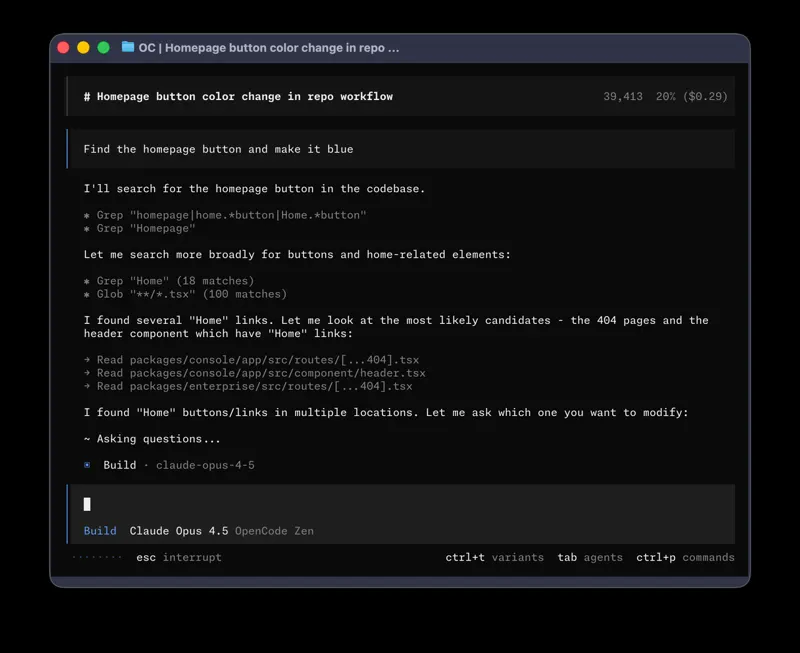
anomalyco/opencode (formerly sst/opencode, 210k stars, MIT) splits the coding agent into a client layer and a server layer: the server exposes OpenAPI 3.1 plus an SDK generated from the spec, and the TUI is just one remote frontend of it, so a single session can be driven from a terminal, an IDE, GitHub Actions and ACP clients such as Zed. More than 75 providers plug in through the AI SDK and Models.dev, OpenCode Zen offers a curated gateway of models tested before listing, the 35+ built-in LSPs ship disabled with docs stating they are not always a net win, skills resolve from .opencode, .claude and .agents roots, and permissions are a three-state allow/ask/deny. It is the most engineering-first branch of open-source coding agents: interface before UI.

136reviewed projects
125builders
12languages
12domains

Find a project by domain

Four collections and twelve task-based domains cover the full catalog. Domains, tags and search compose.

Project index

Start with the work a repository performs, then search by repository, technology, lab or topic.

Model Runtime

Train, serve and run models faster, smaller and cheaper.

13 projects

Inference, Training & Local Deployment

Inference serving, quantization, fine-tuning, caching, speculative decoding, model routing and local/edge execution.

13 projects
Model SystemsC++

llama.cpp

An MIT-licensed, dependency-free plain C/C++ inference implementation built on ggml. Seventeen backends span CUDA, Metal, HIP, Vulkan, SYCL, WebGPU, CANN, Hexagon, MUSA, zDNN and ZenDNN; integer quantisation runs 1.5 to 8 bits; CPU+GPU hybrid inference makes models larger than VRAM runnable at all; and GGUF, its output format, is a de facto standard that even vLLM consumes. Two lines - llama cli or llama serve - start an OpenAI-compatible server.

ggml-org/llama.cpp130k stars24k forks
Model SystemsPython

vLLM

An inference and serving library out of UC Berkeley's Sky Computing Lab with 2000+ contributors: paged KV memory, continuous batching and chunked prefill, CUDA/HIP graphs with torch.compile, quantisation across FP8/MXFP4/NVFP4/GGUF, pluggable attention kernels (FlashInfer, TRTLLM-GEN, FlashMLA), four speculative decoding routes (n-gram, suffix, EAGLE, DFlash), tensor/pipeline/data/expert/context parallelism with P/D disaggregation, and both OpenAI and Anthropic protocols.

vllm-project/vllm93k stars23k forks
Model SystemsPython

unsloth

Self-described as the first desktop app to run and train models (Windows/macOS/Linux; multi-GPU across NVIDIA, AMD, Intel, CPU and Vulkan). Fine-tuning is claimed at 2x faster with 70% less VRAM, the post-training menu covers LoRA, QLoRA, full fine-tuning, pretraining, GRPO, DPO and FP8, and export reaches GGUF, NVFP4 and FP8. Unsloth Start connects Claude Code or Codex to local weights in one command; the model list includes Qwen3.8, GLM-5.3-Flash, Kimi K3, DeepSeek-V4, MiniMax-H3 and Gemma 4, with private web search, deep research, auto-compaction and RAG built in.

unslothai/unsloth77k stars7.1k forks
Model SystemsPython

SGLang

A high-performance serving framework hosted by LMSYS: RadixAttention prefix caching, a zero-overhead CPU scheduler, prefill-decode disaggregation, DFlash and Spec V2 speculative decoding, compressed finite state machines for structured output, and large-scale expert parallelism (96 H100 GPUs; 3.8x prefill and 4.8x decode on GB200 NVL72 part II). Its day-0 ledger covers Kimi K3, DeepSeek-V4, GLM5.2 NVFP4, Nemotron 3 and MiniMax M2, and AReaL, Miles, slime, Tunix and verl all use it as an RL rollout backend.

sgl-project/sglang37k stars9.2k forks
Model SystemsPython

TensorRT-LLM

NVIDIA's inference optimisation library for LLMs and visual generation models, fully open source since 2025-03-22. Its 28 tech blogs form an auditable engineering ledger: Skip Softmax and sparse attention for long context, the three-part expert parallelism series with one-sided AlltoAll over NVLink, DWDP for NVL72, guided decoding cooperating with speculative decoding, inference-time compute, and evaluating agentic serving with trace replay and job-level metrics. Claims include Llama 4 Maverick above 1,000 TPS per user and 40,000+ tok/s on B200; Bing and NAVER Place run it in production.

NVIDIA/TensorRT-LLM15k stars2.8k forks
Model SystemsRust

Dynamo

NVIDIA's open-source (Apache-2.0) orchestration layer, Rust for the performance path and Python for extensibility. It explicitly does not replace SGLang, TensorRT-LLM or vLLM - it wires them into a coordinated multi-node system: disaggregated prefill/decode, KV-aware routing (2x faster TTFT on Qwen3-Coder 480B), KVBM offloading KV cache to CPU/SSD/remote, ModelExpress streaming weights over NVLink for 7x faster cold starts, an SLA-driven Planner (80% fewer breaches at 5% lower TCO in Alibaba production), and Grove for topology-aware NVL72 scheduling.

ai-dynamo/dynamo8.2k stars1.6k forks
Model SystemsC++

NInfer

A from-scratch C++/CUDA inference engine for five explicitly registered Qwen checkpoints on one NVIDIA GeForce RTX 5090. Startup-frozen residency picks MTP or DFlash speculative decoding, Vision, and one of five KV storage formats; a shared Device KV pool plus pinned Host State/KV checkpoints reuse exact prompt prefixes across 240k-token contexts. Measured aggregate decode reaches 1,146.9 tok/s at concurrency 8 and 15,544.3 tok/s on a 7,680-token prefill.

Neroued/ninfer1.4k stars261 forks

As an Amazon Associate, we earn from qualifying purchases.