Skip to content

Open-sourceproject atlas

A reviewed field guide to robotics, embodied AI and agent software, arranged by what each repository actually does.

opencode: the open-source coding agent split into client and server
Lead repositoryanomalyco/opencode

opencode: the open-source coding agent split into client and server

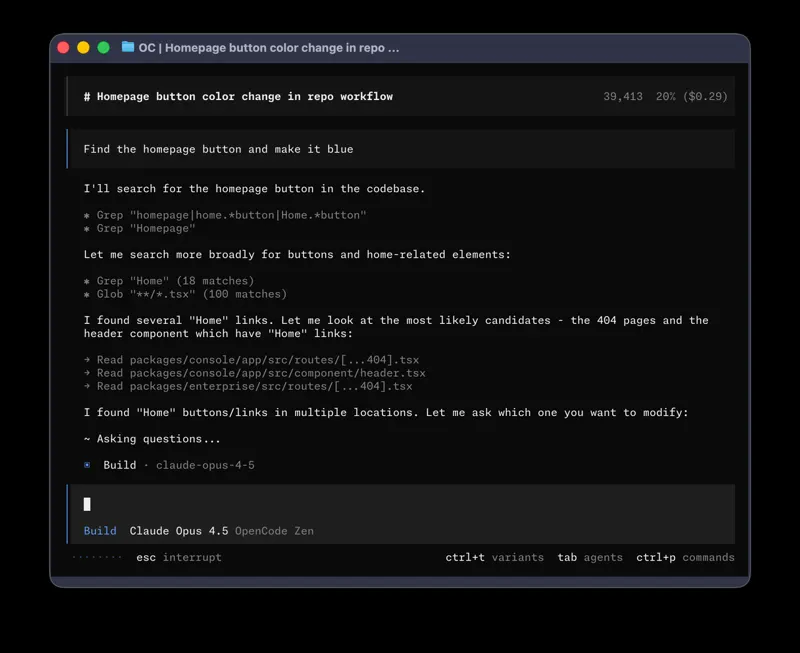
anomalyco/opencode (formerly sst/opencode, 210k stars, MIT) splits the coding agent into a client layer and a server layer: the server exposes OpenAPI 3.1 plus an SDK generated from the spec, and the TUI is just one remote frontend of it, so a single session can be driven from a terminal, an IDE, GitHub Actions and ACP clients such as Zed. More than 75 providers plug in through the AI SDK and Models.dev, OpenCode Zen offers a curated gateway of models tested before listing, the 35+ built-in LSPs ship disabled with docs stating they are not always a net win, skills resolve from .opencode, .claude and .agents roots, and permissions are a three-state allow/ask/deny. It is the most engineering-first branch of open-source coding agents: interface before UI.

136reviewed projects
125builders
12languages
12domains

Find a project by domain

Four collections and twelve task-based domains cover the full catalog. Domains, tags and search compose.

Project index

Start with the work a repository performs, then search by repository, technology, lab or topic.

Agent Workflows

Write and understand code, operate computers and carry long-running work to completion.

19 projects

Agent Runtimes, Orchestration & Memory

Agent harnesses, multi-agent orchestration, long-horizon control planes, durable memory, sandboxes and general runtimes.

19 projects
Agent RuntimesPython

Hermes Agent

The self-improving agent from Nous Research (248k+ stars). Its learning loop has five mechanisms: periodic memory nudges, autonomous skill creation after tasks, skills that self-improve in use, FTS5 session search with LLM summarization, and Honcho user modeling. One TUI, seven terminal backends (local/Docker/SSH/Singularity/Modal/Daytona/Vercel Sandbox), six chat platforms from a single gateway, no model lock-in. It doubles as a trajectory data-production apparatus. Self-improvement is falsifiable and no controlled experiment has been run, so this is graded as needing reproduction.

NousResearch/hermes-agent248k stars52k forks
Agent RuntimesTypeScript

DeepSeek Harness

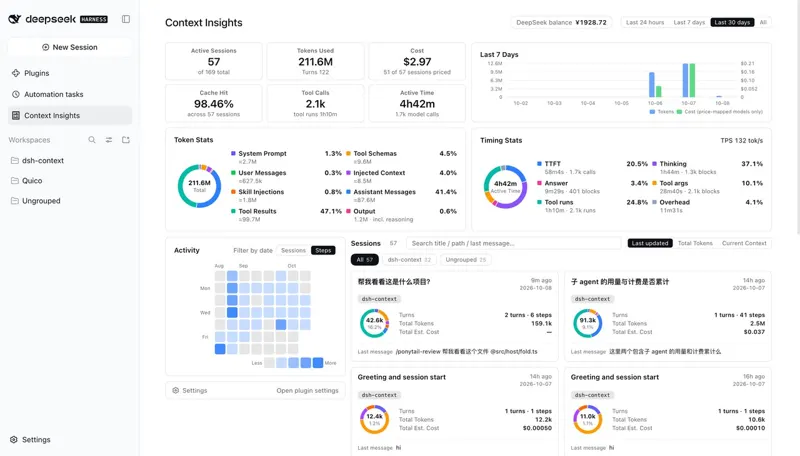
DeepSeek AI's open-source agent harness (CLI dsh, MIT, 233k+ stars). The kernel provides only plugin-system semantics; tools, surfaces and model access all attach as plugins, on top of Cordis' paradigm for spatiotemporal composability (arXiv:2608.25512). It is in developer preview with an explicit warning about compatibility-breaking changes, and SAFETY.md is required reading before you run it. Not benchmarked yet, so this entry is graded as needing reproduction.

deepseek-ai/deepseek-harness234k stars28k forks
Agent RuntimesTypeScript

Pi

Pi Agent Harness (formerly badlogic/pi-mono; 108k+ stars, MIT/TypeScript). Not one CLI but layered packages usable on their own: pi-coding-agent (interactive coding agent), pi-agent-core (runtime with tool calling and state), pi-ai (unified multi-provider LLM API), plus chord composition runtime, pi-telemetry contracts, pi-durable persistence and pi-tui differential terminal rendering. The README states plainly that there is no built-in permission system and offers micro-VM / Docker / sandbox paths instead. Not independently benchmarked; graded needs-reproduction.

earendil-works/pi109k stars14k forks
Agent RuntimesPython

LangGraph

A low-level stateful-graph orchestration framework from LangChain, MIT licensed, with Python and JS/TS implementations, and Klarna, Replit and Elastic named as production users in the README. Its lineage is stated in the acknowledgements - inspired by Google Pregel and Apache Beam, interface borrowing from NetworkX - which means the BSP graph-computation model applied to agents: nodes are model calls or tool executions, edges are control flow, state is an explicit object. The value is not in the loop-the-model-with-tools layer but in four runtime capabilities: durable execution (resume exactly where it stopped after a crash), human-in-the-loop interrupts (approval can stay suspended for hours or days), separate short-term and long-term memory, and LangSmith execution-path tracing. Its actual claim is that agent reliability is a runtime problem, not a model problem. Usable without LangChain; any CompiledStateGraph can be handed to Deep Agents above it as a sub-agent. 42.1k stars. Not run yet, and checkpoint-resume consistency is unverified, so this is graded as pending reproduction.

langchain-ai/langgraph42k stars7.1k forks
Agent RuntimesPython

Deep Agents

The README opens by calling itself an off-the-shelf agent harness: MIT licensed, Python (plus deepagents.js), built on LangGraph, so streaming, durability and checkpoints are inherited rather than rewritten. The key to reading it is the acknowledgement - inspired by Claude Code, trying to figure out what makes it general and pushing that further - which makes this a reverse-engineering exercise: take a closed coding agent that is known to work well, open it up, and ask what actually lets it handle long tasks. Its answer is four bundled things: a pluggable-backend file system (the artefacts of long tasks are files, not messages, so context keeps only pointers), sub-agents each with their own window (context isolation and compression, not extra helpers), long-thread summarisation with tool output offloaded to disk, and on-demand Skills. Also sandboxed shell execution, cross-session persistent memory, human-in-the-loop approval/edit/reject before a tool call runs, and any MCP server as a tool. Model agnostic: frontier APIs, open weights hosted on Baseten or Fireworks, and self-hosted Ollama/vLLM/llama.cpp all work, with three lines of create_deep_agent giving you a planning, file-reading-and-writing agent. The security section is unusually blunt - it follows a trust-the-LLM model, boundaries must be enforced at the tool and sandbox layer, and you should not expect the model to restrain itself. 29.7k stars. Not run yet; sub-agent isolation quality and summarisation information loss are unverified, so this is graded as pending reproduction.

langchain-ai/deepagents30k stars4.2k forks
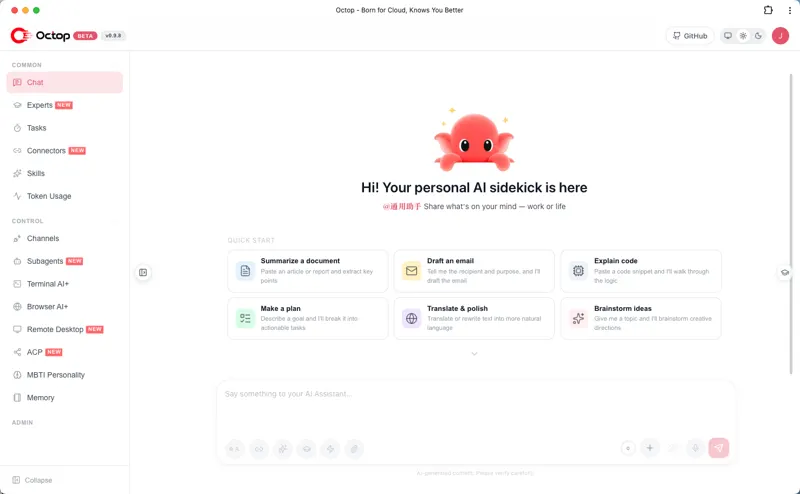
Octop: a self-hosted multi-user, multi-agent assistant in one Python process
Agent RuntimesPython

Octop

Tencent Cloud's open-source, self-hosted AI assistant platform (MIT, 8,777 stars). One process serves the FastAPI backend, React dashboard, CLI, IM channels and cron, with a SQLite WAL control plane and optional PostgreSQL. It composes four runtime libraries (octop-harness, octop-gateway, octop-memory, octop-browser) into a single self-hostable product, adding an expert library with AgentTeams, bidirectional ACP, a cross-instance Bridge, tool guardrails and PII redaction, with ADRs and line-level specs as reviewable evidence.

TencentCloud/Octop8.8k stars1.1k forks
Agent RuntimesPython

HarnessRouter

HarnessRouter Community Edition is the self-hosted, Apache-2.0 implementation of a unified interface for agent harnesses: it turns existing harnesses like Codex, Claude Code, Hermes, PI and DSH into plug-and-play agent backends, so your product runs tasks, retrieves results and switches harnesses through one API. It implements the open Unified Harness Protocol (UHP) and exposes an OpenAI Responses-compatible API, meaning existing Responses SDKs, streaming parsers and UI components work against a UHP server out of the box. The platform handles persistent sessions, streaming progress, files/artifacts, cancellation and structured failures. Inside the container, a three-layer architecture (Console :3000, the only published port, proxies to Gateway :8080 for the Responses API and harness lifecycle, which talks over loopback to Runner :8081 executing harnesses in session workspaces) isolates sessions with separate workspaces and OS users rather than separate containers. Ships with a Console UI, Bring-Your-Own-Key model integrations, custom harness configuration (instructions/tools/skills) and Starter Kits; the UHP spec, machine-readable schemas and a conformance suite live in the repo, with a cloud offering on the same protocol at harnessrouter.ai. For product teams drowning in per-harness integrations, it collapses 36 integration responsibilities into one standardized protocol layer.

HarnessRouter/harnessrouter2.8k stars290 forks
Agent RuntimesTypeScript

CopilotKit open-sources OpenDots

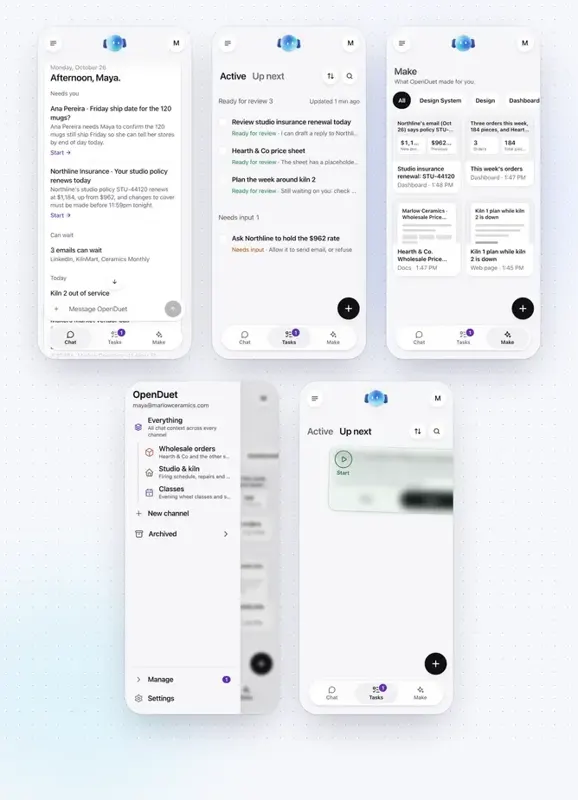
CopilotKit open-sourced OpenDots (MIT) on Oct 1: a fully self-hostable template for always-on AI coworkers — its answer to OpenAI's closed Dots (powered by GPT-6 Astra). Each Dot is a specialist agent with a name, role, instructions and tool allowlist, plus its own computer via OpenBot's container supervisor (browser profile and workspace files persist across stop/start). Dots move seamlessly between text chat, realtime voice calls and Slack: calls pair a separate compute agent so long work keeps running mid-conversation, all sharing the same context and tool permissions. AG-UI carries streamed messages, tool calls and agent state between any agent harness and the UI; human-in-the-loop cards pause tool calls for approval; Spaces and Pages hold working documents. Built on TanStack AI + CopilotKit React SDK + Threads + Channels SDK. Clone and customize — enterprise-ready.

CopilotKit/OpenDots591 stars73 forks

As an Amazon Associate, we earn from qualifying purchases.