
OPEN SOURCE DEEP DIVE
AME-2 Minimal: Humanoid Locomotion on a Lidar Neural Map
A minimal AME-2 release connecting a G1 teacher, Mid-360 neural height mapping, active-gaze distillation and PPO fine-tuning.
This repository is not a complete release of the AME-2 system. It is a deliberately minimal but end-to-end reproduction: a Unitree G1 teacher, a Livox Mid-360 mapping pipeline that produces a neural height map, an active-gaze student, and a training stage that combines distillation with reinforcement learning. The authors expose the observation interfaces, model code, training configurations, two checkpoints, and links to the training reports. That makes it more useful for understanding how the paper becomes an engineering pipeline than a release containing only a policy to play back.
This review is based on a static close read of the README, model-zoo notes, environment configuration, sensor implementation, training code, and model definitions. I did not retrain the policy in Isaac Sim or deploy it on a physical robot. The assessment therefore separates three kinds of evidence: behavior that is explicit in code, results reported by the authors, and validation that the repository does not provide. That distinction matters because the AME-2 paper is about generalized locomotion, while this repository is a usable reproduction path rather than a complete replica of every paper experiment.
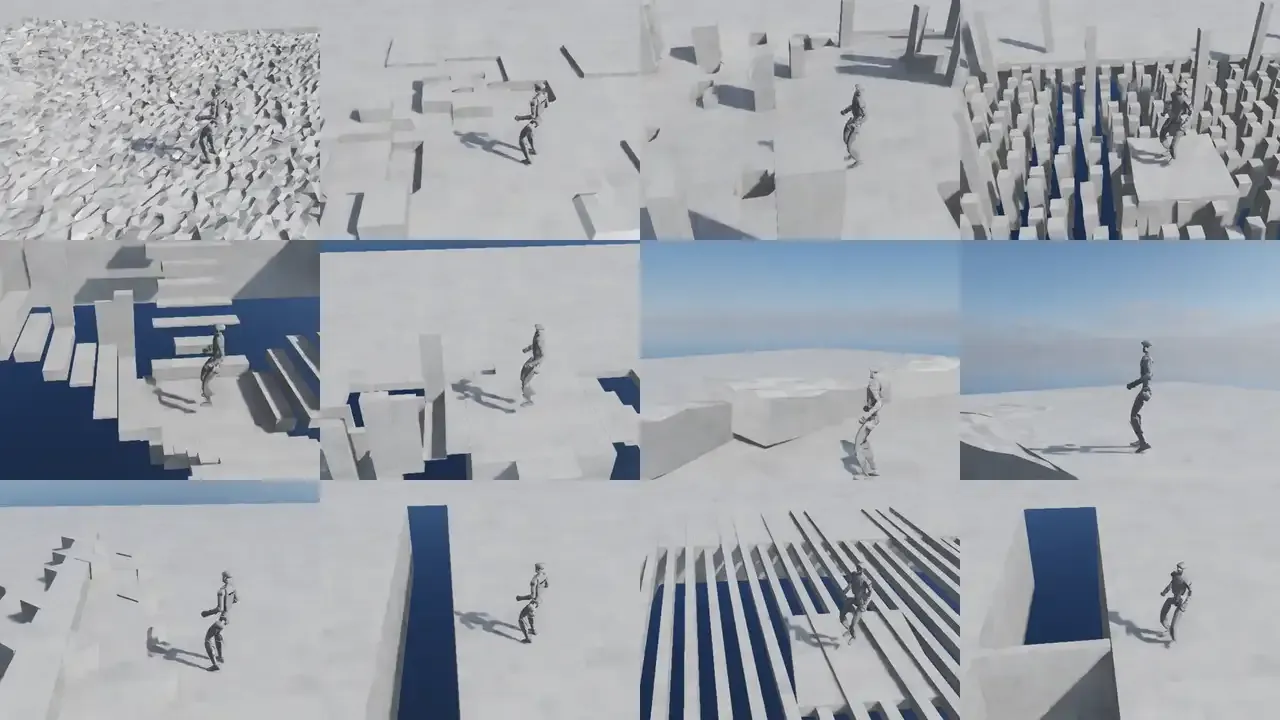
One: The release reproduces a method chain, not the full experimental program
The central AME-2 question is how to turn local terrain perception into a control representation that retains contact-relevant detail while generalizing to unfamiliar terrain. In the paper, this is a problem of attention-based neural-map encoding and legged locomotion. In an implementation, it also becomes a problem of privileged height scans, real lidar geometry, heterogeneous observations, teacher distillation, reinforcement-learning fine-tuning, and compute scale. The repository exposes all of those interfaces instead of preserving only the inference network.
“Minimal” has several concrete meanings here. The robot scope is the G1. The documented evidence is mainly about legs, even though optional torso, arm, and foot shaping code exists; those terms are explicitly untuned. Most importantly, the neural-map training code is not released, with a current estimate of late December 2026. The repository can therefore run teacher training, student training, mapping inference, and playback, but it cannot retrain the Mid-360 height-mapping model from scratch. That omission is a material limit on reproduction, not a minor documentation gap.
The project describes itself as half-archived and says it will not accept feature contributions. That posture is consistent with the code: it is a reference from which other work can be derived, not a product with a maintenance guarantee or a broad regression suite. Anyone treating it as a humanoid locomotion baseline should distinguish “the examples run” from “the system is ready to carry safety responsibility on a real machine.”
Two: Teacher and student are separated by information access
The teacher receives a privileged observation that is easy to obtain in simulation but unavailable in deployment. A height scanner produces a base-frame patch two meters long and 1.12 meters wide, centered slightly forward. The student reads a neural map on the same exported lattice: 26 cells along forward x, 15 cells laterally, 0.08-meter resolution, x from -0.5 to 1.5 meters and y from -0.56 to 0.56 meters. Sharing this geometry is a precondition for transferring the teacher’s representation.
The teacher does not simply compress a height image into an action. Each map cell is projected to 16 features, while the non-coordinate terrain channels pass through two convolution layers to yield 48 spatial features per cell. The combined 64-dimensional cell representation is projected to 96 dimensions and used as an attention key and value. Proprioception is encoded separately to 128 dimensions. A 64-dimensional global context is formed by applying an MLP before max-pooling across map cells. The resulting query attends over all 390 cells, and the final action network receives 288 dimensions: 96 from attention, 128 from proprioception, and 64 from global context.
| Component | Teacher | Student |
|---|---|---|
| Terrain input | Privileged simulation height scan | Mid-360 point cloud after neural mapping and probabilistic fusion |
| Map lattice | 26 by 15 cells at 0.08-meter resolution | Same export lattice, with height and uncertainty channels |
| Proprioception | Current teacher proprioceptive observation | 20-step history, latest three steps, and velocity commands |
| Map encoding | Dense attention over the full map or an active-gaze crop | Matching 128/96/64 latent interfaces for distillation |
| Training | Multi-component rewards with a multi-headed critic | Pure distillation followed by reinforcement learning plus distillation |
The essential point is not that one network teaches a smaller network. It is that the information condition changes. The teacher can rely on a clean, fixed-frame height map. The student must recover control-relevant structure from scans containing occlusion, near-field blind zones, voids, and estimation error. Matching latent widths, crop size, and export geometry puts the two observations into representations that can be compared. The student then learns from teacher actions and from the teacher’s attention output and global context.
Three: AME-2 keeps local geometric tokens and global context separate
A conventional convolutional encoder gradually enlarges its receptive field, but small steps, narrow supports, and gaps can disappear through pooling. AME-2 instead keeps one token per map cell and lets attention select cells according to the robot state. The per-cell linear path retains all channels, including explicit coordinates. The convolutional path sees only the measured terrain channels, expands them from the input width to 8 and then 48 channels, and is fused with the 16-dimensional cell projection. The resulting 96-dimensional token serves as a key and value.
Global max-pooling supplies a different kind of summary. It does not preserve the relative location of an obstacle; it compresses the strongest activation over the whole map into a 64-dimensional context. Locomotion benefits from both forms of information. Local tokens preserve where the geometry is. Global context helps the policy distinguish the broader scene, such as stairs, a climb, stepping stones, or boxes. Because the query is built from proprioception and global context, the same terrain can induce different attention as the body state changes.
The active-gaze variant changes the computational boundary again. A shallow dilated convolutional network first scans the full map, producing 32 feature channels. Spatial max-pooling and a linear projection reduce that result to the 64-dimensional context. A gaze head combines this context with the proprioceptive embedding and predicts a continuous two-dimensional center. The network then extracts a 12 by 10 patch from the 26 by 15 map and runs dense attention only over the crop. The full-map branch decides where to look; the crop branch computes a more focused representation.
Four: The gaze crop must preserve discrete heights and continuous gradients
The crop center is continuous, but the map cells are discrete. Bilinear interpolation in the forward pass would invent step heights and support-surface heights that are not present in the source map, changing the control problem. Taking only the nearest integer window would remove the gradient needed to train the gaze head. The implementation uses a straight-through crop: the forward path gathers original values from the integer-aligned window, while a bilinear sample supplies gradients with respect to the continuous center. Interpolation therefore appears only in the backward path.
A boundary penalty handles another failure mode. Even with the center constrained by a sigmoid, the authors note that the learned gaze can drift toward the edge of the map. The model adds a quadratic penalty once the normalized center moves beyond a no-penalty margin, and the trainer inserts that term into the PPO or PPO_IL objective. Released gaze configurations use a margin of 0.45, while the generic model constructor defaults to 0.35. Reimplementing the configuration without matching that value changes the effective constraint.
This detail is a useful warning against reading the network in isolation. Gaze prediction, cropping, attention, auxiliary loss, and training are connected through a stateful contract: a forward pass stores the latest gaze location, and the trainer reads the auxiliary loss afterward. A review that opens only one file can miss the path entirely.
Five: Mid-360 neural mapping bridges the privileged and deployable observations
The student scene uses a simulated Livox Mid-360 producing 20,000 rays at 10 hertz. Hits are scattered into a 201 by 101 local grid at 0.03-meter resolution, covering x from -3 to 3 meters and y from -1.5 to 1.5 meters. Each occupied cell keeps the highest return, while empty cells receive a void sentinel. Ray tests against oriented boxes around robot links are discarded, as are returns closer than 0.5 meters. These two filters correspond to self-body filtering and near-range rejection during deployment.
Each scan is passed through a pretrained TorchScript model that predicts a mean height map and a log-variance map. The result is not simply stamped into a recent-frame buffer. It is fused into a per-environment, world-aligned map through a confidence-aware probabilistic update. A measurement may overwrite an existing cell only when it is sufficiently better, and its precision is capped relative to the prior so that one overconfident bad scan cannot erase established geometry. When the robot approaches the edge of the global map, the map recenters by whole cells and fills newly exposed strips with a high-uncertainty prior.
The policy does not read the raw sensor grid. At every query, the system samples the world map back onto the same 26 by 15 export lattice used by the teacher, at the current base pose. Height and uncertainty become the student’s map observation. Training also applies domain perturbations: an episode-consistent query drift of 0.03 meters, clean critic-scan episodes in 10 percent of environments, and random-pixel corruption at a 1 percent rate. These cover localization offset, an idealized no-mapping-error source, and sparse bad pixels. They do not represent a complete lidar failure model.
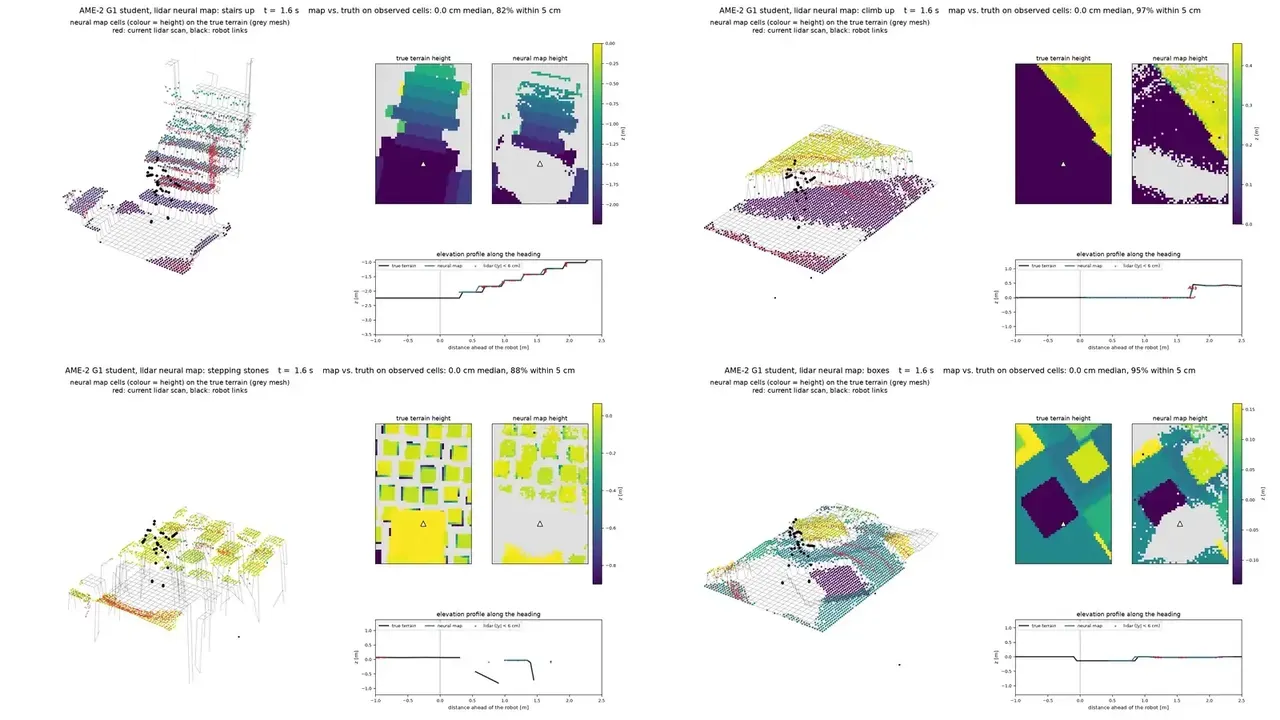
The repository does not hide an important approximation. The realistic noise function for the Mid-360 ray caster is currently an identity placeholder. Mixed-pixel ghosts, edge dropout, driver filtering, near-field pull-ins, and related artifacts are not simulated at the sensor model. Probabilistic fusion, random pixels, query drift, and local occlusion improve robustness within the implemented distribution, but they are not equivalent to physical lidar testing. The mapping animation is excellent for understanding the control loop; it is not a substitute for sensor calibration or failure analysis on hardware.
Six: Student proprioception is a multiscale history, not one state vector
The student receives a 20-step proprioceptive history, but it does not flatten the full sequence into an MLP. A one-dimensional convolution extracts longer temporal structure and compresses it to 64 dimensions. The latest three steps pass through a separate linear path to 60 dimensions. Those vectors are combined with four command dimensions and fused to the 128-dimensional proprioceptive representation used by the map encoder. The design keeps both slow history and the most recent contact-relevant changes visible to control.
Base linear velocity is intentionally excluded. The policy therefore cannot read a clean simulation-only velocity signal and must infer motion state from recent changes and commands. This makes the observation more relevant to deployment, but it also makes optimization harder. A student trained with the same architecture but given base velocity would not be evaluating the same information constraint.
PPO_IL keeps a frozen JIT teacher in evaluation mode. Before each update it obtains teacher actions, the 96-dimensional attention latent, and the 64-dimensional global context. The student loss combines an imitation term based on teacher-action likelihood with mean-squared error between the corresponding student and teacher representations. The released student performs 500 updates of pure distillation and then enables the reinforcement-learning term for the remaining updates. Its checkpoint uses a switch point of 501, while the generic training configuration defaults to 4001. That difference matters when trying to reproduce the published curve.
The RL phase uses reward components with a multi-headed critic. Update-time forward passes and losses use bfloat16 autocast, while weights, backward propagation, optimizer state, and exported models remain FP32. Muon updates matrix-shaped weights, while AdamW handles biases and vectors. These choices show that the release attempts to reproduce the training mechanics needed at large environment counts, not only the forward architecture.
Seven: The released checkpoint proves the pipeline, not the performance ceiling
The model zoo provides two playable checkpoints. The teacher was trained for 2,400 iterations with 64,000 environments across four GPUs, taking about ten hours. The student used 16,000 environments on one GPU for 1,000 iterations, taking about eight hours. That scale is large enough to exercise distributed gradients, attention memory, and long rollouts, but it is far smaller than a campaign aimed at final policy quality.
| Metric | Released student checkpoint | Interpretation |
|---|---|---|
| Goal-reaching success, exponential moving average | 0.70 | Final training-curve reading, not a seed-level confidence interval |
| Mean success over twelve terrain types | 0.77 | Evidence that the policy works across several terrain families |
| Mean terrain level | 6.3 of 9 | The curriculum has not reached its hardest setting |
| Physical-robot validation | Not provided | Simulation success cannot be extrapolated directly to hardware |
The model-zoo note is explicit: these models prove that the pipeline works and are not fully converged; longer training should produce better policies. That statement should shape every conclusion drawn from 0.70. The value is not a method ceiling, and it does not isolate the contribution of the neural map against a privileged height scan. It shows that a 1,000-iteration student with only 500 updates of joint RL and distillation can already reach goals across multiple terrains.
The aggregate also hides terrain-specific failure modes. Stairs, climbs, stepping stones, and boxes differ in the sensing distance, support width, and foot-placement precision they demand. The repository does not publish a per-terrain evaluation table, multi-seed variance, or physical logs. The reported numbers are therefore useful as a pipeline-health signal, not as a paper-grade ablation.
Eight: Four boundaries matter before attempting reproduction
First, the environment is version-sensitive: the project expects Isaac Lab 2.3.2 and Isaac Sim 5.1, and changes in simulator APIs or sensor timing can alter the result. Second, mapping inference is available but mapping training is not, so using the shipped TorchScript model is not equivalent to retraining the mapper. Third, the checkpoints are intentionally unconverged; short fine-tuning runs can confuse optimization headroom with a method failure. Fourth, torso, arm, and foot shaping are untuned, and the evidence is primarily about legs.
Licensing also needs directory-level attention. The main project is GPL-3.0. The bundled modified rsl_rl is BSD-3-Clause, and files derived from Isaac Lab retain their original license. Teams embedding the code in a commercial system should inspect those boundaries rather than reading only the root license.
The strongest research value of the release is its interface design. Teacher and student use one map lattice. The lidar mapper emits both mean and uncertainty. Proprioception is split into long and short temporal scales. Distillation supervises actions and representations. Active gaze preserves source heights through a straight-through crop. Each stage has an explicit input and output, making it practical to replace the mapper, robot, or training algorithm later.
The production conclusion is more restrained. The repository contains no physical-robot logs, the lidar noise model has known simplifications, the student is unconverged, and the mapping training code is still pending. The correct statement is not that AME-2 is ready for direct deployment. It is that the key engineering path of AME-2 is now available to inspect, run, and challenge. That is the release’s real contribution.
SOURCE LINKS