Where Do Today's Agentic Robots Succeed and Fail?
Ten coding agents, one attempt each on 481 core robot tests: best solves 279, 112 defeat all. Resets beat exact state; prompts lift RoboDojo 63% to 81%; failed attempts cost more than solved ones.
Coding agents can refactor a codebase, drive a browser and ship a pull request. Can they control a robot? The team behind the Embodied First Exam (EFE) put ten frontier coding agents through a unified, agent-native robotics evaluation and then did something most leaderboards skip: they labeled where every failed attempt went wrong. The result is a test-by-test failure analysis of agentic robotics. The headline numbers are humbling and hopeful at once. The best agent, GPT-6.2 Astra, solves 279 of 481 hard core tests under real-robot constraints; 112 tests defeat all ten agents; and most of those 112 become solvable the moment an agent is handed the simulator's exact state and unlimited resets.
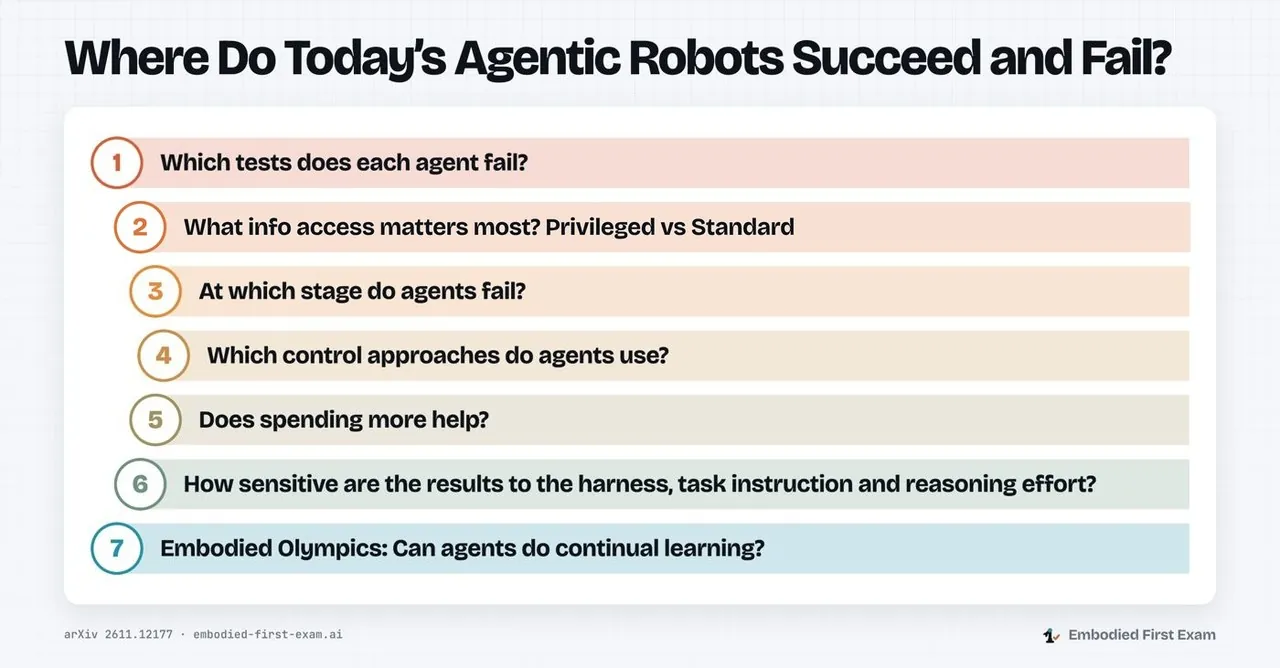
The analysis, published by Manling Li and the EFE collaboration as a long-form X article and a full technical blog, asks eight questions:
- Which tests does each agent fail?
- What information access matters most: privileged simulator state or standard sensors?
- At which stage do agents fail?
- Which control approaches do agents use?
- Does spending more help?
- How much does the harness matter?
- How much does the task prompt matter? On RoboDojo, Fable 5.2 rises from 63% to 81%.
- Embodied Olympics: can agents continually improve?
The Setup: Three Settings, Ten Agents, One Attempt
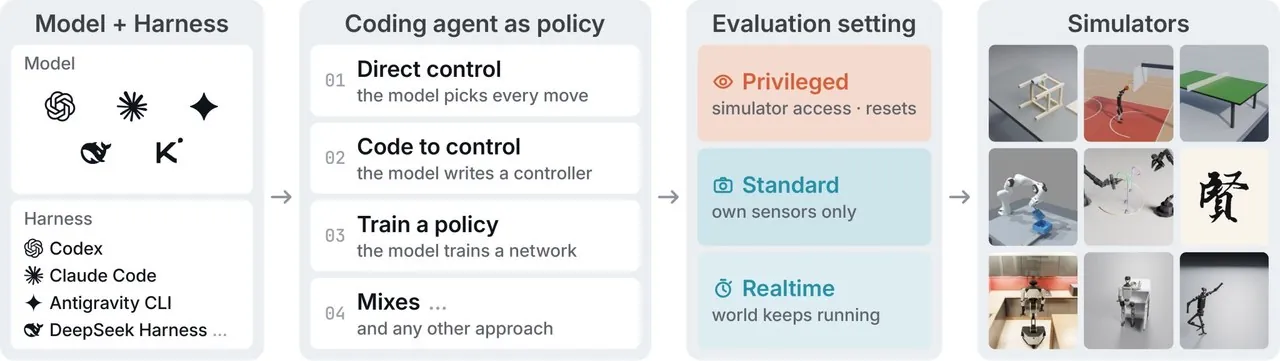
EFE is a large exam: 1,156 tasks in 35 suites on 47 robots, including nine new suites that go beyond pick-and-place into spatial puzzles, dexterous manipulation, multi-robot interaction, dynamic whole-body control and sim-to-sim engineering. What makes it agent-native is that the coding agent chooses how to control the robot, and what makes this failure analysis sharp is that the exam controls exactly what the agent can see and do. Each test runs in one of three settings that share the same scene, success check and time limit:
| Setting | What the agent gets |
|---|---|
| Standard | Only what a real robot has: cameras and other sensors, and no resets by default. |
| Privileged | The simulator: exact pose of every object, plus unlimited resets. |
| Realtime | Standard, except the world keeps moving while the agent thinks. |
Unless noted, every number below is from the Standard setting, with one attempt per agent and test. Ten agents ran the 481 hard core tests; the harness each model runs in is part of the story, so it is listed with the results:
| Agent | Harness | Standard tests solved (of 481) |
|---|---|---|
| GPT-6.2 Astra | Codex | 279 |
| Claude Fable 5.2 | Claude Code | 248 |
| GPT-6 Astra | Codex | 175 |
| GPT-6.1 Sol | Codex | 163 |
| Claude Opus 5.5 | Claude Code | 130 |
| Gemini 4 Argon | Antigravity CLI | 127 |
| Kimi 3.1 Pro | Claude Code | 55 |
| Gemini 3.8 Flash | Antigravity CLI | 32 |
| DeepSeek V4.1 Flash | DeepSeek Harness | 17 |
| GLM 5.3 Flash | Claude Code | 12 |
1. Weaker Agents Sometimes Solve Tests That Stronger Agents Fail
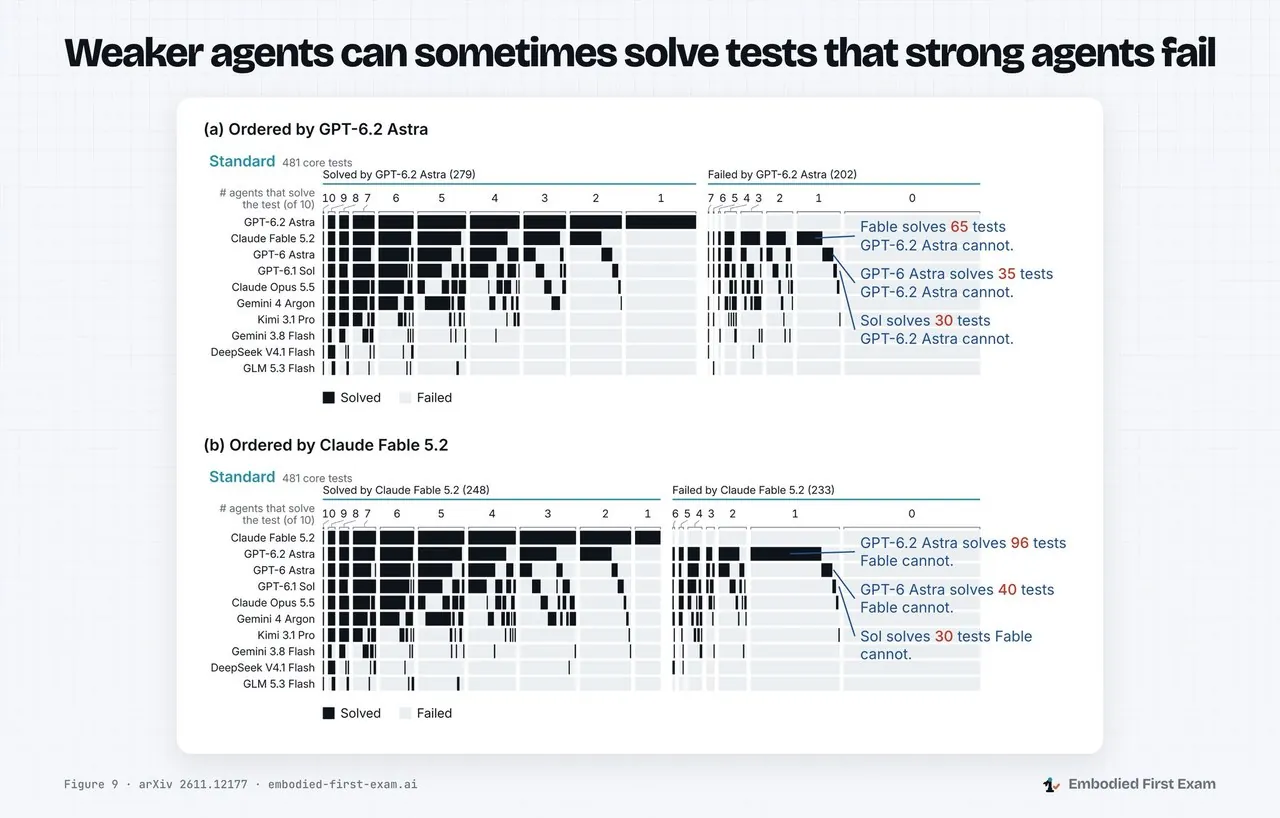
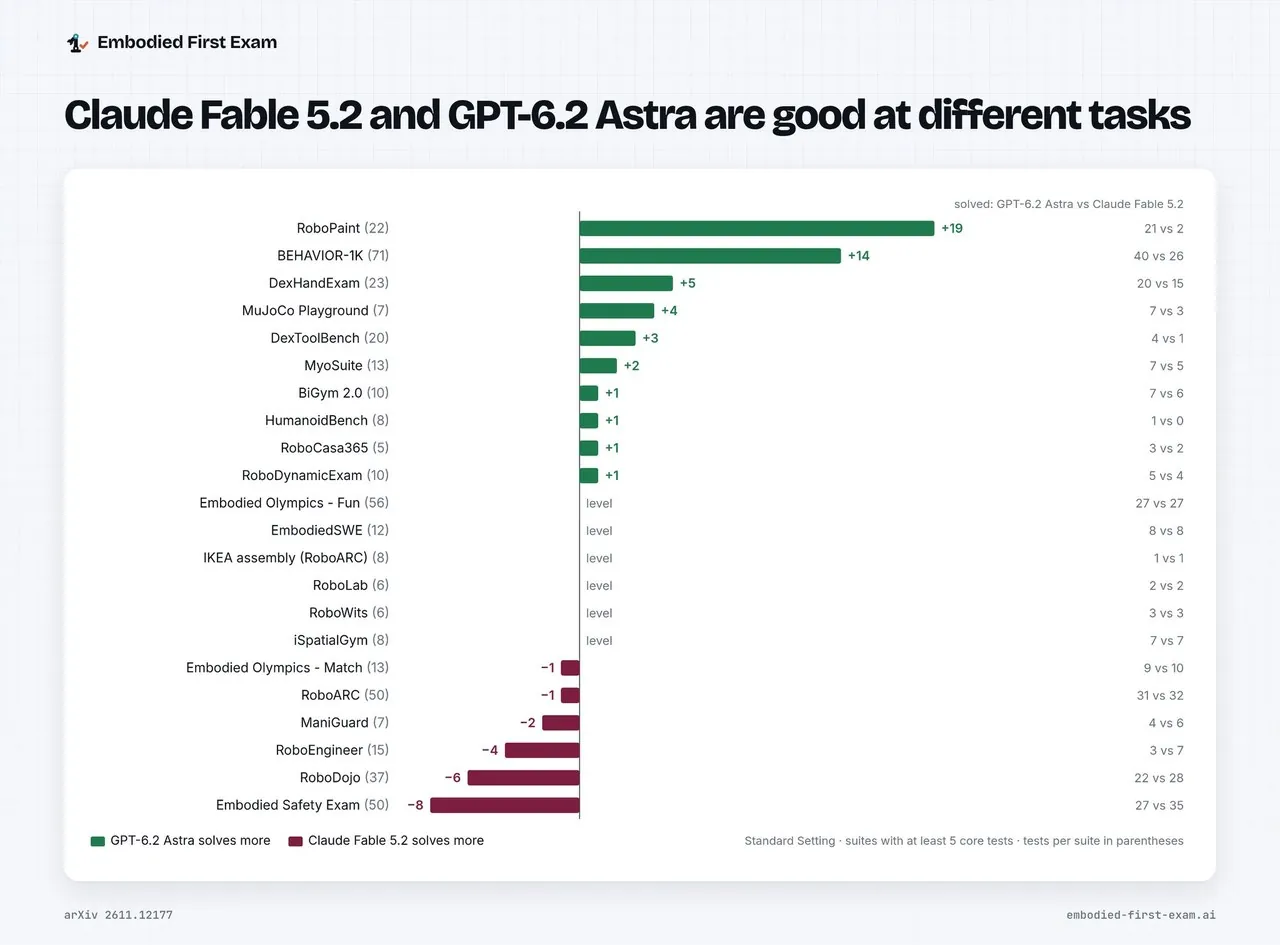
Is the stronger agent always better? No. GPT-6.2 Astra solves 96 Standard tests that Fable 5.2 fails, while Fable 5.2 solves 65 that GPT-6.2 Astra fails. The same is true for most pairs of agents: each solves some tests the other fails. Kimi 3.1 Pro, one of the weaker agents, solves 8 Standard tests that GPT-6.2 Astra fails and 8 that Fable 5.2 fails.
No agent leads every suite. GPT-6.2 Astra solves 19 more RoboPaint tests than Fable 5.2 (21 vs 2), while Fable 5.2 solves 8 more on the Embodied Safety Exam (35 vs 27). Of the 137 tests both of them fail, the other eight agents solve 25. And only Opus 5.5 solves all 7 ManiGuard tests. Some leads are lopsided: GPT-6.2 Astra solves all 10 brush calligraphy tests, while the other nine agents solve only two of them, both by GPT-6 Astra.
2. Prompt Matters: RoboDojo Scores Rise from 63% to 81%
The EFE team appreciates RoboDojo's effort in evaluating agents alongside VLAs, but RoboDojo's prompts are mainly designed for VLA settings. Its VLA prompt is one sentence. For its GPT-6 Astra evaluation, RoboDojo added a task recipe and a return-to-start note — the team calls this the agent prompt. EFE aims for an agent-native evaluation, so it also wrote a Fully Specified Prompt for RoboDojo, following Terminal-Bench's task guidelines: the description "completely describes what the verification algorithm will look for" and, as the review criteria put it, states "what to achieve, not how".
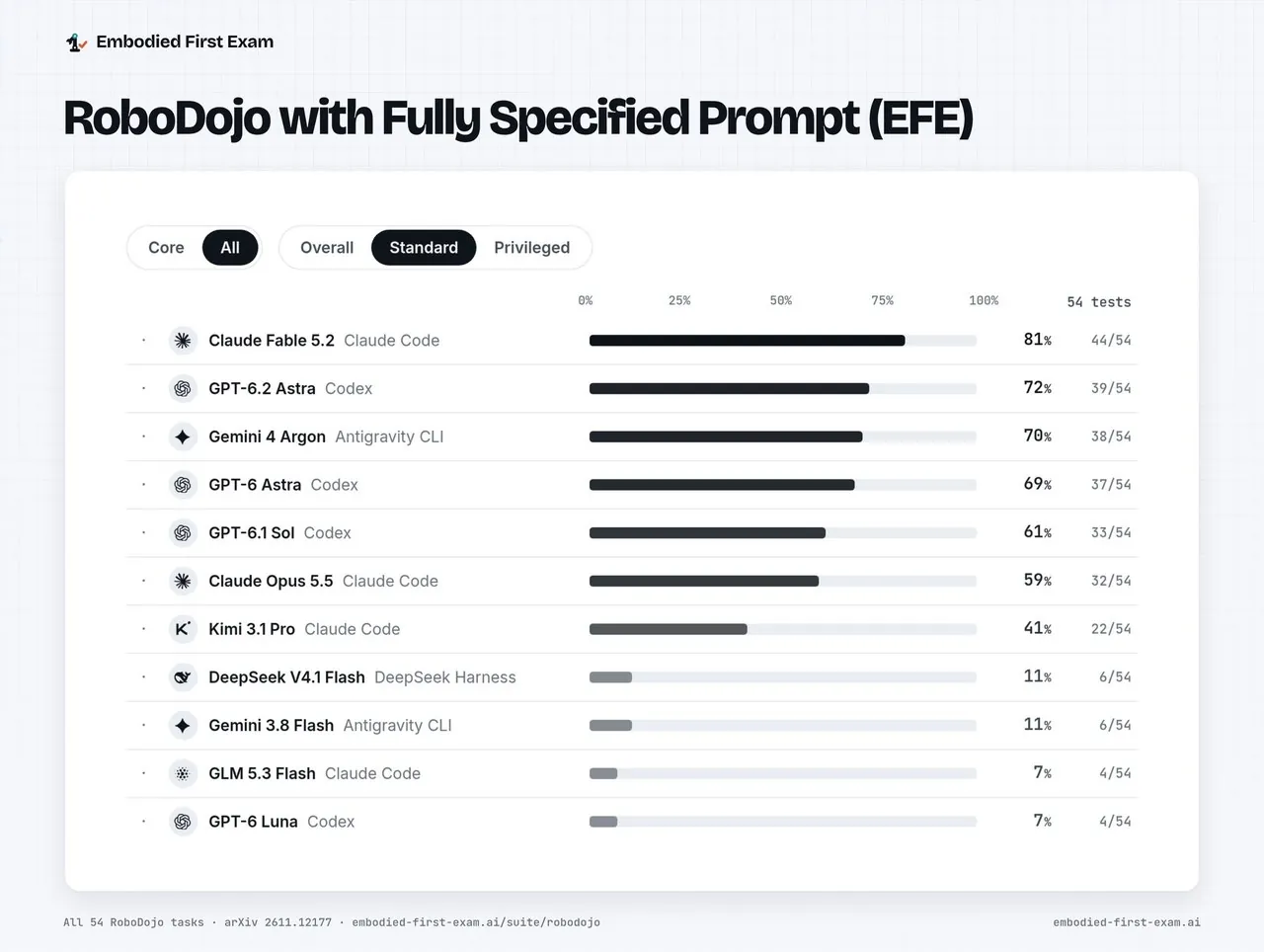
RoboDojo's simulation benchmark has 42 tasks, and 12 of them also come in a randomized version that tests generalization, for 54 in total. With only the task instruction changed — robot, scenes, step limits and the 60-minute limit kept the same — GPT-6 Astra rises from 22% with the VLA prompt and 61% with the agent prompt to 69% with the fully specified prompt, and Fable 5.2 from 63% and 74% to 81%.
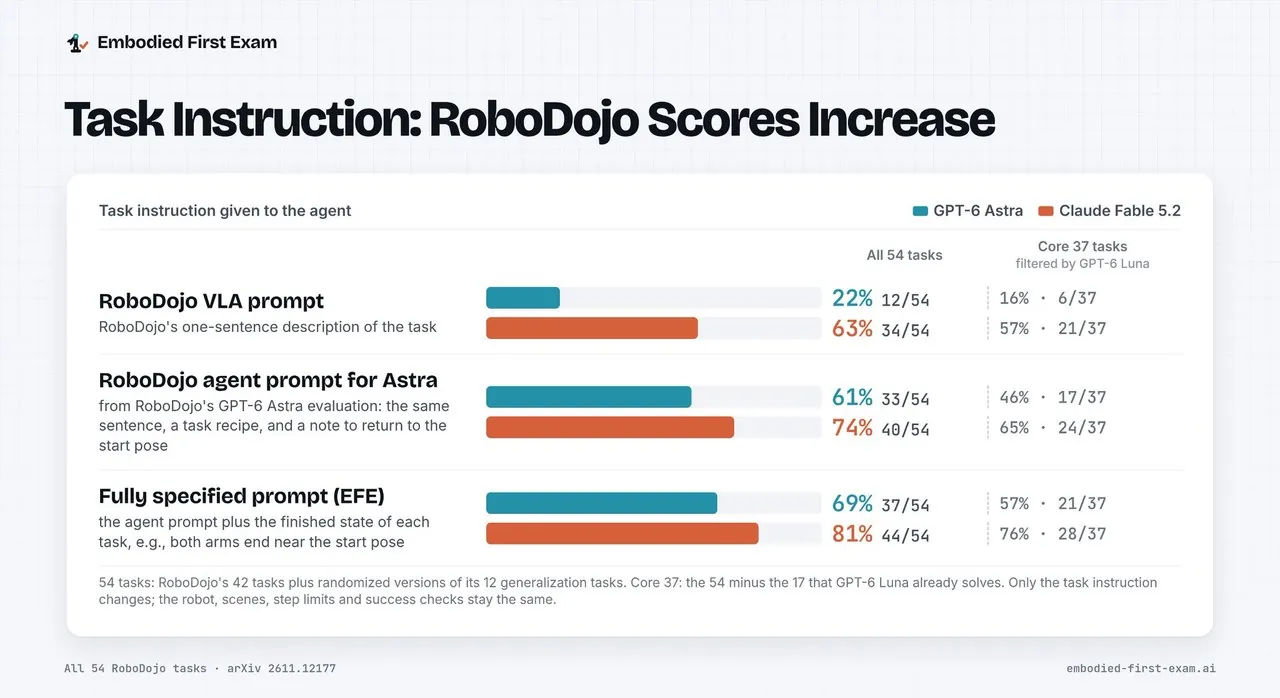
With the one-sentence VLA prompt, GPT-6 Astra solves 12 of 54 tasks (22%). The agent prompt brings it to 33 (61%), and the fully specified prompt to 37 (69%). For GPT-6 Astra, most of the gain comes from the agent prompt. One likely factor is its note to return to the start pose: 47 of the 54 tasks require the robot to end in its start pose, so an agent that finishes the visible task but leaves an arm hovering fails. RoboDojo's own leaderboard lists GPT-6 Astra at 22.48%, run with the agent prompt in RoboDojo's end-effector harness over 42 tasks × 50 episodes; EFE's numbers count tasks solved in a single attempt in Codex and are not directly comparable.
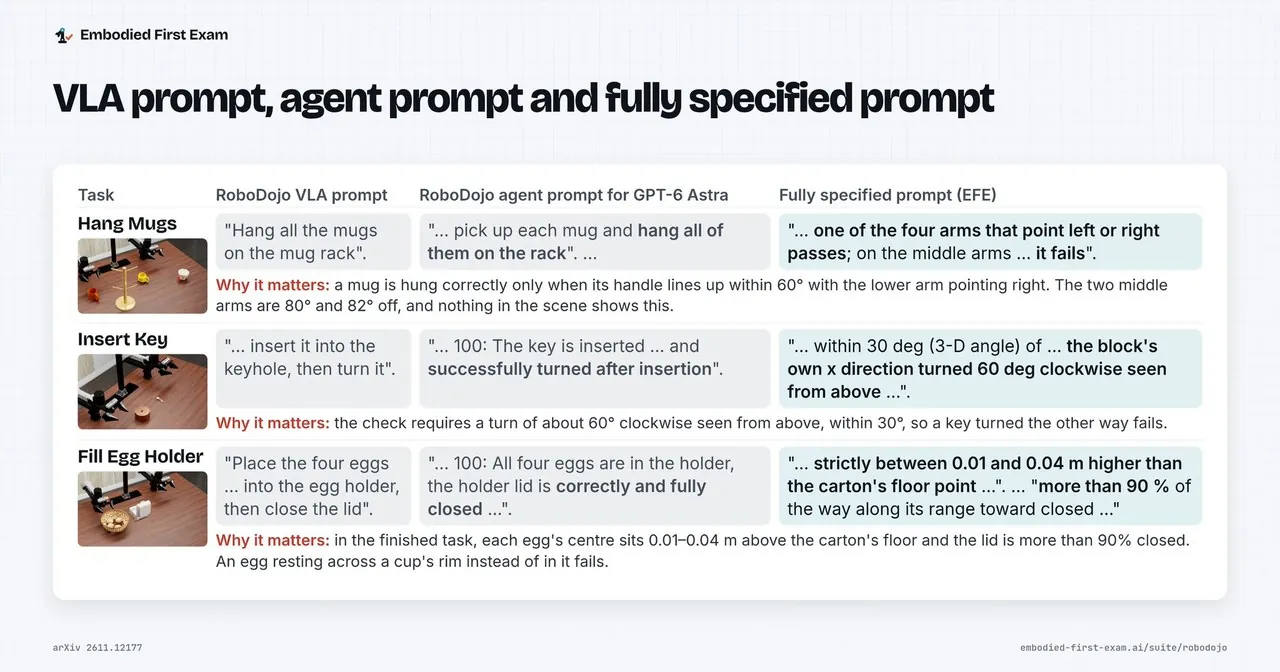
Three examples show what "fully specified" adds:
- Hang Mugs. RoboDojo's prompt reads "Hang all the mugs on the mug rack". The rack has six arms at three heights. A mug is hung correctly only when its handle lines up within 60° with the lower arm pointing right, so the four arms that point left or right are accepted, while the two middle arms are 80° and 82° off and are not. Nothing in the scene shows this, so an agent that is not told must guess which arms are accepted. The fully specified prompt states it: "A mug hanging through its handle on one of the four arms that point left or right passes; on the middle arms that point toward or away from you its cross direction is about 80 deg off and it fails".
- Insert Key. RoboDojo's prompt ends "insert it into the keyhole, then turn it", and its scoring asks only that the key be "successfully turned after insertion". The check requires a turn of about 60° clockwise seen from above, within 30°, so a key turned the other way fails. The fully specified prompt states it: "the block's own x direction turned 60 deg clockwise seen from above".
- Fill Egg Holder. RoboDojo's prompt reads "Place the four eggs from the basket into the egg holder, then close the lid", and its scoring asks for eggs "placed correctly" and the lid "correctly and fully closed". In the finished task, each egg's centre must sit 0.01–0.04 m above the carton's floor and the lid hinge must be more than 90% closed, so an egg that comes to rest across a cup's rim instead of dropping into it fails. The fully specified prompt states: "the egg's centre strictly between 0.01 and 0.04 m higher than the carton's floor point".
A fair concern is whether spelling out the finished state is handing the agent the grading rubric. In part, it does: the agent learns what the finished state looks like, while the verification code itself stays hidden. The agent still has to perceive the scene, plan and act to reach that state, which has been the main bottleneck — turning a coding agent's skills into manipulation in the physical world. In line with Terminal-Bench's task guidelines, the description for coding agents is expected to "completely describe what the verification algorithm will look for" and states "what to achieve, not how".
How much information should go into the prompt is an open question. One view is that spelling out the finished state makes the task easier than it should be, since inferring the final state is part of the challenge. Another is that without it the task is under-defined: some requirements, such as which arms of the rack a mug may hang on, cannot be seen in the scene, and a person given the same task would likely ask. Both readings are reasonable. The score gap shows how much that line matters.
Even with the fully specified prompt, some tasks stay hard. One example is inserting a key into a lock: Opus 5.5 found both the key and the lock in its depth images, but still failed. It dropped the key at least nine times, and its closest try, at minute 36, was still about 9 mm off. No agent solves this test.
3. Resets Help More than Providing Exact Object State
What helps more: knowing where everything is, or trying again?
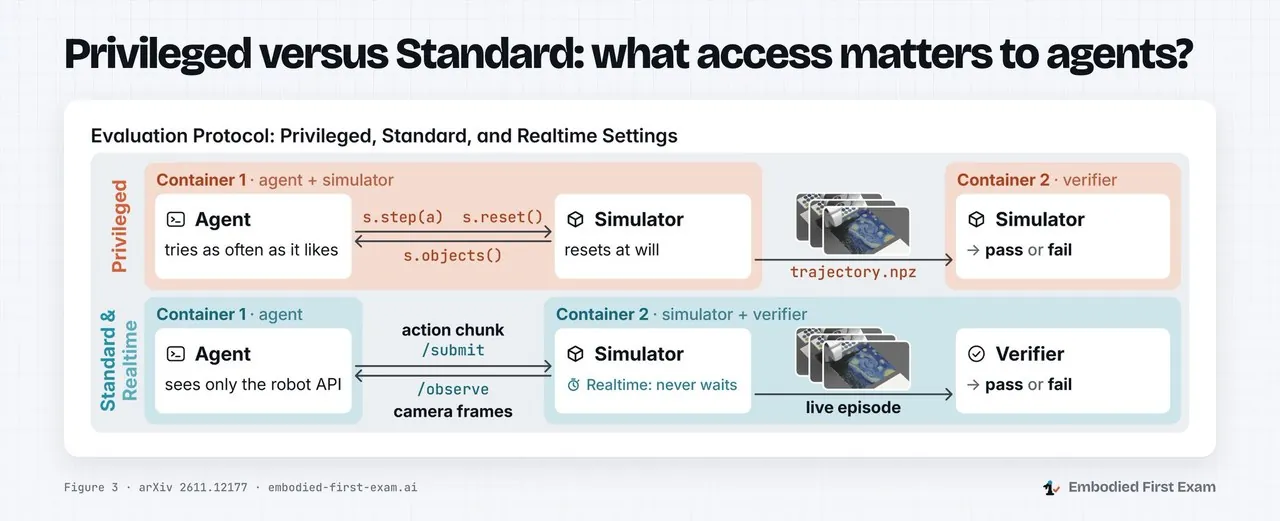
Standard gives the agent what a real robot has: its own sensors, such as cameras, and no resets by default. Privileged gives it the simulator: the exact pose of every object and unlimited resets. To see which part matters, the team added Privileged features to GPT-6 Astra's Standard interface one at a time, across 391 core tasks, in one run per configuration.
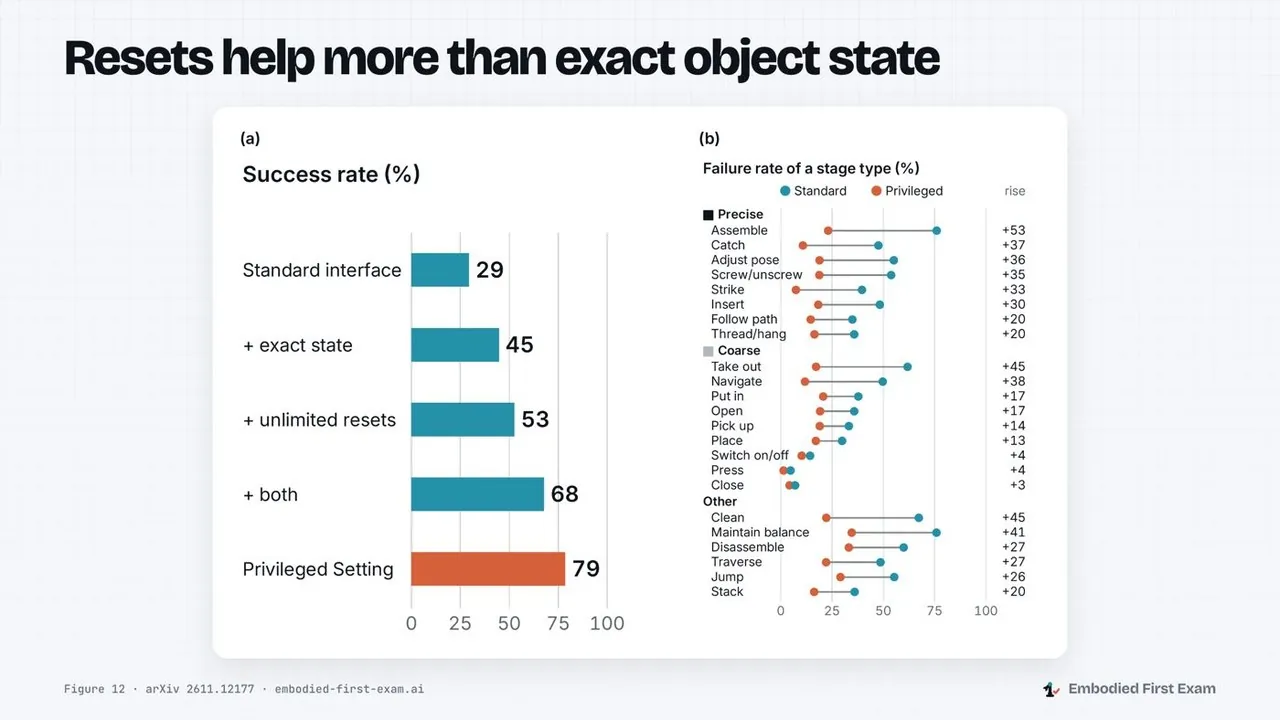
Exact object state: 29% → 45%. Unlimited resets with saved states: 29% → 53%.
Why do resets help so much? They let agents retry just the hard step: an agent saves its progress partway through and restarts from there. Of the 206 successes with resets, 136 (66%) came from restarting at a saved mid-task state.
On steps that need precision, the hard part seems to be carrying out the action, not understanding the scene. On these steps, exact object positions rescue only 21% of GPT-6 Astra's failures, about the same as simply running it again (19%). Restarting from a saved mid-task state rescues 36%.
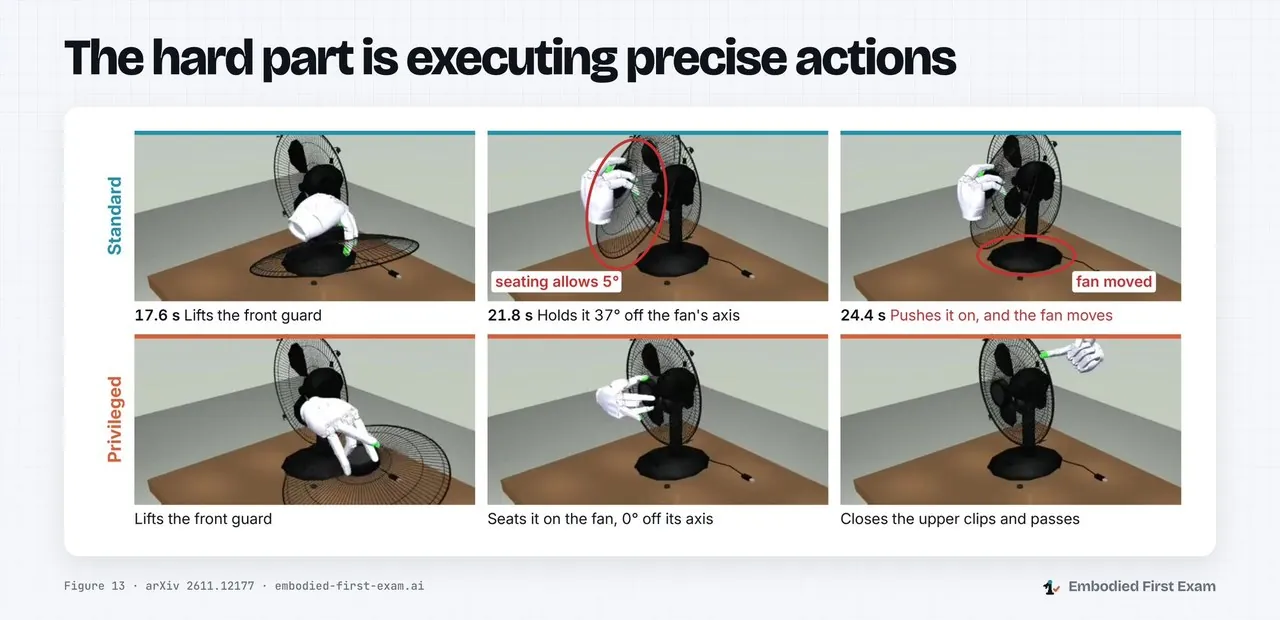
Example: seat a guard on a fan, within 5° of the fan's axis. Opus 5.5 could see both parts through its cameras, so why did it fail? It had to estimate the guard's pose in its hand, and ended up holding it 36 to 39° off the fan's axis, so pushing moved the whole fan instead of seating the guard. In Privileged, it seated the guard at 20 s.
4. Where Does the Money Go? Into Failures
Failed attempts cost more than solved ones.
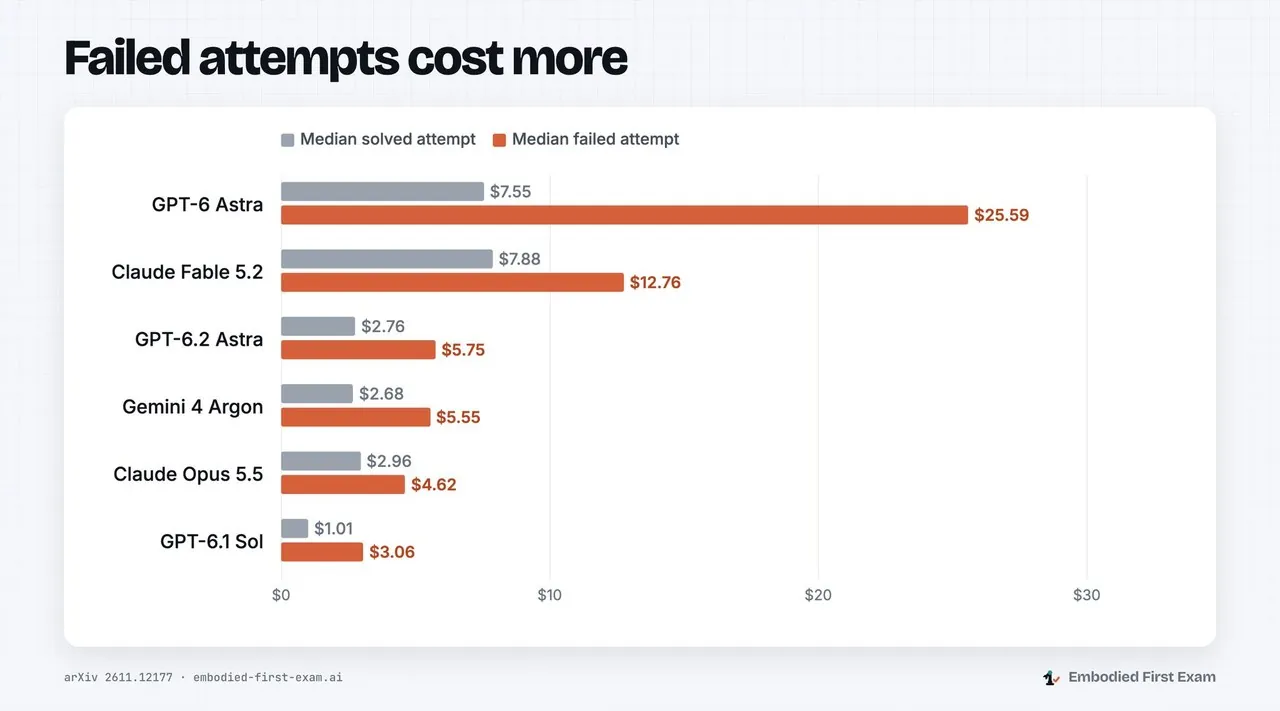
For all ten agents, the median failed attempt costs more than the median solved one. For GPT-6 Astra in Standard, the median solved attempt costs $7.55 and the median failed attempt $25.59.
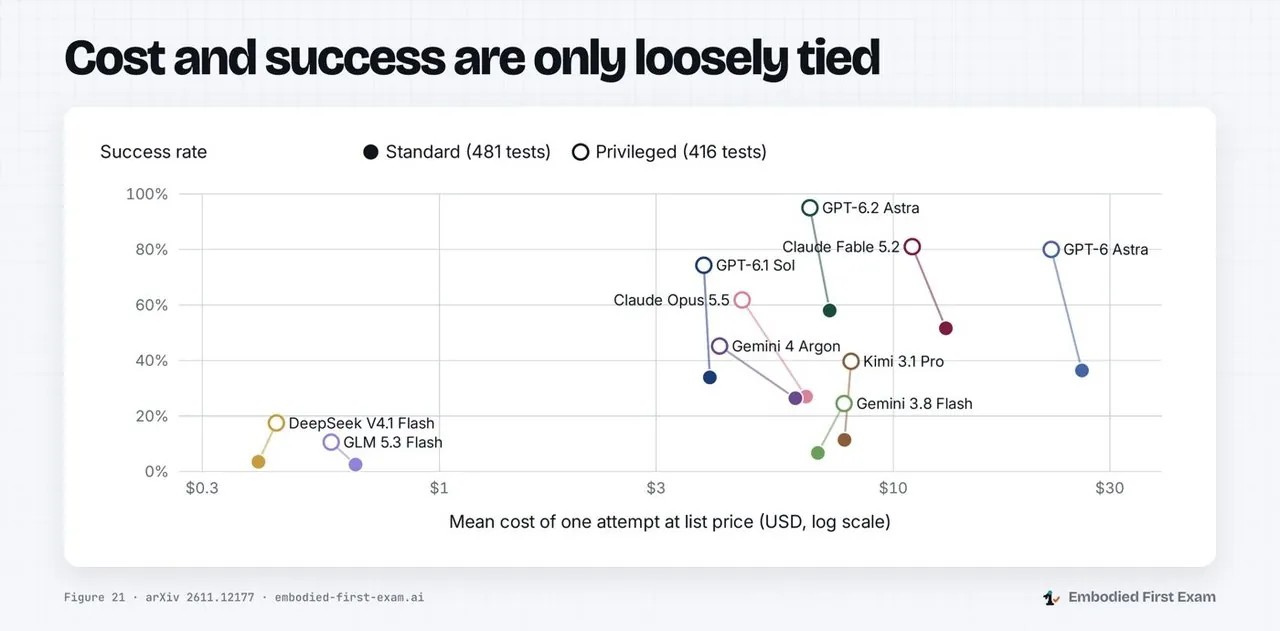
Price and success are only loosely tied. GPT-6.1 Sol costs $3.9 per Standard attempt, about a seventh of GPT-6 Astra's $26.0. GPT-6.1 Sol solves 163 Standard tests; GPT-6 Astra solves 175.
Agents also spend in different ways, and each keeps its own style across settings: some think more, some act more, some stop early. In Standard, Fable 5.2 thinks the most: a median 135k output tokens per attempt, over the fewest steps (63). GPT-6 Astra acts the most: a median 147 steps, and 161 of its 481 attempts use 95% or more of the time limit. GPT-6.2 Astra writes the least: 17k tokens over 107 steps. Opus 5.5 stops earliest: its failed attempts end at a median 45% of the time limit. At $6.42 per attempt, it is also the cheapest of these four agents.
Medium Reasoning vs High Reasoning?
Does more reasoning effort help? Not clearly, in these runs. In a single run each, GPT-6.1 Sol solves 30.7% of 456 core Standard tests at medium effort and 30.9% at maximum. What the team sees so far is a change in how the agent works: more output tokens, fewer requests and longer sessions, at about the same cost ($3.91 to $4.10 per attempt). They are analyzing this further and will share more soon.
Does using more of the time limit help? Agents differ in how much of it they use. GPT-6 Astra keeps correcting until time runs out: its failed attempts end at a median 97% of the time limit. Fable 5.2 tends to stop once it expects to fail: its failed attempts end at a median 66% of the time limit, and 160 of its 205 failed Standard attempts end with ten or more minutes left. Neither habit works everywhere. On a spatula test in Privileged, Fable 5.2 stopped at minute 40, 0.6 mm outside tolerance at one of 48 target points; GPT-6 Astra kept going and reached all 48 at minute 47. On a calligraphy-copying test, Fable 5.2 used all 71 of its strokes, and its overlap with the target was 0.796, just below the required 0.80. More time seems to help only if the agent can tell how close it is.
5. Given a GPU, Agents Train RL Policies
Agents control the robot in three ways:
- Direct control: step by step, the model looks at the latest camera view and decides the next action.
- Code to control: the agent writes a program before the task starts, and the program runs the robot during the task.
- Train a policy to control: the agent trains a model in simulation before the task starts, and that model runs the robot during the task.
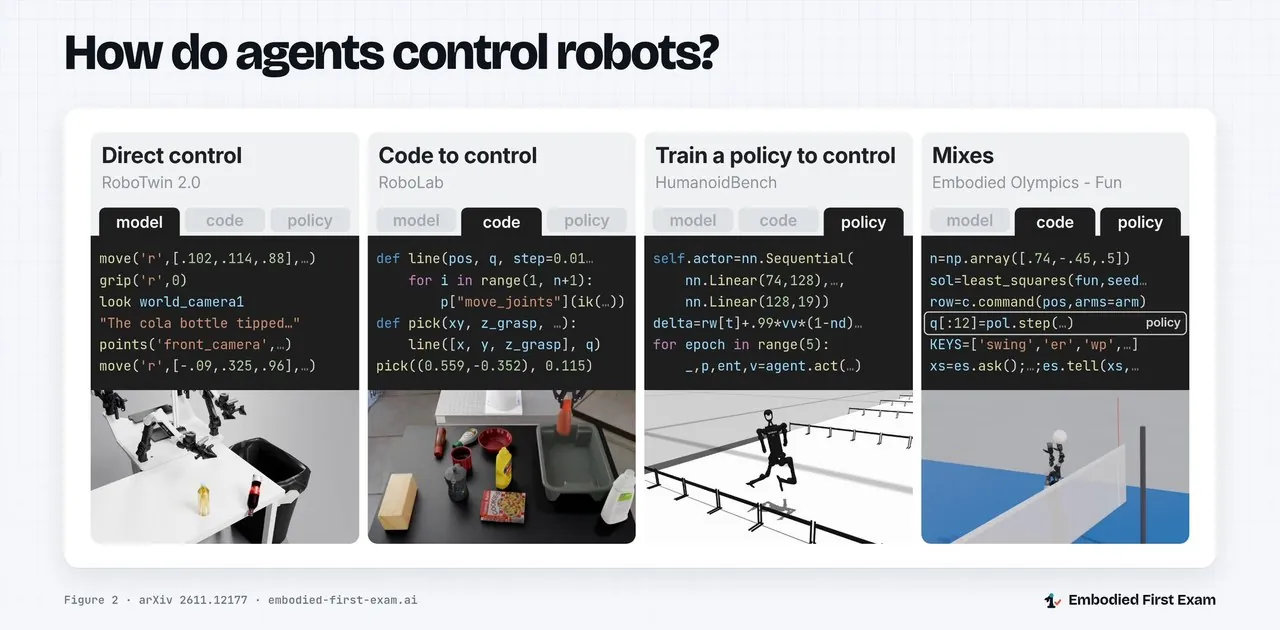
Which control approach do agents pick? It tends to depend on whether the world waits for them. When the simulation pauses while they think (Standard), they use direct control in 61% of sampled attempts; when it keeps running (Realtime), they write a program in 95%. A likely reason is that a running clock leaves little time to decide step by step, so agents prepare a program, or train a model, before the task starts. Training a policy is rare: across all three settings, only 13 of 2,359 sampled attempts trained one, and agents train mainly when the test supplies the tools, such as a GPU and a training library.
In humanoid soccer with a GPU, agents trained a policy in 25 of 26 tests and won 8 of them, all with a trained policy. With CPUs only, just 1 test trained a policy, and the CPU tests won only once.
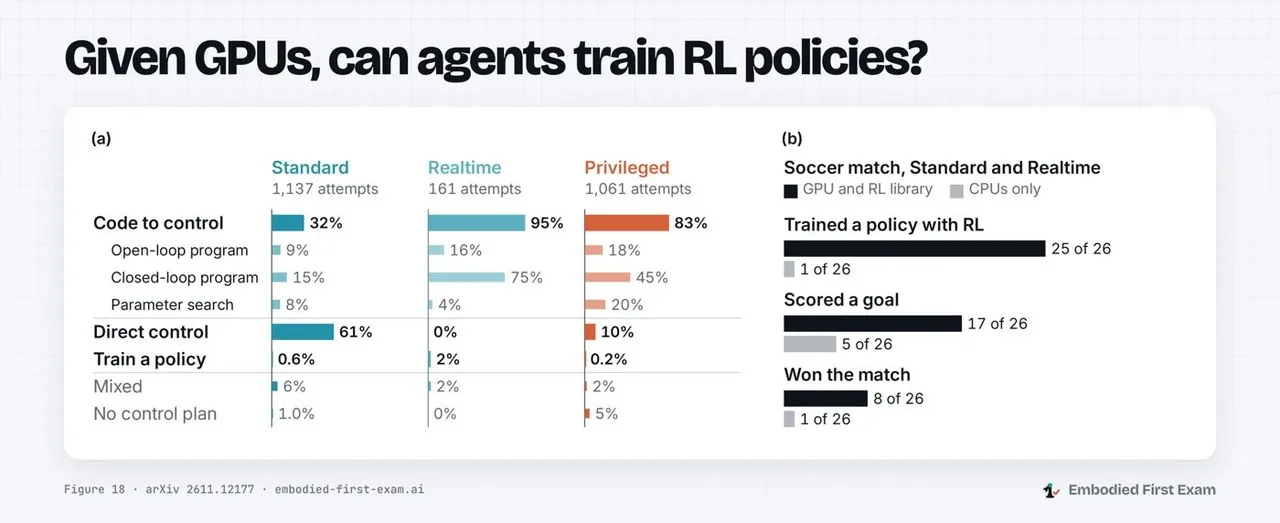
The gap is also visible within a single agent. Against the same learned opponent, GPT-6 Astra won its soccer match by 10 goals to 8 with a GPU, but lost 3 to 13 without GPUs.
What changed? With the GPU, it trained policies for walking and ball control. With CPUs only, it wrote a walking gait by hand; its two robots fell 59 times, against 7 for the opponent's, and the match was stopped early once the opponent led by 10 goals.
6. Embodied Olympics: Can Agents Learn Continually?
Can agents improve during a match? In Embodied Olympics, play pauses after each point, such as a rally in tennis or a goal in soccer. The agent sees a record of that point and can update its program before the next one. When an agent claimed its update helped, the team checked the claim with replays. The replays confirmed the improvement in only 35 of 305 cases.
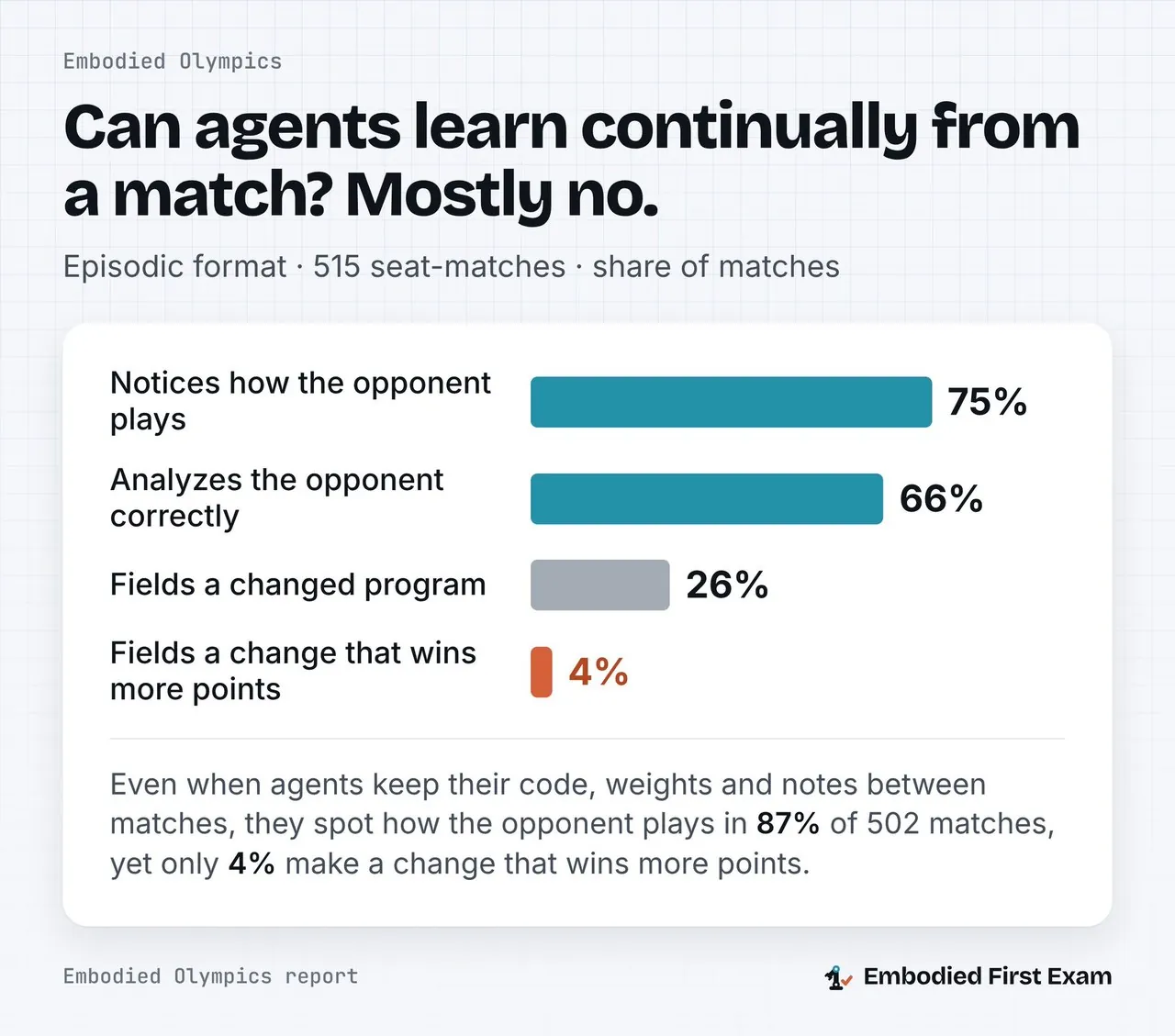
Do agents learn from the opponent during a match and win more points? The team tracked 515 agent-match pairs in which each match starts from an empty workspace. In most of them, the agent notices how the opponent plays (75%) and analyzes it correctly (66%). Yet even when they understand the opponent, far fewer act on it: the agent changes its program in only 26% of the matches, and makes a change that actually wins more points in only 4%.
Why don't agents improve during a match? Not for lack of memory. Even when they keep their workspace, memory and the video of earlier matches, they notice the opponent in 87% of matches, yet only 4% make a change that wins more points.
So a match is largely decided by the first initial program each agent writes before play starts. To test this, the team ran each initial program against the same set of fixed opponents to score it on its own. In 91% of matches, the agent whose initial program scored higher went on to win.
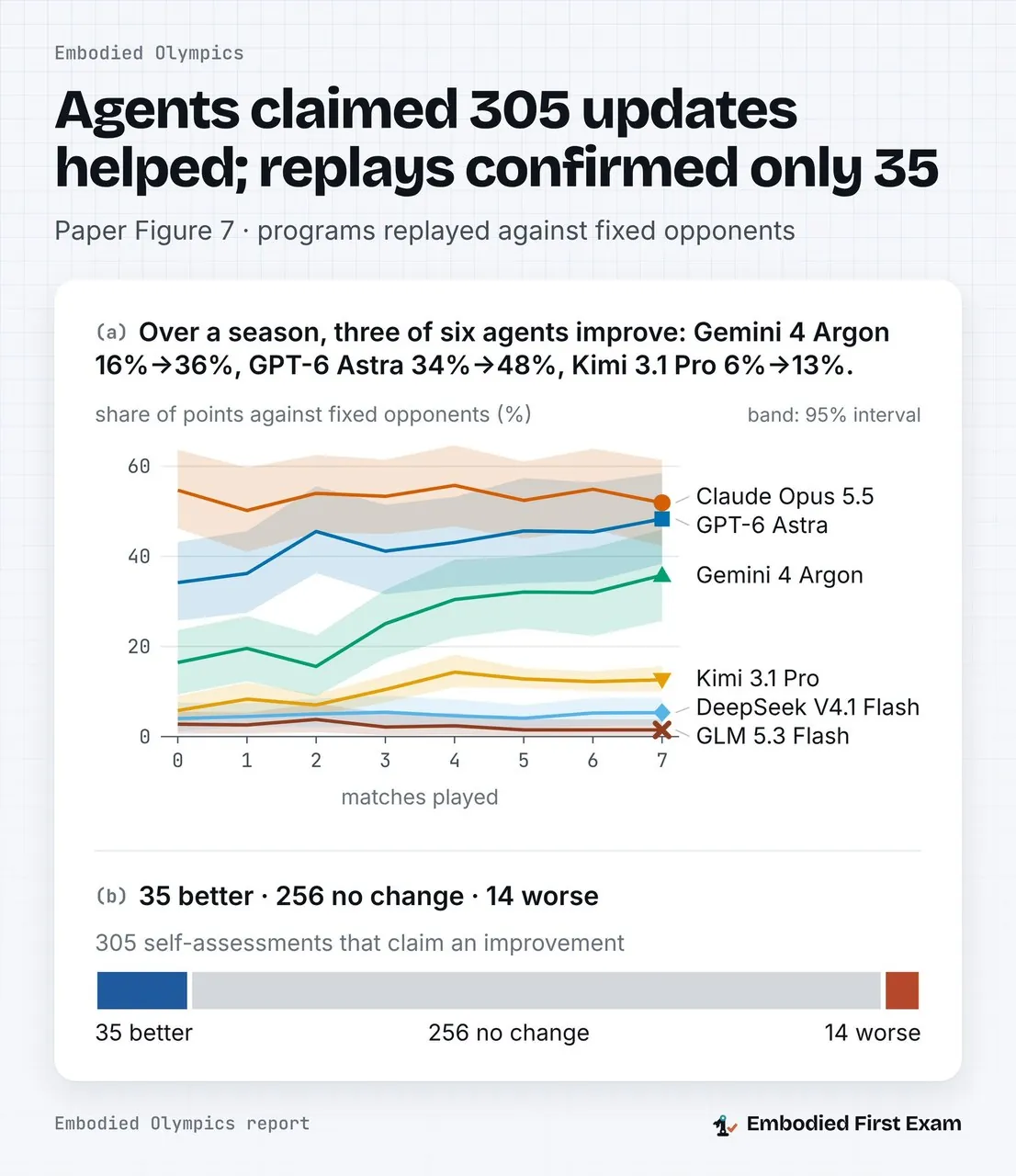
Of the 305 updates that agents said had helped, 256 made no measurable difference and 14 made things measurably worse.
Do agents notice when a change makes things worse? Often not: in the 22 cases where the replay actually lost points, the agent still called the change an improvement in 14 cases.
Do agents improve over a whole season, then? Some do: Gemini 4 Argon goes from 16% to 36% of points against fixed opponents, GPT-6 Astra from 34% to 48%, and Kimi 3.1 Pro from 6% to 13%.
7. How Sensitive Are the Results?
Harness and instruction move the score. Reasoning effort stays within the run-to-run range of under 5 points.
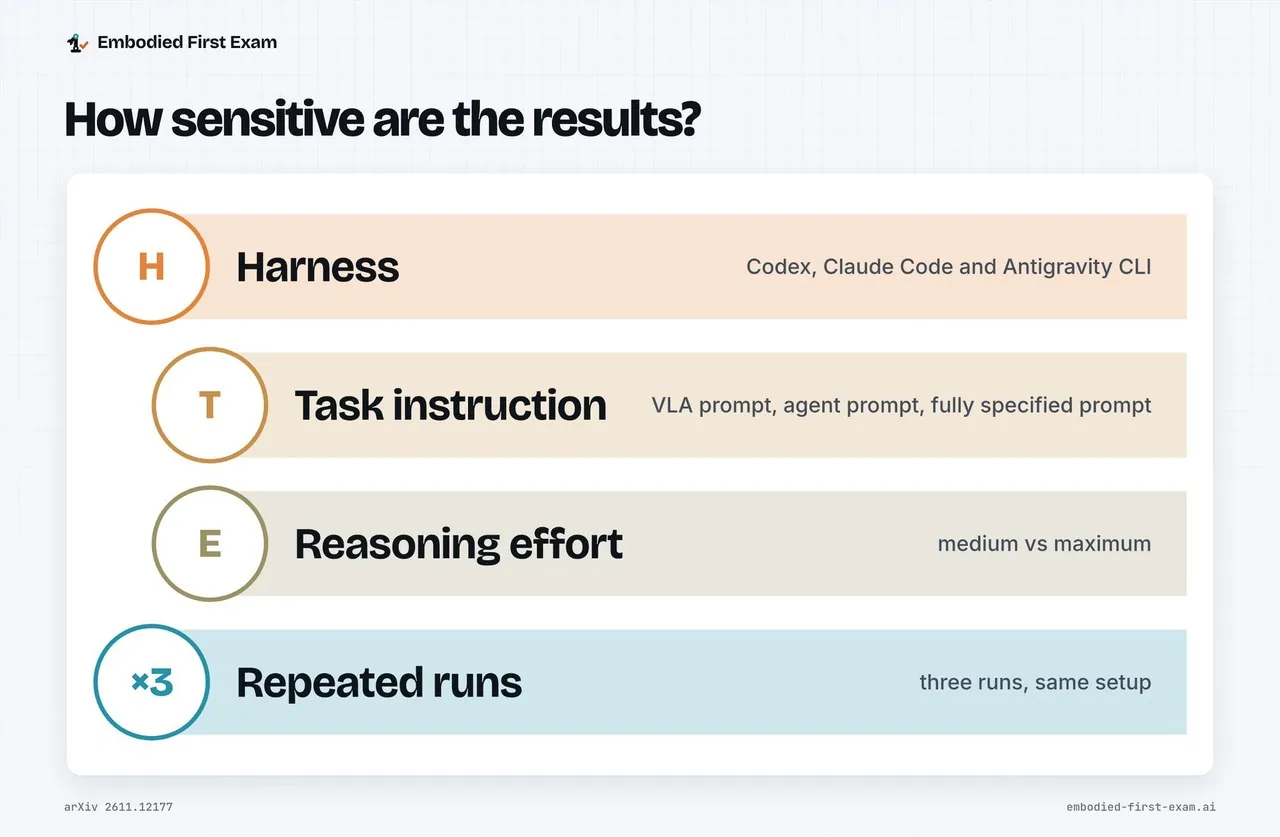
How much does the harness matter? In these runs, GPT-6 Astra solves 34% in Codex and 27% in Claude Code.
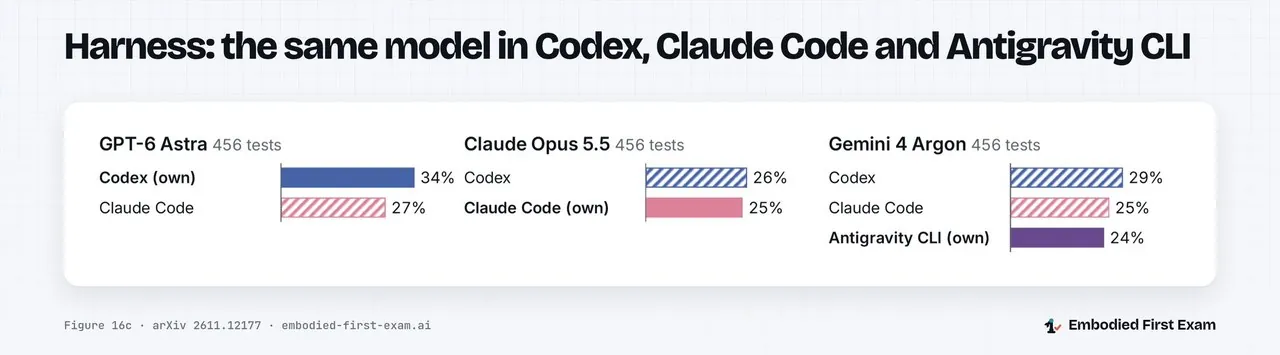
Is the gap only because one harness allows longer sessions and more retries? Not only: it already appears on the first try, before any reset, where GPT-6 Astra succeeds 119 times in Codex and 95 in Claude Code.
Other models are less sensitive: Opus 5.5 solves about the same in both (119 and 114 tests).
The team is excited about the release of Google's Robotics plugin for Antigravity and is currently testing it on the exam.
8. What Happens When the World Doesn't Pause?
In Realtime, the world keeps moving while the agent thinks. On the 54 core tasks that have both a Standard and a Realtime version, GPT-6.2 Astra solves 33 in Standard and Fable 5.2 solves 27. In Realtime, both solve 22. Tests that no agent solves rise from 15 of 54 (28%) in Standard to 22 (41%) in Realtime. Agents also change approach: instead of sending commands step by step, they write a program that runs the robot, in 95% of sampled Realtime attempts.
9. Do Different Models Fail at the Same Stage?
Often, yes. When two different agents fail the same test, they fail at the same stage 57% of the time; if each failure fell at a random stage, this would happen only 35% of the time. This suggests that some stages are hard for today's agents across models.
Which stages? When an agent reaches a stage that involves materials (wiping, pouring, painting), it fails there 54% of the time. For stages that involve the robot's body (walking, balancing), the rate is 36%; for mechanisms (doors, lids, buttons), 15%.
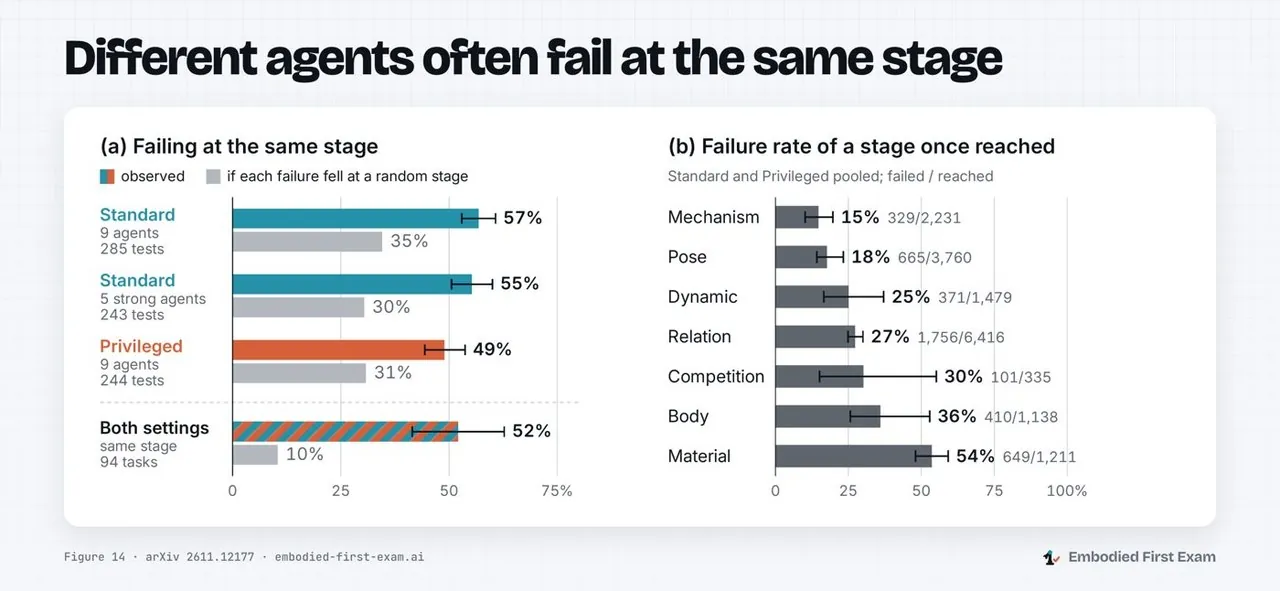
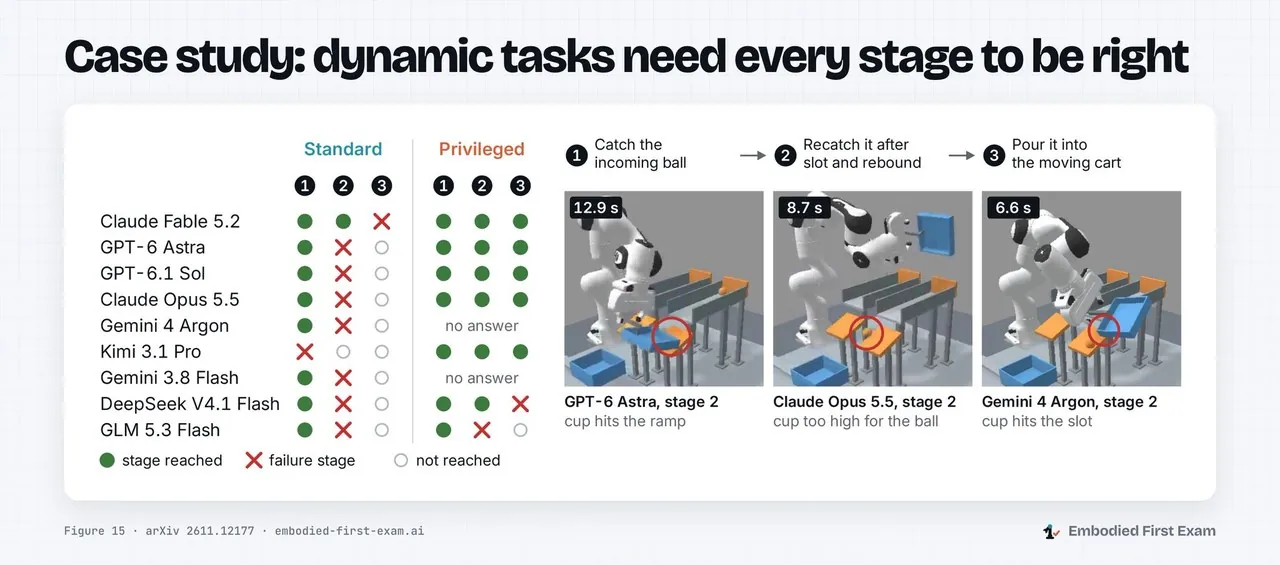
Example: a robot arm holding a cup must catch a thrown ball, pour it into a slot, and catch it again as it rebounds off a ramp. Of the nine agents whose attempts were labeled, seven made the first catch but missed the second.
Why is the second catch so hard? The timing is tight. After the pour, the cup must be turned back upright before the ball returns from the ramp. By Opus 5.5's own estimate, turning the cup upright takes about 1.4 s, while the ball stays catchable for only about 1.3 to 1.6 s after it leaves the cup, leaving almost no margin.
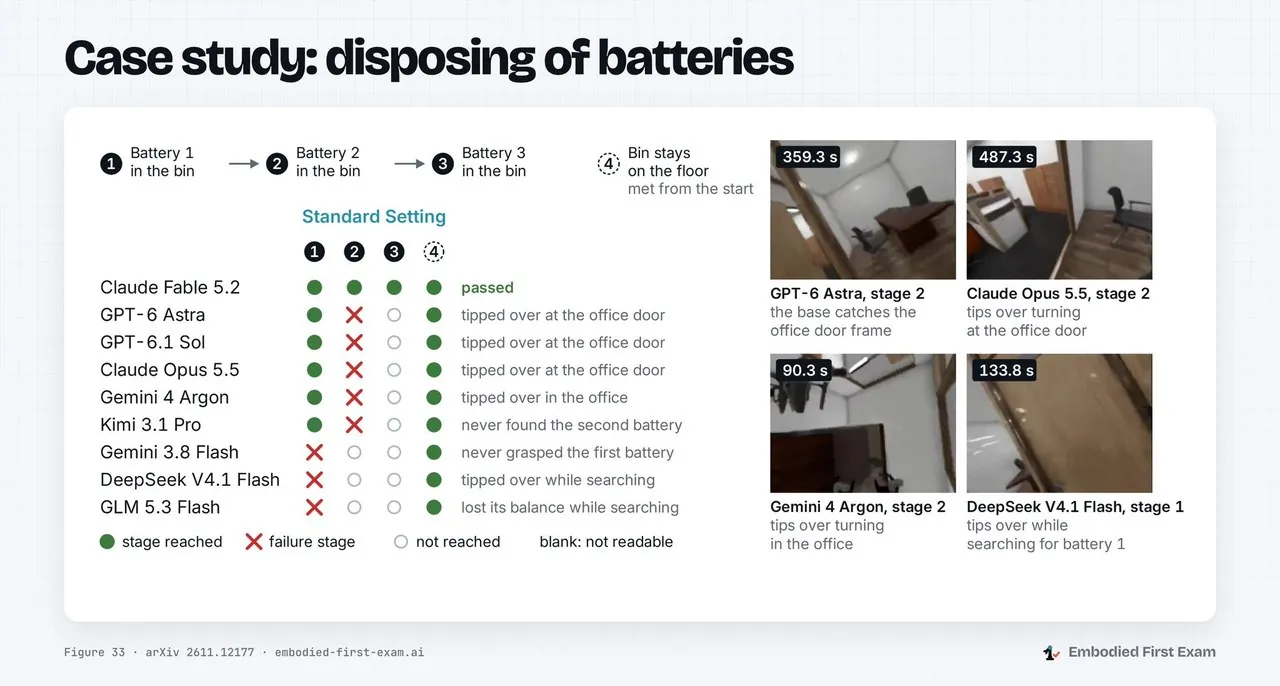
Another example: a robot must collect batteries around an office and dispose of them. Several agents disposed of the first battery, then tipped the robot over on the way to the second.
Why? Picking up and dropping the batteries is not the problem: in Privileged, five agents solve this test. The hard part is driving through a doorway and turning without tipping. GPT-6 Astra's base caught the door frame at 359 s, and the robot fell on its side.
Does full simulator access change where agents fail? Mostly not. For each task, the team compared the stage where agents fail most often (its hardest stage) in Standard and in Privileged. Leaving aside 85 tasks whose hardest stage is the very first one in both settings, 52% of the remaining 94 tasks have the same hardest stage in both settings. If the hardest stage were picked at random, this would happen only about 10% of the time.
10. Weaker and Stronger Agents Fail in Different Ways
Do weaker agents (those solving fewer than 12% of Standard tests) simply fail the same steps more often? Not quite. They tend to fail earlier, often before completing a single stage.
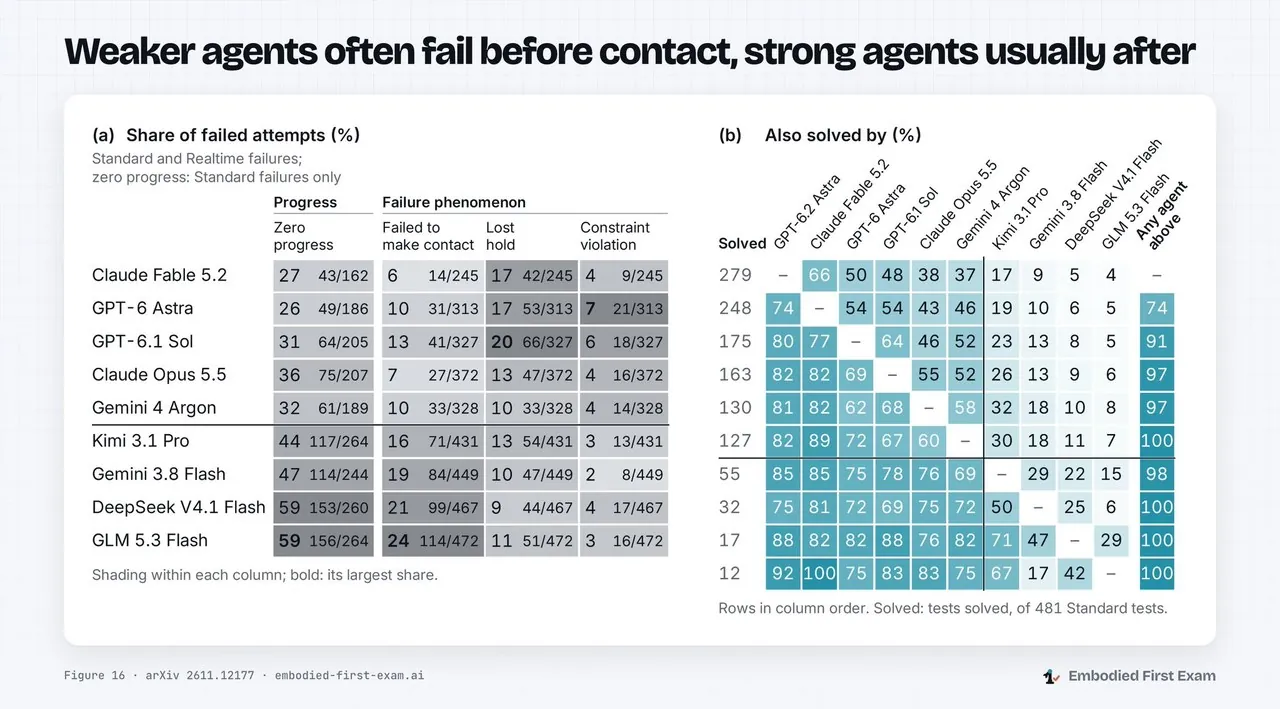
44% to 59% of weaker agents' failed attempts end before completing a single stage, against 26% to 36% for strong agents (those solving more than 25% of Standard tests). Weaker agents also fail more often to make contact with the object: this accounts for 16% to 24% of their failed attempts, against 6% to 13% for strong agents. Each time they reach a step that requires contact, weaker agents miss it 9% to 19% of the time; strong agents miss it only 1% to 4% of the time.
Consider a short task in which the robot fetches a cereal box and a bowl from a cabinet. Some strong agents got hold of the bowl and then dropped or misplaced it, while the weaker agents all failed before even making contact. At the same time, almost every test a weaker agent solves is also solved by at least one stronger agent.
112 Tests Stay Unsolved by Every Agent
No agent solves 112 Standard tests, about a quarter of the total. The largest groups are in BEHAVIOR-1K (23), Embodied Olympics – Fun (21) and DexToolBench (13).
Most of them become solvable with exact object state and unlimited resets: 104 also have a Privileged version, and at least one agent solves 90 of those 104 in Privileged.
What We're Working on Now
- A hidden challenge set. Held-out tasks that will not be released, to test agents on tasks they could not have seen.
- Eval env → RL env. Building continual-learning infrastructure on top of EFE to see how environments can help agents learn.
- Real-robot evaluation. Whether the same infrastructure can evaluate agents on real robots.
Two caveats travel with every number above: all results except one real-robot demonstration are in simulation, and every comparison uses one attempt per agent and test.
The full analysis is in the EFE blog: embodied-first-exam.ai/blogs/failure-analysis. If you use these results, please cite the paper: arXiv:2611.12177.
Source: Manling Li's X post x.com/ManlingLi_/status/2125300304648470767 and the attached X article "Where Do Today's Agentic Robots Succeed and Fail?" (2026-11-24), with context from the Embodied First Exam paper and the project's failure-analysis blog. This article is a complete English adaptation; all figures are from the original article.
Source:Manling Li / Embodied First Examhttps://x.com/ManlingLi_/status/2125300304648470767