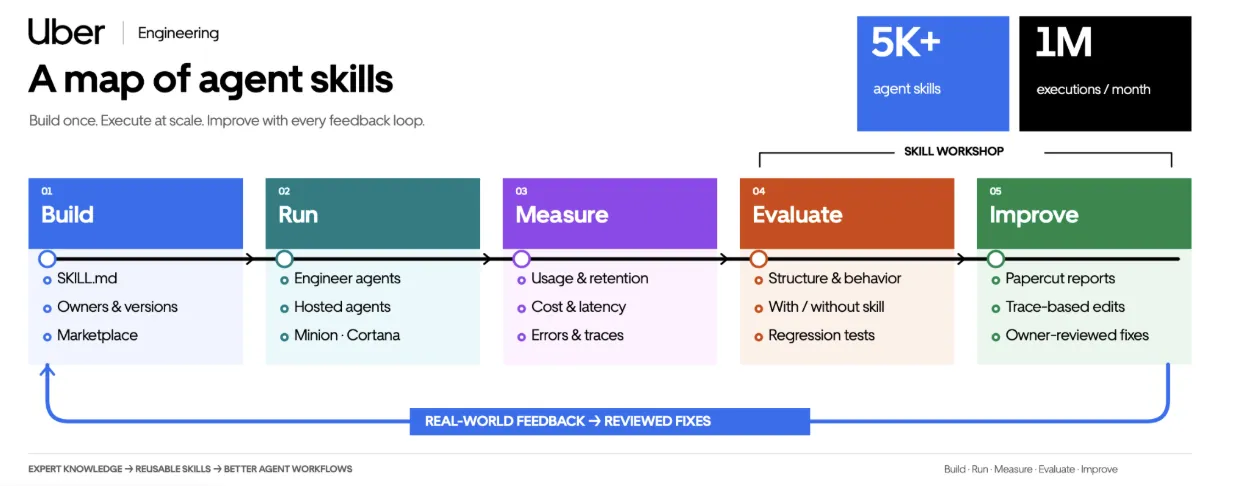
How Uber Evals 1 Million Agent Skill Invocations a Month
Uber turns more than one million monthly agent-skill invocations into a governed system through portable skills, layered configuration, telemetry, trajectory evals, ablations, and feedback loops.
An agent is only as useful as the procedures it can execute reliably. Uber’s engineering organization learned that lesson at a scale few companies have reached: its shared skills marketplace grew from one skill in October 2025 to more than 5,000 in one year, and agents invoked skills more than one million times in a single month. The interesting part is not the catalogue size. It is the infrastructure Uber built around the catalogue: one portable format, layered configuration for several agent runtimes, usage telemetry, trajectory evals, cost measurement, ablation tests, and a structured way for agents to report failures in their own tooling.
Uber’s examples are mostly software workflows, but the architecture is directly relevant to embodied AI. A robot fleet also needs reusable operating procedures, versioned deployment, simulation and hardware regression tests, runtime traces, and a feedback path from field failures to the people who own each procedure. Uber’s account shows what that operational layer looks like when it has to survive thousands of authors and millions of executions.
Skills at Enterprise Scale
A skill is a Markdown file that teaches an AI agent to do one job well. That job might be creating a pull request, querying a metrics store, or outlining a weekly sales presentation. Skills are one of the building blocks of Uber’s software factory.
The growth curve creates a different problem from the one faced by a single developer with a private prompt library. Once thousands of people can publish skills and several agent products can invoke them, the organization needs to answer questions that ordinary prompt files cannot answer: Who owns the skill? Which version ran? Did the agent choose it or did the user invoke it explicitly? How much context and money did it consume? Did it improve the result, or merely add another wall of instructions?
What Is a Skill?
Uber defines a skill as a packaged workflow. A workflow can be a runbook, a team process, or a task that an expert normally performs by hand. It may be as small as editing a Linear issue or as large as a complete root-cause analysis.
On disk, a skill is a directory. Its SKILL.md file contains a name, a description, and a body of instructions. The directory may also contain scripts and reference files. For RobotWorld readers, this is a useful separation: the natural-language procedure carries intent, while executable helpers carry repeatable mechanics. A skill can therefore talk about when to inspect a sensor or how to triage an anomaly without asking the model to replay every low-level command in its context window.
The skill is loaded in three stages so that a large marketplace does not impose a huge context cost before work begins:
- Always loaded: the name and description, about 100 tokens. The agent uses the description to decide whether the skill applies.
- Loaded when the skill runs: the body, kept under 500 lines.
- Loaded on demand: scripts and references, read only by the step that needs them.
skill-directory/
├── SKILL.md          # name, description, instructions
├── scripts/          # executable helpers
└── references/       # material loaded only when needed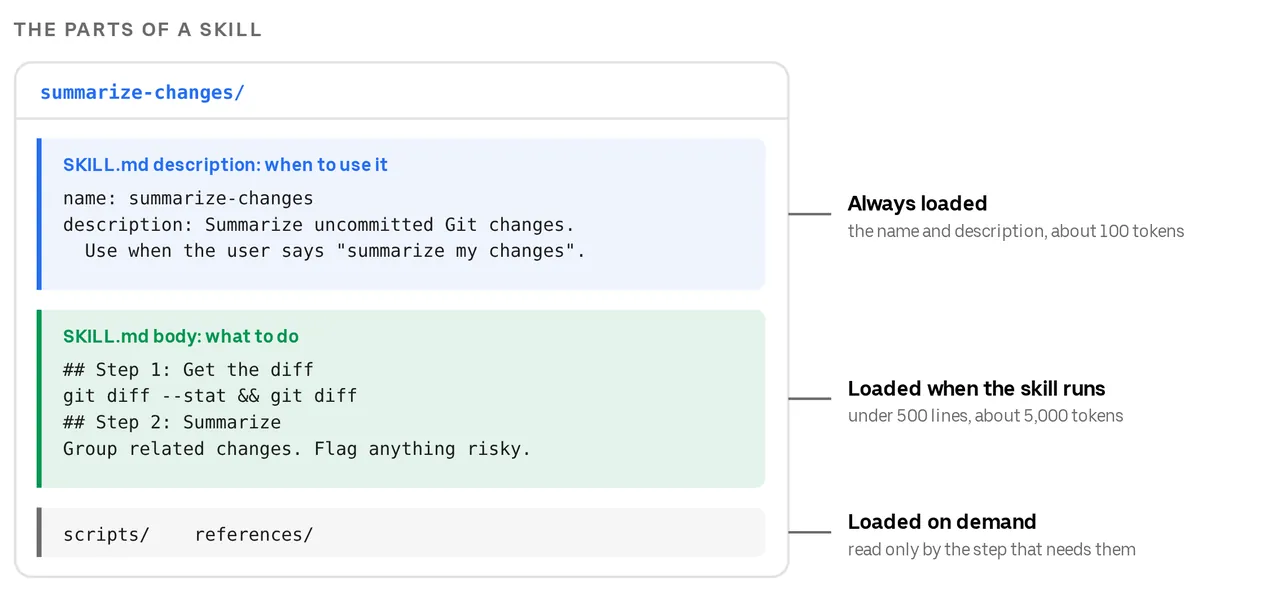
The open Agent Skills specification describes the format in more detail.
Distributing Skills
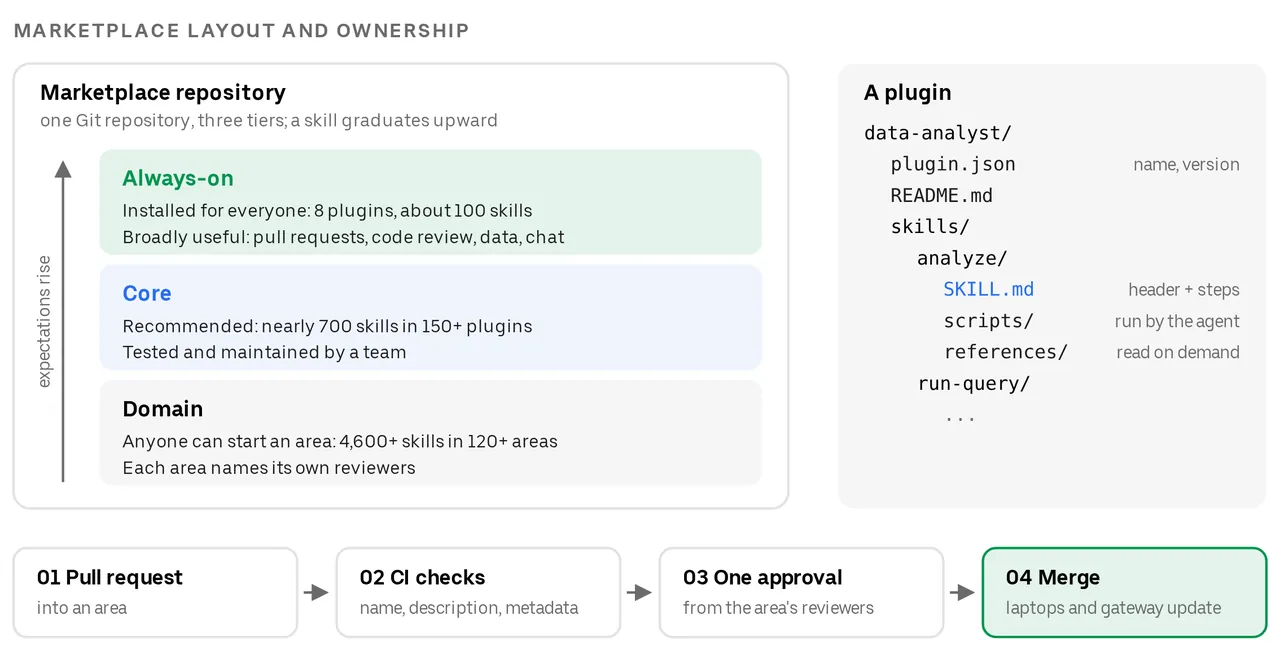
Uber wanted one place where teams could publish skills and where those skills would load easily wherever people use agents. A Git repository turned out to be the best fit because version control already supplies an owner, a review path, and a history. That choice also makes the marketplace legible to existing engineering processes: a skill change can be reviewed like code and audited like any other production asset.
Organizing the Marketplace: Always-On, Core, and Domain
The goal is to let teams write skills quickly while still giving every user a curated default set. Uber separates the marketplace into three tiers. Expectations for quality and efficiency rise as a skill graduates, and graduation depends on the eval system plus a set of quality and usefulness checks.
| Tier | Ownership and review | Purpose |
|---|---|---|
| Domain | Any team can start an area. Named reviewers approve changes, with one peer approval and a CI check. | Fast, distributed experimentation without waiting for a central group. |
| Core | A team maintains the skill; the platform team reviews every change. | Recommended, tested skills that are broadly useful. |
| Always-on | Platform-managed and enabled for everyone. | About 100 default skills covering pull requests, code review, tool access, data analysis, and chat. |
The tiering solves a governance problem that also appears in robotics. A useful manipulation primitive, safety check, or fleet diagnostic may begin inside one team, but it should not become a company-wide default merely because its first demo worked. The tier is a promotion mechanism: local ownership first, shared review later, broad deployment only after evidence.
One Install for Every Agent
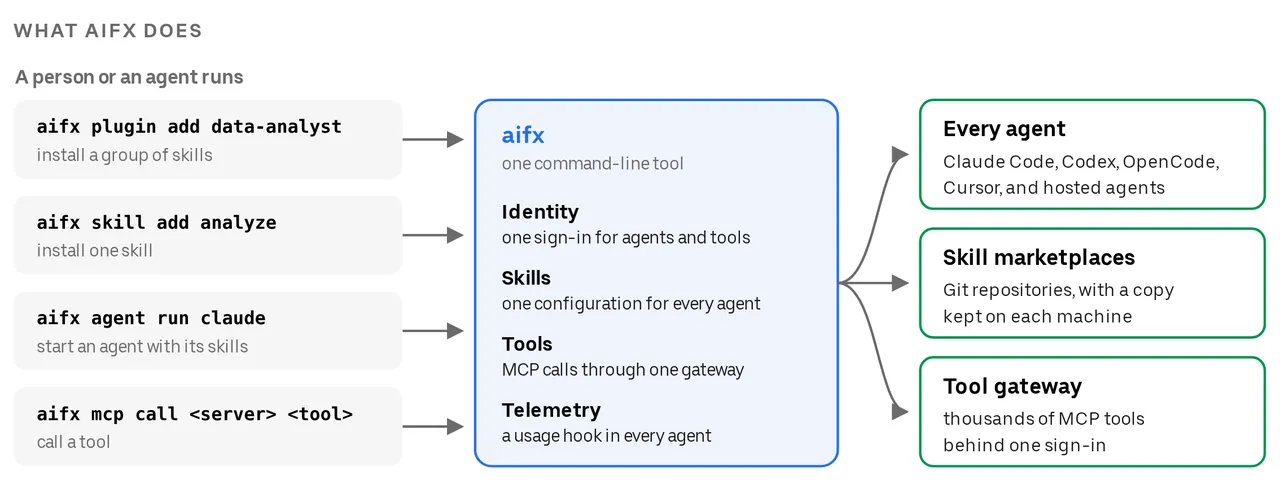
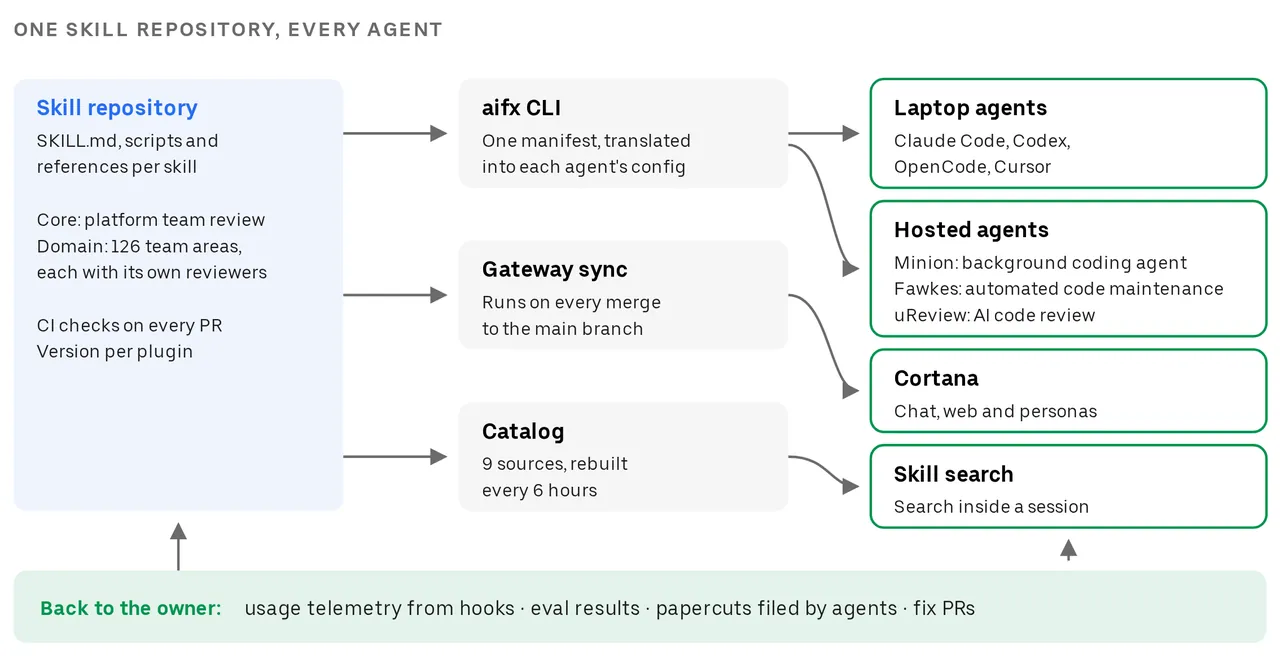
Supporting multiple agents is deliberate. Users can choose the agent that fits a task, but each product defines and installs skills differently. Uber’s aifx command-line tool starts each type of agent and stores configuration. It also handles skill management, MCP calls, observability, and advanced configuration.
A person or an agent can run aifx plugin add data-analyst to install a group of skills, or aifx skill add analyze to install one skill. The selection is recorded in one configuration file and applied to whichever agent starts next. An engineer moving among Claude Code, Codex, and OpenCode keeps the same skills.
aifx merges configuration in layers: company defaults, a team or program, the repository, the working directory, the user, and a local override. Later layers add plugins and never remove them. A repository can therefore declare the plugins everyone working in it needs, while an individual still retains a local override for a narrower experiment.
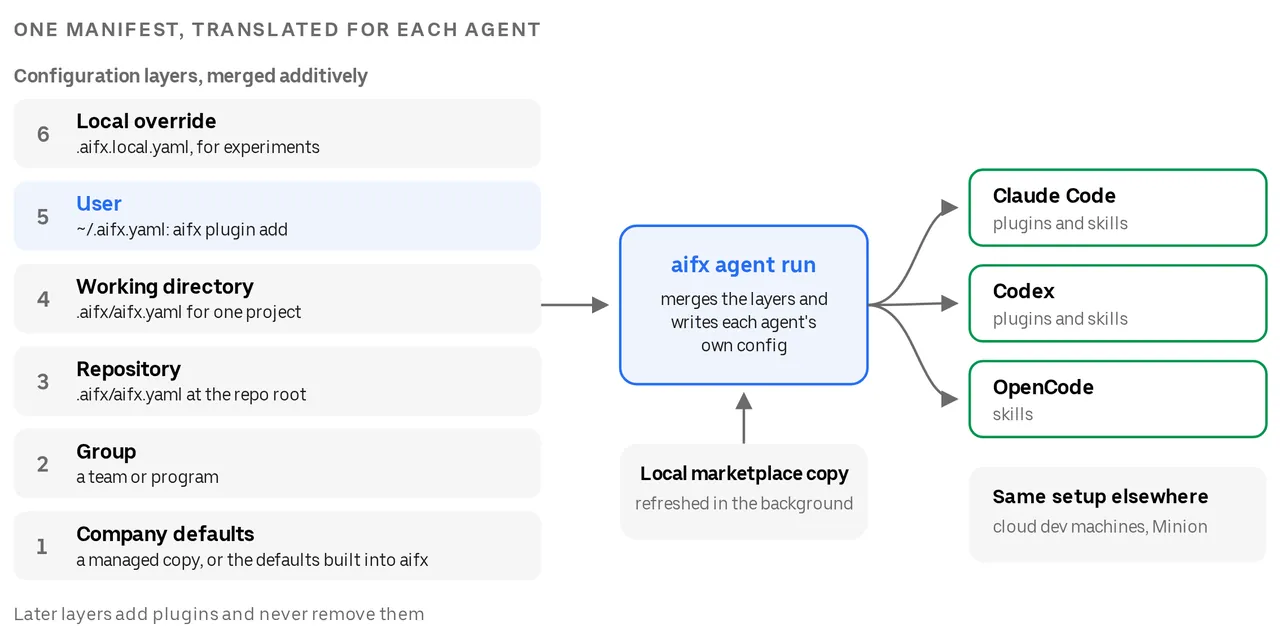
aifx merges six configuration layers and writes the result into each agent’s native configuration.Personas are managed through the same system. Engineers, data scientists, and other roles receive a default set of skills and configuration without forcing every user to assemble an environment manually. A single repository feeds laptop agents, hosted agents, and skill search; telemetry, evals, and papercuts then flow back to the skill owner.
Skill Discovery
With thousands of skills, finding the right one becomes its own capability. Uber has a find-skills skill that can locate and download a quality skill and run it within a specific workflow. The catalogue ranks skills with evals and run counts and computes a skill quality score.
The company also uses its internal context graph to answer a more social question: “Give me the skills my peers are using that I’m not.” That is more than recommendation. It lets proven operational knowledge spread across teams without requiring a central author to anticipate every local need.
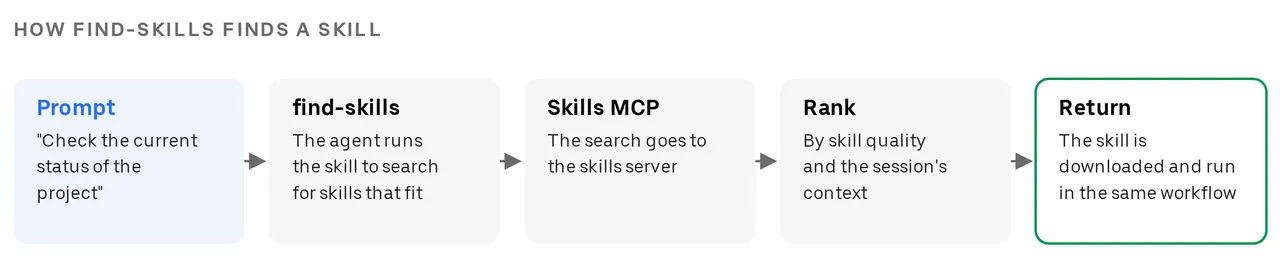
find-skills skill finds a suitable skill for a prompt.Measuring Skill Usage
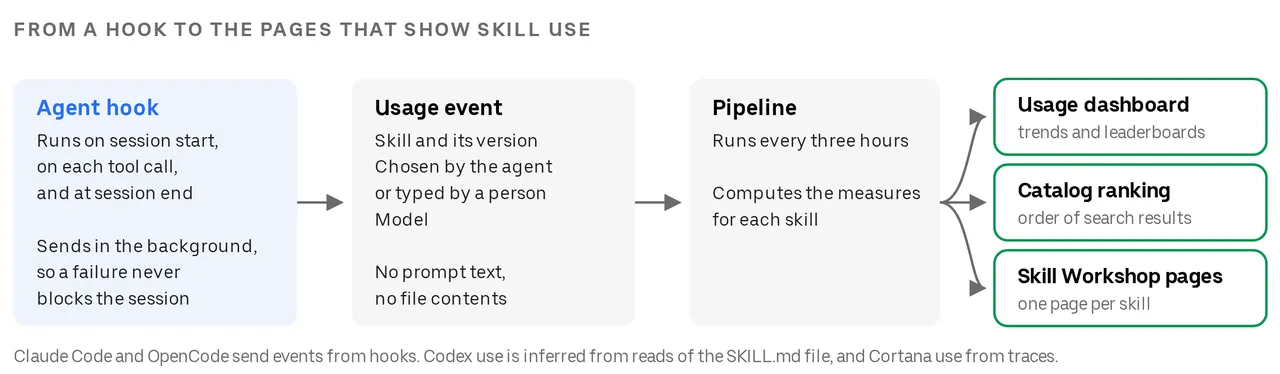
Uber collects usage statistics from agents with OpenTelemetry hooks. Hooks emit events such as session start and tool call, which lets the platform record skill use and its surrounding context. When the tool is a skill, the event records the skill, its version, and whether the agent selected it or the user typed its command. Events carry no prompt text and no file contents.
From those events, Uber computes 12 measures for each skill: usage, retention, reach, co-use, cost, context, latency, errors, tools, versions, agent, and installs. Authors see the measurements on the skill’s page in Skill Workshop, Uber’s authoring tool.
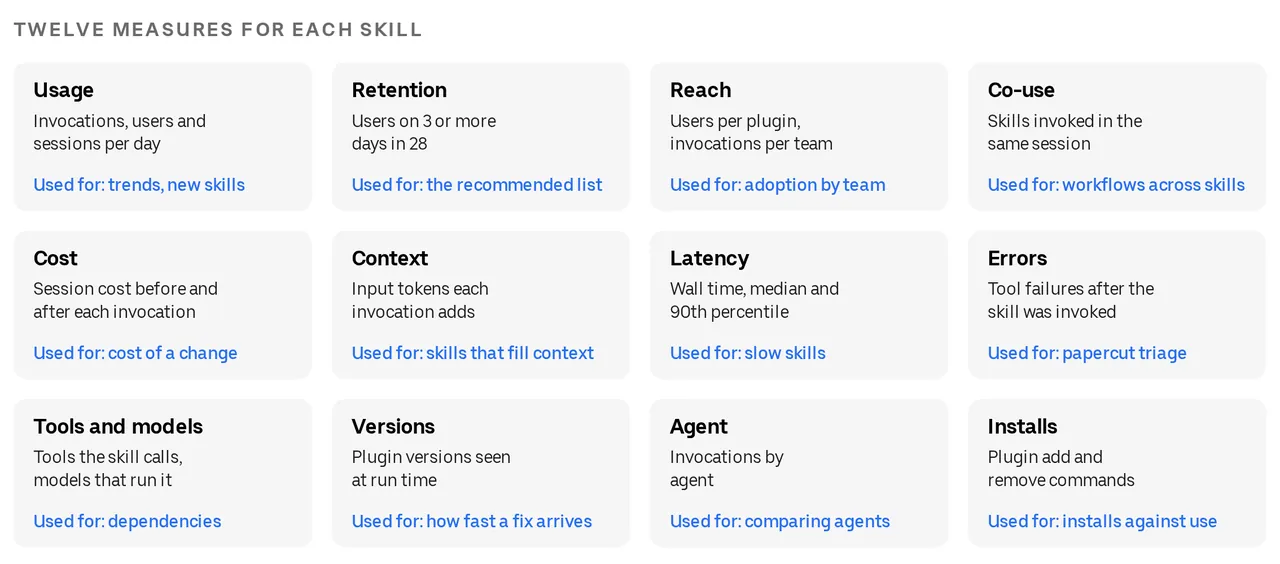
The privacy boundary is important. Measuring that a skill ran, which version ran, and whether it produced errors does not require collecting the user’s prompt or file bodies. For robot systems, the analogous telemetry boundary would separate execution metadata and fault labels from raw camera streams or sensitive facility data.
The Never-Ending Battle for Skill Quality
Skills create agent workflows, and workflows present different challenges from standalone agents. A skill must work across many contexts, in domains where the right answer requires human judgment, and across multiple agent environments. Uber built Skill Workshop as a plugin and web app to improve skills through systematic evaluation and user feedback.
Skill Workshop and the Spec-First Lifecycle
A skill has a lifecycle. An author writes it, tests it, ships it through the marketplace, improves it from real runs, and eventually retires it when a better model or workflow makes it unnecessary. Skill Workshop has workflows for each stage and a page for every skill that shows usage, cost, and quality.
Uber starts with a well-defined spec because models and harnesses change quickly. The spec records the skill’s intent: its goal, outputs, required or forbidden tool actions, and the agents and models it targets. Skill Workshop compiles SKILL.md and its test prompts from the spec, then recompiles them when a model or agent changes.
The durable artifact is not a particular sequence of model prompts. It is the specification of what the workflow must accomplish and which actions are legitimate.
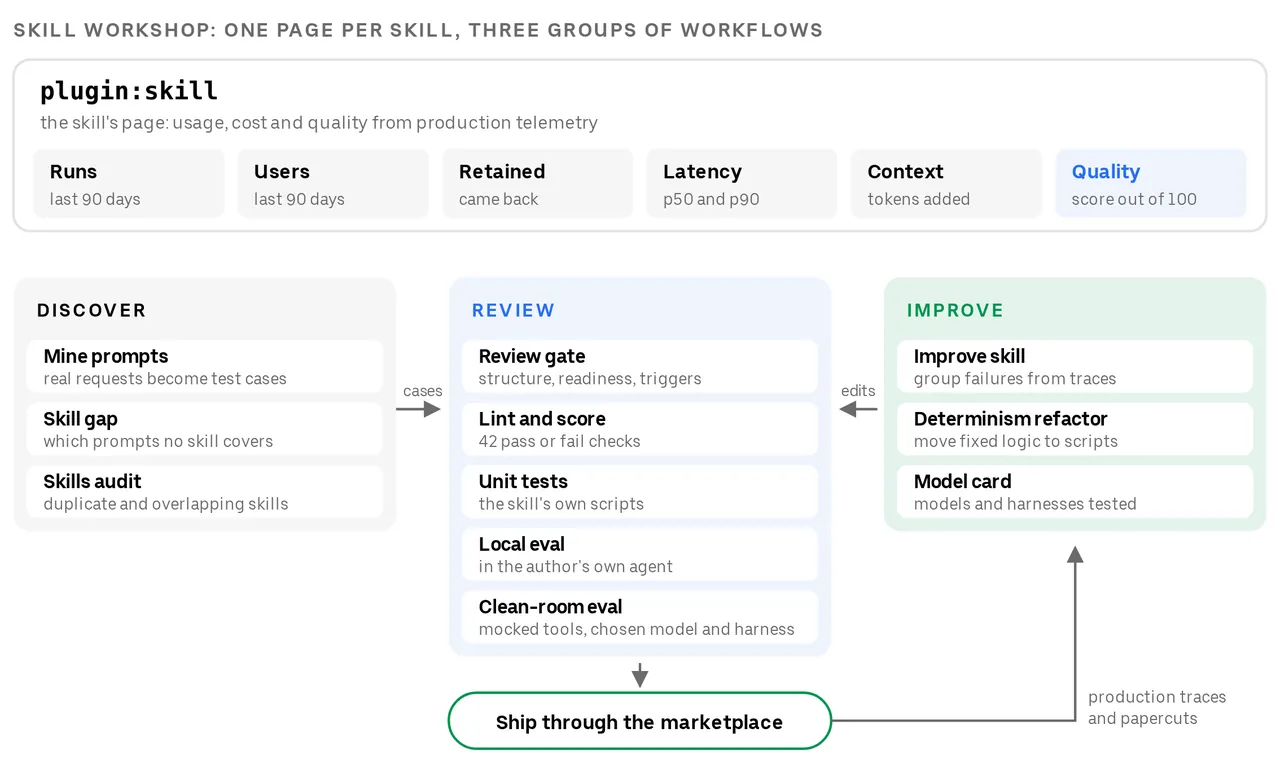
Distilling Skill Code Smells Into a Linter
Uber distilled research papers, model prompting guides, observed failures, and examples of good skills into a linter with pass-or-fail checks. Some of the most useful rules are concrete:
- Steps are numbered, and each step has one objective with at least a soft verification method.
- Each step gives a concrete command and checks the result before continuing.
- The skill includes an error-recovery section: a table of failures and fixes. “Try again” does not count.
These checks turn vague prompt-quality advice into executable review criteria. A skill that says “inspect the logs” is hard to evaluate; a skill that says which command to run, what successful output looks like, and what to do on a specific failure can be tested.
Evals: Golden Cases, Real Prompts, and Trajectory
Uber needed to move past manual feedback. It built several evaluation systems and created hand-annotated prompts and runtime environments for testing. The recommended mix is:
| Eval category | Share | What it measures |
|---|---|---|
| Golden cases | About 5% | Fixed input, expected output, and mocked tools. |
| Real prompts | About 80% | Whether the agent used the right skills and tools in the right order. |
| Author-judged cases | About 15% | Nuanced cases where the skill author decides whether the result is acceptable. |
Trajectory means the sequence of actions: did the agent query the table, read the Google Doc, check the context graph, and consult its error-recovery instructions? Trajectory evaluation deliberately examines what the agent tried to do and why, even when the final answer happens to look correct.
Uber runs evals in three environments: Minion, its background agent platform; AES, its managed agent sandbox; and devpods, its remote development machines. Clean-room execution catches dependencies on the author’s laptop. As in ordinary software, “it works on my machine” concealed assumptions about file paths, cached documents, and installed OS tooling.
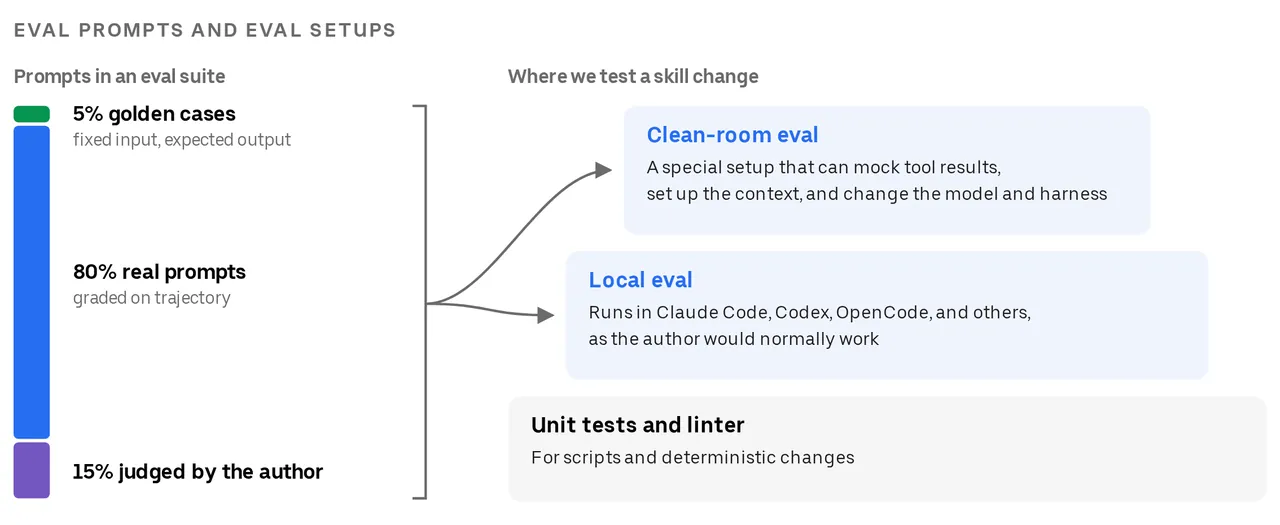
Uber warns that evals remain part art and part science for nondeterministic models. In its experience, suites that pass 70% to 90% of runs can be more useful than suites that pass 100%. A perfect pass rate may mean the test set no longer contains meaningful variation. Judges are nondeterministic too, and can focus on irrelevant details or miss a significant hallucination when the answer follows the expected format.
LLM-as-judge works best with a human-annotated set. Skill authors therefore create examples, collect them from users, and grade them repeatedly. That is why the suite is split among golden cases, real prompts, and author-created cases instead of relying on one synthetic benchmark.
Less Is Sometimes More: Ablation
Uber tests removing words and entire skills from workflows while holding the input prompts constant in an isolated environment. For a whole skill, it replays real prompts once with the skill and once without it, then a blind judge picks the better answer. It also tests partial skills and removes words from a skill. As models improve, extra instructions can sometimes reduce performance rather than improve it.
In most cases, skills made the session more successful and cost less. The biggest wins came from skills that supplied something the agent could not easily discover or understand on its own, such as internal documents or a reliable way to run warehouse queries.
The warehouse-query skill is a useful example of a complete ablation result. Sessions without the skill made 13% more tool calls, produced six times as many tool errors, took 31% longer, and the answer with the skill won 87% of comparisons. The skill was not merely a helpful prompt; it changed the path through the tool space.
Skill Efficiency
A skill makes the cost of a task measurable, and Uber is deliberately moving more sessions onto measured skills. Without the skill, an agent may try several approaches, find the wrong answer or table, and misuse tools. With the skill, the probability of a correct answer rises, and the path to that answer becomes more efficient.
But a skill also has a cost. Its instructions, tool calls, and results enter the context, and every later turn in the session pays for that context again. Uber measures the cost and then attacks it from several directions.
How Uber Measures the Cost of a Skill
Agents maintain a running total of the cost of a session, and telemetry reports that total in periodic snapshots. When an agent invokes a skill, Uber takes the last total reported before the call and the first total reported after it, then subtracts. That difference is the cost of the call. Calls are summed by skill per day and divided by the number of calls to obtain cost per invocation.
The measurement includes the model reading the skill, the turns that follow, and other tool calls in that window. It is not a perfect attribution model, but it is stable enough to show where cost goes and to compare a skill before and after a change.
The Levers Used to Reduce Cost
- Use code instead of LLM turns. Steps that never vary run in scripts, so the model does not need to read every tool definition and every result.
- Run the skill in a worker on a cheaper model. The skill dispatches a subagent, and the caller chooses its model: a small model for lookups and a more capable one for correlating results. The large tool result remains in the worker’s context, while only a bounded summary returns to the caller. A tracing skill’s cost per invocation fell 46%; a deployment skill showed no drop in its first week, which is why Uber measures every skill after changing it.
- Run a script when the skill loads. When output is small and always needed, the skill runs its script at load time and inserts the result into the prompt, removing a model turn. One search skill went from four turns to three and reduced mean cost by 32%.
- Move polling out of the main session. In Uber’s 20 highest-spend sessions, notification turns accounted for roughly one third of spend. In September it moved polling for its pull-request monitoring skill to a background agent running a cheaper model.
Code Mode: Use Code Over LLMs When You Can
Code is cheaper, easier to test, and more reliable for deterministic work. Uber observed many tokens being spent on repeated patterns: run a query and read the response, read and send a Slack message, search remote code, read and send email. The agent needed only the result, but the default integration loaded and executed everything through the language model and its context window.
The default MCP installation in an LLM client made the problem worse because it loaded every tool’s full description into every call. With more than 100 tools, those definitions consumed 50,000 to 70,000 tokens before the user typed anything.
Inspired by Cloudflare’s Code Mode, Uber moved these flows into utility scripts that call tools through its gateway. The configuration avoided preloading all tool definitions, and the agent read only the needed parts of each result. The scripts improved success rate, latency, and cost for some of Uber’s most-used flows.
Code Mode skills became packages that other company skills reference by name. This gives teams a high-quality implementation to depend on instead of duplicating tool plumbing. Uber also blocks mcp.json files, which install tool servers, inside skills and plugins.
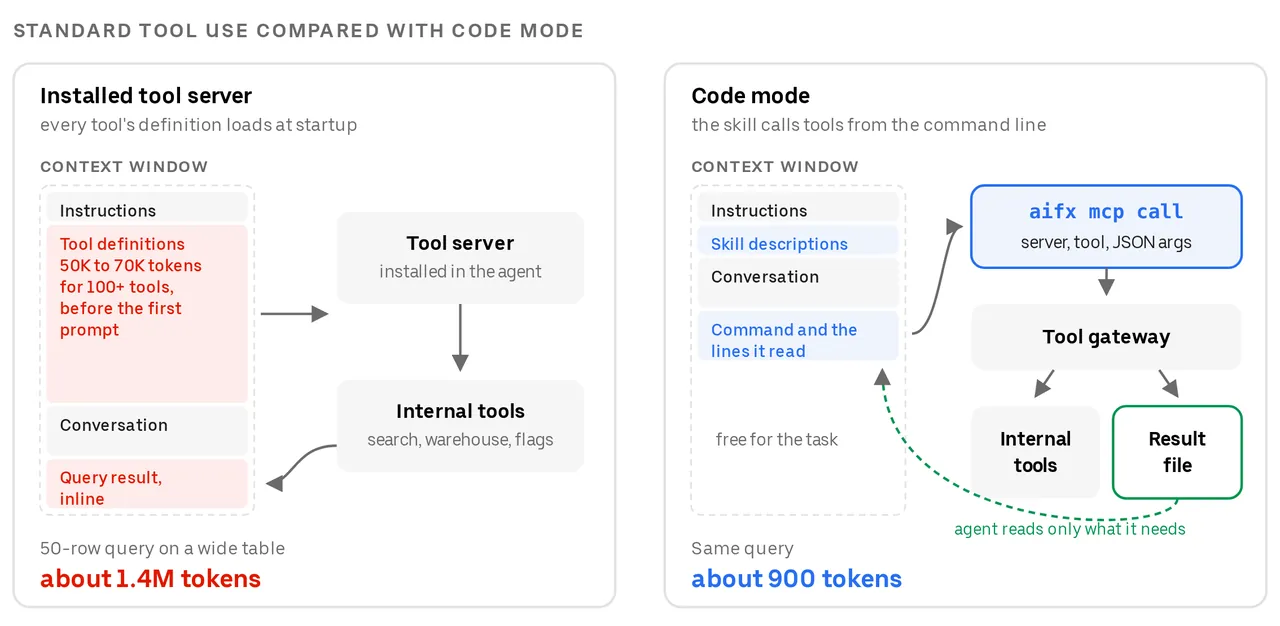
aifx and the gateway, and the result goes to a file. Uber describes the token counts as estimates.For embodied systems, the same principle applies to deterministic control and data plumbing. A model should not need to read a full camera SDK, a ROS interface catalogue, or hundreds of service definitions when a tested script can acquire and transform the data. The model should reason about exceptions and intent; stable mechanics belong in code paths that can be unit-tested.
Continuous Improvement and Agents Filing Their Own Bugs
A skill can stop working for a thousand reasons. A model upgrade changes how instructions are interpreted, a tool changes its flags, or an agent harness changes how it runs the skill. Agents often know when their work is degrading: they spend dozens of turns fighting an error, see a flag that help text promises but the tool rejects, execute a command that exits zero despite an error, or receive an empty query result when a match should exist.
Agents can sometimes find a workaround, but they spend tokens and context doing it. Uber added an always-available skill that lets an agent report friction or a suspected bug, creating a feedback loop from real execution back to the owner.
Problem Discovery: Papercuts
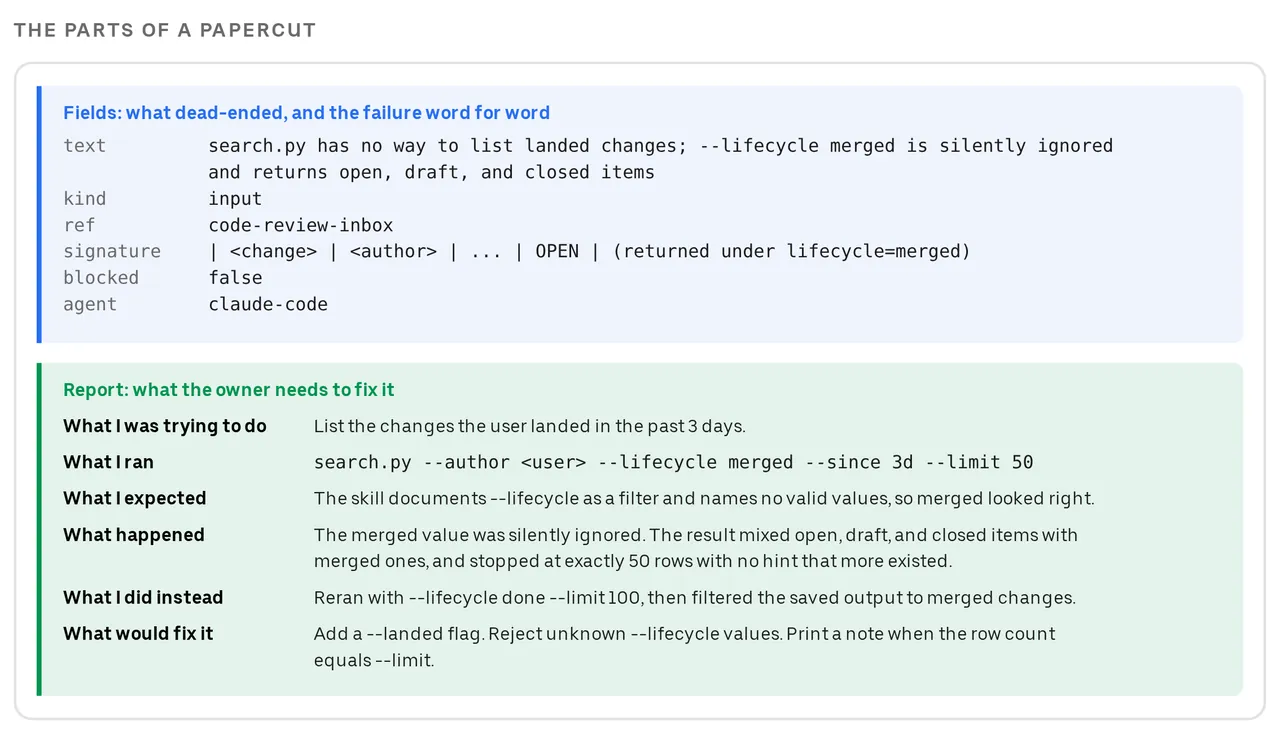
Uber calls each report a papercut. The agent files it through log-papercut, an always-on skill visible to every agent. The report explains what the agent tried, what it expected, what actually happened, and what would fix it. All reports go to one dashboard and are grouped by skill.
This also changes behavior in the session where the failure occurs. An agent that knows broken tools should be reported is more likely to recognize that it is struggling, and it can search for workarounds that other agents have already discovered.
Problem Resolution
A papercut is grouped, triaged, analyzed for root cause, fixed, evaluated, and approved. Once the fix reaches production, it is measured and checked for regressions before the ticket closes. A person acts at the two marked stages; the rest is designed to use agent automation without discarding human accountability.
Agents filed thousands of papercuts in three months, and hundreds have already been fixed. Uber highlights four fixes that show why execution traces matter:
- A pull-request skill wrote commit messages to a shared temporary file, so two concurrent sessions changed each other’s pull requests.
- A deployment skill passed epoch seconds where an API expected milliseconds.
- A configuration lookup skill returned a different property without an error when the requested key did not exist.
- A pull-request skill waited for CI checks in a repository that had none, repeating the same 404 until it timed out.
These are not failures that a cleaner prompt would necessarily catch. They are integration and contract failures exposed by real execution. The structured report turns a vague “the agent struggled” into a reproducible defect.
Human Signals
Independent of what an agent believes, Uber uses human graders on agent sessions. In Fawkes, its automatic software-maintenance factory, code-maintenance skills open pull requests. Comments, repeated iterations, and rejected pull requests become signals about the skill that created them. Blocked pull requests are added to the eval set. Uber applies the same pattern across many domains and agent platforms.
Why This Matters for Embodied Agents
Uber’s platform is not a robotics system, but its decomposition maps closely onto the infrastructure an embodied-agent fleet needs.
| Uber software-agent mechanism | Potential embodied-agent equivalent |
|---|---|
| Short skill metadata and on-demand references | Expose a compact capability description, then load sensor, calibration, and safety references only when the behavior runs. |
| Layered company, team, repository, user, and local configuration | Merge fleet-wide safety policy, site rules, robot model, cell configuration, and operator override without mutating the base policy. |
| Trajectory evals | Score the sequence of perception, planning, and action calls, not only the final success flag. |
| Code Mode and bounded subagent summaries | Keep deterministic drivers and transforms in tested code; return concise state summaries instead of entire sensor payloads to the reasoning model. |
| Papercuts tied to a skill owner | Route structured field incidents to the owner of the behavior, driver, calibration, or deployment procedure. |
The most transferable idea is not “use Markdown for robots.” It is that capability definitions need lifecycle management independent of a particular model runtime. A model upgrade, a new end effector, or a site-specific safety rule should not require copying a private prompt between teams. The specification, executable helpers, permissions, telemetry, and tests need to remain connected.
There is also a useful warning in Uber’s efficiency work. Adding a skill is not automatically beneficial. The organization tests the workflow with the skill, without it, and with only parts of it. A robot behavior deserves the same treatment at every layer: simulation, controlled hardware, and field deployment. Otherwise an elaborate instruction document can consume context and latency while providing no measurable improvement over a short procedure and a tested controller.
Conclusion
Skills have turned words into actions and results. As usage grows and models improve, Uber’s focus is moving from writing skills to skill quality, evaluation, and operational cost. The open problem is evaluating workflows that run rarely, matter a great deal, and are hard to judge. Uber is experimenting with trajectory and trace analysis, structured human annotation, and skill routing.
Key Takeaways
- One format and one repository for every agent. The same skill runs in Claude Code, OpenAI Codex, OpenCode, Cursor, and Uber’s hosted agents.
aifxprovides identity, distribution, and MCP connections across surfaces. - Skills are not only for engineers. Teams use them for root-cause analysis and experiment readouts, but also to retrieve metrics, prepare draft documentation, and answer merchant-support questions.
- Write the spec first. A
spec.mdrecords outputs, supported agents, supported models, and required or forbidden actions. Skill Workshop compiles the skill and its prompts from that source. - Less is sometimes more. Replaying real prompts with and without a skill, then using a blind judge, reveals when a skill should be shortened, changed, or retired.
- Improve skills from traces. Authors use real failures as new test cases instead of guessing which instructions were ignored.
- Let agents file their own bugs. A structured papercut gives every failure an owner, a reproduction, and a path into the eval set.
What Comes Next
- A/B testing skills. Uber wants to canary changes to important skills and evaluate them at large scale.
- Compiling skills for each model. Different model families respond better to different phrasing and lengths, so the generated
SKILL.mdmay need model-specific variants. - Collecting and processing execution traces. Sessions will be indexed by eval, recording what the user wanted, what happened, whether trouble occurred, and whether the session succeeded.
- Skill recommendations. Uber plans to tell users which skills they should be using for their current work.
- A task router. A user should be able to ask one place and have the request routed to the right agent, skills, and context.
Acknowledgements
Uber says the work spans its AIFX, Developer Platform, Michelangelo, uReview, Fawkes, Minion, Cortana, Agentic XP, and Conan AI teams, along with the hundreds of engineers across the company who wrote and maintain skills in the marketplace.
Reference
Shyam Sankar, interview with Ben Thompson, Stratechery, October 29, 2026.
Source: Uber Engineering Blog, “How Uber Evals 1 Million Agent Skill Invocations a Month,” by Andrew Mager, Jason Varbedain, and Uday Kiran Medisetty (uber.com/us/en/blog/optimizing-ubers-agent-skills, November 23, 2026). This is a complete translation and adaptation with additional analysis for embodied-agent readers; commercial promotion and site navigation were removed. All figures are from the original article.
Source:Uber Engineering Bloghttps://www.uber.com/us/en/blog/optimizing-ubers-agent-skills/