
What Anthropic's Forward Deployed Engineer Path Actually Teaches: From Model Judgment to a Measured Customer Pilot
Anthropic's 9.5-hour FDE path links model judgment, customer-repo implementation, reusable Skills and MCP, and delivery method into one evidence chain from baseline to a customer-owned pilot.
Anthropic's Forward Deployed Engineer path is less about learning a catalogue of Claude features than about learning how to turn an ambiguous customer problem into a pilot with a baseline, an agreed definition of success, and a first system that people can actually use.
That is the clearest signal in the public curriculum. The path is framed as a field role: "Take a customer from a first use case to a working pilot, on site." Its stated final capability is not to pass an API quiz. It is to write a customer pilot plan containing the baseline to measure against, the success measures agreed before building, the first shippable slice, and a plan for onboarding the first wave of users.
Anthropic lists about 9.5 hours of self-paced material across 11 numbered learning items. The sequence starts with model capability and AI collaboration, moves through the Claude Platform, Claude Code, Model Context Protocol, and Agent Skills, then ends with delivery methodology and enterprise adoption. Nine items overlap with the Claude Developer path. Someone who has completed that path has two remaining courses, about 100 minutes in total.
This article examines what that structure says about the forward deployed engineering role. It is not a course catalogue reordered into prose. The useful question is why Anthropic places judgment, implementation, packaging, and organizational change on the same path, and what that pattern means for teams deploying AI into physical systems.
The pilot plan is the real product
The four fields in the final artifact are deceptively ordinary. A baseline tells the team what the current process actually does. Pre-agreed success measures prevent a successful pilot from being redefined after the result arrives. The first shippable slice forces a choice about the smallest unit of value. The onboarding plan acknowledges that software which works but remains unused has not delivered a customer outcome.
Together, they turn scope negotiation into evidence design. The FDE has to ask what will be measured before the team knows whether the model will look good. That is harder than selecting a benchmark after a demo. It also aligns the customer, product team, and engineers around a claim that can survive an executive readout.
The path page makes the intended output explicit, but the same logic appears in the delivery course. Delivery Methodology describes the first 30 days as an engagement with an answer at the end, not merely a collection of positive impressions. Its artifact is a Delivery Plan Pack combining use-case qualification, pilot design, an ROI scorecard, and a champion plan.
This is where forward deployment differs from a general solutions-engineering demo. A demo proves that a capability can be shown. A pilot proves, under a defined operating boundary, that the capability changes a process or creates a measurable result. Those are different evidentiary standards.
Three layers, not a list of tools
The public path groups the work into three stages. The grouping matters because each stage produces a different kind of proof.
| Layer | Public learning items | What it establishes |
|---|---|---|
| Core judgment | AI Capabilities and Limitations; AI Fluency for Builders; Claude Platform and Model Foundations; Choosing the Right Claude Model | What AI can reliably do, how to choose a model and entry point, and how to delegate without giving up technical or professional judgment |
| Building in the customer's environment | Claude Platform 101; Claude Code 101; Claude Code in Action; Introduction to Model Context Protocol; Introduction to Agent Skills | How to implement against a real repository, connect outside systems, control long-running work, verify outputs, and package repeatable procedures |
| Delivering the pilot | Delivery Methodology; Driving Enterprise Adoption of Claude | How to qualify a use case, define a baseline and scorecard, manage adoption, enable champions, and move from activation toward scale |
The order is not arbitrary. Platform knowledge without delivery discipline produces technically interesting work that may not answer a customer's business question. Delivery discipline without implementation depth produces a project plan disconnected from model limits. Adoption advice without a working system becomes change-management theatre.
For an FDE, the path is a compression of all three. The role has to decide what the model can do, build enough of the system to test that claim, and create the conditions for the customer's team to own it.
Judgment comes before prompting
The first layer starts by making limits part of the product conversation. AI Capabilities and Limitations is described on the path as material for "the limits you'll be explaining to users from the first day of a pilot." That sentence captures a practical part of forward deployment: expectation management is not a late communication task. It shapes which use cases are credible from the beginning.
AI Fluency for Builders introduces the 4D Framework: delegation, description, discernment, and diligence. The public section summaries connect those ideas to concrete builder behavior, including deciding what to delegate, writing acceptance tests before implementation, evaluating generated code, and owning what happens after launch.
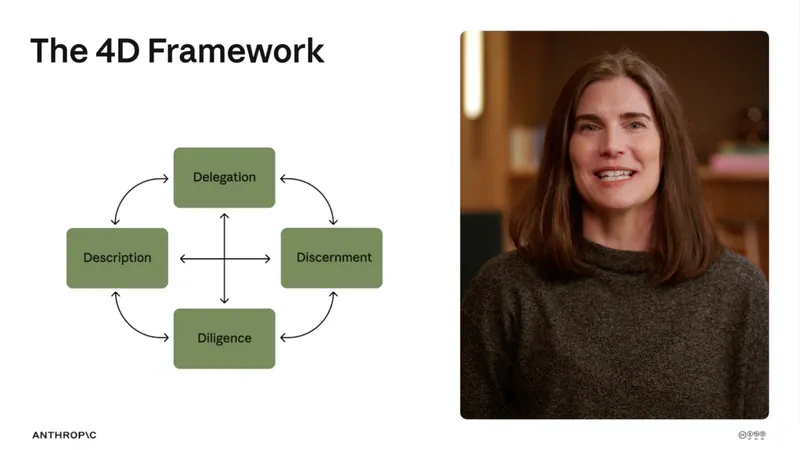
For forward deployment, Discernment and Diligence carry particular weight. A customer does not buy the generated artifact. The customer buys confidence that the artifact fits the workflow, survives exceptions, and can be maintained. The course's emphasis on reviewing AI-generated code across several lenses and making a ship, fix, or stop decision points toward that operational standard.
Claude Platform and Model Foundations moves one level earlier in the stack. Its four decisions are entry point, capability features, model, and context. The course frames these as setting the quality ceiling before a prompt is written. A team that chooses the wrong integration surface, context strategy, or quality-speed tradeoff cannot repair the entire decision with clever wording later.
This is useful discipline for customer work. The question is not "Which prompt performs best in a chat window?" It is "Which combination of interface, model, context, permissions, and surrounding application produces a dependable result for this user?"
Build in the customer's repository, not beside it
The building layer repeatedly returns to the customer's real environment. Claude Code 101 describes its role as "the tool you prototype with in the customer's repository." Claude Code in Action extends this to long-running, hands-off sessions controlled with permission modes, hooks, and verification.
The distinction is important. A prototype built in an isolated sandbox can avoid messy authentication, legacy conventions, weak tests, and undocumented system behavior. The customer's repository cannot. Working there reveals whether the agent can gather relevant context, make a change, and verify the result inside the same constraints the customer's engineers face.
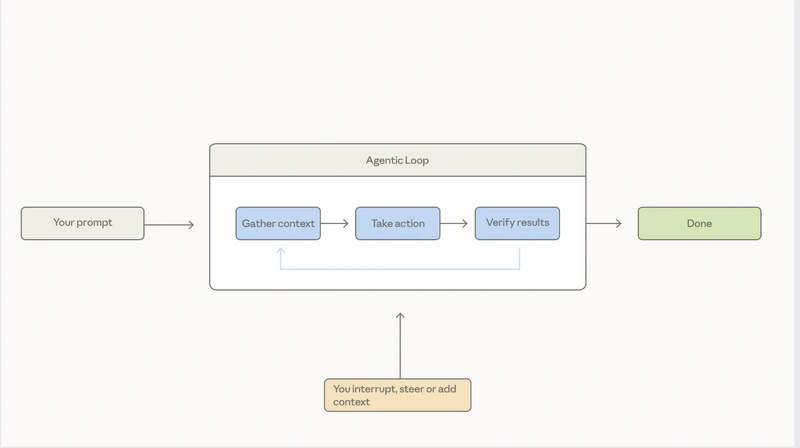
Claude Platform 101 broadens the same pattern from a coding agent to an application. Its public curriculum covers API requests, model choice, tool use, extended thinking, context management, managed agents, and cost and latency tradeoffs. Each lesson is intended to end in runnable code. The path is therefore not separating strategy from engineering. It is teaching a feedback loop in which implementation produces evidence for the next decision.
MCP adds a standard way to connect Claude to external tools and data. The public course builds servers and clients from scratch using Python and covers three primitives: tools, resources, and prompts. Agent Skills then addresses reuse: package a procedure once, make it trigger on the right task, constrain its tools, and distribute it to a team or organization.
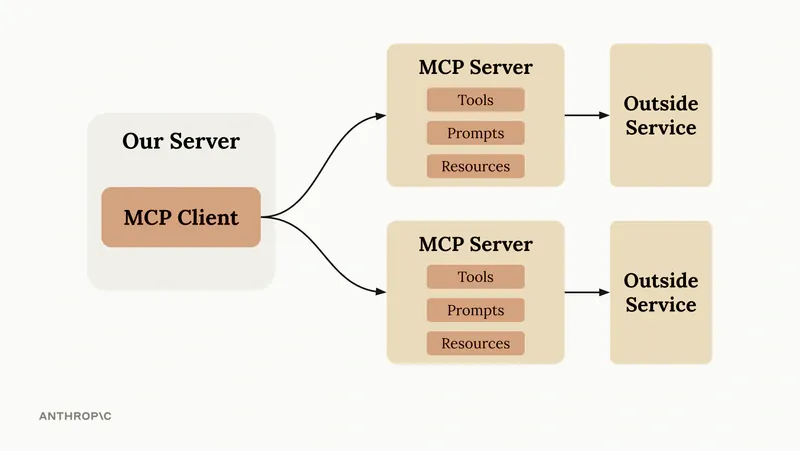
These two courses serve different forms of leverage. MCP makes an integration extensible. Skills make a working procedure repeatable. Neither is useful on its own if the first deployment is a pile of customer-specific prompts and connectors that only its author understands.
The architectural instinct an FDE should take from this layer is simple: solve the customer problem, but look for the boundary that can become a shared primitive. The first deployment may require custom work. The second should require less of the same work.
The delivery layer separates an impressive test from a useful pilot
Delivery Methodology makes a distinction that is especially relevant to enterprise AI: marginal gain versus structural gain. Marginal gain means the same work runs faster. Structural gain means the unit of work changes.
| Gain type | Anthropic's public description | Why it matters in a 30-day pilot |
|---|---|---|
| Marginal gain | The same work runs faster. The productivity change can be real, but it is hard to anchor a CIO-level business case to within 30 days. | Useful for adoption and local team value, but may require a longer measurement window or a very stable baseline |
| Structural gain | The unit of work changes. A task that required four people for six weeks might require two people for two weeks. | Creates a result that is measurable before Day 30 and easier to defend in an executive readout |
The course combines that distinction with four use-case qualification criteria: volume, complexity, measurability, and developer readiness. It then asks for a baseline before Day 1, a pilot cohort and scope, success criteria that can produce an answer at Day 30, a phased rollout plan, and a champion enablement plan. The customer's internal documentation and project instructions are treated as deployment infrastructure, not as optional cleanup.
The detail is operationally coherent. A high-volume use case may matter, but if the workflow cannot be measured, the team cannot prove improvement. A highly complex use case may create a stronger demo, but if the customer's developers cannot maintain the result, the deployment is fragile. Qualification is therefore not a sales checklist. It is a feasibility test for evidence.
The path-level time estimate is also worth reading carefully. It says about 9.5 hours in total. The Delivery Methodology page separately lists 1 hour 13 minutes of measured Skilljar time plus an estimated 1 hour 10 minutes for practice and building the artifact. Durations across a learning catalogue can mix video time, practice, and course completion time. Treat 9.5 hours as a planning estimate, not a precise accounting identity.
Adoption is a second system around the pilot
Driving Enterprise Adoption of Claude extends the view beyond the first successful workflow. Its public three-phase framework is Activation, Acceleration, and Expansion. Activation establishes technical foundations and organizational readiness. Acceleration scales impact through governance and Centers of Excellence. Expansion applies earlier success to more advanced capabilities and transformational use cases.
The course also introduces the productivity J-curve, leader-led articulation of the adoption rationale, psychological safety for experimentation, champion programs, train-the-trainer enablement, and systematic sharing of wins. Those topics can sound softer than API design, but they describe a real failure mode. A pilot can end with a working system and no durable operating environment around it.
An FDE should therefore treat adoption as part of the architecture. Who owns the integration after handoff? Which internal expert can update the instructions or connector when the workflow changes? Where will failures be reported? Which team is allowed to expand access? How will the customer measure whether the change is spreading or stalling?
A pilot that depends permanently on the external deployment engineer has not produced structural gain. It has created a new dependency.
What this says about the job
The public path describes a role with several forms of translation. The FDE translates a customer's messy process into a testable use case, a model decision into an application boundary, and a working prototype into reusable instructions and integrations. The final translation is from a successful engagement into an adoption process the customer can sustain.
That requires enough model knowledge to recognize a capability gap, enough engineering skill to distinguish a bad prompt from a bad system design, and enough customer judgment to know whether the measured improvement matters. The role is neither a pure forward sales engineer nor an isolated research engineer. It sits where product evidence is created.
The limitation is equally important: this is a Claude deployment path, not a general certification in enterprise transformation. Its evidence is a public syllabus and selected course previews. The exercises, private lesson detail, participant outcomes, and independent effectiveness of the curriculum are not exposed on these pages. The structure is informative; it is not a controlled study of FDE performance.
RobotWorld analysis: translating the model to physical AI
The rest of this section is RobotWorld's analysis, not a claim from Anthropic. Anthropic's public examples are software-centric, while robotics adds hardware, safety, latency, maintenance, and an environment that cannot be fully represented by a repository. The deployment discipline still transfers, but the evidence has to be stronger.
A physical-AI pilot should start with the operational outcome, not the policy architecture. If the stated goal is "use a VLA model in the work cell," the team has not defined a customer result. A better starting point is a bounded change such as reducing manual exception handling at one station, increasing first-pass completion for a family of parts, or shortening changeover time for a known set of tasks.
The baseline then needs to capture the current physical process. Useful measures include cycle time, first-pass success, intervention rate per 100 cycles, recovery success after an exception, safety events and near misses, uptime, changeover time, operator workload, and cost per completed unit. Not every pilot needs all of them, but the team should choose the ones that make the customer's claim falsifiable.
| Pilot decision | Weak framing | Evidence-oriented framing |
|---|---|---|
| Scope | Deploy the robot policy across the site | One station, one shift, a bounded object family, explicit exception rules, and a named fallback operator path |
| Success | The demonstrations look smoother | Agreed thresholds for cycle time, first-pass success, interventions, recovery, uptime, and safety observations against a frozen baseline |
| Integration | The model can already see the object | Calibration, coordinate transforms, latency budget, controller interface, telemetry, and exception recovery tested end to end |
| Reuse | Keep the deployment engineer available forever | Task specs, adapters, replay data, evaluation suites, safety gates, and operator onboarding owned by the customer team |
The structural-versus-marginal distinction is useful here too. A robot that executes the same motions faster is a marginal gain. A robot system that allows a smaller team to commission a new product variant, retrain an exception, or recover a line without a specialist changes the unit of work. The second kind of result is more likely to justify a capital project and a larger rollout.
flowchart LR
    A[Customer outcome] --> B[Capture physical baseline]
    B --> C[Agree success measures]
    C --> D[Choose first shippable slice]
    D --> E[Integrate, instrument, and evaluate]
    E --> F{Gap type}
    F -->|Integration or workflow| G[Fix adapters, recovery, UX, and telemetry]
    F -->|Model or policy capability| H[Collect targeted episodes and improve evaluation]
    G --> I[30-day pilot readout]
    H --> I
    I --> J[Customer-owned onboarding and next workload]
The most valuable diagnostic is the gap-type branch. If a pick fails because the camera-to-robot transform drifted, more training data will not solve the integration problem. If every policy attempt fails on transparent objects that the perception stack can see clearly, the bottleneck may be manipulation rather than sensing. If cycle time is lost while the model waits for a remote planning service, the answer may be systems engineering rather than a larger model. A useful FDE keeps these explanations separate long enough to test them.
The reusable layer is also different from a software repository. For physical AI it may include task specifications, robot and PLC adapters, a standard telemetry schema, simulation scenarios derived from field failures, replayable episodes, safety permission gates, recovery skills, and an evaluation protocol for each work cell. MCP-style interfaces can expose customer systems; Skills-style packages can preserve procedures. But safety and deterministic control still need hard boundaries that do not depend on a model choosing to comply.
The first shippable slice should therefore be narrow without being artificial. One station, one shift, and one product family can produce credible evidence if the baseline is real and the exceptions are representative. A site-wide demonstration with hidden manual intervention does not. The point of the pilot is not to make the robot look autonomous. It is to learn which parts of the work can be delegated, which parts need supervision, and which parts need a deterministic recovery path.
A short reading guide
For a team using this path as preparation, the first pass should be structured around the pilot plan rather than around completion badges. Before starting, choose a real customer use case and write a one-page baseline, proposed success measures, first slice, and user-onboarding hypothesis. Then revise it after each layer. The model and platform courses expose missing technical assumptions. Claude Code and MCP expose integration work. Skills expose what should be packaged. Delivery Methodology exposes whether the evidence can survive a business review.
Developers who already completed the Claude Developer path can focus on Delivery Methodology and Driving Enterprise Adoption, about 100 minutes by the path's estimate. The broader 9.5-hour sequence matters most for someone who needs the complete translation from capability judgment to customer delivery.
After the path, Anthropic points toward Claude Certified Developer - Foundations, with about 13 hours of preparation described on the page. It notes that the certification counts toward partner tier. That progression reinforces the intended role: first prove the ability to turn a Claude capability into a working customer pilot, then deepen the production engineering or architecture specialization.
The lesson worth carrying into robotics
The strongest idea in the curriculum is not that an FDE should be able to prompt, code, and present. It is that those skills should converge on a shared evidence chain. The choice of model affects the application boundary. The application boundary affects what can be integrated and observed. The observations affect whether the pilot succeeded. The adoption plan determines whether the evidence changes how the customer works.
For physical AI, that chain must also include the robot, the environment, the operator, and the safety case. The curriculum does not supply those pieces. It does supply a useful discipline for organizing them: agree on the baseline before building, ship a narrow first slice, keep the human steering path visible, package what works, and design the handoff before declaring the pilot complete.
The test of a forward deployed engineer is ultimately whether the customer can continue without the same heroic effort next time. That is true for a software workflow, and it is even more important for a robot deployment.
Source: Anthropic, "Claude Forward Deployed Engineer" learning path, and its public course pages (anthropic-partners.skilljar.com/path/claude-fde), accessed November 20, 2026. This bilingual article analyses the public curriculum and selected course previews; it does not reproduce private lesson content. The physical-AI translation is RobotWorld's explicitly labeled analysis. Public course images remain the property of Anthropic.
Source:Anthropichttps://anthropic-partners.skilljar.com/path/claude-fde