Skip to content
Tags

#diffusion (4)

RoboGesture: Real-Time Semantic-aligned Co-Speech Gestures Generation for Humanoid Interaction

RoboGesture: Real-Time Semantic-aligned Co-Speech Gestures Generation for Humanoid Interaction

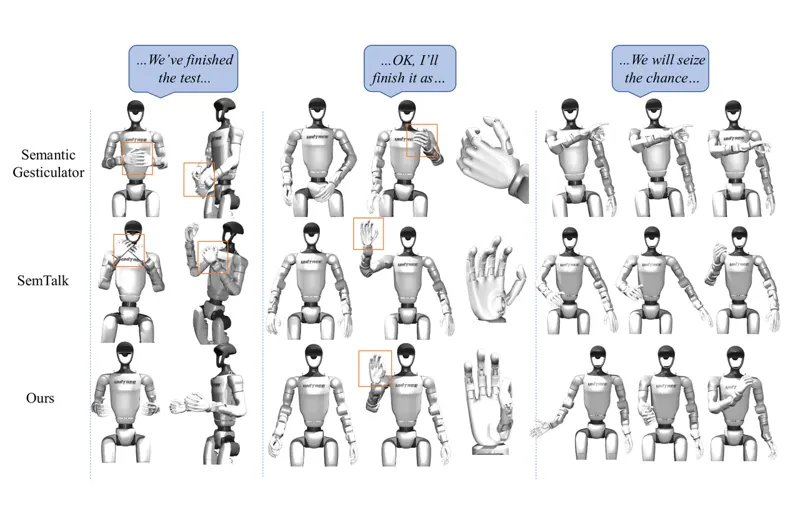
Enabling humanoid robots to respond to human speech with synchronized and semantically meaningful gestures is fundamental to natural human-robot interaction. However, this task faces three critical barriers: the scarcity of semantically rich datasets, the "modality eclipse" where models ignore audio cues in favor of kinematic inertia, and the sim-to-real gap regarding physical safety. We propose RoboGesture, a robot-centric framework that co-designs data, modeling, and control to power a complete interactive human-humanoid system in which the robot listens, responds, and gestures in real time. We first establish the RoboGesture dataset featuring over 300 gesture categories and develop an automated pipeline to synthesize large-scale collision-free, robot-specific audio-motion pairs. Our architecture features a Hierarchical Semantic-Acoustic Aligner that extracts multi-granular prosodic and semantic cues directly from raw audio tokens. These cues drive a Streaming Conditional Motion Generator based on a diffusion transformer with conditional flow matching. To ensure high responsiveness, we introduce Anti-Inertia CFG Masking, which prevents the model from collapsing into repetitive historical patterns by compelling it to proactively mine control signals from the audio modality. Finally, an MPC-based safety filter ensures real-time, collision-free execution on physical hardware. Experiments on a Unitree G1 humanoid demonstrate that RoboGesture generates safer, more rhythmic, and more semantically appropriate responses compared to state-of-the-art baselines.
Wang, Zifan, Ren, Ziang, Shi, PengyangAug 27, 2026
MPCSim-to-RealUnitreeAug 27, 2026
πR²: Reactive Real-time Flow Policies

πR²: Reactive Real-time Flow Policies

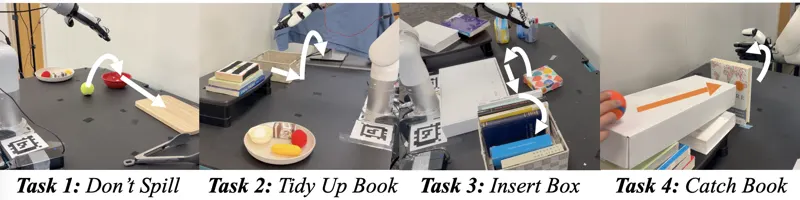
Generalist manipulation policies increasingly take the form of action-chunking flow policies built on large pretrained backbones. Such chunks run open-loop, so the policy cannot react to sensory input arriving mid-execution, sacrificing reactivity. Replanning more often would restore it, but the perception-to-action pipeline (a large backbone plus multiple denoising steps) is too slow: this latency forbids frequent replanning and leaves committed actions stale, making such policies ill-suited for dynamic, closed-loop control. We present πR², which makes these policies reactive and real-time while retaining large backbones, expressive multi-modal policies, and multi-action prediction. Built on the per-position noise schedule of diffusion forcing, πR² contributes two ideas. First, it splits conditioning into a fast channel (proprioception, fresh every tick) and an asynchronously updated slow channel (vision-language features), so the policy reacts to proprioception within a chunk while tolerating stale vision. Second, a latency-adaptive flow schedule treats in-flight actions as inpainting conditioning and emits actions in one denoising step per call, letting one trained model adapt to varying hardware latency. Requiring minimal modification to existing architectures, πR² can be finetuned from a pretrained policy: applied to GR00T-N1.7 on a real xArm6+XHand platform, it replans closed-loop roughly 4× faster than the base policy (~$25$Hz on an A5000 GPU), acting on a fresh observation every $40$ms. Across simulation and real-world manipulation tasks, πR² improves the success rate by up to 23% in simulation and 30% in the real world over the strongest baseline. Project page: https://pi-r2-flow.github.io/

Sungjae Park, Shubham TulsianiJul 28, 2026
VLAreactivediffusionJul 28, 2026