Skip to content
← Tags

#Visual-Language-Action Model (4)

Juno: Taming Predictive Latents for Vision-Language-Action Models

Juno: Taming Predictive Latents for Vision-Language-Action Models

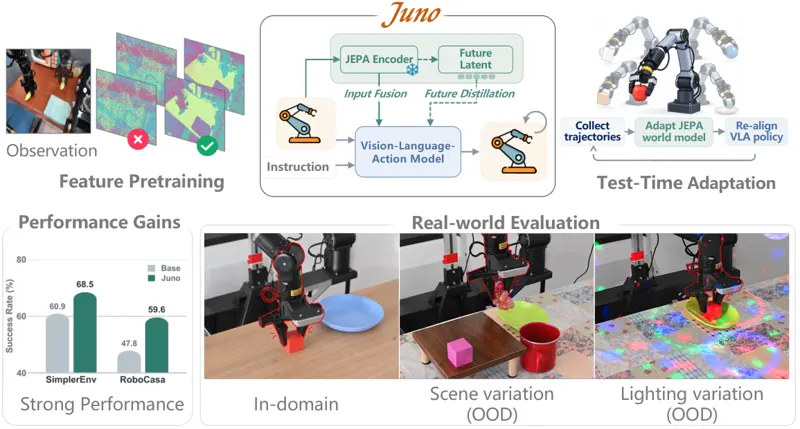
Joint-embedding predictive architectures (JEPAs) predict masked or future observations in representation space, offering a natural source of predictive latents for vision-language-action (VLA) models. Yet making these latents useful across pretraining, policy learning, and deployment requires addressing three failures: mismatch with embodiment-specific control, interference with action learning, and teacher miscalibration under distribution shifts. We introduce Juno, a unified framework built around one action-conditioned JEPA that serves as a control-aligned representation backbone, a predictive teacher, and an adaptable dynamics model. During pretraining, we train it on embodiment-matched trajectories and use a dynamic CLS loss to transfer motion-weighted patch dynamics to a compact global state. During policy learning, we fuse current-frame JEPA patches into VLA perception and use a decoupled reasoning branch with separate transformation parameters to distill future latent states for action generation. During deployment, we adapt the world model on all observed transitions, including failed rollouts, freeze the adapted teacher, and re-align the policy on verified executions using LoRA adapters and a trainable action head, without expert corrections or task rewards. On SimplerEnv, Juno raises average success from 60.9% to 68.5% over Qwen3GR00T, the strongest baseline, and test-time adaptation further reaches 72.7%; on a real robot, it retains 70%–75% success under background, height, and object shifts where the base policy collapses to 0%.
Yuchen Zhu, Chenyi Xu, Yulin Zhang · 219 views · Oct 7, 2026
Vision-language-action (VLA)World Models
Oct 7, 2026
IMLE-VLA: Fast Single-Step Action Generation for Vision-Language-Action Policies

IMLE-VLA: Fast Single-Step Action Generation for Vision-Language-Action Policies

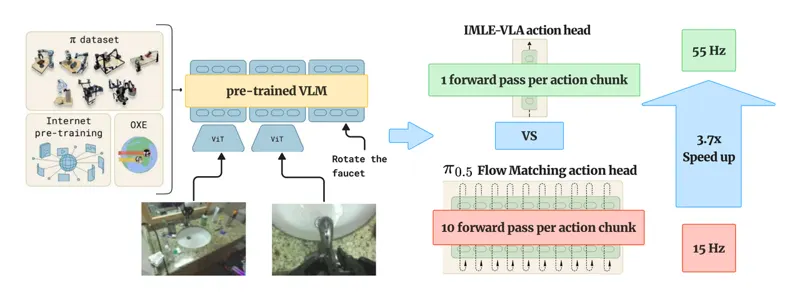
Vision-language-action (VLA) policies leverage pretrained vision-language backbones to achieve strong cross-task generalization. A leading design couples this backbone with a dedicated continuous action head trained via diffusion or flow matching. However, such heads rely on iterative multi-step sampling, for example 10 Euler steps in π_0.5. This creates an inference bottleneck that produces stop-and-go movement in the robot and slower task completion. We introduce IMLE-VLA, which replaces the iterative action head with a single-step conditional generator trained via conditional Implicit Maximum Likelihood Estimation (cIMLE). The cIMLE objective promotes multimodal action coverage, avoiding the mode collapse of naive regression heads while eliminating multi-step sampling entirely. When IMLE-VLA is applied to π_0.5, it increases inference frequency 3.67x (55 Hz vs. 15 Hz), enabling up to 11x higher action throughput. On the 40-task LIBERO benchmark, IMLE-VLA achieves the highest average success rate (98.0%) among all baselines while leading in inference frequency. Under the test-time perturbations of LIBERO-plus, IMLE-VLA retains π_0.5's robustness while other baselines degrade sharply, confirming that the cIMLE head preserves generalization. Real-world experiments on a Franka Emika Panda across four tasks demonstrate smoother motion (2.2x to 3.0x lower jerk) and faster task completion, with IMLE-VLA outperforming π_0.5 on every task and reducing average VLA inference time per episode by 3.9x to 6.6x. Videos and code are available at https://kianhk6.github.io/IMLE-VLA/

Hosseinkhani, Kian, Peng, Qinhe, Shramko, George · 1k views · Sep 10, 2026
VLAEfficient Inference
Sep 10, 2026
A4A: Cross-Embodiment Transfer of Action-Oriented 4D Affordances from Human Demonstrations

A4A: Cross-Embodiment Transfer of Action-Oriented 4D Affordances from Human Demonstrations

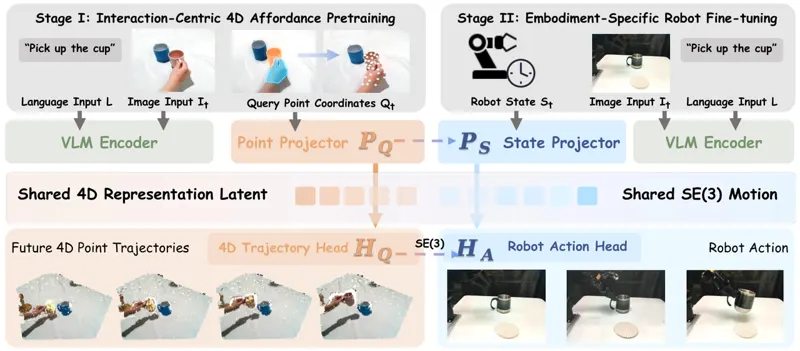
Human demonstrations contain rich manipulation knowledge, but it remains unclear what information can be transferred effectively to robot control. Existing affordance representations are typically formulated as 2D masks, 3D regions, contact points, or actionability scores, and therefore primarily identify where interaction may occur. However, effective manipulation also requires modeling how interaction-relevant geometry evolves during task execution. To bridge this gap, we introduce action-oriented 4D affordances, which represent the language-conditioned future trajectories of interaction-relevant 3D points. These trajectories capture task-conditioned geometric evolution rather than embodiment-specific actions, enabling transferable interaction priors across humans and robots. Based on this representation, we construct a large-scale action-oriented 4D affordance dataset from existing human–object interaction video data and complementary RGB-D demonstrations, and introduce A4A, an affordance-to-action framework that uses 4D affordance trajectory prediction to pretrain robot policies before manipulation fine-tuning. Experiments in both simulation and the real world validate the effectiveness of A4A, showing that pretraining with action-oriented 4D affordance data consistently improves the manipulation performance of diverse VLA policies. These results establish action-oriented 4D affordances as an effective cross-embodiment representation for transferring manipulation knowledge from human demonstrations to robot control.

Yifan Han, Litao Liu, Yuqi Gu · 913 views · Sep 5, 2026
VLAAffordance
Sep 5, 2026

As an Amazon Associate, we earn from qualifying purchases.