Skip to content
← Tags

#UC Berkeley (8)

Agentic World Action Models

Agentic World Action Models

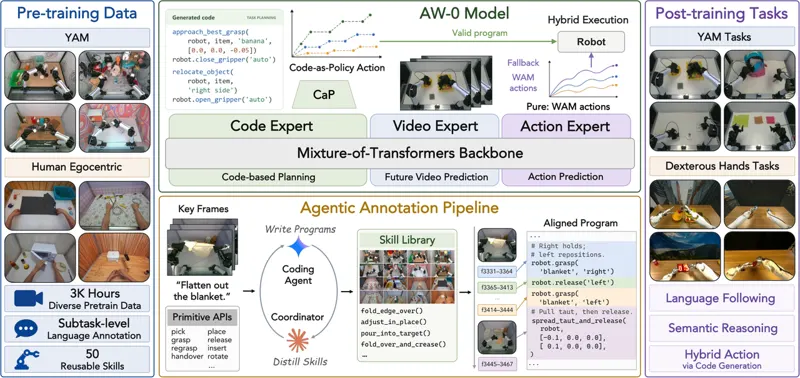
Recent world action models provide visual foresight and future prediction for robot manipulation, but lack explicit mechanisms for compositional skill reuse. Agentic robotics combines code-based planning and reasoning with reusable skills, but often lacks predictive grounding in physical dynamics. We introduce AW-0, an agentic world action model framework that integrates code-based planning with joint video and action prediction. We jointly model code, future video, and robot actions as three coupled generative streams within a unified mixture-of-transformers architecture. Within this architecture a code expert generates parameterized skill routines and control logic while video and action experts generate future visual states and low-level motor commands. Code serves two complementary roles: it structures multi-step prediction and control within the world model and represents skills as reusable programs for subsequent agentic execution. We further introduce an automated curation pipeline that labels robot and human video trajectories with aligned programs and consolidates recurring routines into reusable skill libraries. Evaluations on RoboTwin 2.0 and physical bimanual manipulation tasks show improved task performance over VLA and WAM baselines, alongside gains in language following, semantic reasoning and robustness, demonstrating that agentic code enables connection between planning, prediction and execution within WAMs.
Liu, Zhuoyang, Niu, Dantong, Zhang, Botong · 288 views · Oct 21, 2026
World-action modelsVision-language-action (VLA)
Oct 21, 2026
TANGO: Humanoid Navigation in Cluttered Environments with a Whole-Body Vision-Language-Action Model

TANGO: Humanoid Navigation in Cluttered Environments with a Whole-Body Vision-Language-Action Model

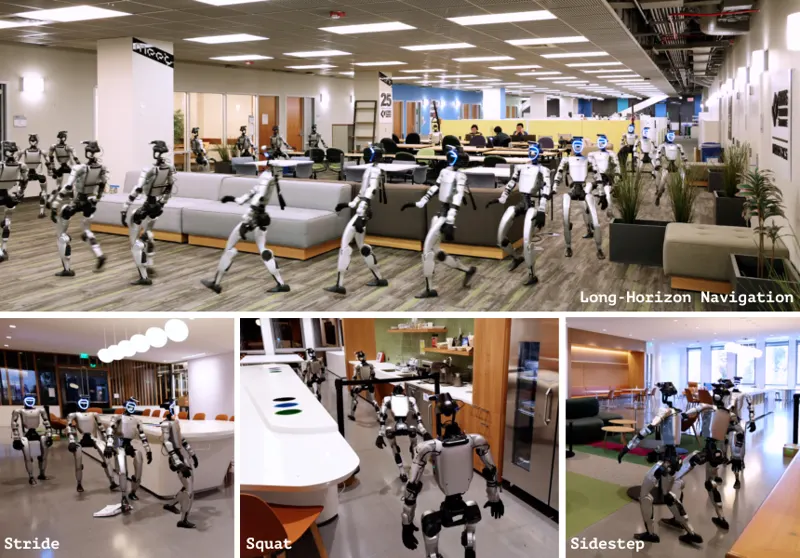
We study the problem of navigating cluttered indoor environments with a humanoid robot. Unlike conventional methods that model navigation as a 2D path planning problem, humanoid traversal in cluttered environments requires continuous geometry-aware whole-body adaptation, including coordinated arm placement, torso adjustment, and gait modulation for collision-free movement through complex 3D spaces. We introduce TANGO, the first whole-body vision-language navigation framework for language-conditioned humanoid traversal in cluttered environments. Given a natural-language instruction and egocentric RGB observations, TANGO directly predicts 29-DoF joint-space actions for downstream whole-body control. We train TANGO entirely in simulation by synthesizing diverse collision-free traversal behaviors via global path planning, kinematic whole-body motion generation, obstacle-aware motion editing, and RL-based tracking. This pipeline provides dynamically feasible action supervision for learning language-conditioned whole-body policies. In extensive simulation experiments, TANGO demonstrates state-of-the-art performance in vision-language navigation, while outperforming strong modular baselines in navigating challenging scenes requiring obstacle negotiation. Lastly, we deploy TANGO zero-shot on a Unitree G1 humanoid robot, and observe robust language-guided traversal in cluttered real-world scenes without training on any real-world navigation data.

Anqi Li, Yuxin Chen, Zhaobo Li · 1.1k views · Sep 8, 2026
HumanoidVLA
Sep 8, 2026

As an Amazon Associate, we earn from qualifying purchases.