CosFly-VLA: A Spatially Aware Vision-Language-Action Model for UAV Tracking
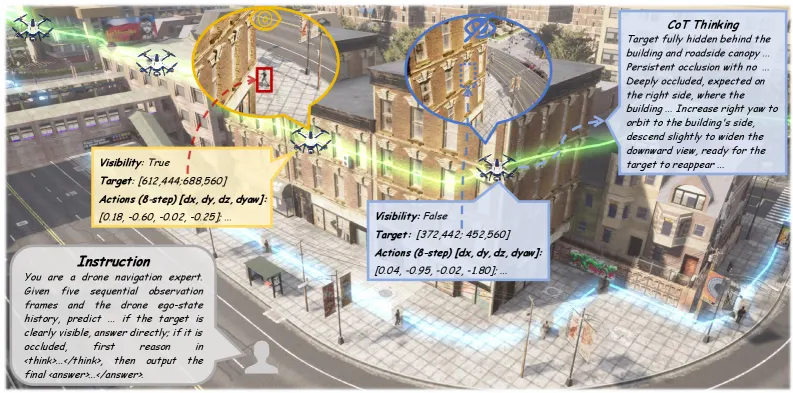
Dynamic target tracking is essential for Unmanned Aerial Vehicles (UAVs) operating in complex urban environments, where both the target and the camera viewpoint change continuously. Existing Vision-Language-Action (VLA) policies can track visible targets effectively, but their performance often degrades when buildings, vegetation, or roadside objects block the line of sight. During sustained occlusion, a policy may lose the target state, execute actions toward an incorrect region, and amplify this error through subsequent observations until re-acquisition becomes impossible. To this end, we present CosFly-VLA, a spatially aware VLA model that jointly grounds the target, estimates its visibility, and generates continuous flight actions through a structured prediction interface. To train this policy, we use a large-scale recipe over diverse data sources. Spatially Grounded Continued Pretraining (CPT) on a 500k mixed pool injects UAV-view depth, distance, and 3-D spatial reasoning. A three-stage Curriculum-based Supervised Fine-Tuning (SFT) process then specializes the tracker through multi-head warm-up followed by two-stage curriculum learning over natural and hard / long-occlusion data. Chain-of-Thought (CoT) training subsequently teaches recovery-oriented reasoning traces before structured answers. Finally, a closed-loop Reinforcement Learning (RL) stage optimizes tracking behavior with a multi-component reward covering stand-off tracking, grounding quality, collision avoidance, and task success. Relative to OpenVLA, CosFly-VLA-0.8B reduces open-loop Average Displacement Error (ADE) by 34.1% on seen-test and 35.3% on unseen-test. Closed-loop optimization improves Success Rate (SR) by 29.8% and 2.5%, respectively. These results demonstrate progress from visible-frame imitation toward spatially grounded action-closed-loop control, evaluated under a shared oracle state history.
Ruilong Ren, Songsheng Cheng, Yunpeng Zhou·Jul 16, 2026
UAVVLATrackingJul 16, 2026
 0:33
0:33