Skip to content
← Tags

#Tool Invocation (5)

OpenVLHarness: Real World Visual Agentic Tool-Use with Multimodal Memory

OpenVLHarness: Real World Visual Agentic Tool-Use with Multimodal Memory

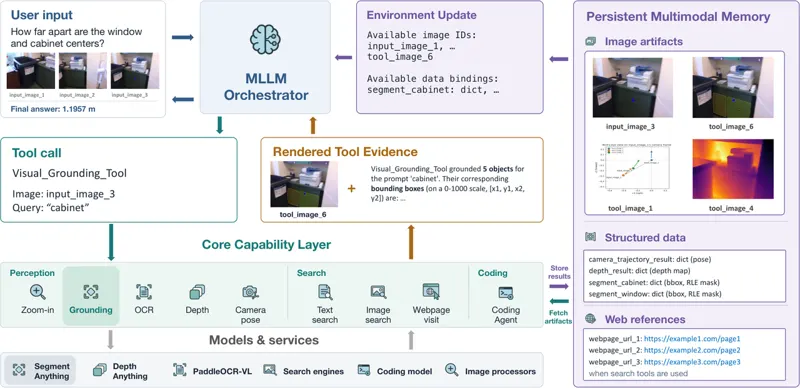
Multimodal large language models (MLLMs) have made rapid progress on visual reasoning, yet many tasks require evidence that is difficult to obtain through internal reasoning alone: our controlled study on 22 benchmarks shows that simply increasing the inference budget of the base model yields only modest gains. Such tasks demand grounded perception, external knowledge, and numerical measurements obtained through heterogeneous tools, whose outputs must be made interpretable to the model and retained across reasoning steps. We introduce OpenVLHarness, a multimodal reasoning harness organized around a capability layer and persistent multimodal memory. The capability layer combines task-level tool interfaces with evidence rendering, providing consistent access to heterogeneous backends and converting their outputs into model-readable observations. Persistent multimodal memory retains the corresponding images, structured data, and web references as addressable artifacts throughout each query. A coding interface executes generated programs over stored data, enabling computations that combine results from multiple tools. Together, these mechanisms support an iterative process of acquiring, inspecting, and composing multimodal evidence. Evaluated on 22 benchmarks with eight open and proprietary backbones, OpenVLHarness improves average scores by 9.7-12.6 points over matched no-tool baselines, including +11.2 with Qwen3-VL-8B, +9.7 with Kimi K3, and +9.9 with GPT-6 Astra. With GPT-6 Luna at medium reasoning effort, OpenVLHarness outperforms the base model, Codex, and Visual Sketchpad at maximum effort by 7.7-8.5 points while incurring at most 37% of their model-token cost.

Yu Zhou, Cheng-Fu Yang, Rui Sun · 464 views · Oct 19, 2026
Multimodal ReasoningTool Use
Oct 19, 2026
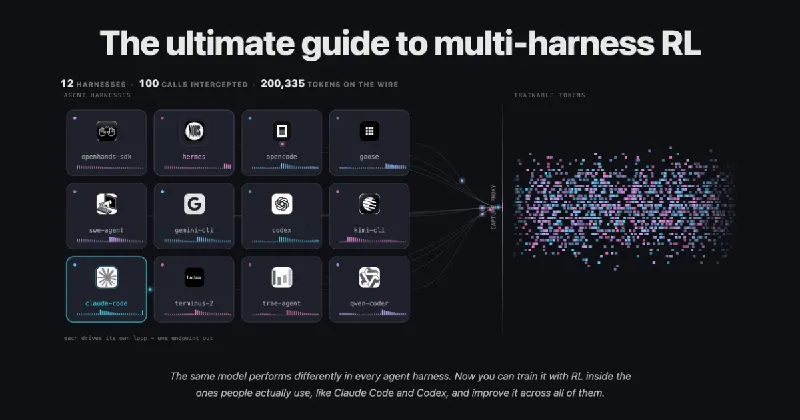
The ultimate guide to multi-harness RL: train models inside Claude Code and Codex — Hugging Face's four-harness experiment with a 2.6B model

The ultimate guide to multi-harness RL: train models inside Claude Code and Codex — Hugging Face's four-harness experiment with a 2.6B model

The same model behaves like two different models depending on the agent harness around it: GLM-5.2 scores 23% in one harness and 52% in another on SWE-bench Pro; in a controlled experiment swapping the harness moved scores 13 points while swapping the model moved only 2.5–5. A Hugging Face team (Adithya S Kolavi, Joel Niklaus, Lewis Tunstall, Leandro von Werra and colleagues, with Liquid AI) publishes an open fix: run agentic RL inside the real harnesses — Claude Code, Codex, OpenCode, Mini-SWE-Agent — with zero harness code changes. The stack: OpenEnv as the shared interface, a capture proxy that mints a session id per rollout and records exact token ids, per-token behavior logprobs and loss masks at the model endpoint (full-distribution sampling, top_p=1.0), Harbor for 40+ harness adapters and 26 sandbox backends, and TRL's Async GRPO consuming the masked training sequences. The numbers: LFM2.5-2.6B trained across four harnesses rises from 42.2% to 54.2% average pass@1 with gains under all four, and uses 31% fewer tool calls on tasks both it and the base model solved, while the OpenCode-only arm's gains stay mostly at home. The article also reports the SFT comparison (RL 54.6% vs SFT 47.5%), the full attribution of the earlier Qwen rise-and-decline (output-budget exhaustion, working without submitting, and a reward term that collapsed held-out accuracy from 0.740 to 0.178), and engineering boundaries like the proxy's concurrency ceiling.

BLOG

Reinforcement LearningRL

As an Amazon Associate, we earn from qualifying purchases.