Skip to content
Tags

#Terrain perception (4)

DELTA: Deformable Elevation-Based Local Terrain Attention Encoder for Sparse-Terrain Quadrupedal Locomotion

DELTA: Deformable Elevation-Based Local Terrain Attention Encoder for Sparse-Terrain Quadrupedal Locomotion

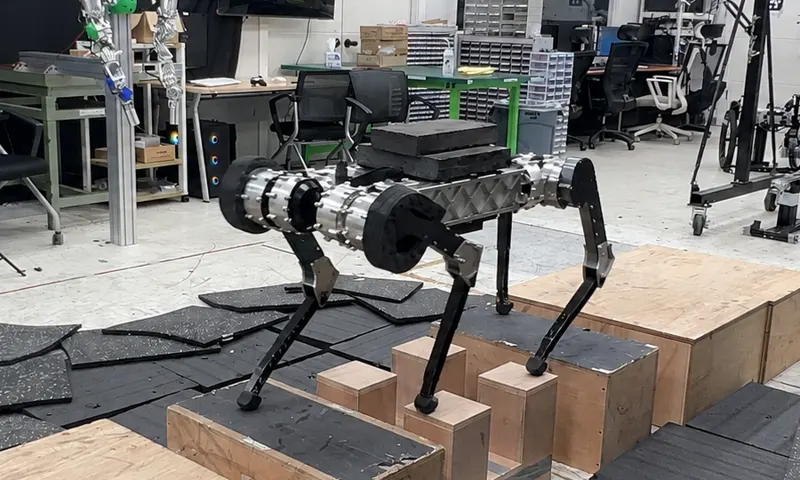
Stable quadrupedal locomotion on sparse terrain requires selecting state-relevant terrain evidence for precise foot placement. Model-based foothold planners provide precise foothold selection but rely heavily on explicit model assumptions. Recent attention-based map encoding (AME) studies show that end-to-end reinforcement learning (RL) can learn implicit foothold guidance. However, the computational cost of dense AME encoding grows with map resolution, limiting its scalability to fine-grained sparse terrain. We propose DELTA, a Deformable Elevation-Based Local Terrain Attention encoder. DELTA predicts state-conditioned sampling locations, forms terrain evidence tokens from adaptive local elevation patches, and attends only to a fixed-size token set. With fixed sampling and patch settings, DELTA's encoder cost is independent of map resolution. Experiments show that DELTA achieves final traversal performance comparable to AME at the standard resolution while improving learning efficiency. This fixed encoder cost enables the use of higher-resolution terrain maps, improving traversal on fine-grained sparse terrain. DELTA also demonstrates strong generalization to unseen mixed evaluation courses composed of continuous and discrete terrain elements. Beyond simulation, DELTA demonstrates successful sim-to-real transfer on RAIBO2. Analysis of the learned sampling offsets and attention weights shows that DELTA samples steppable regions and attends to terrain evidence relevant to future touchdowns without foothold labels or attention supervision.
Sanghyun Park, Moonkyu Jung, Jemin HwangboAug 22, 2026
Sim-to-RealQuadruped robotsLocomotionAug 22, 2026
Explicit Stair Geometry Conditioning for Robust Humanoid Locomotion

Explicit Stair Geometry Conditioning for Robust Humanoid Locomotion

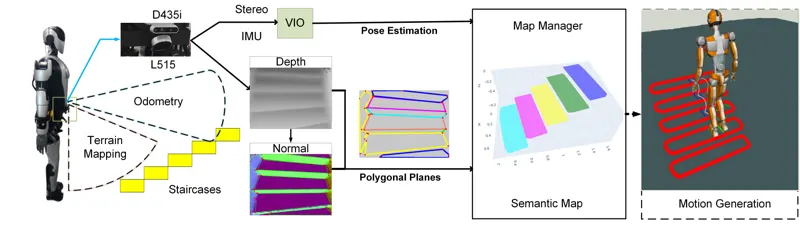
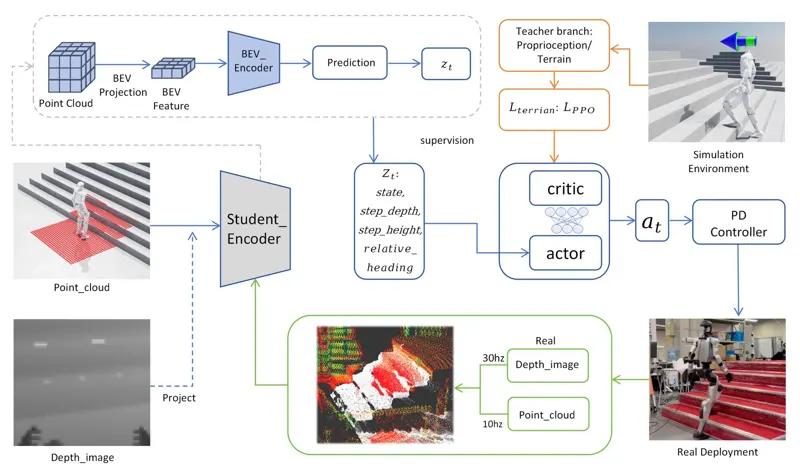
Robust humanoid stair climbing remains challenging due to geometric discontinuities, sensitivity to step height variations, and perception uncertainty in real-world environments. Existing learning-based locomotion policies often rely on implicit terrain representations or blind proprioceptive feedback, limiting their ability to generalize across varying stair geometries and to anticipate required gait adjustments. This paper proposes an explicit stair geometry conditioning framework for robust humanoid stair climbing. Instead of encoding terrain as high-dimensional latent features, we extract a compact set of interpretable geometric parameters, including step height, step depth, and current yaw angle relative to the robot heading. These explicit stair parameters directly condition a Proximal Policy Optimization (PPO)-based locomotion policy, enabling proactive modulation of swing-foot clearance and stride characteristics according to stair structure. Simulation experiments demonstrate improved generalization across unseen stair heights beyond the training distribution. Real-world experiments on the Unitree G1 humanoid validate reliable indoor and outdoor stair traversal. In challenging outdoor scenarios, the robot successfully ascends 33 consecutive steps without failure, demonstrating robustness and practical deployability.

Jianguo Zhang, Wentai Xu, Shusheng YeMay 11, 2026
HumanoidStair ClimbingReinforcement LearningMay 11, 2026
Learning Terrain-Aware Whole-Body Control for Perceptive Legged Loco-Manipulation

Learning Terrain-Aware Whole-Body Control for Perceptive Legged Loco-Manipulation

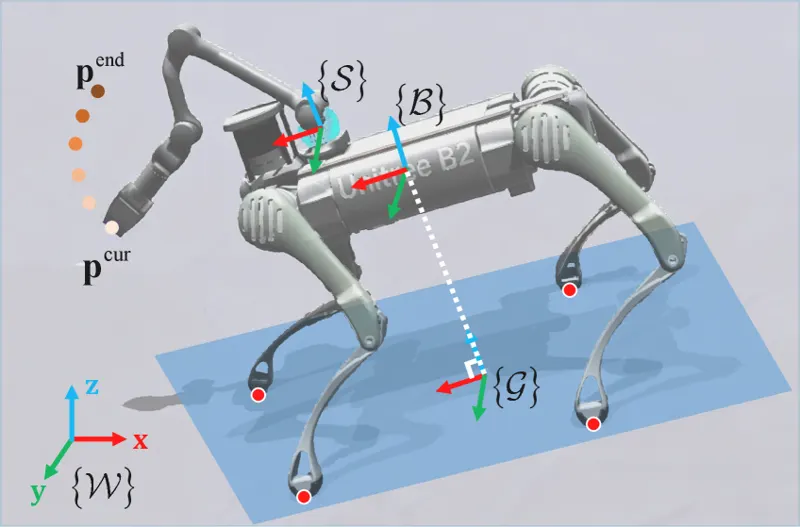
Legged manipulators integrate exceptional terrain adaptability along with mobile manipulation capabilities, which make them highly promising for deployment in human-centric environments. By coordinating the control of both legs and arms, a whole-body controller can significantly expand the operational workspace of legged manipulators. However, many existing whole-body controllers primarily depend on proprioception and do not incorporate the critical exteroception required for effective terrain topology perception. This limitation can hinder their ability to adapt to varying environmental conditions and navigate complex terrains effectively. In this paper, we introduce TA-WBC, a terrain-aware whole-body control framework for legged manipulators, which features a novel RL-based unified policy tailored to whole-body loco-manipulation tasks in various terrains. Specifically, we employ a hybrid exteroception encoder to extract terrain features, providing an essential basis for the robot to proactively adapt posture and footholds. Furthermore, to facilitate stable cross-terrain loco-manipulation, we propose a novel end-effector sampling method based on the foot contact plane, decoupling manipulation target from base fluctuations. Moreover, a dual-policy distillation module is introduced to integrate expansive whole-body motion with terrain adaptability without catastrophic forgetting. The simulation and real-world experiments validate the robustness of our proposed controller, which leads to a larger reachable space, less tracking error, and reduced unexpected stumbles. This unified policy highlights the promising capabilities of legged manipulators in performing loco-manipulation tasks across complex terrains.

Sikai Guo, Yudong Zhong, Guoyang ZhaoMay 29, 2026
Legged manipulationTerrain perceptionWhole-Body ControlMay 29, 2026