
Skip to content
← Tags

#Terminal Agent (2)

AI CodingDevelopmentTopA

Claude Code: the agentic coding tool that lives in the terminal, and the reference harness for Anthropic models

Claude Code is the agentic coding tool from Anthropic, and its own definition is deliberately modest: it lives in your terminal, understands your codebase, and executes routine tasks, explains complex code and handles git workflows through natural language. The official docs name three surfaces - terminal, IDE, and tagging @claude on GitHub. anthropics/claude-code stood at 148,438 stars / 24,902 forks on 2026-09-28, among the highest in this class; stated plainly, the repository has no LICENSE file (the GitHub API returns null), so it is publicly readable but not openly licensed - a material difference from the Apache-2.0 core of Codex CLI that must not be blurred during evaluation. Installation moved from npm to native installers (claude.ai/install.sh, install.ps1, brew cask, winget) and npm install -g @anthropic-ai/claude-code is officially deprecated, usually a way to escape the Node version matrix and global-permission support burden. The plugins/ directory is not a shell: it ships 13 officially maintained capability packs - code-review, pr-review-toolkit, commit-commands, feature-dev, frontend-design, security-guidance, agent-sdk-dev, plugin-dev, hookify, the explanatory and learning output styles, the opus 4.5 migration and ralph-wiggum - each a bundle of custom commands plus agents, turning personal prompts into installable team assets. It is also the reference harness for Anthropic models in third-party benchmarks (the Cursor footnote routes Anthropic model scores through Claude Code). Boundaries: no open license, closed models with unavoidable data egress, a terminal-first form factor that costs non-CLI users a learning curve, and a ceiling that depends on how well any third-party model adapts to the Anthropic protocol and tool calling when swapped in. The card metric is the verifiable fact (stars). Confidence: confirmed.
148,438GitHub stars (repo has no LICENSE)Confirmed · 2026-09
ProductAnthropicSiteRepo
Claude Code: the agentic coding tool that lives in the terminal, and the reference harness for Anthropic models
Terminal-RSI: Recursive Self-Improving Terminal Agents via Recursive Self-Rewrite and Policy-Refine

Terminal-RSI: Recursive Self-Improving Terminal Agents via Recursive Self-Rewrite and Policy-Refine

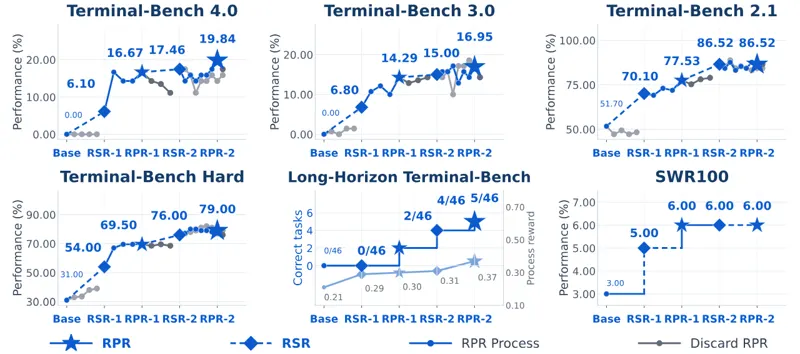
Converting verifier outcomes into useful policy updates and partial progress into complete task resolution is crucial for terminal agents. We present Terminal-RSI, which alternates Recursive Self-Rewrite (RSR) of verified trajectories with critic-inheriting Recursive Policy-Refine (RPR). We formulate Turn-Boundary Skip-Observation GAE (TB-GAE) to retain token-specific baselines while applying decay across interaction turns. Family Dense Reward (FDR) calibrates semantic progress across task families; Success-Prioritized Reward (SPR) separates strict success from bounded partial credit. A Warm-up Critic Model, recursive critic handoff, and stage-specific learning rates coordinate the two refinement phases. The five-stage sequence from Qwen3.8-27B base model through RSR-1, RPR-1, RSR-2, and RPR-2 yields Terminal-RSI-27B: 19.84% on Terminal-Bench 4.0, 86.52% on Terminal-Bench 2.1, 16.95% on Terminal-Bench 3.0, and 79.00% on Terminal-Bench Hard. On LHTB, process reward rises from 0.21 to 0.37 and strict completion from 0/46 to 5/46; SWR100 success doubles from 3.00% to 6.00%. By recursively coupling verified trajectory rewriting with critic-inheriting policy refinement, each retained stage consolidates discovered behaviors and progressively advances the agent from partial local repairs to strict terminal verification.

Junyao Yang, Zongxia Li, Yucheng Shi · 521 views · Oct 15, 2026
Terminal AgentReinforcement Learning
Oct 15, 2026

As an Amazon Associate, we earn from qualifying purchases.