Skip to content
← Tags

#Semantic mapping (7)

OpenBelief-Nav: Evidence-Preserving Object Memory for Open-Vocabulary Language-Guided Navigation

OpenBelief-Nav: Evidence-Preserving Object Memory for Open-Vocabulary Language-Guided Navigation

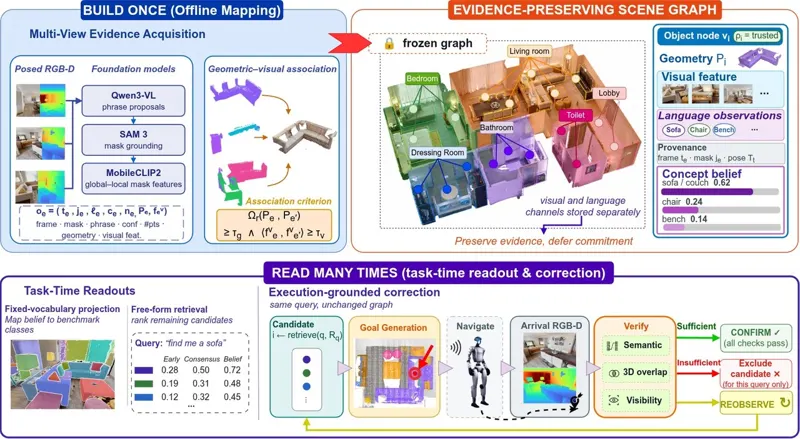
Open-vocabulary 3D scene graphs provide compact semantic memory for language-guided navigation, but mapped objects are often exposed through a single fused feature or committed semantic label. Such commitment can remove minority yet task-relevant hypotheses from the task-time interface. We present OpenBelief-Nav, an evidence-preserving object memory that retains observation-level phrases, reliability cues, and frame-mask provenance while maintaining separate aggregate geometric and visual representations. Semantically related phrases are consolidated into a vocabulary-independent object belief from which task-specific readouts perform fixed-vocabulary projection or free-form retrieval. On five ScanNet200 and eight Replica scenes, full-belief projection achieves mIoU scores of 0.2742 and 0.2912, compared with 0.2393 and 0.2701 for a matched early-commit readout. Across 78 HM3D-YCB navigation trials, consensus and early-commit retrieval each achieve 60/78 successes, compared with 58/78 for belief-weighted retrieval and 55/78 for DualMap. Across 20 Unitree G1 runs organized as 10 matched evaluation cases, a correction policy permitting at most two verified candidate attempts improves target-confirmation success from 6/10 to 8/10 relative to top-1-only execution. Code will be released upon acceptance at https://openbelief-nav.github.io/.
Dinh Tuan Nguyen, Anh Dao, Phuong Nam Dang · 191 views · Aug 14, 2026
Open-Vocabulary Navigation3D scene graphs
Aug 14, 2026
DL-SLAM: Enabling High-Fidelity Gaussian Splatting SLAM in Dynamic Environments based on Dual-Level Probability

DL-SLAM: Enabling High-Fidelity Gaussian Splatting SLAM in Dynamic Environments based on Dual-Level Probability

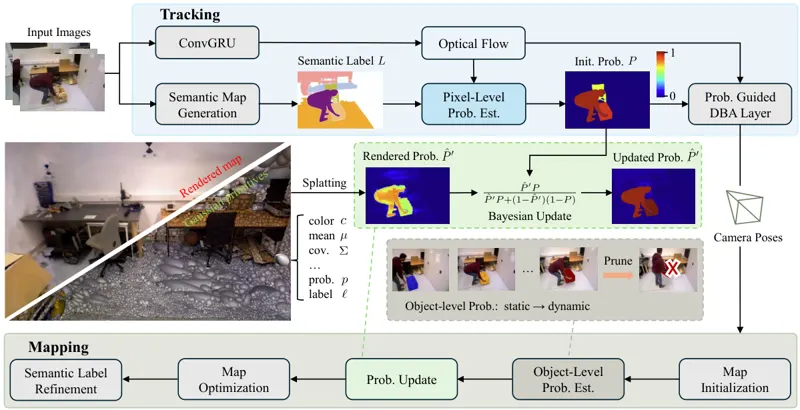
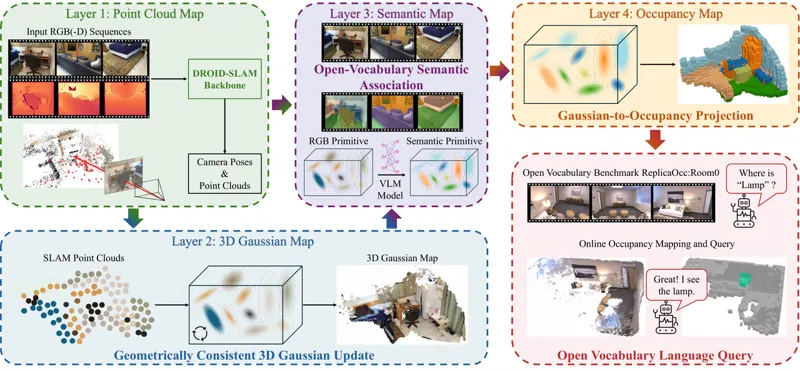
Recent advances in 3D Gaussian Splatting (3DGS) have enabled significant progress in dense dynamic Simultaneous Localization And Mapping (SLAM). Prevailing methods typically discard predefined dynamic objects, ignoring that transiently static objects offer valuable geometric constraints for pose estimation. A recent work attempts to leverage this potential by employing per-pixel uncertainty maps to quantify the magnitude of motion. While this approach enables transiently static objects to enhance pose estimation, it erroneously integrates these objects into the static map, resulting in persistent artifacts. Moreover, its reliance on purely geometric information leads to ambiguous object boundaries in the uncertainty maps. To overcome these limitations, we present DL-SLAM, a monocular Gaussian Splatting SLAM system built upon a novel dual-level probabilistic framework. Our method computes dynamic probability maps by combining semantic and geometric information. These pixel-level probabilities are lifted to 3D and aggregated to derive an object-level dynamic probability for each instance. Object-level probability enables the categorical pruning of dynamic Gaussians, resulting in an artifact-free static map. The static map, in turn, provides a geometrically consistent guidance to refine the pixel-wise probabilities, enhancing their reliability. Experimental results demonstrate that DL-SLAM outperforms existing approaches, improving tracking accuracy by up to 13% while generating high-fidelity semantic maps.

Ziheng Xu, Qingfeng Li, Xuefeng Liu · 797 views · Jul 2, 2026
Dynamic EnvironmentSLAM
Jul 2, 2026

As an Amazon Associate, we earn from qualifying purchases.