PredActor: Predictive Action Diffusion for Steerable Onboard Humanoid Control
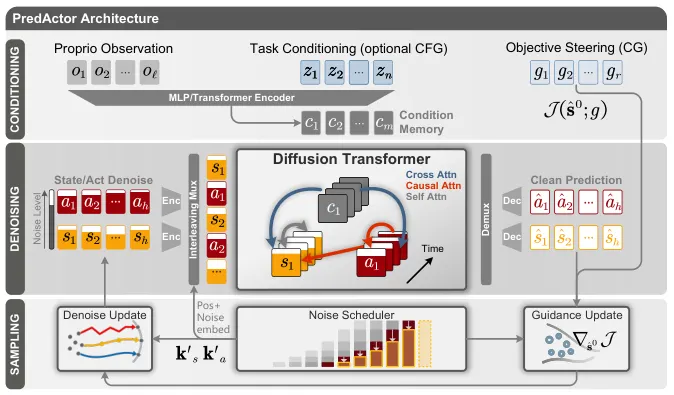
Diffusion models provide a flexible framework for motion generation, but turning this flexibility into closed-loop humanoid control remains challenging. Hierarchical generator-tracker systems steer motion through reference trajectories, yet these references may exceed the capabilities of the downstream tracker, leaving physical feasibility and disturbance recovery largely to a separate control module. Action-only diffusion avoids this separation by directly generating executable actions, but provides no explicit future-state trajectory that can be steered toward test-time motion objectives. Joint state-action diffusion offers a natural alternative, but existing controllers often rely on privileged full-body states, while learned behavior selection and test-time motion steering remain only partially integrated. We present PredActor, a predictive action diffusion policy that unifies both steering modes in one directly executed policy using proprioception alone. Given proprioceptive history and optional task context, PredActor jointly predicts actions and an internal future-state trajectory that enables guidance: classifier-free guidance strengthens text-conditioned motion, while classifier guidance steers future states toward test-time objectives. Only actions are executed, requiring neither a motion-reference tracker nor privileged full-body states. In simulation, PredActor reaches 44 of 45 destination targets and achieves a text retrieval score of 0.539 versus 0.424 for conditional action diffusion, with similar disturbance survival. Rolling denoising and computation-preserving runtime optimizations reduce the complete callback to 16.790 ms median and 19.383 ms p95 on a Jetson Orin NX, within the 20 ms control period. Deployed on a Unitree G1, PredActor demonstrates text-conditioned motion, disturbance response, joystick control, and semantic interpolation in simulation and hardware.