
From Video to Vision: Learning Generalizable Humanoid Carrying from Human Motion
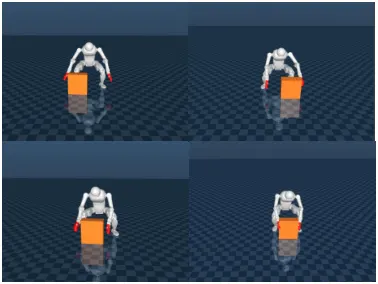
Most video-driven humanoid imitation policies still need an upper-level module to generate reference trajectories at deployment, and the resulting controllers often depend on global position in a motion-capture studio. MOVER replaces that dependency with a three-stage teacher-assistant-student pipeline. It first recovers human motion from 100 videos with GENMO, retargets it to a 29-DoF Tiangong 3.0 humanoid through GMR, and augments object geometry, scale, and pose to obtain 4,000 reference trajectories. A teacher policy learns strict motion and object tracking; an assistant relaxes global body-position tracking to improve placement generalization; and a DAgger-PPO student removes proprioceptive position and reference-joint-position inputs. At deployment, a head-mounted RGB-D camera and an object tag provide relative object pose, while QuatNet predicts the reference anchor orientation from object pose, joint state, and target location. The paper evaluates four object placements and two shape-size configurations in simulation, then demonstrates carrying on the physical robot without motion capture. Remaining limitations include limited demonstration diversity, imperfect target localization without global proprioception, and a small real-world trial count.