Skip to content
Tags

#Legged manipulation (3)

Learning Dynamic Pick-and-Place for a Legged Manipulator

Learning Dynamic Pick-and-Place for a Legged Manipulator

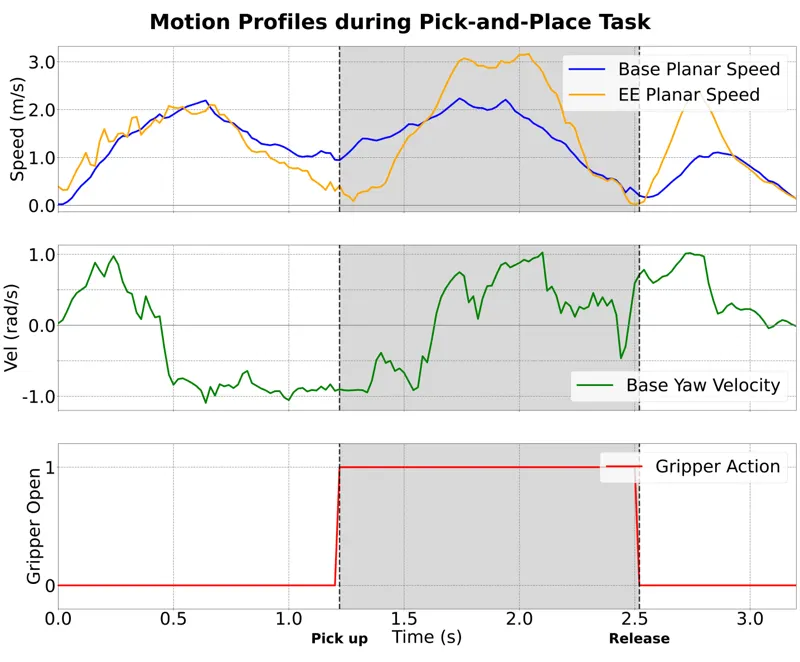
Legged manipulators extend robotic capabilities beyond static manipulation by integrating agile locomotion with versatile arm control. However, achieving precise manipulation while maintaining coordinated locomotion remains a major challenge. This work presents a hierarchical reinforcement learning framework for dynamic pick-and-place tasks using a quadruped equipped with a 6-DOF robotic arm. The framework incorporates an explicit mass estimation module enabling adaptive whole-body control for objects with varying weights. In simulation, the system achieves an 86.05% success rate with payloads up to 2.3 kg. The approach is further validated through real-world experiments across six representative scenarios with controlled variations in object physical properties (size and mass) and task heights. Specifically, within a wide vertical workspace ranging from ground level to 1.1~m-high tabletops, the system demonstrates an average success rate of 73.3% for payloads up to 1.3 kg, with an average execution time of 4.06 s. Unlike prior works that handle lightweight objects and execute pick-and-place motions with slow, piecewise motions, the proposed framework exploits concurrent locomotion and manipulation for dynamic, continuous execution. These results demonstrate the potential of quadrupedal mobile manipulators for adaptive, whole-body pick-and-place with heavier payloads and extended workspaces.

Moonkyu Jung, Jiseong Lee, Zhengmao HeMay 15, 2026
Legged manipulationDynamic GraspingReinforcement LearningMay 15, 2026
Learning Terrain-Aware Whole-Body Control for Perceptive Legged Loco-Manipulation

Learning Terrain-Aware Whole-Body Control for Perceptive Legged Loco-Manipulation

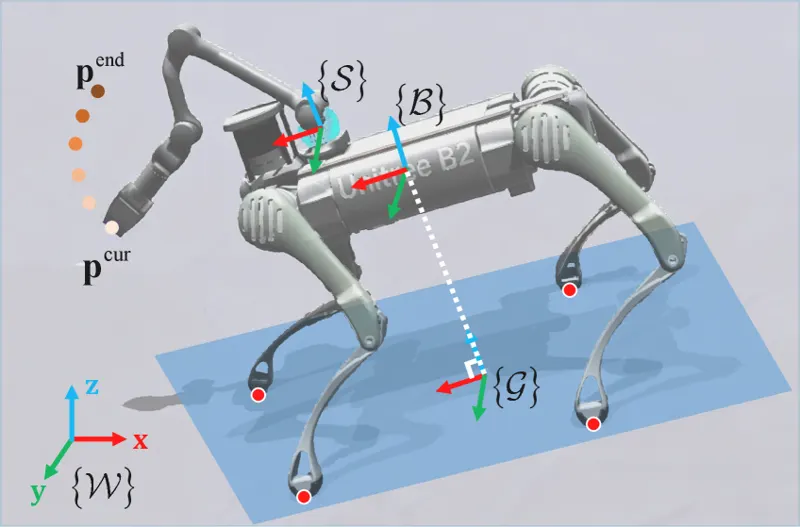
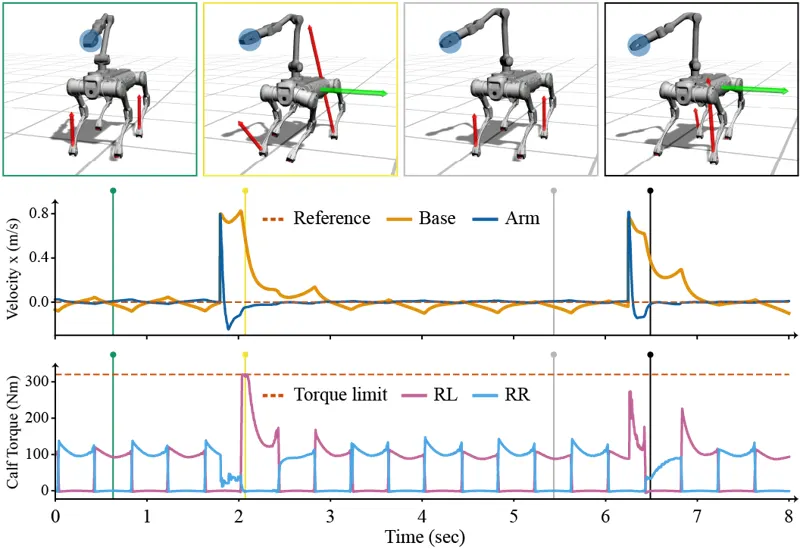
Legged manipulators integrate exceptional terrain adaptability along with mobile manipulation capabilities, which make them highly promising for deployment in human-centric environments. By coordinating the control of both legs and arms, a whole-body controller can significantly expand the operational workspace of legged manipulators. However, many existing whole-body controllers primarily depend on proprioception and do not incorporate the critical exteroception required for effective terrain topology perception. This limitation can hinder their ability to adapt to varying environmental conditions and navigate complex terrains effectively. In this paper, we introduce TA-WBC, a terrain-aware whole-body control framework for legged manipulators, which features a novel RL-based unified policy tailored to whole-body loco-manipulation tasks in various terrains. Specifically, we employ a hybrid exteroception encoder to extract terrain features, providing an essential basis for the robot to proactively adapt posture and footholds. Furthermore, to facilitate stable cross-terrain loco-manipulation, we propose a novel end-effector sampling method based on the foot contact plane, decoupling manipulation target from base fluctuations. Moreover, a dual-policy distillation module is introduced to integrate expansive whole-body motion with terrain adaptability without catastrophic forgetting. The simulation and real-world experiments validate the robustness of our proposed controller, which leads to a larger reachable space, less tracking error, and reduced unexpected stumbles. This unified policy highlights the promising capabilities of legged manipulators in performing loco-manipulation tasks across complex terrains.

Sikai Guo, Yudong Zhong, Guoyang ZhaoMay 29, 2026
Legged manipulationTerrain perceptionWhole-Body ControlMay 29, 2026