Skip to content
← Tags

#Human-in-the-Loop (8)

ResearchImbad0202/academic-research-skills

Academic Research Skills: A five-skill research pipeline

Editor's takeIts strongest idea is not that it can draft a paper, but that it makes research state, evidence, and stopping conditions explicit: every stage needs scholar confirmation, integrity gates inspect citations and declared provenance, and simulated review is constrained to author feedback rather than a publication decision.

v3.23.0, 50,461 stars, CC BY-NC 4.0. Five Claude Code skills connect deep research, paper writing, simulated peer review, a 10-stage orchestrator, and systematic-review screening, using a Material Passport, mandatory checkpoints, and integrity gates to keep the scholar in control.

Claude Code
/plugin marketplace add Imbad0202/academic-research-skills && /plugin install academic-research-skills
PythonImbad020250.5k
Academic Research Skills: A five-skill research pipeline
PaperBanana-Interact: Scientific Diagram Refinement with Multi-Turn Human Feedback

PaperBanana-Interact: Scientific Diagram Refinement with Multi-Turn Human Feedback

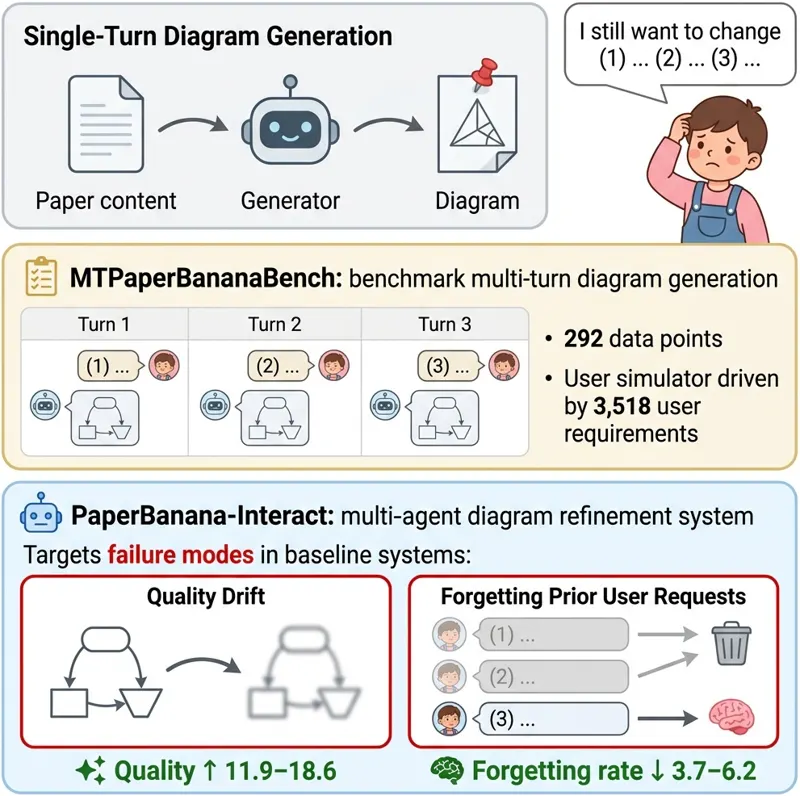
Recent efforts have aimed to automate scientific diagram generation from paper content (Lin et al., 2026; Zhu et al., 2026a). However, fully satisfying an author's visual and communicative preferences in a single turn is challenging: in our formative user study (N = 14), all participants requested further revisions after viewing an initial draft, and 86% of them rated the refined diagrams as more satisfactory. Despite the clear demand, the multi-turn workflow remains largely underexplored. To bridge this gap, we present MTPaperBananaBench, a benchmark for multi-turn diagram generation containing 292 images annotated with 3,518 user requirements. To reduce expensive human studies and enable scalable benchmarking, we construct a user simulator that, at each turn, identifies unsatisfied requirements and converts k of them into natural language feedback. Evaluating both requirement satisfaction and overall diagram quality reveals two key failure modes shared across baseline multiturn systems: (1) quality drift, where diagram quality progressively declines over turns, and (2) forgetting, where previously implemented features are lost in subsequent turns. To address these issues, we introduce PaperBanana-Interact, a multi-agent system that refines diagrams via an internal critique-and-refine loop. PaperBanana-Interact consistently improves rather than degrades diagram quality across turns, outperforming baselines by 11.9-18.6 points in quality score and reducing forgetting by 3.7-6.2 points.

Xueqing Wu, Ashwin Balasubramanian, Bingxuan Li · 210 views · Aug 31, 2026
Multi-agentDiagram Generation
Aug 31, 2026
RoboPrompt: Intuitive Robot Policy Steering with Sparse Human Input

RoboPrompt: Intuitive Robot Policy Steering with Sparse Human Input

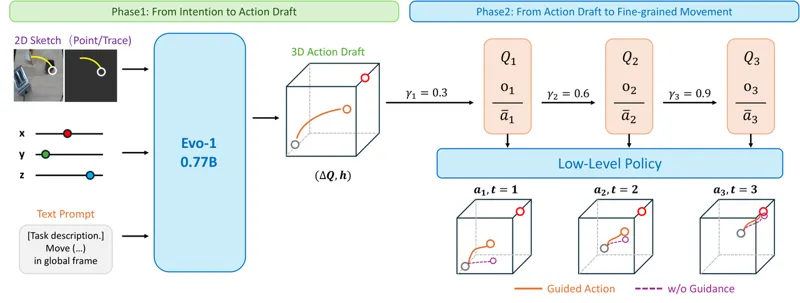
End-to-end robot policies trained through imitation learning remain constrained by limited data diversity, making reliable zero-shot deployment in real-world settings challenging. Shared-autonomy methods enable human correction through teleoperation, but specialized hardware and operator training hinder deployment at scale. Other approaches incorporate human guidance as additional policy inputs, often requiring architectural changes and dedicated training for steerability, which limits their applicability across policies. We present RoboPrompt, a general-purpose, lightweight robot policy steering system that enables users to guide policy behavior through intuitive, sparse inputs, including drawn traces, target points, and coarse directional instructions. RoboPrompt decouples human-intention translation from the underlying policy: a reusable module converts human guidance into action drafts, which are refined through the diffusion or flow-matching dynamics of the base policy. By controlling action generation in noise space, RoboPrompt balances human intent with the policy prior without modifying the base policy architecture or fine-tuning it for steerability. Experiments demonstrate effective steering across Diffusion Policy, π_0.5, and FastWAM. We further use steered rollouts for online policy improvement through DAgger. After 2-3 rounds of iteration, average success rates increase by 15.5% for π_0.5 across three tasks and by 21.3% across three policies(Diffusion Policy, π_0.5, FastWAM) on the Insert Bread task, while average human intervention counts decrease by 44.0% (2.86 to 1.60) and 81.9% (2.60 to 0.47), respectively.

Yanwen Zou, Chenyang Shi, Guoxuan Xu · 510 views · Oct 7, 2026
ManipulationImitation Learning
Oct 7, 2026

HIL-UMI: Bringing Human-in-the-Loop Post-Training of Vision-Language-Action Models to Universal Manipulation Interface

HIL-UMI: Bringing Human-in-the-Loop Post-Training of Vision-Language-Action Models to Universal Manipulation Interface

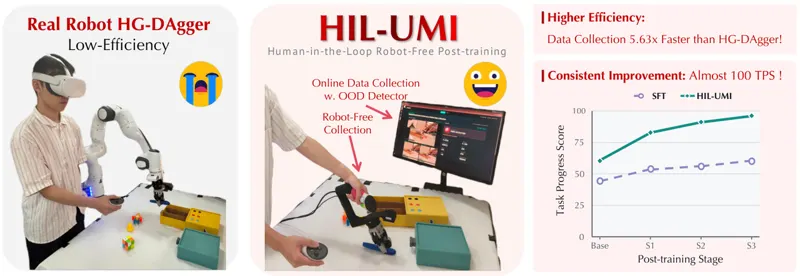
Large-scale vision-language-action (VLA) models provide powerful priors for robot manipulation, yet adapting them to a specific deployment remains challenging. Supervised fine-tuning (SFT) on task-specific demonstrations provides a step toward deployment, but faces two persistent limitations: static data provide limited coverage of out-of-distribution states, and standard imitation objectives do not distinguish progressing behavior from less useful data. Interactive post-training can address these limitations, but typically requires repeated policy execution and human intervention on a physical robot. We introduce HIL-UMI, a policy-guided Universal Manipulation Interface (UMI) framework for robot-free human-in-the-loop VLA post-training. During handheld UMI demonstrations, HIL-UMI queries the current policy on the same observation stream without executing its predictions. The Energy Score compares the human action trajectory with policy inference and triggers collection when their discrepancy indicates an out-of-distribution region. In a separate feedback loop, low online advantage predictions identify essential segments for refining a progress-based advantage estimator. The updated estimator then guides advantage-conditioned behavioral cloning using a balanced mixture of base demonstrations and new policy data. This design preserves the iterative and policy-aware nature of human-in-the-loop learning while decoupling data collection from robot deployment. Experiments on four real-world tasks spanning long-horizon and precise manipulation show that HIL-UMI achieves consistent improvement over SFT and benefits from both targeted collection and advantage refinement. Moreover, HIL-UMI outperforms HG-DAgger on Clean Up Table with lower per-frame collection time, suggesting a scalable path for VLA post-training across operators and locations.

Han, Zimu, Zeng, Yiming, Zhang, Jiyao · 1.2k views · Sep 17, 2026
VLAHuman-in-the-Loop
Sep 17, 2026

As an Amazon Associate, we earn from qualifying purchases.