Skip to content
← Tags
RLSR: Reinforcement Learning from Self Reward

RLSR: Reinforcement Learning from Self Reward

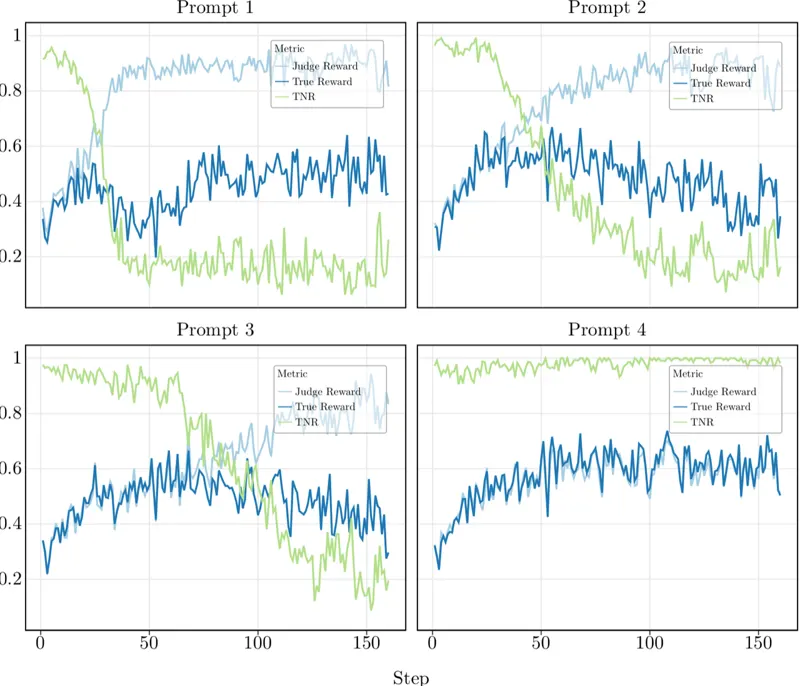
Large language models can generate solutions to complex problems, but training them with reinforcement learning typically requires verifiable rewards that are expensive to create and not possible for all domains. We demonstrate that LLMs can effectively self-improve through self-judging without reference solutions, leveraging the inherent asymmetry between generating and verifying solutions. Our experiments show that models can provide reliable reward signals without ground truth answers, enabling reinforcement learning in domains where verifiable rewards are impractical. By implementing self-judging across Countdown puzzles and integration problems, we achieve performance comparable to formal verification without ground truth solutions. Most notably, Qwen 2.5 7B DeepSeek Distilled trained with self-rewards qualifies for the prestigious MIT Integration Bee competition, performance through self-supervised improvement. When combined with synthetic question generation, we establish a complete self-improvement loop where models generate practice problems, solve them, and evaluate their own performance without any external validation. Our findings demonstrate that LLM judges can provide effective reward signals for training, unlocking reinforcement learning in countless domains previously limited by reward engineering challenges. This work represents a significant step toward autonomous AI systems that continuously improve through self-directed learning rather than human-guided training, potentially accelerating progress across domains where training data is scarce or evaluation is complex.

Toby Simonds, Kevin Lopez, Akira Yoshiyama · 191 views · May 12, 2025
Reinforcement LearningLarge Language Models
May 12, 2025
Agent World Model in the Wild: Computer-Use Agent Environment Synthesis

Agent World Model in the Wild: Computer-Use Agent Environment Synthesis

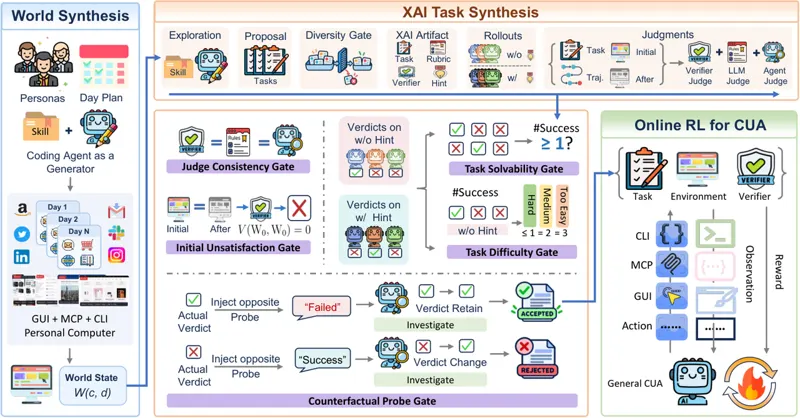
Agent learning is shifting from learning from human data toward learning through interaction with the world. However, scaling such learning directly in real-world computer systems is challenging and can introduce substantial security risks. We therefore propose Agent World Model in the Wild (WildAWM), a scalable pipeline for synthesizing controllable environments and tasks for training general computer-use agents (CUAs). Whereas existing approaches typically specialize in a single agent interaction interface, we construct executable environments that jointly support graphical user interfaces, model context protocol services, and command-line interfaces, allowing agents to flexibly combine visual interaction, tool use, and code execution. WildAWM is entirely powered by open-source models, demonstrating that high-quality computer-use environments can be generated without proprietary frontier models. Beyond environments, we address three recurring challenges in task synthesis: ensuring solvability, maintaining sufficient difficulty, and producing reliable verifiers, by introducing execution-based quality gates that combine heterogeneous agent rollouts, cross-judge consistency checks, and counterfactual probes of judgment robustness. The resulting pipeline synthesizes 341 long-horizon environment-task pairs that can require over 100 agent steps to solve and remain challenging even for frontier models, with GPT-6-Astra solving only 60% of them. We train two Qwen models of different sizes exclusively in these synthetic worlds. Both models achieve substantial gains across 8 out-of-distribution benchmarks spanning web, claw, and computer-use agents, demonstrating that learning in WildAWM's synthesized worlds generalizes broadly to unseen computer-use tasks. The code is publicly available at https://github.com/MSR-Orchard/WildAWM.

Zhaoyang Wang, Qianhui Wu, Haorui Wang · 350 views · Oct 19, 2026
Computer-Use AgentWorld Models
Oct 19, 2026
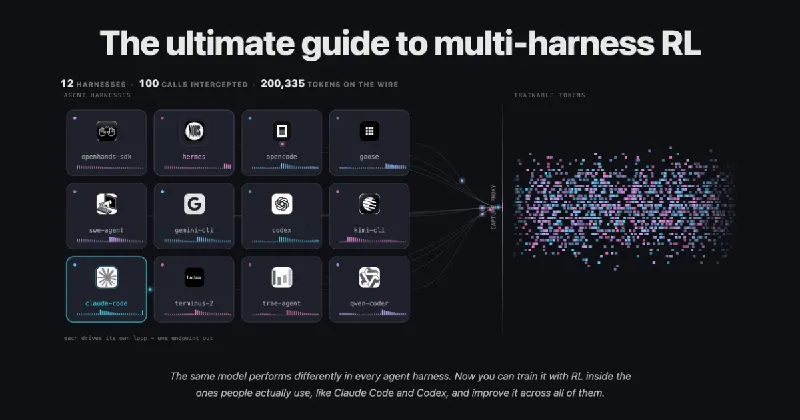
The ultimate guide to multi-harness RL: train models inside Claude Code and Codex — Hugging Face's four-harness experiment with a 2.6B model

The ultimate guide to multi-harness RL: train models inside Claude Code and Codex — Hugging Face's four-harness experiment with a 2.6B model

The same model behaves like two different models depending on the agent harness around it: GLM-5.2 scores 23% in one harness and 52% in another on SWE-bench Pro; in a controlled experiment swapping the harness moved scores 13 points while swapping the model moved only 2.5–5. A Hugging Face team (Adithya S Kolavi, Joel Niklaus, Lewis Tunstall, Leandro von Werra and colleagues, with Liquid AI) publishes an open fix: run agentic RL inside the real harnesses — Claude Code, Codex, OpenCode, Mini-SWE-Agent — with zero harness code changes. The stack: OpenEnv as the shared interface, a capture proxy that mints a session id per rollout and records exact token ids, per-token behavior logprobs and loss masks at the model endpoint (full-distribution sampling, top_p=1.0), Harbor for 40+ harness adapters and 26 sandbox backends, and TRL's Async GRPO consuming the masked training sequences. The numbers: LFM2.5-2.6B trained across four harnesses rises from 42.2% to 54.2% average pass@1 with gains under all four, and uses 31% fewer tool calls on tasks both it and the base model solved, while the OpenCode-only arm's gains stay mostly at home. The article also reports the SFT comparison (RL 54.6% vs SFT 47.5%), the full attribution of the earlier Qwen rise-and-decline (output-budget exhaustion, working without submitting, and a reward term that collapsed held-out accuracy from 0.740 to 0.178), and engineering boundaries like the proxy's concurrency ceiling.

BLOG

Reinforcement LearningRL
ReST-RL: Reinforcing LLM Reasoning through Unified Self-Training and Value-Guided Search

ReST-RL: Reinforcing LLM Reasoning through Unified Self-Training and Value-Guided Search

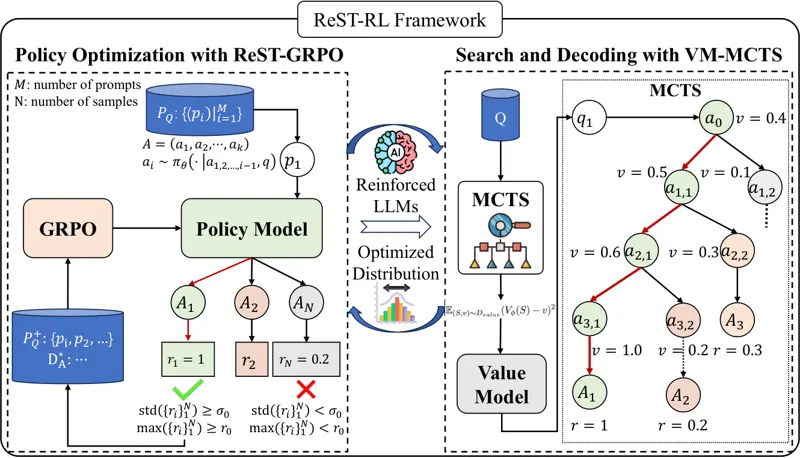
GRPO is the representative RL method for improving LLM reasoning, yet it only ever sees one sparse reward at the end of a whole trajectory: when the rewards inside a sampled group land close together, the group-relative advantage collapses into noise and the policy learns almost nothing. ReST-RL reconnects policy optimization and value-guided search into a single self-training pipeline. Stage one, ReST-GRPO, first filters out low-information prompts by reward standard deviation, then draws prefixes from each prompt's highest-reward trajectory under a discrete exponential distribution and uses them as fresh online-GRPO starting contexts. A selected prefix is context only; its suffix is re-sampled and optimized rather than imitated. Stage two, VM-MCTS, runs MCTS under the now-static policy to self-collect value targets and trains a value model that predicts expected terminal reward. At inference the same model both allocates the tree search through UCT and ranks completed candidates in a Best-of-N fashion, so search and verification share one state-value scale. On coding benchmarks including APPS, BigCodeBench and HumanEval, Qwen3-8B moves from 0.503 to 0.689 average. In matched policy-value controls, ReST-GRPO + VM-MCTS reaches 0.642 on APPS-500 while GRPO + VM-MCTS reaches only 0.538, so the stage-one distributional shift survives value learning. End-to-end accounting puts ReST-GRPO at 1,752 GPU-hours against 2,080 for GRPO, hitting a 9% gain in 71 hours instead of 207. A value model trained only on code trajectories also transfers to MATH, Omni-MATH and GPQA-Diamond without target-domain tuning.

Sining Zhoubian, Dan Zhang, Jie Tang · 752 views · Aug 27, 2025
Reinforcement LearningGRPO
Aug 27, 2025

As an Amazon Associate, we earn from qualifying purchases.