Skip to content
← Tags

#Benchmarks (27)

InteractiveWorld: A Verifiable Human-Centric Environment for Building Better Interactive MLLM Assistants

InteractiveWorld: A Verifiable Human-Centric Environment for Building Better Interactive MLLM Assistants

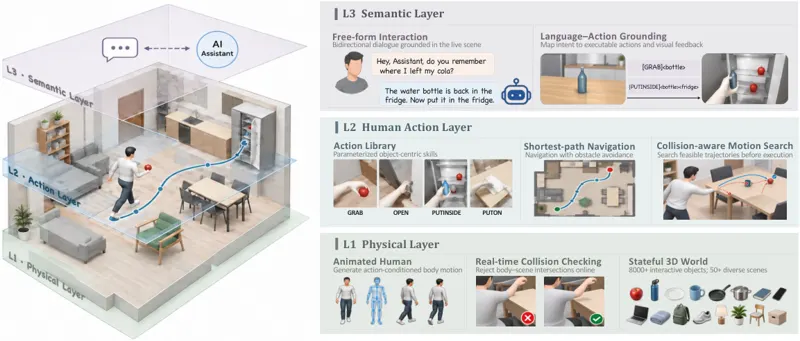
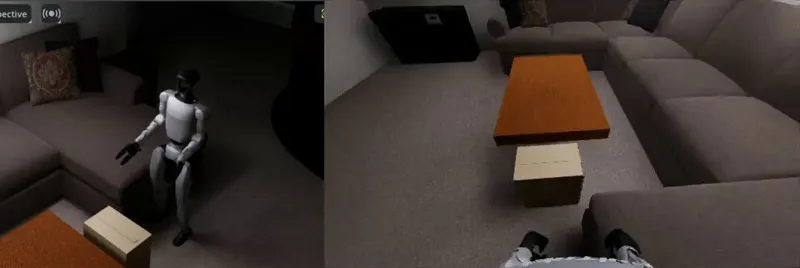
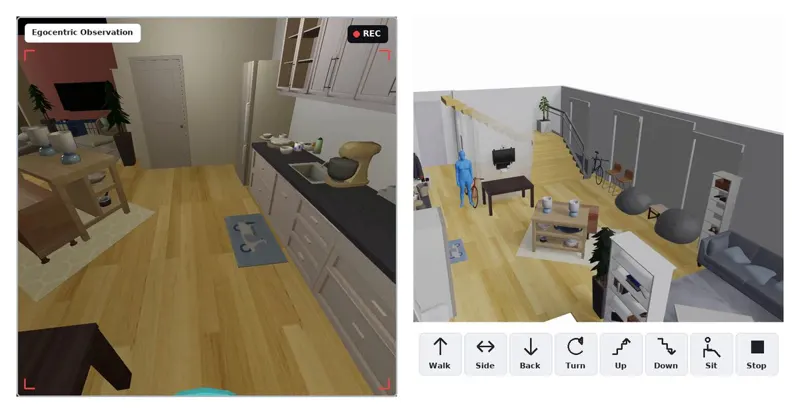
People have long dreamed of an assistant that is always there to guide them and remind what they forget, from new dishes to lost keys. Powered by multimodal large language models (MLLMs), egocentric AI assistants on wearable devices are bringing this dream within reach: they see what the user sees and give instructions for user's physical work when necessary. However, testing such assistance is challenging and usually requires real people. The expensive and rare real interaction data leaves a key question unanswered: Can today's MLLMs truly help people in physical world? To answer this question, we propose InteractiveWorld, the first verifiable environment for closed-loop interaction between human and AI assistant. Unlike existing robot-centric simulators, InteractiveWorld lets the assistant guide a human agent who observes the scene, understands instructions, and acts independently. It thus realistically simulates how AI assistant collaborates with human: the assistant instructs, the human acts, and the environment executes actions and updates what they see next. Building on it, we introduce InteractiveBench, the first dynamic benchmark for egocentric AI assistants, with 120 multi-turn tasks across six categories. In each task, the assistant guides the human in real time, and every instruction shapes the outcome, which is scored by verifiable, state-based rewards. Experiments with 12 frontier MLLMs show they are still far from reliable assistants. Even the strongest model, Claude Fable 5.1, achieves at most 20% and 25% on long-horizon Guidance and Planning tasks, respectively. Overall, our work offers a verifiable platform and a rigorous evaluation set, laying a solid foundation for research on interactive MLLM assistants that truly help people in the physical world.

Qinsi Wang, Wei Wen, Chong Zhou · 176 views · Oct 25, 2026
MLLMEgocentric AI Assistant
Oct 25, 2026
PaperBanana-Interact: Scientific Diagram Refinement with Multi-Turn Human Feedback

PaperBanana-Interact: Scientific Diagram Refinement with Multi-Turn Human Feedback

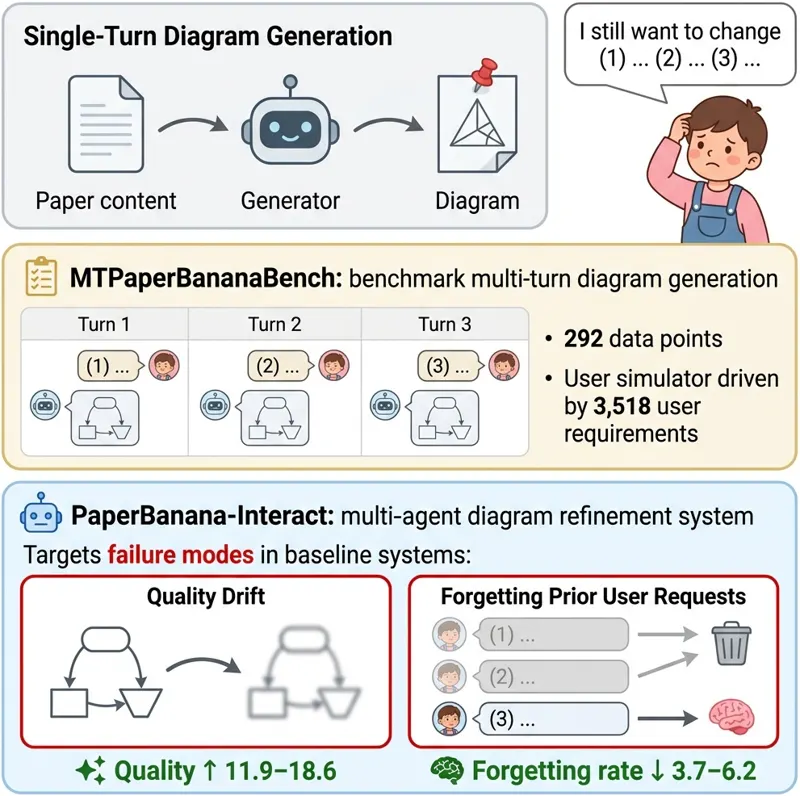
Recent efforts have aimed to automate scientific diagram generation from paper content (Lin et al., 2026; Zhu et al., 2026a). However, fully satisfying an author's visual and communicative preferences in a single turn is challenging: in our formative user study (N = 14), all participants requested further revisions after viewing an initial draft, and 86% of them rated the refined diagrams as more satisfactory. Despite the clear demand, the multi-turn workflow remains largely underexplored. To bridge this gap, we present MTPaperBananaBench, a benchmark for multi-turn diagram generation containing 292 images annotated with 3,518 user requirements. To reduce expensive human studies and enable scalable benchmarking, we construct a user simulator that, at each turn, identifies unsatisfied requirements and converts k of them into natural language feedback. Evaluating both requirement satisfaction and overall diagram quality reveals two key failure modes shared across baseline multiturn systems: (1) quality drift, where diagram quality progressively declines over turns, and (2) forgetting, where previously implemented features are lost in subsequent turns. To address these issues, we introduce PaperBanana-Interact, a multi-agent system that refines diagrams via an internal critique-and-refine loop. PaperBanana-Interact consistently improves rather than degrades diagram quality across turns, outperforming baselines by 11.9-18.6 points in quality score and reducing forgetting by 3.7-6.2 points.

Xueqing Wu, Ashwin Balasubramanian, Bingxuan Li · 210 views · Aug 31, 2026
Multi-agentDiagram Generation
Aug 31, 2026
Interactive Navigation Beyond Reachability: Benchmark and Agentic Framework

Interactive Navigation Beyond Reachability: Benchmark and Agentic Framework

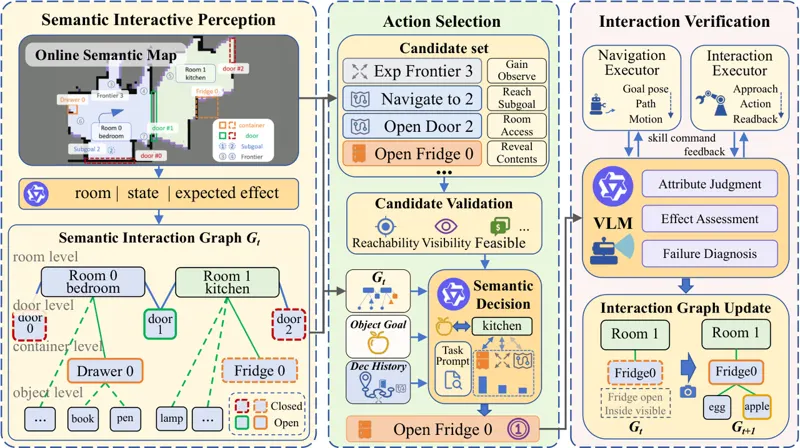
Existing embodied navigation tasks commonly assume that traversability and object states remain fixed during an episode. Yet reaching a goal may require opening a door to access a room and then opening a container to reveal a hidden target. We formulate interactive navigation beyond reachability, unifying channel-induced changes in spatial connectivity, container-induced changes in target visibility, and their sequential dependencies. We introduce MultINav-Bench, a 3K-episode ObjectGoal benchmark in MolmoSpaces spanning channel, container, and mixed tasks, with interaction-necessity annotations covering required and unnecessary episodes. Its data generation pipeline automates task construction across multiple task types. The evaluation protocol separately measures navigation success, interaction effectiveness, and cost. We further propose MultINav-Agent, a three-stage agentic framework built on a persistent, state-conditioned interaction graph. Semantic interactive perception grounds entities and interaction states; a vision-language model selects task-relevant actions based on expected changes in connectivity and target observability; and post-interaction verification updates the graph to guide subsequent navigation, exploration, or interaction. Experiments on MultINav-Bench show that MultINav-Agent consistently outperforms adapted baselines across channel, container, and mixed tasks.

Delun Li, Xueyao Wei, Rui Chen · 273 views · Oct 12, 2026
Embodied NavigationInteractive Navigation
Oct 12, 2026
N₀-Foundation: Towards the Age of Tactile Intelligence

N₀-Foundation: Towards the Age of Tactile Intelligence

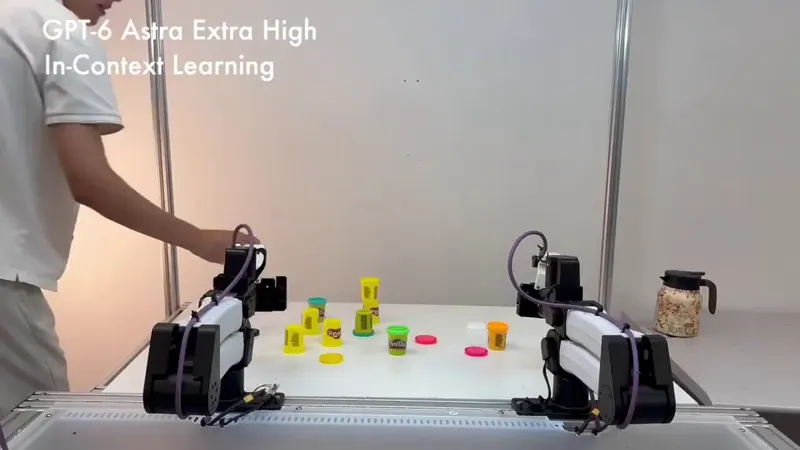
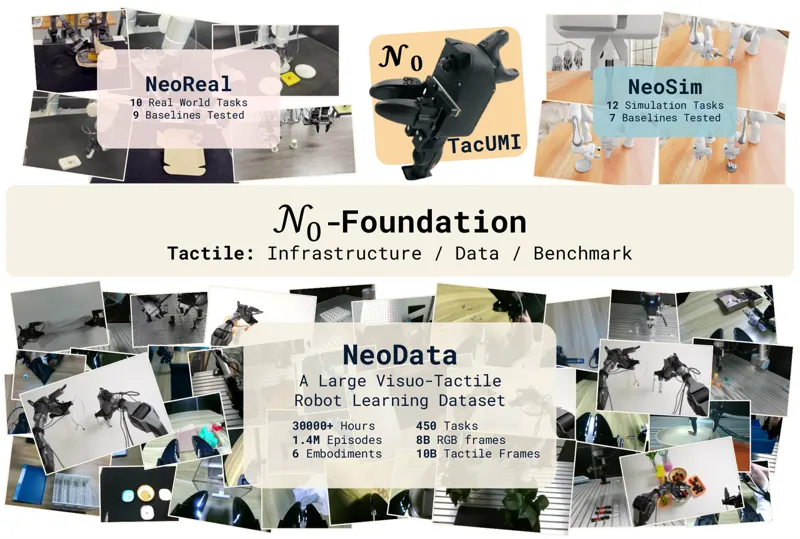
We present N₀-Foundation, a paradigm for tactile-enabled embodied manipulation, which integrates tactile sensing hardware, large-scale multimodal data, tactile representation learning, and standardized evaluation. First, we engineer the infrastructure for scalable data collection, including a vision-based tactile sensor, a tactile Universal Manipulation Interface (UMI), and a synchronized visuo-tactile data collection system supporting both robot embodiments and UMI-based demonstrations. Leveraging this infrastructure, we construct NeoData, which contains more than 30000 hours of synchronized visual and tactile demonstrations, spanning six embodiments, 450 tasks, and billions of paired RGB and tactile frames collected through a mixture of real-robot teleoperation and UMI-based demonstrations. To facilitate open research, we further release OpenNeoData, a 5000-hour open-source subset of NeoData. The dataset addresses a central limitation of existing manipulation corpora, critical for deformable-object manipulation, precise assembly, delicate force control, and sustained surface interaction. Capitalizing on the large-scale, heterogeneous tactile measurements, we propose NeoForce, a visuo-tactile representation model that learn transferable tactile representations across different sensor designs. To enable systematic evaluation of tactile embodied models built upon our infrastructure, datasets and tactile representations, we further propose a comprehensive benchmark, which combines the real-world NeoReal suite and the simulated NeoSim suite for standardized evaluation. Experiments across both suites show that policies benefit from the physical contact state rather than from the device-specific appearance of the tactile signal. We release the dataset, the representation, and the benchmark, aiming at supporting future work on tactile-enabled embodied manipulation.

NeoteAI Team, Fudan TEAI Team · 1.2k views · Aug 30, 2026

UMIVLA
Aug 30, 2026

As an Amazon Associate, we earn from qualifying purchases.