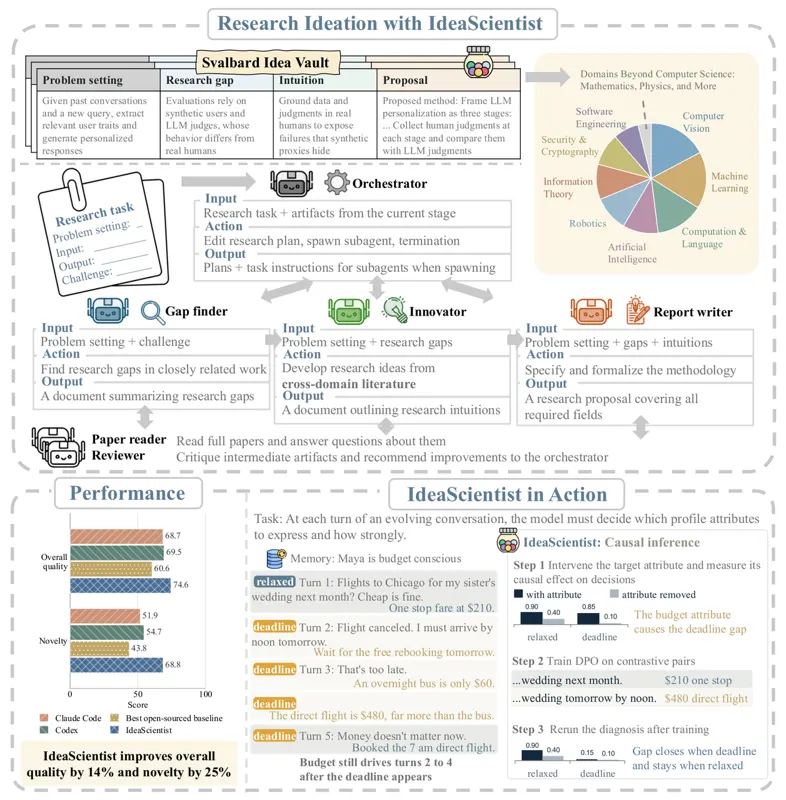
IdeaScientist: Orchestrating Agents for Grounded Scientific Ideation
Most autoresearch systems couple idea generation with implementation, experiments, and writing, so it is unclear whether success comes from the idea or from downstream execution. IdeaScientist isolates research ideation as a standalone task: given a problem definition and a challenge that current solutions fail to meet, produce a grounded research proposal. An orchestrator coordinates three sub-agents - a gap finder that locates the shared methodological limitation in same-problem prior work, an innovator that retrieves mechanisms which solved an analogous challenge in other fields and adapts them, and a report writer that develops the surviving intuition into a complete proposal. Each role is trained separately with asynchronous GRPO and reference-grounded rubric rewards. The Svalbard Idea Vault decomposes 4.7M arXiv papers into 2.77M (problem, challenge, gap, intuition, proposal) tuples for retrieval, training, and temporally controlled evaluation with a January 1, 2026 cutoff and 277 held-out post-cutoff methodology papers. On Qwen3.6-27B, IdeaScientist reaches 74.6% overall, 14.0% above the strongest open-source autoresearch baseline, driven mainly by novelty, and beats Claude Code SDK with Claude-4.8-Opus by 5.9% and Codex SDK with GPT-5.4 by 5.1% on the same open backbone.