
Skip to content
← Tags

#4D Generation (2)

DyCraft: An Agentic System for Long-Horizon 4D Scene Generation

DyCraft: An Agentic System for Long-Horizon 4D Scene Generation

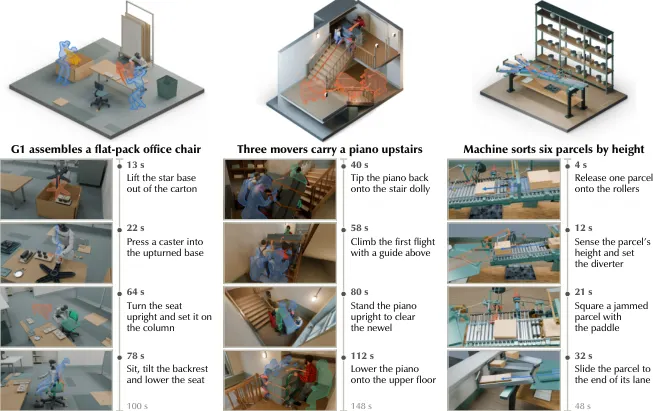
While frontier coding agents can generate high-quality 3D scenes and articulated assets, they struggle to create coherent long-horizon animations. When equipped with general-purpose harnesses, they frequently produce physically implausible outputs, generating objects that interpenetrate, lack physical support, or move unnaturally. Such bare agents struggle to repair these errors because they default to scripting the full animation in one pass, making it difficult to verify their work and disentangle complex spatiotemporal constraints. Drawing on the practice of human animators, we introduce DyCraft, a system for animated 3D scene generation that breaks animation into steps that coding agents can more reliably solve. DyCraft first expands the user's prompt into a detailed plan and builds a static scene. It then creates a 3D storyboard of key animation poses, where each frame is a static 3D scene that the agent can build and debug in isolation. Storyboarding decomposes the problem into pairs of verified start and end states, allowing the agent to author local motion between them with a collection of motion authoring tools. We evaluate DyCraft on 24 long-horizon, multi-shot animation tasks covering humanoid robots, human and animal characters, and physical mechanisms. Compared with a native GPT-6 agent in Codex and prior agentic baselines, DyCraft substantially reduces physical violations and generates higher-quality animated 3D scenes that are more often preferred by human raters.
Jeff Tan, Hang Dai, Zeqian Long · 31 views · Oct 29, 2026
4D GenerationAgentic AI
Oct 29, 2026
GS-Agent: Creating 4D Physical Worlds With Generative Simulation

GS-Agent: Creating 4D Physical Worlds With Generative Simulation

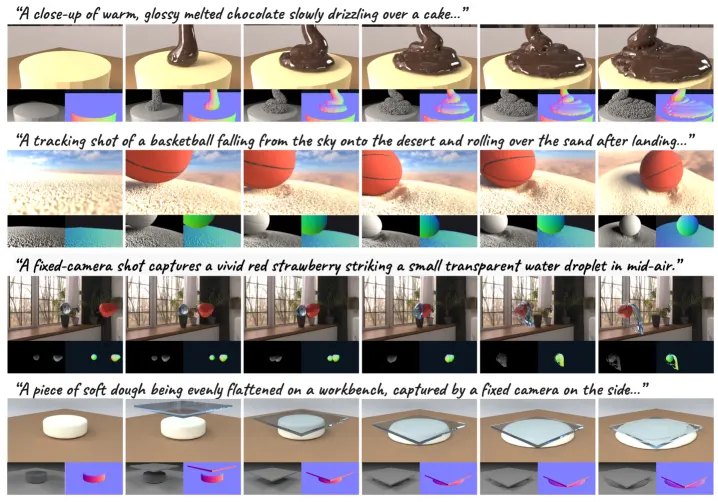
Creating dynamic and physically realistic 4D worlds from natural language descriptions is both fascinating and challenging. Traditional computer graphics methods rely on manual creation, requiring extensive human effort to fine-tune materials, motions, and visual fidelity. Recent advances in generative foundation models have sparked interest in learning to generate such 4D worlds from large-scale data; however, existing methods still struggle to ensure physical plausibility and controllability. In this work, we take a different path by leveraging foundation models to construct an agentic system that emulates how humans traditionally create 4D worlds, yet automates the entire process. We present GS-Agent, an end-to-end multi-agent framework that integrates physics engines in the loop to generate realistic, dynamic, and controllable 4D physical worlds from natural language. Inspired by how humans build 4D worlds, GS-Agent decomposes the task into entity management, covering 3D asset curation, material tuning, placement, and motion control, and rendering configuration, including camera and lighting manipulation. Multiple agents with distinct expertise interact with the physics engine via code, seek multimodal feedback, and collaborate to iteratively construct 4D worlds that align with the given descriptions. Experimental results show that GS-Agent effectively converts natural language into diverse and physically plausible 4D worlds exhibiting rich interactions among liquids, deformable objects, and rigid bodies, while achieving cinematic camera and lighting control. We envision GS-Agent as a foundation for a new paradigm in 4D world generation, empowering creative content creation and physical AI. Project page at https://umass-embodied-agi.github.io/gs-agent/

Hongxin Zhang, Chunru Lin, Junyan Li · 561 views · Jul 23, 2026
3D Gaussian Splatting4D Generation
Jul 23, 2026

As an Amazon Associate, we earn from qualifying purchases.