Skip to content
EA-Nav: Learning Safe Visual Navigation Policies with Embodiment Awareness

EA-Nav: Learning Safe Visual Navigation Policies with Embodiment Awareness

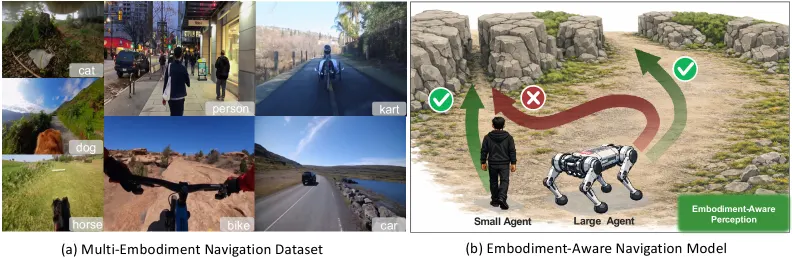
Cross-embodiment navigation is a key challenge in embodied intelligence. Due to differences in embodiment, the same visual observation may imply different actions for different agents, making prediction ambiguous when relying solely on vision. Existing studies mainly rely on reinforcement learning, which requires large-scale interaction and careful reward design, making it difficult to support scalable pretraining and real-world adaptation. In contrast, imitation-learning-based approaches remain limited. To address these challenges, we propose an imitation-learning-based embodiment-aware navigation framework with a modular multi-stage design. In pretraining, we construct a cross-embodiment navigation dataset from Internet videos and introduce embodiment geometry as conditional tokens to reduce action ambiguity under the same observation. In fine-tuning, we design a multimodal information injection mechanism based on a decoupled architecture. Specifically, we design a trajectory augmentation strategy to generate high-risk samples, which are used to train spatial perception and risk-aware correction separately, thereby explicitly incorporating embodiment geometry for safe navigation. Experimental results show that the proposed method effectively improves navigation performance across different embodiment settings, demonstrating the effectiveness of incorporating embodiment geometry into embodied navigation.

Visual navigationBody-Awareness
Jialu Zhang, Yong Du, Xianda Guo · 615 views · Jul 22, 2026
ReferTrack: Referring Then Tracking for Embodied Visual Tracking

ReferTrack: Referring Then Tracking for Embodied Visual Tracking

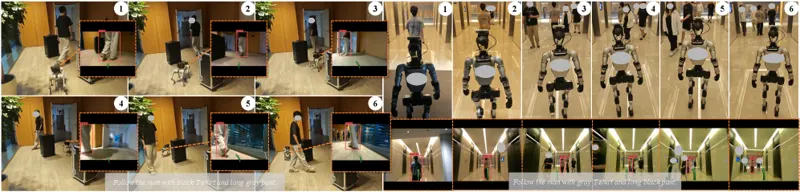
Embodied visual tracking (EVT) requires a mobile agent to continuously follow a specific target described in natural language using only onboard vision. While recent vision-language-action (VLA) policies unify target identification and trajectory planning, their chain-of-thought (CoT) reasoning often operates in abstract spatial latents that are difficult to supervise and weakly aligned with explicit image-space detections. To address this, we introduce ReferTrack, a referring-then-tracking paradigm that grounds EVT using a single forward-facing camera. Our model first selects the target from an indexed set of bounding boxes, then decodes tracking waypoints conditioned on this image-grounded decision. To preserve target motion cues over time, ReferTrack maintains a sliding-window queue of previously selected bounding boxes, injecting their geometric features into the visual history via temporal-viewpoint-bbox indicator (TVBI) tokens. We further enhance target identification by co-training on a custom Refer-QA dataset. On EVT-Bench, ReferTrack achieves state-of-the-art single-view performance with success rates of 89.4%, 73.3%, and 74.1% on the single-target, distracted, and ambiguity tracking splits, respectively – matching or even surpassing several multi-camera baselines on identification-heavy tasks. Finally, real-world deployments on legged and humanoid robots validate its robust sim-to-real transfer capabilities. Code is available at https://github.com/MedlarTea/referTrack.

VLAObject tracking
Hanjing Ye, Tianle Zeng, Jiazhao Zhang · 490 views · Jul 22, 2026

As an Amazon Associate, we earn from qualifying purchases.