Skip to content
Vision-Language-Motion Maps: An Open-Vocabulary, Uncertainty-Aware, Queryable Motion Attribute for 3D Scene Maps

Vision-Language-Motion Maps: An Open-Vocabulary, Uncertainty-Aware, Queryable Motion Attribute for 3D Scene Maps

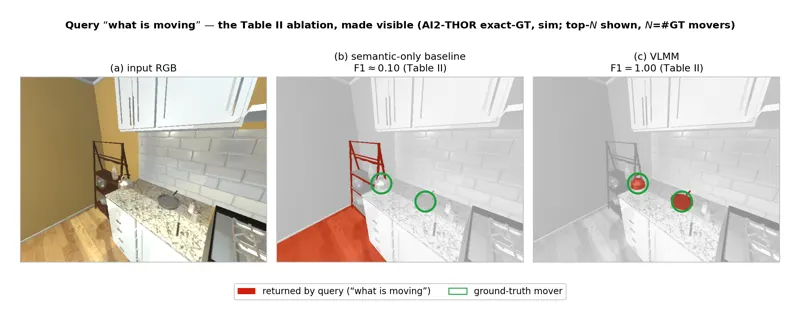
Open-vocabulary 3D maps let robots answer language queries about what and where, but they assume a static world and cannot answer queries about how scene elements behave. We introduce Vision-Language-Motion Maps (VLMM), an open-vocabulary, natural-language-queryable 3D map in which each element carries a fused motion attribute: a VLM/LLM semantic movability prior combined with geometrically observed cross-frame motion, together with a per-element uncertainty. Queries reduce to attribute filters that distinguish what has been seen to move, what could move but has not, and what stays still. On a controlled simulator benchmark with exact ground truth (AI2-THOR, three scene types) we show through ablation that the schema fields are non-substitutable: a semantic-only baseline fails motion queries even with strong features, and neither motion field substitutes for the other (the prior cannot answer "what is moving," observed motion cannot answer "what could move"). On real dynamic RGB-D (TUM and Bonn, six sequences) we show the uncertainty channel-our key difference from prior fused-motion work-consistently improves moving-vs-static average precision and reduces false motion flags, and is robust to estimated (noisy) poses. The raw confidence is not calibrated, but post-hoc isotonic calibration reaches an expected calibration error of 0.10. VLMM is a representation contribution: the closest prior maps each lack at least one of the four properties-open-vocabulary, language-queryable, fused prior-and-observed motion, and per-element uncertainty-that our combination provides.

VLMMOpen-vocabulary
Dibyendu Ghosh, Ayushi Shakya · 437 views · Jul 17, 2026
Safe Execution of RL Policies Via Acceleration-Based CBF-QP Constraint Enforcement for Real-World Robotic Deployments

Safe Execution of RL Policies Via Acceleration-Based CBF-QP Constraint Enforcement for Real-World Robotic Deployments

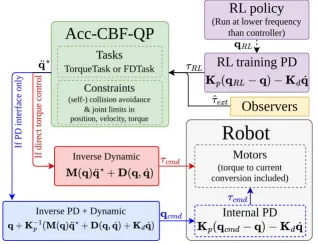
Reinforcement Learning (RL) has demonstrated remarkable capabilities for solving complex robotic control problems, but its lack of safety guarantees severely limits deployment on hardware. In particular, as legged robots and manipulators often operate near safety-critical boundaries, out-of-distribution states can lead to failure upon deployment. To address this, we introduce Acc-CBF-QP, an acceleration-based Quadratic Program (QP) safety filter using Control Barrier Functions (CBFs) that constrains any RL policy onto a safe set at runtime without modifying training. The method applies to unconstrained and Safe-RL policies, and enforces joint position, velocity, torque, and collision constraints within a unified optimization framework. A key contribution is the formulation of RL+QP tasks that regulate deviation from the RL command when constraints would otherwise be violated. We introduce a TorqueTask, minimizing torque deviation, and a Forward Dynamics Task, minimizing induced acceleration deviation, thus providing principled control over safety-performance trade-offs. Experiments on a 7-DoF Kinova Gen3 manipulator and a 19-DoF Unitree H1 humanoid, both in simulation and on hardware, highlight substantial reductions in constraint violations. On the real H1 hardware, a Safe-RL policy alone yielded 10.04 violations/s, which were reduced by 92% to 0.80 violations/s when augmented with Acc-CBF-QP. On the Kinova Gen3, Acc-CBF-QP fully eliminated violations. Nominal task performance of the RL objective is preserved in violation-free regimes. Under aggressive velocity commands on H1, Acc-CBF-QP improves execution by preventing constraint-induced shutdowns, yielding longer survival times. The full pipeline is open-source.

RLSafety
Bastien Muraccioli, Alice Cariou, Pierre-Alexandre Leziart · 476 views · Jul 16, 2026
Scaling Behavior Foundation Model for Humanoid Robots

Scaling Behavior Foundation Model for Humanoid Robots

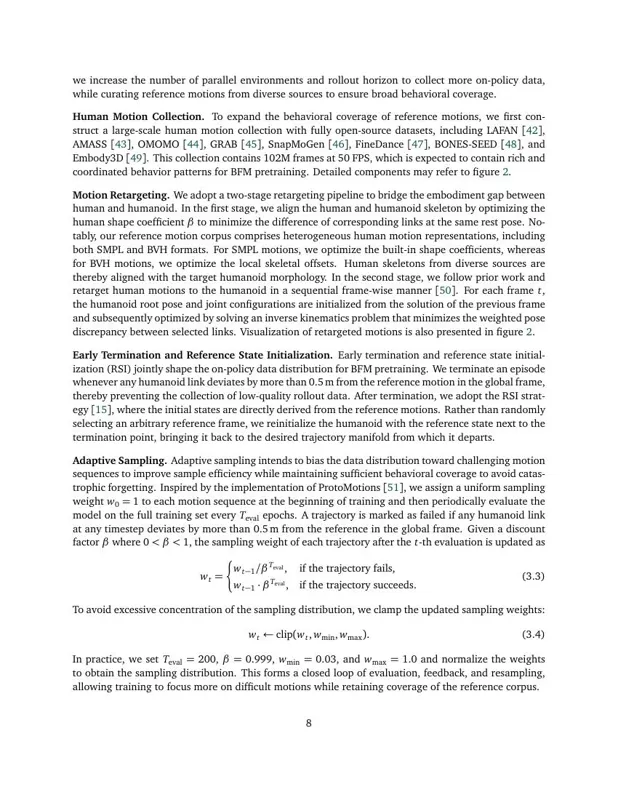
Humanoid control requires natural whole-body coordination, precise real-time responses to control signals, and robust generalization across diverse environmental contexts, making it a cornerstone for generalist embodied agents. Behavior Foundation Models (BFMs) have recently emerged as a promising solution to address these challenges by leveraging large-scale behavioral data to achieve superior expressiveness, versatility and generalization. However, despite growing interest in scaling BFMs to further improve their capabilities, it remains unclear how key factors, including the learning paradigm, behavioral data and model architecture should be coordinated to enable effective scaling. In this work, we revisit the scaling recipe for BFMs and demonstrate that substantial performance gains can be achieved through the coordination of three core components: 1) the learning paradigm of motion tracking that reformulates diverse humanoid control problems as the reproduction of integrated whole-body behaviors in the global frame; 2) the strategic synergy between on-policy rollout quantity and reference motion diversity; and 3) the expressive and scalable model architecture termed Humanoid Transformer that facilitates the natural emergence of structured behavioral representations. Through extensive experiments in both simulation and real-world deployment, we demonstrate that our approach yields significant improvements in control fidelity and task generalization, reducing Mean Per-Keypoint Position Error (MPKPE) on the test set by over 10% in local mode and 82% in global mode compared with existing humanoid controllers. These results establish BFM as a principled and effective foundation for scalable and general-purpose humanoid control.

HumanoidBFM
Weishuai Zeng, Kangning Yin, Xiaojie Niu · 494 views · Jul 16, 2026
RAVEN: Reinforcement-Adaptive Visibility-Graph Planning for Robust Humanoid Navigation with Collision-Free MPC

RAVEN: Reinforcement-Adaptive Visibility-Graph Planning for Robust Humanoid Navigation with Collision-Free MPC

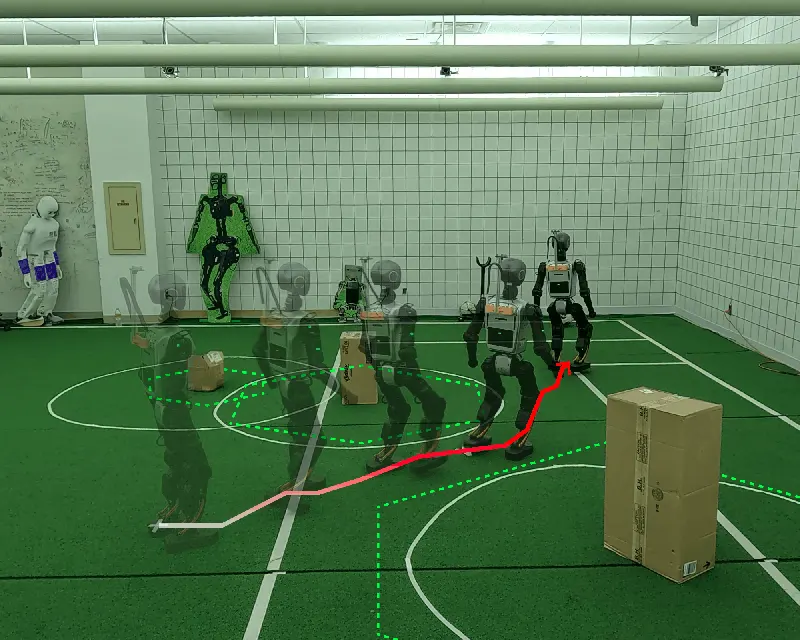
Humanoid navigation in dynamic environments requires long-horizon planning while respecting short-horizon dynamic and safety constraints. Classical visibility-graph planners combined with model predictive control (MPC) can efficiently generate collision-free trajectories, but their performance depends on manually tuned parameters and accurate system modeling. In real robotic systems, control delays, state-estimation noise, and locomotion uncertainties can cause overshoot and constraint violations even when the nominal path is geometrically optimal. We propose RAVEN, a hierarchical reinforcement learning (RL)-MPC framework for robust humanoid navigation. Unlike prior approaches that use learning to tune cost weights or replace planning entirely, RAVEN employs RL to adapt the geometric construction of a visibility-graph planner by modifying obstacle inflation and related graph parameters. By directly reshaping the free-space geometry, the learned planner alters the topology of the global path to compensate for delay and tracking imperfections. A collision-free MPC layer then tracks the planned trajectory while explicitly enforcing velocity bounds and obstacle-avoidance constraints. By training under realistic delays and observation noise, RAVEN learns planning adaptations that improve robustness while retaining explicit long-horizon geometric planning and constrained optimization, in contrast to end-to-end learning approaches. We evaluate RAVEN against a manually tuned visibility-graph MPC baseline and a pure RL navigation policy. Results demonstrate reduced overshoot near obstacles, improved robustness in narrow passages, and more reliable navigation under delay and noise. These findings indicate that reinforcement-adaptive graph construction combined with constrained MPC provides an effective and interpretable alternative to end-to-end learning for robust humanoid navigation.

MPCNavigation
Ruochen Hou, Shiqi Wang, Beom Jun Kim · 461 views · Jul 17, 2026
Handroid: Bridging Dexterous Hand and Humanoid

Handroid: Bridging Dexterous Hand and Humanoid

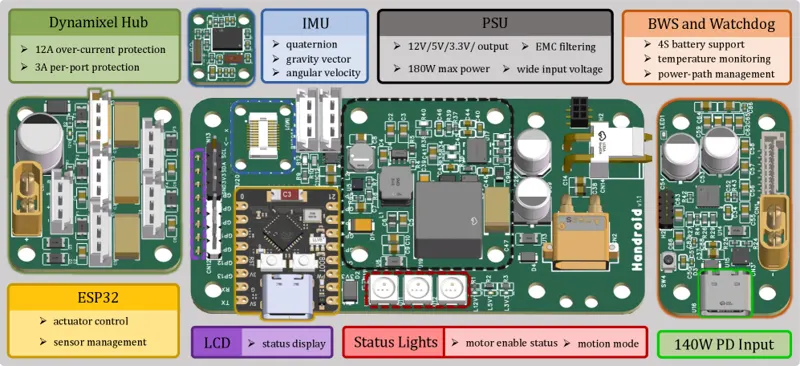
Dexterous hands and humanoid robots are typically developed as distinct embodiments: the former enable contact-rich manipulation at the object scale, whereas the latter provide mobility and whole-body interaction in human-centered environments. We introduce Handroid, a desktop-scale dual-embodiment robot that integrates both capabilities within a single reconfigurable platform. Handroid reuses one 27-DoF electromechanical body as either a dexterous hand or a desktop humanoid, measuring 0.33 m in height and 2.05 kg in weight. In the dexterous hand embodiment, 20 DoFs form an anthropomorphic hand closely matching the kinematic structure of the human hand. In the humanoid embodiment, the same articulated modules are reconfigured into a humanoid with a head, arms, and legs, including a 12-DoF lower-limb structure for locomotion and whole-body motion. Handroid further provides a unified control and learning framework supporting hand teleoperation, dexterous grasping, in-hand manipulation, humanoid locomotion, gait generation, and interactive motion authoring. We validate the platform through real-world dexterous manipulation, reinforcement-learning-based locomotion, keyframe motion deployment, and a long-horizon task involving embodiment reconfiguration, locomotion, docking, and dexterous pick-and-place. These results position Handroid as a compact and reproducible platform for advancing morphology-reconfigurable robotics and cross-embodiment robot learning.

Dexterous HandHumanoid
Ruogu Li, Chenyang Ma, Sikai Li · 421 views · Jul 17, 2026
AeroAct: Action-Centered World-Action Models for Language-Conditioned Quadrotor Flight

AeroAct: Action-Centered World-Action Models for Language-Conditioned Quadrotor Flight

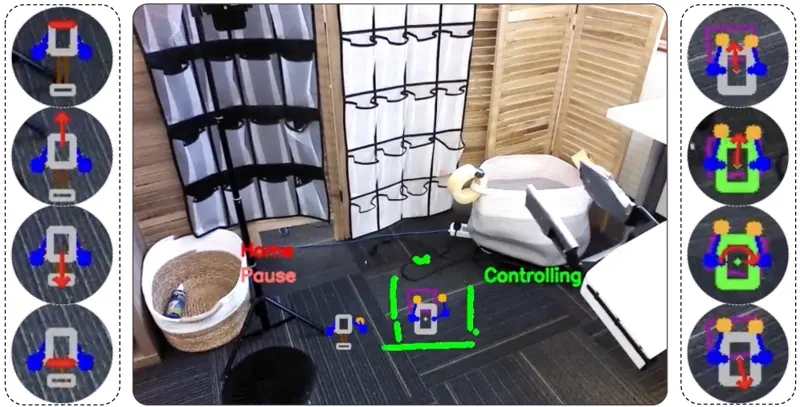
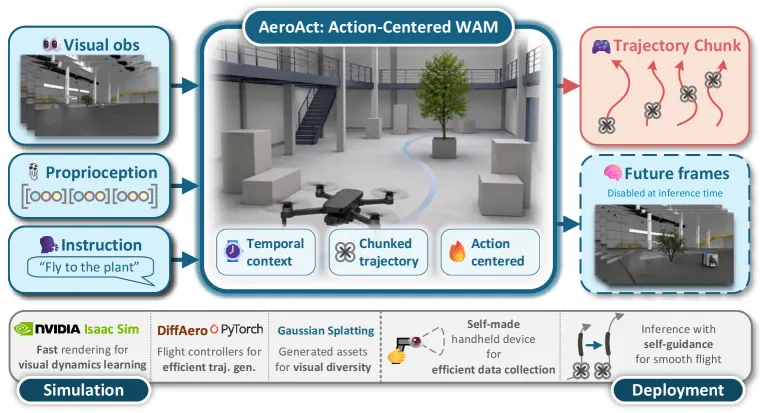
Language-conditioned quadrotor flight requires a policy to ground semantic goals, anticipate the visual consequences of ego-motion, and output control references that remain smooth and dynamically executable under rapidly changing first-person views. Existing aerial vision-language navigation and vision-language-action methods commonly use discrete actions, high-level waypoints, or instantaneous velocity commands, which provide limited supervision about how flight actions change future observations. We present AeroAct, an action-centered world-action model (WAM) for quadrotor navigation. To the best of our knowledge, AeroAct is the first WAM instantiated and demonstrated for real-world aerial flight. The model adapts a pretrained video diffusion Transformer to predict local trajectory-action chunks from egocentric visual history, proprioception, and language. Future first-person frames are used during training as dense consequence supervision, while deployment directly decodes actions without generating future video. To obtain aligned visual, state, language, and dynamically feasible action data, we build a DiffAero-based pipeline with complementary Isaac Lab and 3D Gaussian splatting renderers. We further introduce a low-cost handheld collection device that couples camera observations with motion estimates to recreate flight-like egocentric trajectories, and a self-guidance procedure that improves temporal consistency across overlapping trajectory chunks. Closed-loop simulation and real-world experiments show that temporal visual context improves target tracking and object-search performance, and that WAM-based policies can be executed on a physical quadrotor.

UAVQuadrotor
Xinhong Zhang, Qiyuan Zhu, Yubo Huang · 613 views · Jul 16, 2026
Rendering 3D Gaussians on a Graph Processor

Rendering 3D Gaussians on a Graph Processor

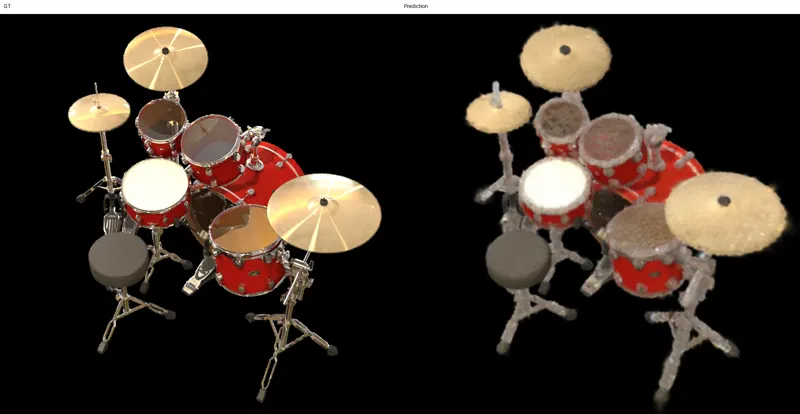
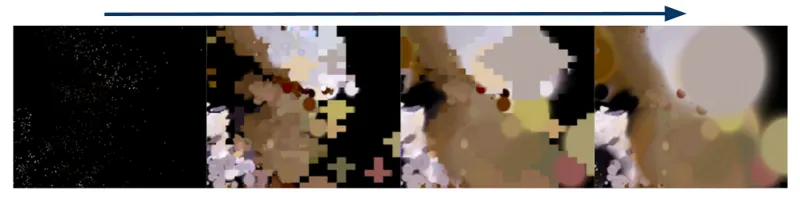
We present the first implementation of a 3D Gaussian renderer on an Intelligence Processing Unit (IPU), comprising 1,472 independent tiles with only on-chip SRAM; constraints that approximate properties of efficient sensor-processor architectures. Our input scenes are 3D Gaussian maps from real-world sequences. Each tile 'owns' a screen-space region of the framebuffer; Gaussian primitives are routed to destination tiles via Manhattan-distance hops on a north-east-west-south (NEWS) grid, then distributed to overlapping neighbours in an expanding tree pattern. Computation follows the IPU's Bulk Synchronous Parallel (BSP) model, with inter-tile communication defined at compile time. We show this hardware allows us to exploit spatial and temporal locality by enabling local data transfer between cores. We evaluate the bottlenecks in this SRAM-only implementation: inter-tile bandwidth, per-tile SRAM capacity, and workload imbalance from non-uniform Gaussian density. We analyse how these constraints affect performance and render quality. This exploration raises broader questions for conventional GPUs and 3D representations, suggesting that direct inter-SM (streaming multiprocessor) communication might offer ways to reduce DRAM access in GPU kernels. We discuss these implications for the future of on-sensor and DRAM-free architectures. Project page: https://nmjfry.github.io/ipu-3dgs/

3D Gaussian SplattingIPU
Nicholas Fry, Ignacio Alzugaray, Mark Pupilli · 330 views · Jul 17, 2026

As an Amazon Associate, we earn from qualifying purchases.