Skip to content
METATRON: A Promptable Whole-Body Execution Layer for Humanoids

METATRON: A Promptable Whole-Body Execution Layer for Humanoids

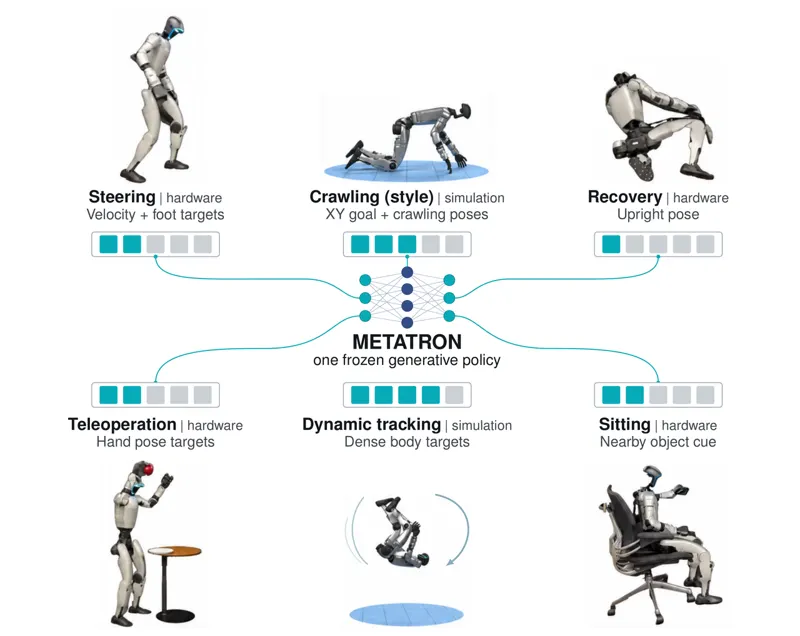
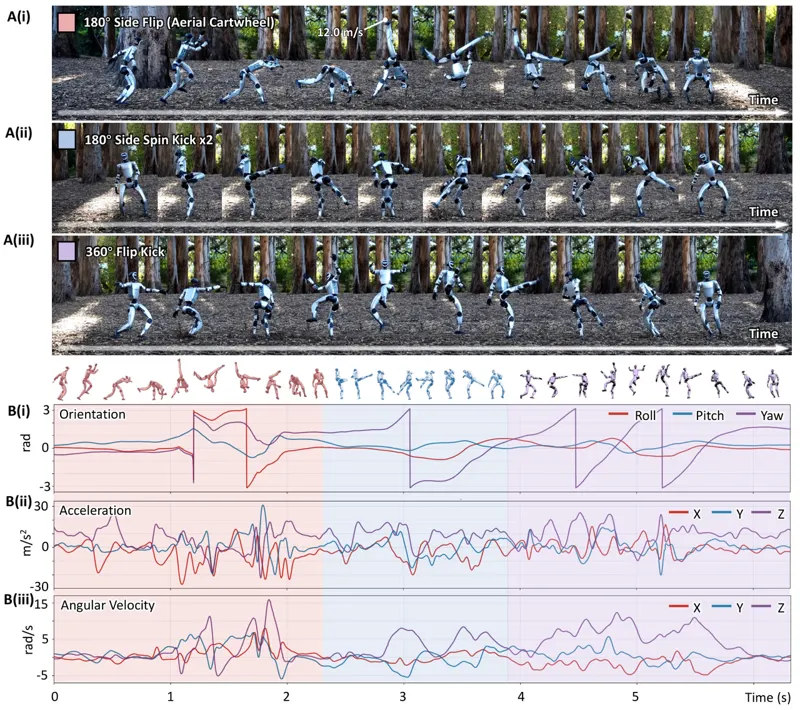
Humanoid controllers often require task-specific training despite sharing the need for balance and whole-body coordination. We present Metatron, a promptable whole-body execution layer combining a generative base policy with a programmable skill layer. The base policy receives partial goals, collectively called a prompt, that can combine timed body-part targets, velocity commands, and style cues. It produces diverse whole-body motions consistent with these goals. Training combines motion capture, synthetic recovery trajectories, and retargeted scene-interaction motions. After training, the policy is frozen. Stateful programs called skills express task intent as prompts at each control step, drawing rough geometric sketches that the policy turns into coordinated movement. Skills are ordinary code, refined by coding agents that analyze motion data and fit compact rules without task-specific policy training. On the physical Unitree G1, one frozen checkpoint supports walking, recovery, teleoperated object pickup, and sitting on furniture. Comparative evaluations show higher reaching success and push robustness than the tested reference-tracking pipelines. The same recipe produces climbing and acrobatics on a simulated character. Metatron enables coding agents to turn learned motor capabilities into new skills through code, without further policy training.

HumanoidWhole-Body Control
Chen Tessler, Yifeng Jiang, Alec Otto · 452 views · Oct 27, 2026
Memory Tax: Dissecting the Net Value of Agent Memory

Memory Tax: Dissecting the Net Value of Agent Memory

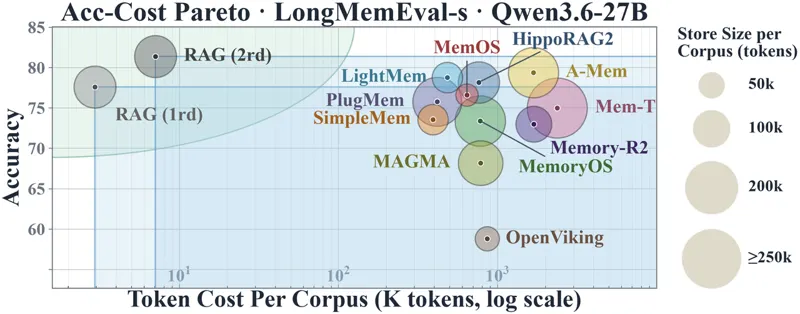
Memory is increasingly used in long-horizon agents, yet the net value of building memory over direct retrieval from raw history remains largely unclear. Through a large-scale evaluation across multiple benchmarks and model backbones, we find many dedicated memory systems underperform naive RAG in many cases, indicating a negative net value. Taking RAG as a reference, we dissect the net value of memory into the gains and losses over direct retrieval, termed memory benefit and memory tax. These gains and losses arise because memory process changes how the raw information is organized and accessed. We view such changes as the double-edged deviations from the raw history. They are originally designed and introduced to benefit the task, for example by reorganizing facts or distilling preferences, but some may also remove or obscure evidence, giving rise to memory tax. Since memory benefit reflects the expected gains of its design, we then focus more on the overlooked memory tax, study how it arises from the system and evaluation side, and generalize the concept to more application scenarios of memory. We hope the notion of memory tax can provide a new lens and shift more attention from standalone performance to the net value of memory, informing more reliable memory designs and evaluations. We will open-source the code and results to the community. Project Page: https://hexuan21.github.io/MemoryTax/

Agent MemoryLong-Term Memory
Xuan He, Sining Zhoubian, Ruozhen Yang · 257 views · Oct 25, 2026
Harness-Zero: Harness Distillation via Agent-as-Harness

Harness-Zero: Harness Distillation via Agent-as-Harness

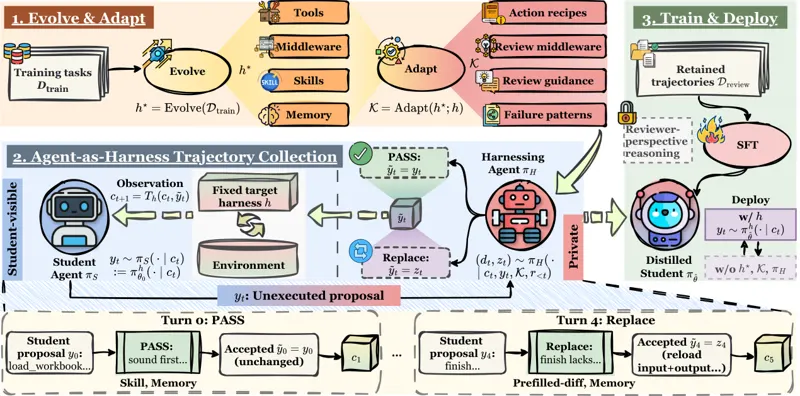
Agent harnesses, the external systems that mediate model-environment interaction, can substantially improve agent performance, but their gains remain tied to the harness at deployment. Because the best harness varies across domains, instances, and models, a general-purpose agent must either settle for a suboptimal shared harness or route among an ever-growing set of specialized ones. We therefore study agent harness distillation: using a domain- or instance-optimized harness as training-time guidance and transferring the behaviors it induces into model weights, so that its gains survive under a single fixed target harness. The challenge is that the two harnesses differ in action space and available information, so guidance from the optimized harness cannot serve directly as supervision for the target one. We introduce Harness-Zero, which enables harness distillation through agent-as-harness. Guided by the optimized harness, a harnessing agent corrects student responses before execution in the target harness's action space, turning harness guidance into training demonstrations. Fine-tuning on the resulting trajectories internalizes harness-induced behavior into the model, so the specialized harness can be removed at deployment. Our experiments spanning knowledge work, tool use, and science domains show that: (1) For frontier LLMs using the same evolved harness, agent-as-harness outperforms code-as-harness. (2) With the specialized harness removed at deployment, Harness-Zero improves the base model's macro-average task success from 23.3% to 44.3%, even exceeding the 41.7% it reaches with that harness still attached. (3) Harness-Zero recovers harness-induced behaviors absent from the base model, with 82.3% average recovery across 28 patterns in the three domains.

Agent HarnessHarness Distillation
Ye, Haoran, Lu, Yuxing, Dong, Haonan · 255 views · Sep 21, 2026
RLSR: Reinforcement Learning from Self Reward

RLSR: Reinforcement Learning from Self Reward

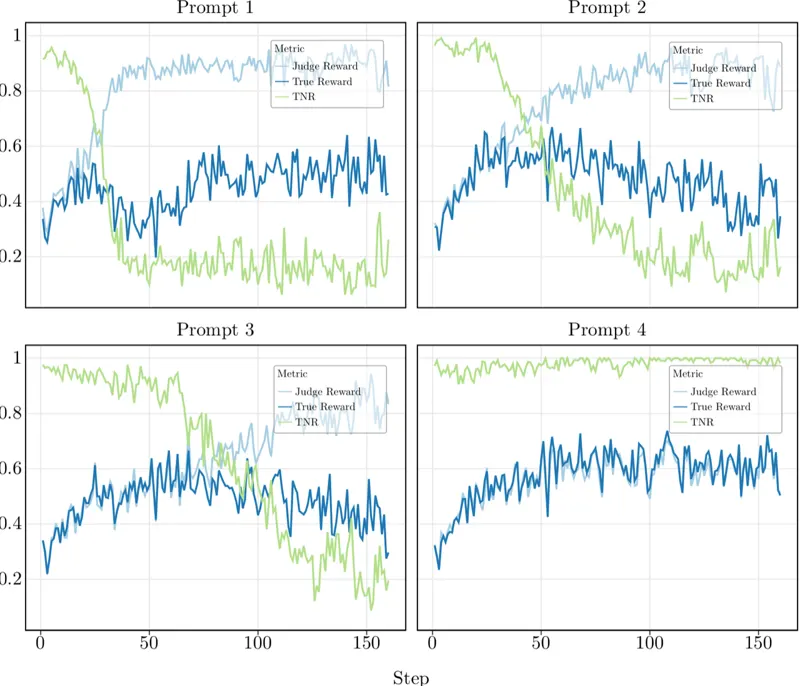
Large language models can generate solutions to complex problems, but training them with reinforcement learning typically requires verifiable rewards that are expensive to create and not possible for all domains. We demonstrate that LLMs can effectively self-improve through self-judging without reference solutions, leveraging the inherent asymmetry between generating and verifying solutions. Our experiments show that models can provide reliable reward signals without ground truth answers, enabling reinforcement learning in domains where verifiable rewards are impractical. By implementing self-judging across Countdown puzzles and integration problems, we achieve performance comparable to formal verification without ground truth solutions. Most notably, Qwen 2.5 7B DeepSeek Distilled trained with self-rewards qualifies for the prestigious MIT Integration Bee competition, performance through self-supervised improvement. When combined with synthetic question generation, we establish a complete self-improvement loop where models generate practice problems, solve them, and evaluate their own performance without any external validation. Our findings demonstrate that LLM judges can provide effective reward signals for training, unlocking reinforcement learning in countless domains previously limited by reward engineering challenges. This work represents a significant step toward autonomous AI systems that continuously improve through self-directed learning rather than human-guided training, potentially accelerating progress across domains where training data is scarce or evaluation is complex.

Reinforcement LearningLarge Language Models
Toby Simonds, Kevin Lopez, Akira Yoshiyama · 195 views · May 12, 2025
Post-Training Large Language Models via Reinforcement Learning from Self-Feedback

Post-Training Large Language Models via Reinforcement Learning from Self-Feedback

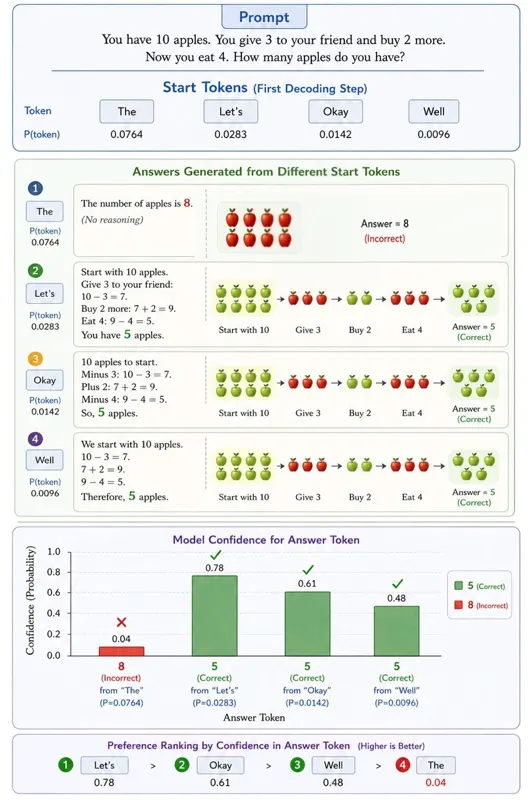
Large Language Models (LLMs) often produce plausible but poorly-calibrated answers, limiting their reliability on reasoning-intensive tasks. Recent research suggests that Chain-of-Thought (CoT) reasoning paths are inherent in pre-trained LLMs and can be elicited by simply altering the decoding process, where the presence of a CoT path correlates with higher answer confidence. Building on these insights, we present Reinforcement Learning from Self-Feedback (RLSF), a post-training stage that utilises the model's intrinsic confidence as a self-generated reward. By generating multiple CoT decoding beams from a frozen LLM, we compute the confidence of each final answer span and rank the resulting traces accordingly to create synthetic preferences. These preferences are subsequently utilised to fine-tune the policy through standard preference optimisation, requiring no human labels, gold answers, or externally curated rewards. RLSF simultaneously (i) refines the model's probability estimates–restoring well-behaved calibration–and (ii) strengthens step-by-step reasoning, yielding improved performance on arithmetic reasoning and multiple-choice question answering. By converting a model's own uncertainty into structured self-feedback, RLSF affirms reinforcement learning on intrinsic model behaviour as a principled and data-efficient component of the LLM post-training pipeline. Our results demonstrate that leveraging these inherent reasoning capabilities provides a robust path for enhancing model reliability without manual prompt engineering or external supervision.

Large Language ModelsReinforcement Learning
Carel van Niekerk, Renato Vukovic, Benjamin Ruppik · 366 views · Jul 29, 2025

As an Amazon Associate, we earn from qualifying purchases.