Skip to content
MulRobBench: A Decision-Level Benchmark for Safe and Security-Policy-Compliant Multimodal UAV Agents

MulRobBench: A Decision-Level Benchmark for Safe and Security-Policy-Compliant Multimodal UAV Agents

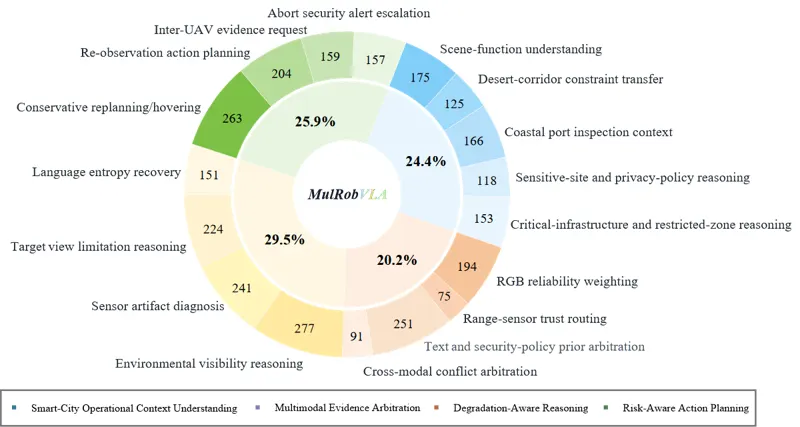
Smart-city airspace is transforming Uncrewed Aerial Vehicles (UAVs) from passive sensing platforms into cyber-physical decision makers that must follow operational rules under degraded observations and ambiguous language. Existing UAV and multimodal benchmarks evaluate perception, navigation, collaboration, and reasoning, but few assess whether physical evidence, protocol constraints, and action risk remain coupled during critical decisions. We introduce MulRobBench, an offline, protocol-conditioned benchmark for Vision-Language-Action (VLA) UAV agents in smart-city environments. MulRobBench integrates real UAV multimodal observations, protocol-level security policies, and action-level cyber-physical safety into a unified evaluation framework. The benchmark contains 3,024 samples spanning 17 task taxonomy nodes and 12 scoring dimensions across four stages: operational context understanding, multimodal evidence arbitration, degradation-aware reasoning, and risk-aware action planning. Evaluation combines semantic scoring with structural diagnostics, including policy compliance, format compliance, unsafe actions, parsing failures, and dimension-level validity. Across 17 multimodal models, the best semantic protocol-decision score reaches only 0.5141, while the best strict mean scoring-dimension accuracy is 0.1599. A controlled 20-anchor modality-ablation study changes 4-15 action selections per model, confirming that both visual and textual inputs influence decisions. Analysis identifies modality-trust selection, constraint extraction, glare, missing data, and operator shorthand as the primary causes of decision instability. MulRobBench provides a reproducible benchmark for trustworthy multimodal UAV decision making under realistic operational constraints.
VLAVision-language-action (VLA)Belal S. Alsinglawi, Weizheng Wang, Junyi Wu·Jul 26, 2026
FutureRTC: Real-Time Robot Execution with Anticipatory-Conditioned Action Chunking

FutureRTC: Real-Time Robot Execution with Anticipatory-Conditioned Action Chunking

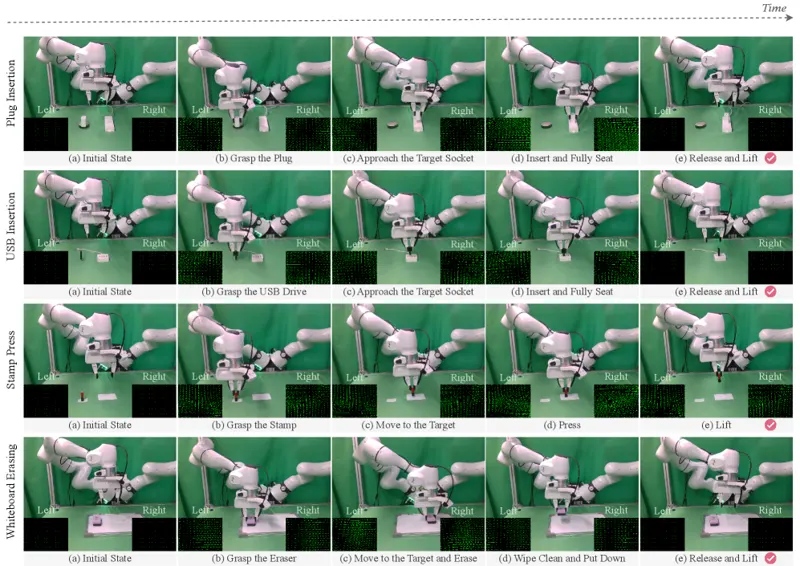
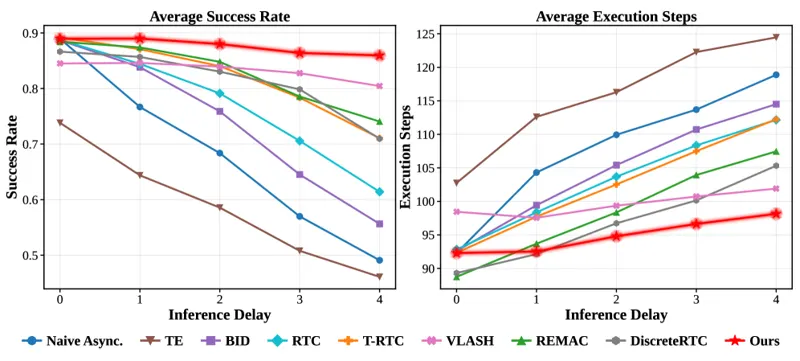
Real-time deployment of Vision-Language-Action (VLA) policies necessitates asynchronous execution, wherein subsequent action chunks are computed concurrently with the execution of the current chunk, leading to prediction-execution misalignment and manifesting as inter-chunk discontinuities. Existing methods either superficially smooth chunk boundaries, require costly policy optimization, or exclusively forward-predict proprioceptive states yet neglect critical visual observations. In this paper, we propose FutureRTC, a plug-and-play adaptation framework that predicts execution-time observations and states for asynchronous VLA control without modifying the underlying policy. Specifically, FutureRTC features a state correction module to compensate for the discrepancy between rolled-forward and actual execution-time proprioceptive states and an observation prediction module that forecasts execution-time visual representations by leveraging robot motion as an explicit physical prior through motion-aware feature transport and reconstruction. Furthermore, we introduce a policy consistency loss to align the action chunks generated from predicted contexts with those produced under the expected execution-time inputs of the VLA policy. Extensive experiments across simulated and real-world environments demonstrate that FutureRTC achieves superior robustness to inference delays, resulting in smoother trajectories, faster execution, and consistently higher task success rates.

VLAVision-language-action (VLA)Hai Jiang, Yixian Zou, Binbin Liang·Jul 27, 2026
DeVA: Decoupled Video-Action Model with physical guidance for robot policy learning

DeVA: Decoupled Video-Action Model with physical guidance for robot policy learning

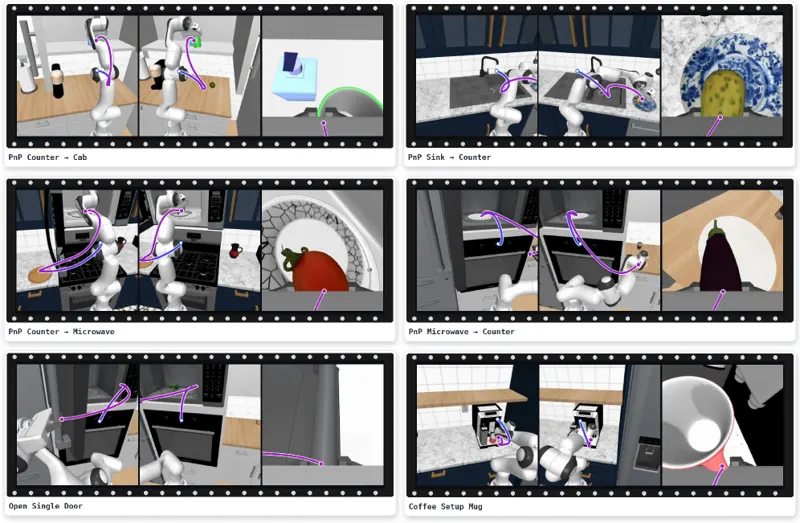
Generalizable robot manipulation requires policies that can anticipate how visual scenes evolve while executing language instructions. While recent Vision-Language-Action models benefit from large-scale pretraining, their predominantly static pretraining objectives provide limited supervision for physical dynamics and temporal causality, leaving control-relevant knowledge to be learned from downstream robot demonstrations. Video generative models offer a promising foundation by encoding rich spatiotemporal priors through future predictions. However, existing Video-Action Models either couple video and action prediction in a shared backbone, making policy adaptation harder to optimize, or under-utilize video information when guiding the action branch. In this work, we introduce DeVA, a Decoupled Video-Action model with specialized video and action experts, multi-level feature transfer, and physically salient guidance. DeVA transfers representations from multiple video layers to the action expert, enabling rich information exchange while making policy learning more tractable. It further supervises intermediate video features and the action stream with physically salient guidance (affordance/depth). Experiments on both simulation benchmarks and real-world deployment demonstrate strong performance with limited data, faster convergence than a unified architecture, and clear performance gains from physical guidance.

VLAVision-language-action (VLA)Mengqi Zhang, Sahil Khose, Simar Kareer·Jul 27, 2026
Addressing the Orchestration Gap in Generalist Robots via Physical Agency

Addressing the Orchestration Gap in Generalist Robots via Physical Agency

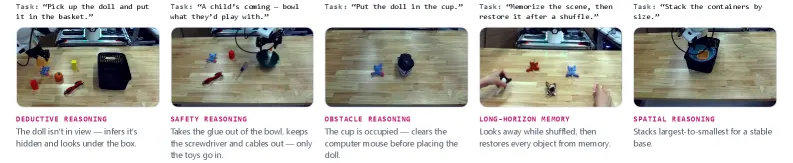
General-purpose robots need to reason about their actions, combining perception, world knowledge, planning, success detection, recovery, and low-level control. Today's state-of-the-art models attempt to combine all these capabilities into the learned policy via large-scale pre-training. Instead, we show that these capabilities can be decomposed into a general language-conditioned policy/control agent and a high-level agent manager/orchestrator. Rather than training policies to reason via pre-training, we build a closed-loop physical agent orchestrator that can do high-level planning, decompose the goal into achievable subgoals, command low-level motor commands, track and verify the outcome from low-level observations, and recover from failures. Our Physical Agency orchestrator (Pigey) can control existing vision-language-action (VLA) policies as well as parametrized skills to solve complex reasoning tasks in the real world, without any additional data collection or post-training. We evaluate Pigey extensively across simulation benchmarks and challenging real-world robotic manipulation tasks, and demonstrate significant performance improvements over existing generalist policies. On LIBERO-PRO, Pigey advances the state-of-the-art by over 4x (12.8% -> 53.3%) with no task-specific fine-tuning. On a real robot, Pigey lifts the frozen policy from near-zero to over 90% on reasoning-limited tasks. We call the difference between what frozen motor skills achieve alone and inside the agentic loop the orchestration gap.

VLAOrchestrationPrincetonLiane Galanti, Dhruv Shah, Tri Dao·Jul 23, 2026
ReferTrack: Referring Then Tracking for Embodied Visual Tracking

ReferTrack: Referring Then Tracking for Embodied Visual Tracking

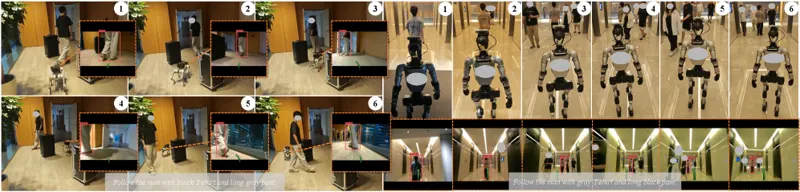
Embodied visual tracking (EVT) requires a mobile agent to continuously follow a specific target described in natural language using only onboard vision. While recent vision-language-action (VLA) policies unify target identification and trajectory planning, their chain-of-thought (CoT) reasoning often operates in abstract spatial latents that are difficult to supervise and weakly aligned with explicit image-space detections. To address this, we introduce ReferTrack, a referring-then-tracking paradigm that grounds EVT using a single forward-facing camera. Our model first selects the target from an indexed set of bounding boxes, then decodes tracking waypoints conditioned on this image-grounded decision. To preserve target motion cues over time, ReferTrack maintains a sliding-window queue of previously selected bounding boxes, injecting their geometric features into the visual history via temporal-viewpoint-bbox indicator (TVBI) tokens. We further enhance target identification by co-training on a custom Refer-QA dataset. On EVT-Bench, ReferTrack achieves state-of-the-art single-view performance with success rates of 89.4%, 73.3%, and 74.1% on the single-target, distracted, and ambiguity tracking splits, respectively – matching or even surpassing several multi-camera baselines on identification-heavy tasks. Finally, real-world deployments on legged and humanoid robots validate its robust sim-to-real transfer capabilities. Code is available at https://github.com/MedlarTea/referTrack.

VLAObject trackingReferenceHanjing Ye, Tianle Zeng, Jiazhao Zhang·Jul 22, 2026
CosFly-VLA: A Spatially Aware Vision-Language-Action Model for UAV Tracking

CosFly-VLA: A Spatially Aware Vision-Language-Action Model for UAV Tracking

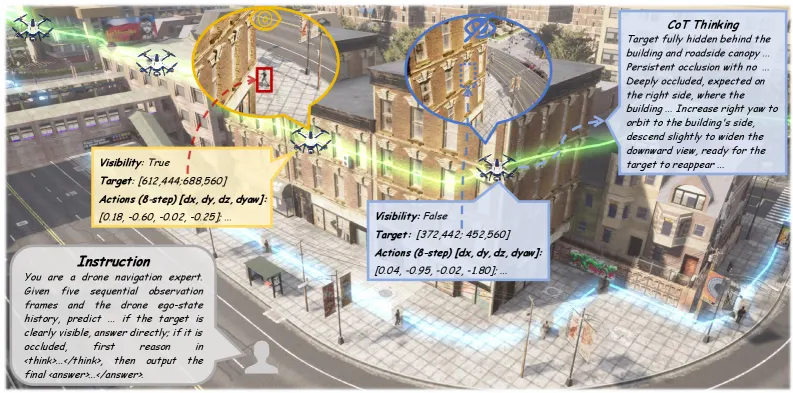
Dynamic target tracking is essential for Unmanned Aerial Vehicles (UAVs) operating in complex urban environments, where both the target and the camera viewpoint change continuously. Existing Vision-Language-Action (VLA) policies can track visible targets effectively, but their performance often degrades when buildings, vegetation, or roadside objects block the line of sight. During sustained occlusion, a policy may lose the target state, execute actions toward an incorrect region, and amplify this error through subsequent observations until re-acquisition becomes impossible. To this end, we present CosFly-VLA, a spatially aware VLA model that jointly grounds the target, estimates its visibility, and generates continuous flight actions through a structured prediction interface. To train this policy, we use a large-scale recipe over diverse data sources. Spatially Grounded Continued Pretraining (CPT) on a 500k mixed pool injects UAV-view depth, distance, and 3-D spatial reasoning. A three-stage Curriculum-based Supervised Fine-Tuning (SFT) process then specializes the tracker through multi-head warm-up followed by two-stage curriculum learning over natural and hard / long-occlusion data. Chain-of-Thought (CoT) training subsequently teaches recovery-oriented reasoning traces before structured answers. Finally, a closed-loop Reinforcement Learning (RL) stage optimizes tracking behavior with a multi-component reward covering stand-off tracking, grounding quality, collision avoidance, and task success. Relative to OpenVLA, CosFly-VLA-0.8B reduces open-loop Average Displacement Error (ADE) by 34.1% on seen-test and 35.3% on unseen-test. Closed-loop optimization improves Success Rate (SR) by 29.8% and 2.5%, respectively. These results demonstrate progress from visible-frame imitation toward spatially grounded action-closed-loop control, evaluated under a shared oracle state history.

UAVVLATrackingRuilong Ren, Songsheng Cheng, Yunpeng Zhou·Jul 16, 2026
AeroAct: Action-Centered World-Action Models for Language-Conditioned Quadrotor Flight

AeroAct: Action-Centered World-Action Models for Language-Conditioned Quadrotor Flight

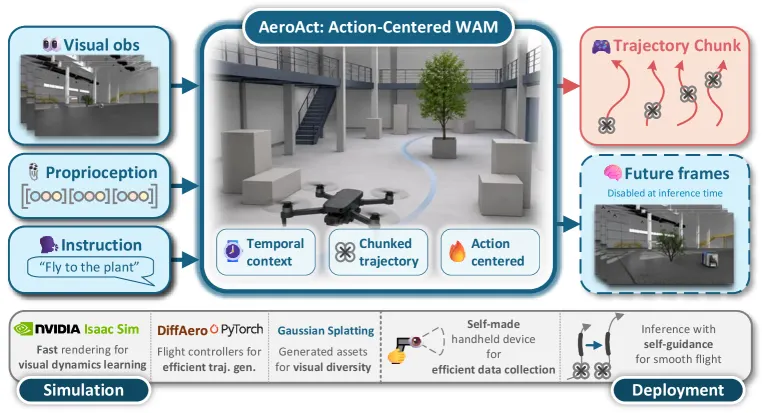
Language-conditioned quadrotor flight requires a policy to ground semantic goals, anticipate the visual consequences of ego-motion, and output control references that remain smooth and dynamically executable under rapidly changing first-person views. Existing aerial vision-language navigation and vision-language-action methods commonly use discrete actions, high-level waypoints, or instantaneous velocity commands, which provide limited supervision about how flight actions change future observations. We present AeroAct, an action-centered world-action model (WAM) for quadrotor navigation. To the best of our knowledge, AeroAct is the first WAM instantiated and demonstrated for real-world aerial flight. The model adapts a pretrained video diffusion Transformer to predict local trajectory-action chunks from egocentric visual history, proprioception, and language. Future first-person frames are used during training as dense consequence supervision, while deployment directly decodes actions without generating future video. To obtain aligned visual, state, language, and dynamically feasible action data, we build a DiffAero-based pipeline with complementary Isaac Lab and 3D Gaussian splatting renderers. We further introduce a low-cost handheld collection device that couples camera observations with motion estimates to recreate flight-like egocentric trajectories, and a self-guidance procedure that improves temporal consistency across overlapping trajectory chunks. Closed-loop simulation and real-world experiments show that temporal visual context improves target tracking and object-search performance, and that WAM-based policies can be executed on a physical quadrotor.

UAVQuadrotorWorld ModelsXinhong Zhang, Qiyuan Zhu, Yubo Huang·Jul 16, 2026
JoyNexus: Service-Oriented Multi-Tenant Post-Training for VLA Models

JoyNexus: Service-Oriented Multi-Tenant Post-Training for VLA Models

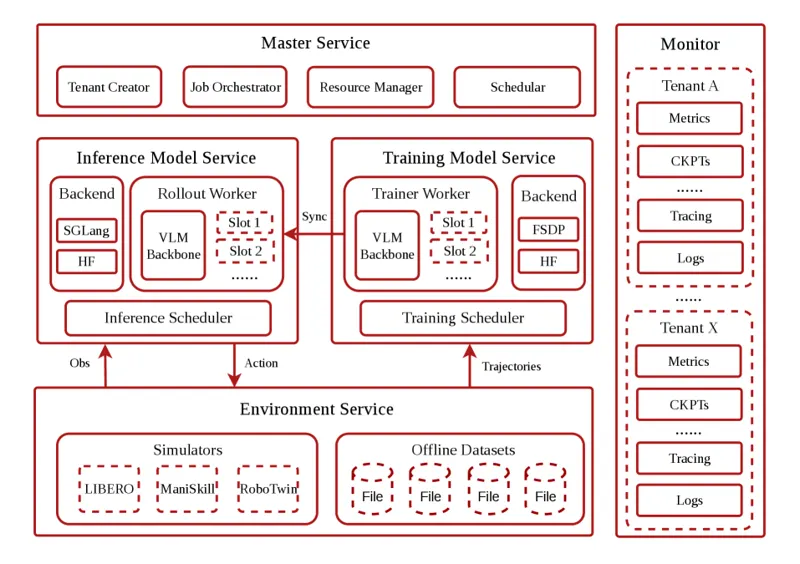
The post-training of Vision-Language-Action (VLA) models is essential due to the diversity of simulators, robot embodiments, and task objectives. Existing compute services, whether offered as direct accelerator rental or batch-workload submission, typically allocate an exclusive set of GPU and CPU resources to a single tenant. While this paradigm maximizes client flexibility, it burdens users with infrastructure adaptation, and the fixed card-hour accounting model renders short or bursty workloads both expensive for tenants and inefficient for the service provider. To address these challenges, we present JoyNexus, a unified service for multi-tenant VLA supervised fine-tuning, reinforcement learning, and evaluation. JoyNexus decouples the Training Model Service, Inference Model Service, and Environment Service, each accessed through APIs and backed by resident shared base models with tenant-specific slots. Tenants can directly invoke high-level semantic APIs for training, rollout, and evaluation, or compose custom algorithms using lower-level APIs and their assigned endpoints. Multiple tenants submit workloads concurrently; their action modules, optimizers, rollout records, and policy versions remain isolated, and the service is scheduled by the global Training Queue and Inference Queue. To further improve multi-tenant training efficiency, JoyNexus introduces group batching for heterogeneous VLA data schemas that share a compatible model-facing prefix, enabling a single shared backbone forward pass over grouped samples. Finally, we evaluate JoyNexus through workload simulation and a group-batching pipeline in a realistic embodied scenario. Results show that, compared with isolated single-tenant execution, JoyNexus reduces aggregate GPU time and improves service utilization via cross-tenant scheduling on shared resources.

VLAPost-trainingMulti-TenantHaoran Sun, Wentao Zhang, Junyang Hua·Jul 17, 2026