Skip to content
CAP: Continuously Adaptive Perception-Blind Humanoid Locomotion via Learned Denoising

CAP: Continuously Adaptive Perception-Blind Humanoid Locomotion via Learned Denoising

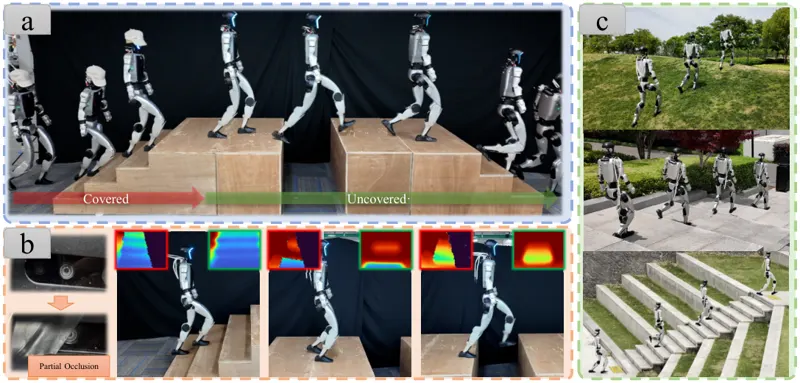
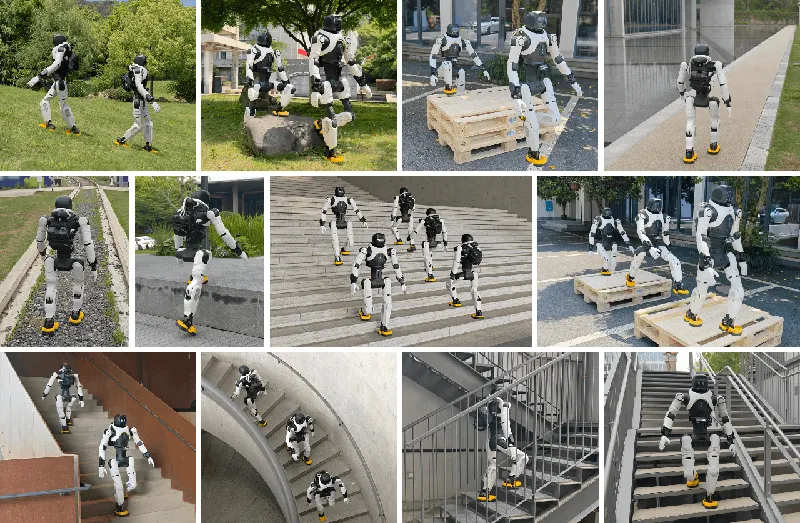
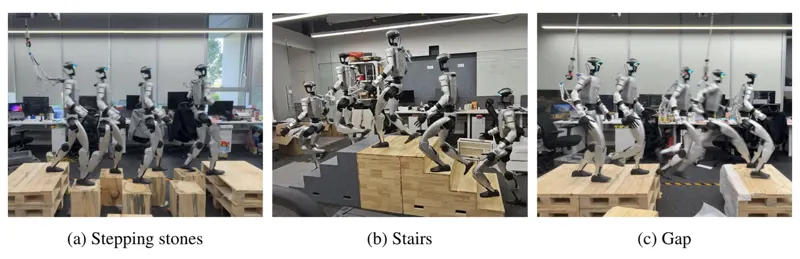
Humanoid locomotion across complex terrain demands forward-looking exteroception to anticipate obstacles, yet this signal is unreliable in real-world deployment, failing partially and intermittently. Existing perceptive policies often assume that depth observations remain clean and in-distribution, while recent attempts to unify perceptive and blind control typically route or switch between separate sub-policies, leaving recoverable information in partially corrupted depth unexploited. We instead propose CAP, a single-stage humanoid locomotion policy that recovers this signal with a perceptive world-model encoder trained as a learned denoiser to reconstruct clean depth from a corrupted input, together with a co-active proprioceptive variational encoder that supplies depth-free body-state information. A coupled training recipe pairs a depth-noise curriculum on the world-model input with world-model feature dropout on the policy-facing latent, exposing the policy to failures across the entire perception-quality spectrum. In simulation, CAP matches or improves upon perceptive baselines when depth remains informative, and degrades more smoothly than a binary-switching baseline as perception worsens. On the Unitree G1, controlled trials and indoor-outdoor deployments demonstrate perception-robust locomotion under intermittent occlusion, real-sensor corruption, and outdoor depth artifacts.

Humanoid LocomotionWorld Models
Chen, Hongjin, Xu, Zijun, Ma, Shihao · 1.4k views · Sep 10, 2026
ReST-RL: Reinforcing LLM Reasoning through Unified Self-Training and Value-Guided Search

ReST-RL: Reinforcing LLM Reasoning through Unified Self-Training and Value-Guided Search

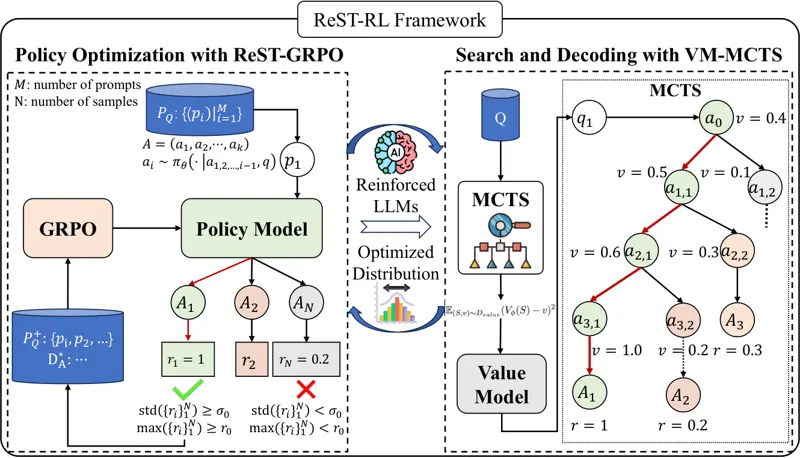
GRPO is the representative RL method for improving LLM reasoning, yet it only ever sees one sparse reward at the end of a whole trajectory: when the rewards inside a sampled group land close together, the group-relative advantage collapses into noise and the policy learns almost nothing. ReST-RL reconnects policy optimization and value-guided search into a single self-training pipeline. Stage one, ReST-GRPO, first filters out low-information prompts by reward standard deviation, then draws prefixes from each prompt's highest-reward trajectory under a discrete exponential distribution and uses them as fresh online-GRPO starting contexts. A selected prefix is context only; its suffix is re-sampled and optimized rather than imitated. Stage two, VM-MCTS, runs MCTS under the now-static policy to self-collect value targets and trains a value model that predicts expected terminal reward. At inference the same model both allocates the tree search through UCT and ranks completed candidates in a Best-of-N fashion, so search and verification share one state-value scale. On coding benchmarks including APPS, BigCodeBench and HumanEval, Qwen3-8B moves from 0.503 to 0.689 average. In matched policy-value controls, ReST-GRPO + VM-MCTS reaches 0.642 on APPS-500 while GRPO + VM-MCTS reaches only 0.538, so the stage-one distributional shift survives value learning. End-to-end accounting puts ReST-GRPO at 1,752 GPU-hours against 2,080 for GRPO, hitting a 9% gain in 71 hours instead of 207. A value model trained only on code trajectories also transfers to MATH, Omni-MATH and GPQA-Diamond without target-domain tuning.

Reinforcement LearningGRPO
Sining Zhoubian, Dan Zhang, Jie Tang · 759 views · Aug 27, 2025
TANGO: Humanoid Navigation in Cluttered Environments with a Whole-Body Vision-Language-Action Model

TANGO: Humanoid Navigation in Cluttered Environments with a Whole-Body Vision-Language-Action Model

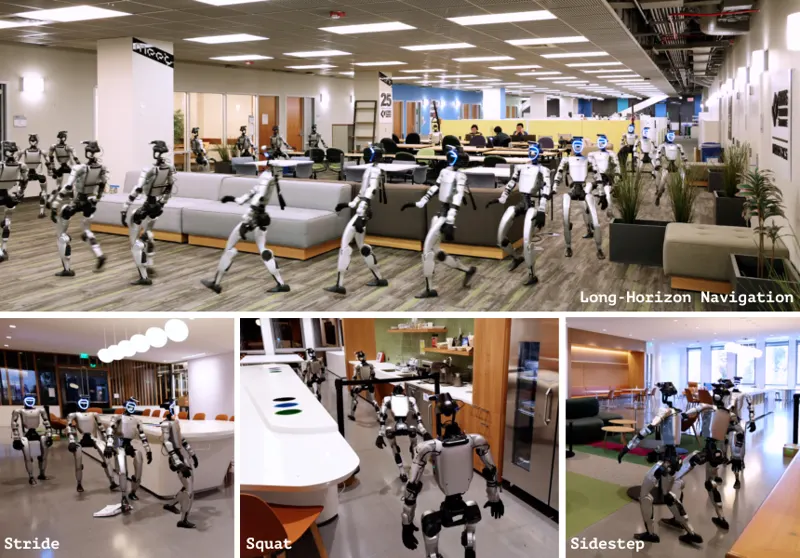
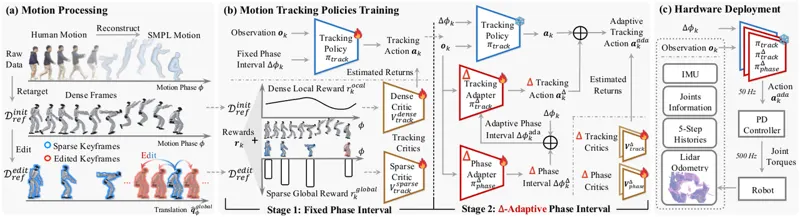
We study the problem of navigating cluttered indoor environments with a humanoid robot. Unlike conventional methods that model navigation as a 2D path planning problem, humanoid traversal in cluttered environments requires continuous geometry-aware whole-body adaptation, including coordinated arm placement, torso adjustment, and gait modulation for collision-free movement through complex 3D spaces. We introduce TANGO, the first whole-body vision-language navigation framework for language-conditioned humanoid traversal in cluttered environments. Given a natural-language instruction and egocentric RGB observations, TANGO directly predicts 29-DoF joint-space actions for downstream whole-body control. We train TANGO entirely in simulation by synthesizing diverse collision-free traversal behaviors via global path planning, kinematic whole-body motion generation, obstacle-aware motion editing, and RL-based tracking. This pipeline provides dynamically feasible action supervision for learning language-conditioned whole-body policies. In extensive simulation experiments, TANGO demonstrates state-of-the-art performance in vision-language navigation, while outperforming strong modular baselines in navigating challenging scenes requiring obstacle negotiation. Lastly, we deploy TANGO zero-shot on a Unitree G1 humanoid robot, and observe robust language-guided traversal in cluttered real-world scenes without training on any real-world navigation data.

HumanoidVLA
Anqi Li, Yuxin Chen, Zhaobo Li · 1.1k views · Sep 8, 2026

As an Amazon Associate, we earn from qualifying purchases.