Skip to content
Scaling Native Multimodal Pre-Training From Scratch

Scaling Native Multimodal Pre-Training From Scratch

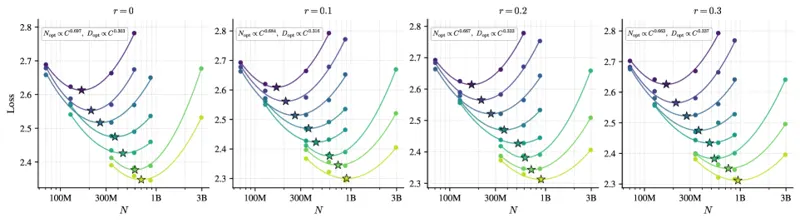
Although large language models (LLMs) exhibit remarkable reasoning capabilities, their reliance on text-only pre-training restricts the perception of the multimodal physical world. Native multimodal pre-training avoids this limitation by training models from scratch on multimodal inputs, thereby achieving deep cross-modal integration and mitigating optimization asymmetries inherent to traditional late-fusion architectures. Despite these advantages, the scaling properties of this paradigm remain systematically uncharacterized. To address this gap, we investigate the optimal model size and token count for training a transformer-based vision-language model under a fixed computational budget. We demonstrate that minimal objective loss adheres to a predictable compute law, whereas compute-optimal model sizes and token counts scale as power laws. Notably, language and multimodal objectives manifest distinct scaling behaviors. The language allocation law is largely invariant to the composition of the data, indicating stable language learning regardless of the multimodal data ratio. Conversely, the multimodal allocation law is highly sensitive to this composition. Specifically, text-heavy mixtures become compute-efficient only at larger model scales, shifting the optimal resource allocation toward greater model capacity. Additionally, by modeling the influence of data composition on compute laws and allocation exponents, we derive an efficiency frontier specifying precise configurations of model size, token count, and data mixture. Downstream evaluations further reveal that native multimodal pre-training induces positive cross-modal transfer, thereby enhancing pure-text spatial reasoning and enabling robust multimodal in-context learning. In summary, this empirical research establishes the essential groundwork for predictably scaling multimodal foundation models.

MultimodalPre-Training
Haoyuan Wu, Aoqi Wu, Hai Wang · 556 views · Jul 24, 2026
Persistent Computational State: A Session-Centric Runtime for Generative World Models

Persistent Computational State: A Session-Centric Runtime for Generative World Models

Generative world models are increasingly driven as simulators: a planner forks a state, rolls out futures, backtracks, and returns to a visited viewpoint. Recent benchmarks establish that current video world models fail this usage, and attribute it to the model, prescribing new architectures and training objectives. We show this attribution is incomplete, and for an important class of models simply wrong. Snapshotting the state the runtime already holds – an observation plus RNG state, a memory bank, or a windowed KV context, by architecture – and restoring it after a genuine excursion reproduces the never-left continuation byte-identically on all three; corrupting only the RNG degrades it. The capability was never missing: request-centric serving discarded it, inheriting from language-model serving the assumption that runtime state is recomputable – but world-model state carries a non-recomputable kernel. We define Persistent Computational State (PCS), the minimal non-recomputable state that must survive across requests, show it can be discovered by measurement, and build a session-centric runtime over it. Checkpoint and restore cost 0.012 ms against a 1.85 s generation step; resident sessions become host- rather than device-bounded (measured to 1,024); and world memory must be evicted by relevance to the return, not recency – the inverse of LLM practice.

World ModelsGenerative
Zhen Lin · 394 views · Jul 23, 2026
On the Identifiability of Controlled World Models

On the Identifiability of Controlled World Models

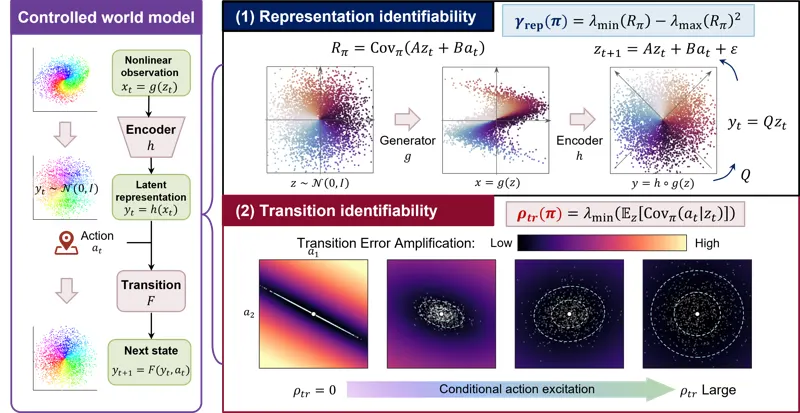
Learning world models that infer environment dynamics from high-dimensional observations and predict outcomes under candidate actions is central to planning and control. Joint-Embedding Predictive Architectures (JEPAs) provide a compelling framework for learning such models in representation space. Recent action-conditioned extensions perform promisingly in visual control and latent-space planning, but leave a fundamental question unresolved: when does controlled latent prediction identify both the underlying state and the controlled dynamics? This is challenging under nonlinear observations and behavior policies with limited conditional action variation, where state-dependent evolution and action effects can be statistically confounded. We establish a joint identifiability theory for controlled world models with Gaussian latent states under state-dependent Gaussian behavior policies. We identify two policy-dependent conditions: spectral separation of the predictable signal governs representation identifiability, while non-degenerate conditional action variation governs transition identifiability. We prove that when both conditions hold, every global minimizer of the JEPA objective identifies the latent state and controlled transition up to an orthogonal transformation. We further derive quantitative bounds on representation and transition identifiability under approximate optimization. Finally, we construct predictor perturbations along weakly excited action directions whose counterfactual-to-on-policy error ratio is the inverse transition-identifiability margin, revealing the cost of limited action coverage. Experiments across nonlinear observation maps and behavior policies corroborate the theory and demonstrate implications for transition identifiability, counterfactual prediction, and goal-conditioned latent planning.

World ModelsIdentifiability
Xiangteng Zhang, Yang Guan, Bo Zhang · 339 views · Jul 24, 2026
ViTacWorld: Scaling Visuo-Tactile World Models for Contact-Rich Robot Manipulation

ViTacWorld: Scaling Visuo-Tactile World Models for Contact-Rich Robot Manipulation

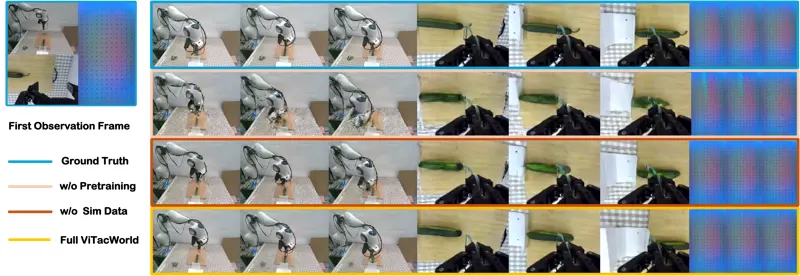
Contact-rich robot manipulation requires physical interaction cues that are often invisible to cameras, making tactile sensing essential for robust control. However, scaling visuo-tactile robot learning remains difficult because real tactile interaction data are expensive to collect, hardware-dependent, and limited in task and scene diversity. We present ViTacWorld, an action-conditioned visuo-tactile world model for scalable contact-rich robot manipulation. ViTacWorld leverages public real tactile datasets and a constructed simulation environment to scale visuo-tactile-action data, exploiting the fact that tactile signals are directly grounded in physical contact and can exhibit a smaller simulation-to-real gap than purely visual observations. The model is first pretrained with large-scale real and simulated visuo-tactile trajectories, and then finetuned with real-world policy rollouts to better match downstream manipulation behaviors. Given robot actions, ViTacWorld predicts temporally aligned visual observations and tactile feedback, enabling visuo-tactile-action rollout generation. To the best of our knowledge, ViTacWorld is the first framework that uses a world model for robot visuo-tactile-action trajectory generation and policy evaluation. It serves two roles: synthesizing rollouts to improve downstream tactile policies, and evaluating policies by predicting action-conditioned visuo-tactile outcomes under controlled action sequences. Experiments on contact-rich manipulation tasks show that ViTacWorld generates physically meaningful rollouts, improves policy performance through scalable data augmentation, and enables action-conditioned policy evaluation. Project page: https://vitacworld.github.io/

World ModelsVisuo-Tactile
Yunao Huang, Shiyu Sang, Haotao Lu · 576 views · Jul 24, 2026

As an Amazon Associate, we earn from qualifying purchases.