Skip to content
SKooP: Symmetric Koopman Predictions for Faster and More Generalizable Legged Robot Locomotion with Reinforcement Learning

SKooP: Symmetric Koopman Predictions for Faster and More Generalizable Legged Robot Locomotion with Reinforcement Learning

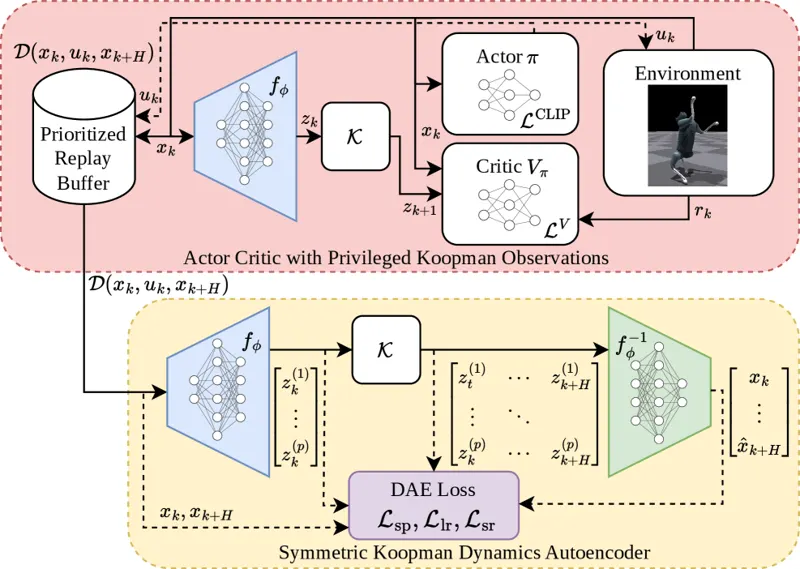
Reinforcement learning (RL) algorithms classically suffer from poor sample efficiency. In robotics, a recent line of work has emerged addressing this problem by encoding physics priors in the learning process. However, most of these approaches are validated on well-defined, low-dimensional benchmark systems rather than high-dimensional robots with complex nonlinear dynamics. In this paper, we introduce SKooP (Symmetric Koopman Predictions), an approach combining the advantages of morphological symmetries with those of a Koopman model learned via autoencoder to enhance policy learning. SKooP learns a Koopman model of the system dynamics alongside the policy. The resulting Koopman predictions are used as privileged observations for the critic, allowing the agent to learn based on smoother, more informative features. We also incorporate group symmetries into the actor, critic, encoder and decoder networks to produce a highly equivariant policy. The SKooP approach is validated via in-depth analysis of the learned Koopman models and symmetric policies to showcase how each of these influences the agent's performance. We also show that the learned policies are transferable to different simulation environments. Our results show that SKooP consistently reduces convergence time and increases the learned reward for multiple challenging bipedal locomotion tasks on a quadruped robot. Project page: https://evelyd.github.io/SymmetricKoopmanPredictions

KoopmanReinforcement LearningGait optimizationEvelyn D'Elia, Weishu Zhan, Giulio Turrisi·Jul 13, 2026
Robust bipedal locomotion on flowable slopes via foot-driven terrain manipulation

Robust bipedal locomotion on flowable slopes via foot-driven terrain manipulation

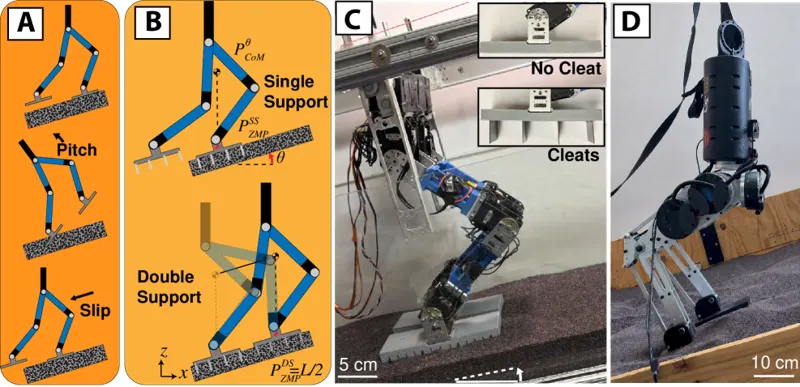
Bipedal robots are challenging to control because they operate close to instability, where small variations in foot-terrain contact can rapidly destabilize locomotion. On rigid terrain, bipedal robots mitigate this fragility by using well-established contact mechanics and control strategies. On flowable surfaces such as granular slopes, foot contact can induce large surface deformations and solid-fluid-like transitions, coupling terrain effects with robot dynamics, leading to underperformance or failure. This is partly due to the lack of reliable methods to represent the dynamics of flowable terrain, making it difficult to account for terrain effects in locomotion design. Here, we investigate how controlling terrain response can improve bipedal locomotion on granular slopes by studying the terradynamics of cleated feet, thin plates emanating from the foot soles. Systematic studies of a small-scale (1.4 kg) robophysical biped reveal that cleats with sparse and dense spacing lead to excessive terrain yielding and resistance, respectively, degrading performance and leading to failure. An intermediate cleat spacing distributes interaction forces to maintain substrate stresses near (or below) the yield threshold, enabling walking on granular slopes up to 30 degrees. Guided by these principles, we design a foot that actively adjusts cleat depth and accommodates both rigid and granular terrain. We also demonstrate that the principles of effective foot-terrain interaction translate to a larger (15 kg) autonomous biped. Our study presents an alternative to conventional body-centric robot control approaches, which regulate terrain-induced effects through body motion, by instead regulating terrain interactions through limb-centric approach.

GranularCleatGait optimizationDeniz Kerimoglu, Junnosuke Kamohara, Jiyeon Maeng·Jul 13, 2026
GaitSpan: Growing Humanoid Locomotion from Walking to Running

GaitSpan: Growing Humanoid Locomotion from Walking to Running

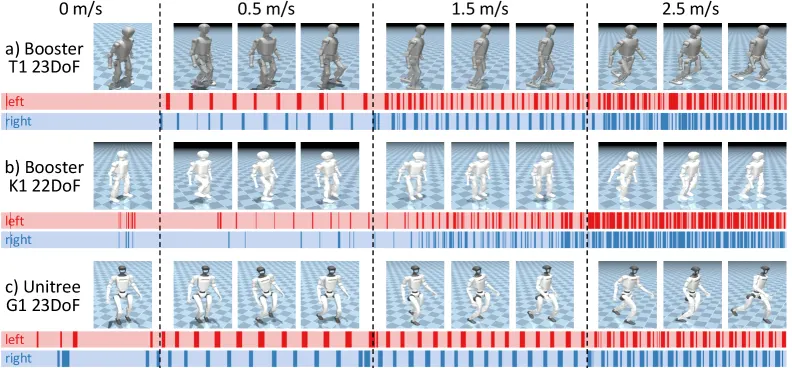
A humanoid that can walk should not relearn locomotion from scratch to jog or run. Yet current approaches often obtain gait diversity by prescribing gait schedules, imitating motion clips, training experts to switch between or distilling skills into one policy. These strategies can produce impressive behaviors, but offer limited flexibility across continuous speed commands, terrains, and morphologies. We study skill growth with GaitSpan, a framework that expands a pretrained, basic walking policy into faster locomotion. It treats walking as a seed skill: reusable motor structure for balance, support, body coordination, and contact transition that can be regenerated at new rhythms, extended into longer/higher strides, and corrected by residual adaptation. This expansion has three aspects: 1) rhythm generation, which modulates the frozen walking policy with multiple internal clocks and learns command-conditioned combinations of the resulting canonical actions; 2) stride shaping, which rewards dynamic locomotion patterns appropriate for higher commanded speeds using a physically grounded objective inspired by spring-loaded inverted pendulum dynamics; and 3) residual adaptation, which captures motion details not accounted for by rhythm generation or stride shaping. GaitSpan is the first to deliver a single command-conditioned humanoid policy that spans walking, jogging, and running-like regimes covering a continuous speed range, transfers across morphologies, and deploys zero-shot on unseen sim-to-sim, and real-world terrains. Compared with baselines either trained with multi-experts or imitation from humans, it learns faster and achieves stronger gait performance.
HumanoidGaitReinforcement LearningKwan-Yee Lin, Zilin Wang, Janelle J. Liu·Jul 13, 2026
Learning Reusable Hybrid Motion Priors for Humanoid Locomotion from Motion Imitation

Learning Reusable Hybrid Motion Priors for Humanoid Locomotion from Motion Imitation

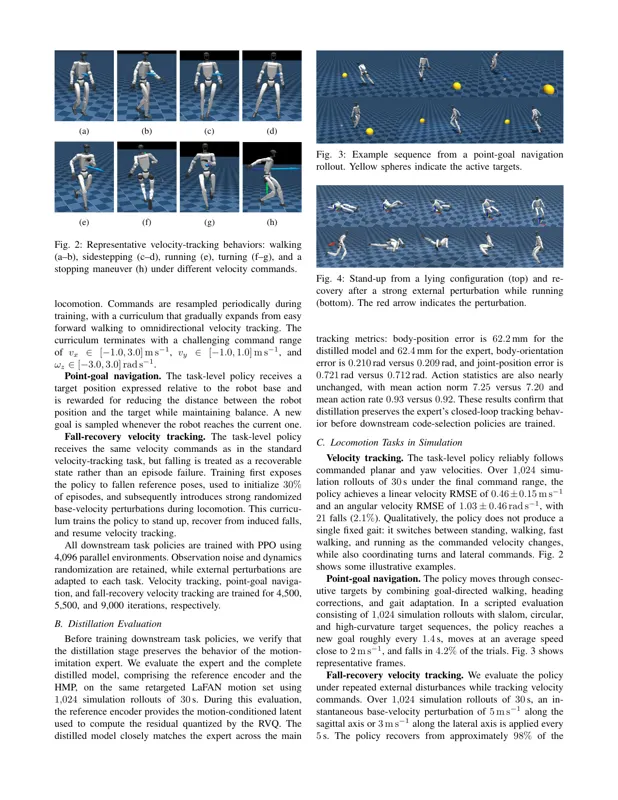
Reinforcement learning can produce robust humanoid controllers, but each new task is typically trained as a separate policy with its own reward design and training process. Motion imitation provides an alternative source of motor competence by training policies to track retargeted human motions, yet the resulting controllers remain reference trackers and are not directly usable as task policies. We propose a three-stage pipeline that turns motion-imitation skills into a reusable hybrid motion prior (HMP) for humanoid locomotion. First, an expert policy is trained to imitate retargeted human motion-capture clips. Second, the expert is distilled into a frozen architecture composed of a proprioceptive encoder, a residual vector-quantized (RVQ) codebook, and an action decoder. Third, task-level policies are trained to solve locomotion tasks by selecting discrete codebook entries while the HMP remains frozen. We evaluate the method on velocity tracking, point-goal navigation, and fall-recovery velocity tracking in simulation, and deploy the velocity-tracking policy on a real Unitree G1 robot. The distillation process preserves the tracking behavior of the expert, while the resulting HMP can be reused without retraining as the action interface for different downstream locomotion policies. The learned HMP reveals an interpretable codebook structure in which the number of active RVQ stages modulates the available gait patterns. We further show that training the codebook with the rotation trick improves latent organization and reduces downstream falls compared with a standard straight-through estimator.

Motion ImitationHumanoidGait optimizationValerio Belli, Valerio Modugno, Enrico Mingo Hoffman·Jul 27, 2026
RAVEN: Reinforcement-Adaptive Visibility-Graph Planning for Robust Humanoid Navigation with Collision-Free MPC

RAVEN: Reinforcement-Adaptive Visibility-Graph Planning for Robust Humanoid Navigation with Collision-Free MPC

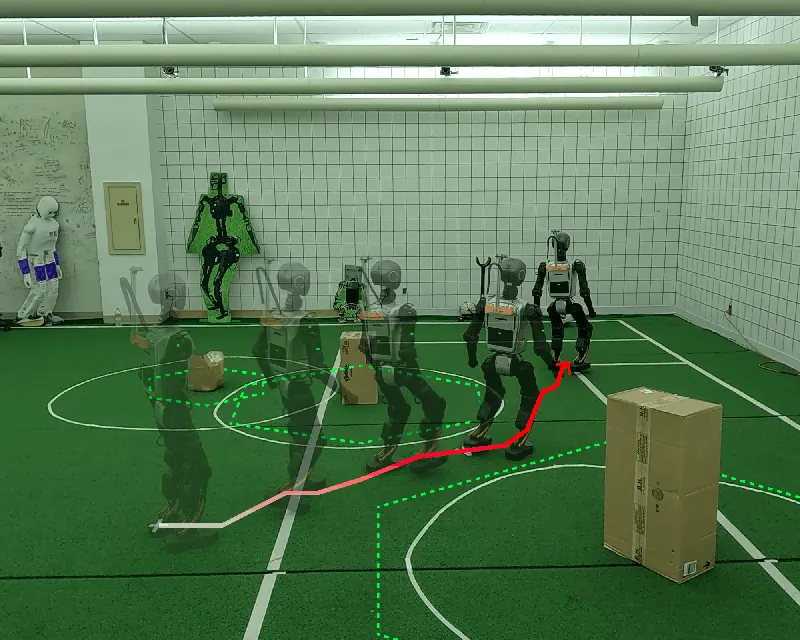
Humanoid navigation in dynamic environments requires long-horizon planning while respecting short-horizon dynamic and safety constraints. Classical visibility-graph planners combined with model predictive control (MPC) can efficiently generate collision-free trajectories, but their performance depends on manually tuned parameters and accurate system modeling. In real robotic systems, control delays, state-estimation noise, and locomotion uncertainties can cause overshoot and constraint violations even when the nominal path is geometrically optimal. We propose RAVEN, a hierarchical reinforcement learning (RL)-MPC framework for robust humanoid navigation. Unlike prior approaches that use learning to tune cost weights or replace planning entirely, RAVEN employs RL to adapt the geometric construction of a visibility-graph planner by modifying obstacle inflation and related graph parameters. By directly reshaping the free-space geometry, the learned planner alters the topology of the global path to compensate for delay and tracking imperfections. A collision-free MPC layer then tracks the planned trajectory while explicitly enforcing velocity bounds and obstacle-avoidance constraints. By training under realistic delays and observation noise, RAVEN learns planning adaptations that improve robustness while retaining explicit long-horizon geometric planning and constrained optimization, in contrast to end-to-end learning approaches. We evaluate RAVEN against a manually tuned visibility-graph MPC baseline and a pure RL navigation policy. Results demonstrate reduced overshoot near obstacles, improved robustness in narrow passages, and more reliable navigation under delay and noise. These findings indicate that reinforcement-adaptive graph construction combined with constrained MPC provides an effective and interpretable alternative to end-to-end learning for robust humanoid navigation.

MPCNavigationGait optimizationRuochen Hou, Shiqi Wang, Beom Jun Kim·Jul 17, 2026