Skip to content
Visual Relocalization from Sparse Views in Aliased and Low-Texture Environments via Novel View Synthesis

Visual Relocalization from Sparse Views in Aliased and Low-Texture Environments via Novel View Synthesis

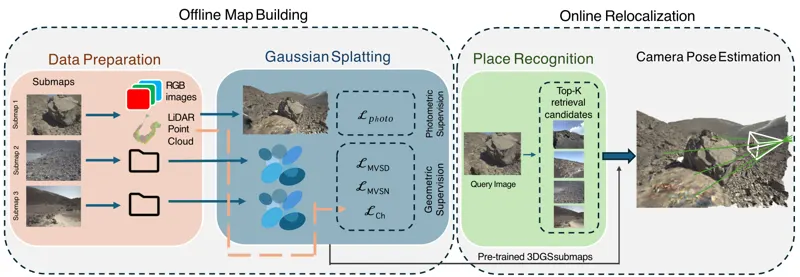
Visual localization becomes extremely challenging in planetary-like terrains characterized by low texture, perceptual aliasing, harsh illumination, and sparse, weakly overlapping viewpoints induced by forward rover motion and unconstrained driving directions. Under these conditions, state-of-the-art image-to-image and image-to-map matching pipelines suffer significant performance degradation. In this work, we propose a visual relocalization method that departs from classical correspondence-based pipelines by directly estimating camera poses against a differentiable map representation built with 3D Gaussian Splatting (3DGS). Our key contribution is a geometry-aware training strategy that combines photometric and geometric losses, where the geometric supervision is provided for the first time by combining multi-view stereo (MVS) and LiDAR depths. We show that this joint optimization produces a 3DGS model that better fits the underlying scene geometry, leading to improved photometric and geometric consistency and more robust, accurate single-image 6-DoF pose estimation. Extensive experiments on data acquired in planetary-analog environments validate the effectiveness of our approach, showing substantial gains in relocalization accuracy under challenging conditions. Code is available at https://github.com/DLR-RM/multimodal-gsplat-relocalization.

3D Gaussian SplattingMaria Peribañez, Javier Civera, Rudolph Triebel·Jul 24, 2026
Fashion-3DLR: A Controllable 3D Garment Generation Using Pairwise Fashion Elements for Intelligent Design

Fashion-3DLR: A Controllable 3D Garment Generation Using Pairwise Fashion Elements for Intelligent Design

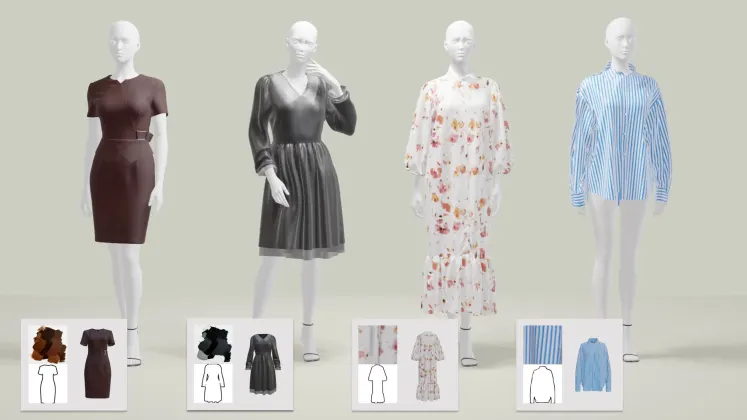
AI-generated content (AIGC) has made significant progress, with 2D generative models becoming ready-to-use tools for the digital fashion industry. However, 3D garment generation remains in its nascent stage, where in the realm of fashion, the semantic information of diverse design elements exhibits intricate coupling relationships in 3D representations, posing substantial challenges for generating diverse 3D garments. In this work, to handle the above problem, We introduce Fashion-3DLR, a novel 3D garment generation framework that utilizes diverse design elements to create high-quality, versatile 3D garment assets. Specifically, to bridge the semantic gaps between different fashion elements, we propose a Garment Feature Fusion Diffusion Transformer (GFF-DiT) module to integrate 2D fashion design elements, e.g., sketch and texture, into latent space. Within the latent space, we then employ a rectified flow transformer to generate geometry latents, which can be decoded into various 3D garment representations, including 3D Gaussians and meshes. Furthermore, we integrate Fashion-3DLR into downstream tasks, achieving the 3D Gaussian Splatting (3DGS)-driven cloth physical simulation and mesh-based virtual try-on. Experimental results indicate that Fashion-3DLR surpass the previous state-of-the-art methods, which verify that the proposed work can generate well-structured, non-watertight garments capable of physical simulation and virtual try-on, underscoring its potential as a versatile 3D garment design tool.
3D Gaussian SplattingShenghao Yang, Hongtao Zhang, Yuhan Yi·Jul 25, 2026
Head Avatars with Dynamic Explicit Hair

Head Avatars with Dynamic Explicit Hair

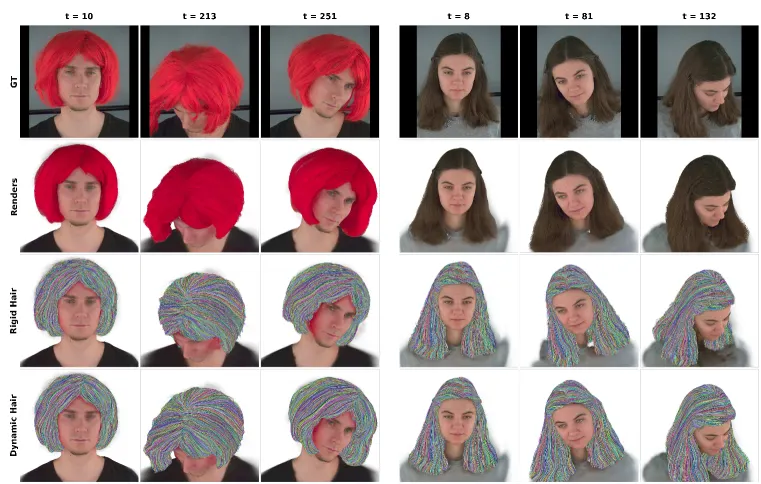
We present DynHair, a novel method for tracking and modeling dynamic hair for human head avatars. From video input, we reconstruct a dynamic head avatar with an explicit strand-based hair representation using structured 3D Gaussian Splatting. In contrast to the face region of human head avatars, which can be modeled with 3D Gaussians that are attached or generated with respect to some expressive 3D head model, hair is particularly challenging as it exhibits dynamic motion effects. Therefore, we present a novel method that models the dynamic deformations of the hair strands using a temporal network that is conditioned on angular velocity and acceleration of the head, as well as relative gravity. Specifically, an LSTM encodes the motion history and modulates per-point strand features via FiLM conditioning which further used by MLP to produce physically plausible displacements to canonical hairstyle. We jointly optimize this motion and appearance representation of the hair, with a 3DGS-based representation of the face-region, via differentiable Gaussian splatting with photometric, geometric, and physics-based supervision. As a result of our method, we retrieve hair tracking of the training video data and an animatable head avatar with controllable hair dynamics. In our experiments, we demonstrate state-of-the-art performance in terms of hair dynamics, temporal consistency, and generalization across subjects.

3D Gaussian SplattingVanessa Sklyarova, Haonan Chen, Berna Kabadayi·Jul 26, 2026
GenSplatCodec: Feed-Forward Gaussian Splatting Compression via One-Step Diffusion

GenSplatCodec: Feed-Forward Gaussian Splatting Compression via One-Step Diffusion

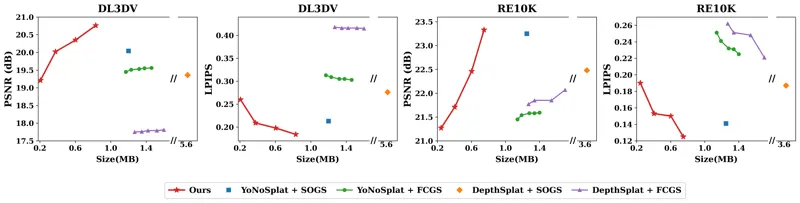
Feed-forward 3D Gaussian Splatting (3DGS) enables scalable scene reconstruction without per-scene optimization, yet produces dense Gaussians that are costly to store and transmit. Existing feed-forward Gaussian compression methods formulate decoding as deterministic representation recovery, which becomes inadequate at low bitrates when high-frequency textures and view-dependent appearance are discarded. Although generative models offer a promising alternative, using them as standalone post-processing decouples generation from the transmitted scene structure, thereby compromising cross-view consistency. To address these limitations, we propose GenSplatCodec, a unified feed-forward Gaussian codec that reformulates low-bitrate Gaussian compression as geometry-guided generative decoding. We present a detail-aware feed-forward Gaussian coding scheme within a dual-stream formulation, where the resulting compact Gaussian structural stream is complemented by a lightweight reference appearance stream. We further introduce a geometry-guided one-step generative decoding approach that jointly exploits decoded structural and appearance cues through hierarchical geometry control to reconstruct high-fidelity and view-consistent novel views. Finally, we develop a three-stage optimization strategy that stabilizes the learning of the unified codec and adapts the generative decoder to codec-derived structural and appearance cues. Extensive experiments across multiple datasets demonstrate that GenSplatCodec consistently achieves superior rate-distortion (RD) performance over existing methods.

3D Gaussian SplattingQiang Hu, Zhenlong Wu, Lei Huang·Jul 27, 2026
Look Before You Edit: Attention-Guided Camera Placement and Multi-View Alignment for 3D Gaussian Splatting Editing

Look Before You Edit: Attention-Guided Camera Placement and Multi-View Alignment for 3D Gaussian Splatting Editing

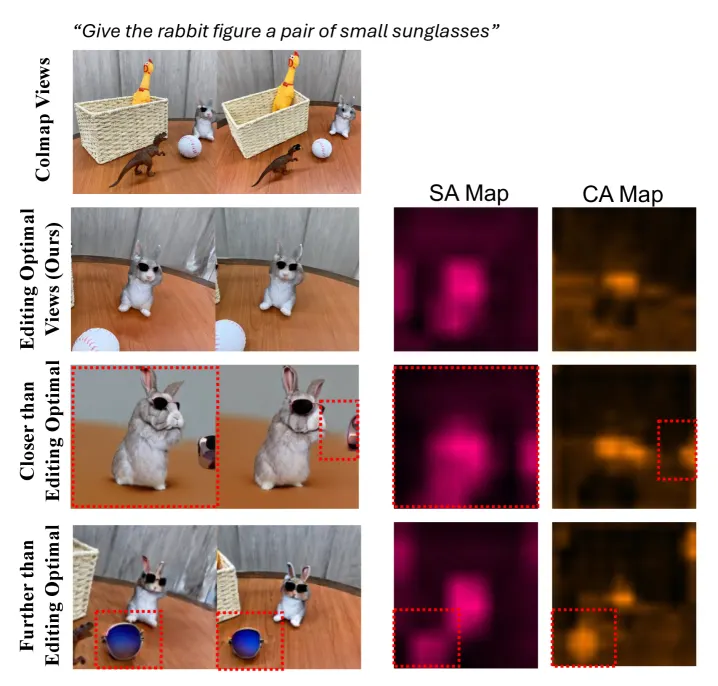
Text-driven 3D scene editing with 3D Gaussian Splatting (3DGS) typically applies a 2D diffusion editor to views rendered from fixed training cameras, limiting both the spatial coverage of edits and the user's freedom to target specific objects in complex scenes. We present LB-Edit, a framework that addresses two coupled problems: where to place editing cameras for localized edits, and how to make per-view edits agree with one another so that the 3D scene remains consistent after fine-tuning. First, Attention-Guided Editing Camera Placement (ACP) probes the diffusion model's self- and cross-attention at multiple candidate camera distances to find where attention is well-contained in the region of interest, then places a compact, geometrically diverse editing camera set at that attention-optimal distance. Second, Multi-view Attention Alignment (MAA) steers the editor toward the same edit across views along two axes: it aligns appearance by sharing self-attention features via token-level correspondence, and aligns spatial location by lifting cross-attention maps onto the 3D Gaussians as a shared 3D attention field, suppressing both appearance and spatial drift. Experiments on multi-object and single-object scenes show that our method achieves the highest user preference in instruction fidelity, multi-view consistency, and editing locality, using as few as 5 editing views and reducing latency by up to 7x over existing methods.

3D Gaussian SplattingScene EditingCamera PlacementJaeyeon Park, Taeho Kang, Youngki Lee·Jul 22, 2026
ATSplat: Compact Feed-forward 3D Gaussian Splatting with Adaptive Token Expansion

ATSplat: Compact Feed-forward 3D Gaussian Splatting with Adaptive Token Expansion

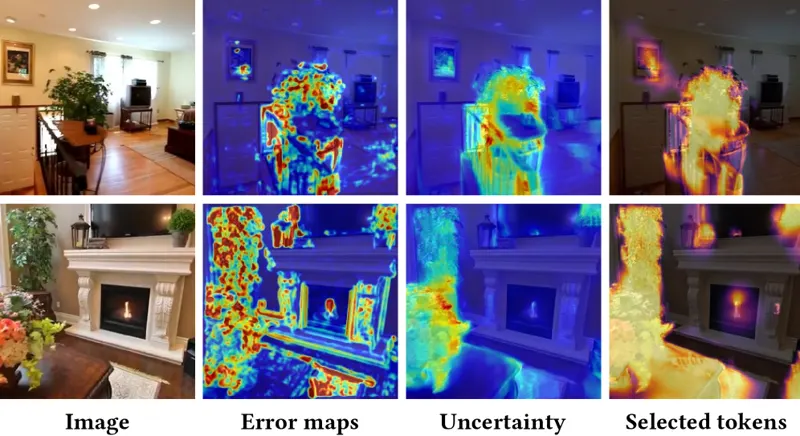
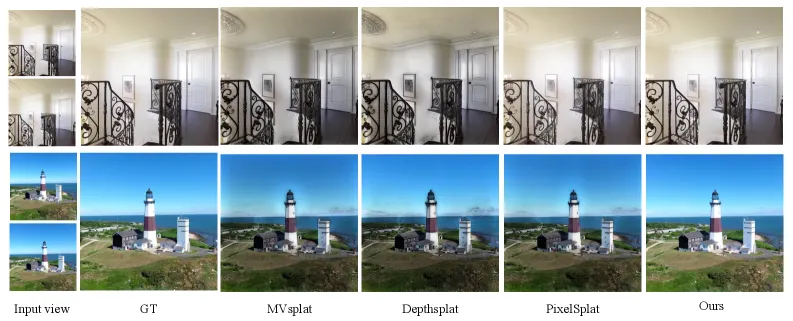
3D Gaussian Splatting (3DGS) achieves high-quality novel-view synthesis by optimizing freely placed primitives in 3D and adaptively densifying them in under-reconstructed regions. However, this scene-adaptive capacity allocation is largely lost in existing feed-forward 3DGS methods, which commonly regress Gaussians at input pixels and lift them along camera rays. Such pixel-aligned formulations make the number and placement of primitives depend on image resolution and input viewpoints rather than scene complexity, resulting in dense and often redundant Gaussian sets. We present ATSplat, a feed-forward 3DGS framework that restores the adaptive allocation capability of 3DGS optimization through Adaptive 3D Tokens. ATSplat first lifts coarse patch-level depth and camera cues into sparse 3D anchor tokens, forming a compact scaffold of the scene. Each token is then regressed into local Gaussians with learnable 3D offsets, decoupling primitive placement from input image grids. An Adaptive Token Expansion module predicts a token-level uncertainty score, supervised by rendering error maps, and selectively expands high-uncertainty tokens through learnable expansion layers. This sparse-to-adaptive formulation enables ATSplat to concentrate primitives in challenging regions while maintaining a compact representation. Experiments on two representative datasets, RealEstate10K and DL3DV, show that ATSplat achieves state-of-the-art rendering quality while reducing the number of Gaussians by more than 5.7× compared with dense feed-forward 3DGS methods. From 12 input images at 512 × 960 resolution, ATSplat completes reconstruction in less than a second using a single commercial GPU, and renders high-quality novel views at 1136 FPS (512 × 960) with only 311K Gaussians.

3D Gaussian SplattingtokenFeedforwardCho In, Jeonghwan Cho, Mijin Yoo·Jul 22, 2026
GLAM-SLAM: Real-time Gaussian Large-scale Mapping via Flow Densification and Spatial Decomposition

GLAM-SLAM: Real-time Gaussian Large-scale Mapping via Flow Densification and Spatial Decomposition

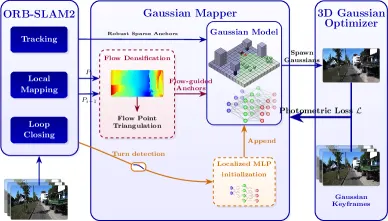
Existing Gaussian-splatting-based monocular Simultaneous Localization and Mapping (SLAM) systems are either tailored to short sequences, are not real-time, or suffer from prohibitive GPU memory requirements, limiting their applicability in realistic, long-horizon scenarios. To address this, we present GLAM-SLAM, a real-time, decoupled Gaussian-splatting SLAM system designed for large-scale outdoor scenes. We ensure lightweight tracking using a robust, feature-based SLAM frontend, while for mapping, we adopt a structured, sparse anchor grid representation that ensures scalable operation and maintains scene coherence across long-term sequences. To satisfy the dense initialization requirements of 3D Gaussian Splatting (3DGS), we introduce a geometry-based flow-densification anchoring strategy using epipolar constraints. Furthermore, by treating mapping as a multi-scene problem, we propose a scene-partitioning strategy that introduces a strong spatial inductive bias via MLP initializations to generate localized Gaussians. We evaluate our system on the challenging, long-sequence KITTI Odometry, Oxford RobotCar, and M'alaga datasets. Extensive ablations and comparisons demonstrate a 15% improvement in reconstruction quality over the second-best performer, while maintaining real-time performance and the ability to scale to longer sequences. Code is publicly available for the benefit of the community.

3D Gaussian SplattingSLAMReal-TimePanagiotis Mermigkas, Argyris Manetas, Petros Maragos·Jul 23, 2026
GrainGS: Gradient-Decoupled Gaussian Splatting for Efficient Dynamic Novel View Synthesis

GrainGS: Gradient-Decoupled Gaussian Splatting for Efficient Dynamic Novel View Synthesis

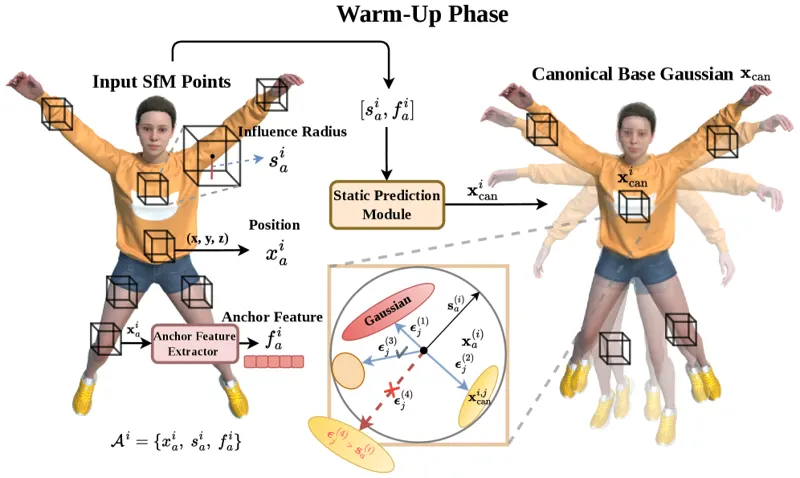
Dynamic scene reconstruction with 3D Gaussian Splatting requires a balance between fine-grained motion modeling, structural stability, and compact representation. Existing per-primitive methods provide flexible local deformation but often suffer from redundant primitive growth, while anchor-based methods improve spatial regularity at the cost of suppressing locally varying motion. To address these issues, we present GrainGS, a dynamic Gaussian framework that combines a hierarchical anchor scaffold with per-Gaussian deformation. A static warm-up stage first establishes a time-invariant canonical representation from observations across all timestamps. During joint training, a stop-gradient operation blocks the deformation-mediated gradient pathway to the canonical positions while preserving their direct refinement through the reconstruction objective. Each Gaussian then predicts independent temporal offsets for position, rotation, and scale, enabling detailed local motion within a structurally constrained scaffold. A canonical-residual appearance decomposition further models frame-dependent photometric changes without forcing them into geometric deformation. Experiments on synthetic monocular and real-world multiview benchmarks show that GrainGS achieves high reconstruction quality, real-time novel view synthesis, and compact storage. Under the synthetic benchmark setting, it reaches an average peak signal-to-noise ratio of 36.98 decibels, renders at 435.6 frames per second, and requires 4.67 megabytes of storage.

3D Gaussian SplattingDynamic SceneNovel view synthesisJiahao He, Yihua Shao, Zhengkai Zhao·Jul 23, 2026
GS-Agent: Creating 4D Physical Worlds With Generative Simulation

GS-Agent: Creating 4D Physical Worlds With Generative Simulation

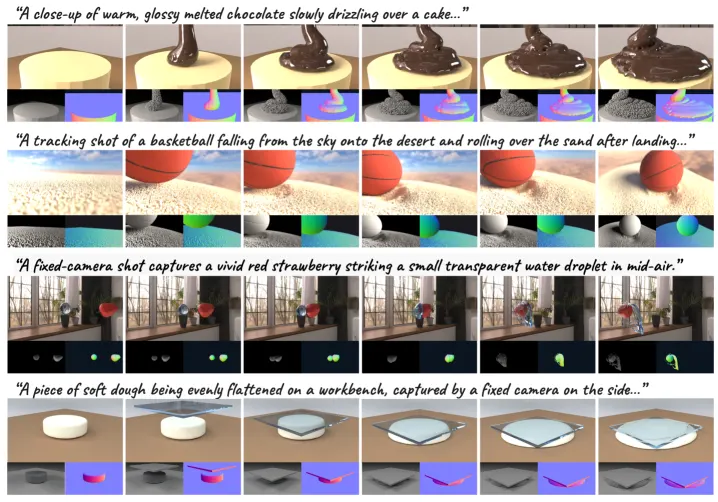
Creating dynamic and physically realistic 4D worlds from natural language descriptions is both fascinating and challenging. Traditional computer graphics methods rely on manual creation, requiring extensive human effort to fine-tune materials, motions, and visual fidelity. Recent advances in generative foundation models have sparked interest in learning to generate such 4D worlds from large-scale data; however, existing methods still struggle to ensure physical plausibility and controllability. In this work, we take a different path by leveraging foundation models to construct an agentic system that emulates how humans traditionally create 4D worlds, yet automates the entire process. We present GS-Agent, an end-to-end multi-agent framework that integrates physics engines in the loop to generate realistic, dynamic, and controllable 4D physical worlds from natural language. Inspired by how humans build 4D worlds, GS-Agent decomposes the task into entity management, covering 3D asset curation, material tuning, placement, and motion control, and rendering configuration, including camera and lighting manipulation. Multiple agents with distinct expertise interact with the physics engine via code, seek multimodal feedback, and collaborate to iteratively construct 4D worlds that align with the given descriptions. Experimental results show that GS-Agent effectively converts natural language into diverse and physically plausible 4D worlds exhibiting rich interactions among liquids, deformable objects, and rigid bodies, while achieving cinematic camera and lighting control. We envision GS-Agent as a foundation for a new paradigm in 4D world generation, empowering creative content creation and physical AI. Project page at https://umass-embodied-agi.github.io/gs-agent/

3D Gaussian Splatting4D GenerationWorld ModelsHongxin Zhang, Chunru Lin, Junyan Li·Jul 23, 2026
Odin: Primitive-Level Synchronization for Distributed Point-Based Neural Rendering

Odin: Primitive-Level Synchronization for Distributed Point-Based Neural Rendering

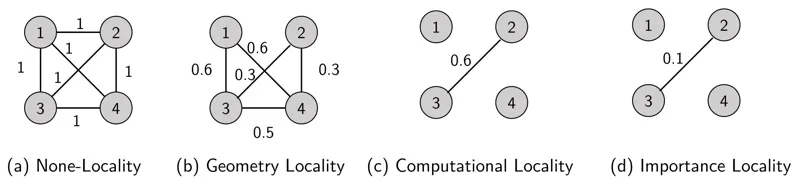
Point-based neural rendering (PBNR) represents 3D scenes as explicit, trainable primitives and underpins high-quality reconstruction and emerging embodied AI and world-model pipelines. Unlike layer-structured neural networks, PBNR has primitive-indexed dependencies: each view reads and updates only a sparse, view-dependent subset of mutable scene state. As large scenes require distributed training and optimized renderers reduce per-view computation, global task- or iteration-level barriers increasingly place synchronization, rather than rendering, on the critical path. We present Odin, a distributed PBNR training system that replaces global barriers with primitive-level synchronization. Its ahead-of-time scheduler uses stable locality and phase order to identify low-conflict overlap windows, while the runtime validates primitive publication before later work observes mutable state. Odin provides a quality-first path that preserves synchronized-training visibility and a throughput-first path that uses overlap and gradient evidence to admit only small, low-impact delayed reads; structural changes and high-impact cases remain synchronized. Across four existing PBNR pipelines and 13 non-city scenes on 8 GPUs, Odin improves throughput by 1.22 times on average and hides 82% of critical-path wait while preserving reconstruction quality. In a MatrixCity mixed-parallel case study scaling to 64 GPUs, Odin improves throughput over Grendel by up to 1.89 times without changing renderer kernels, optimizers, training budgets, or model capacity.

3D Gaussian SplattingNeural renderingPoint cloudsZhenxiang Ma, Zeyu He, Yuanzhen Zhou·Jul 22, 2026