Skip to content
Motion-Omni: End-to-End Joint Speech and Full-Body Motion for Spoken Dialogue

Motion-Omni: End-to-End Joint Speech and Full-Body Motion for Spoken Dialogue

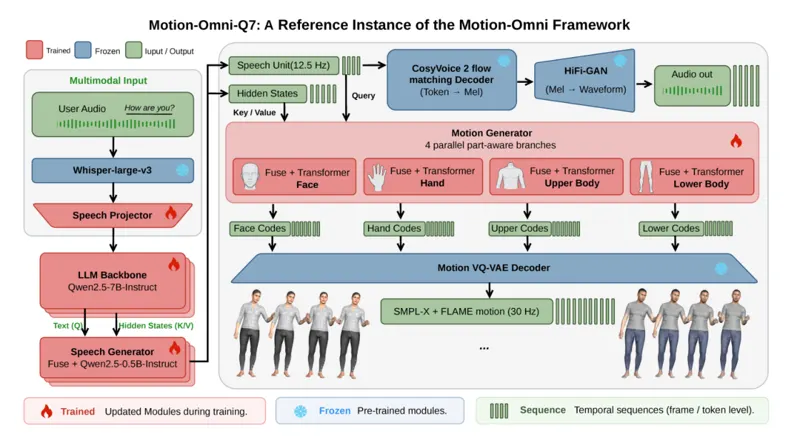
An avatar that holds a conversation should decide what to say and to move while saying it, yet these abilities live in separate model families: spoken dialogue models produce speech without motion, and co-speech motion models produce motion only from audio handed to them. The standard remedy is a cascade that first generates the spoken response and then runs a motion model over the finished audio, which requires a second full inference pass and precludes any joint optimisation between the two. We present Motion-Omni, an end-to-end framework in which a spoken dialogue model natively outputs explicit facial expression together with hand, upper-body and lower-body motion, generated directly from the hidden states that produce the speech. Joint training is not optional here: with the speech pathway frozen, motion remains misaligned with the audio, and co-adapting the LLM, Speech Generator and Motion Generator under both objectives is what recovers alignment while retaining spoken-dialogue ability. Supervision comes from a scalable, model-agnostic pipeline that pseudo-labels consistent-voice speech responses with a replaceable motion teacher, yielding 422,856 quality-ranked pairs (1,402 hours). We further release SwDA-500 and, to our knowledge, the first public evaluation protocol for stochastic open-ended full-body spoken dialogue, matching audio across motion systems while unifying rendering, automatic metrics, human evaluation, and latency measurement. Instantiated with a Qwen2.5-7B-Instruct backbone, Motion-Omni-Q7 matches the same-audio teacher cascade to within 2% on reference-free motion metrics while responding 5.4 x faster (RTF=0.78, faster than real time), surpasses all non-teacher cascades on beat correlation and diversity, and reaches a 2.62% word error rate, the lowest among the omni-modal systems compared.

Spoken Dialogue ModelCo-Speech Motion
Chengqian Ma, Wei Tao, Haoyu Zhang · 802 views · Aug 28, 2026
Token-Wise Latent Streaming from Slow Reasoners to Fast Planners for Dynamic Vision Language Navigation

Token-Wise Latent Streaming from Slow Reasoners to Fast Planners for Dynamic Vision Language Navigation

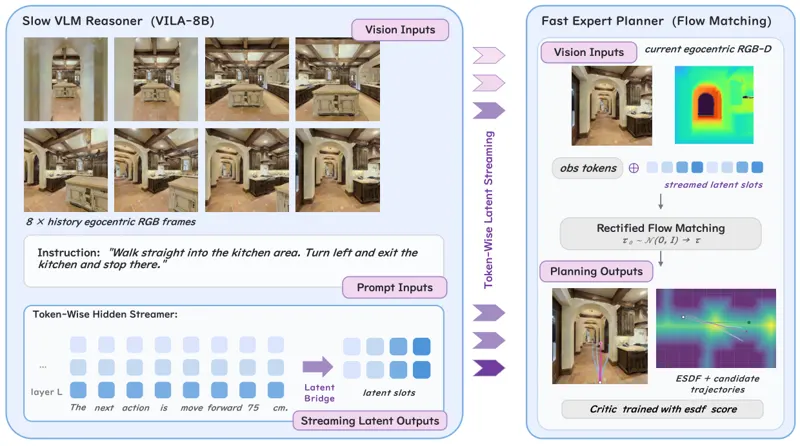
Vision-Language Navigation in dynamic, human-centric environments exposes a fundamental tension: linguistic reasoning is slow and deliberative, whereas safe, socially compliant planning should be instant and reactive. The resulting observation staleness is safety-critical: a maneuver chosen during inference can already be unsafe by the time it executes. We observe that, long before a VLM finishes its inference, its intermediate hidden states already encode action-relevant intent. We propose SPARK-VLN, a dual-system framework for dynamic social VLN that streams the slow VLM reasoner's knowledge to a fast flow-matching expert planner throughout token generation, providing fresh and evolving guidance during inference. This design is realized by three modules: a Token-Wise Hidden Streamer that extracts intermediate hidden states along the token generation process, a Sequence-to-Slot Latent Bridge that projects them into fixed-size latent slots, and an Evolving Latent Conditioner that infuses them into the expert planner. We also introduce a human-centric benchmark suite for dynamic social vision-language navigation that keeps pedestrians and the robot active throughout inference and reports navigation success, social compliance, human collisions, and explicit staleness statistics. Across these settings, SPARK-VLN mproves navigation success and social compliance while sustaining inference efficiency. Webpage: https://hutslib.github.io/SPARK-VLN/.

Vision-language navigationSocial Navigation
Tianshuai Hu, Yangyi Zhong, Zeying Gong · 748 views · Jul 18, 2026
VLA-Corrector: Lightweight Detect-and-Correct Inference for Adaptive Action Horizon

VLA-Corrector: Lightweight Detect-and-Correct Inference for Adaptive Action Horizon

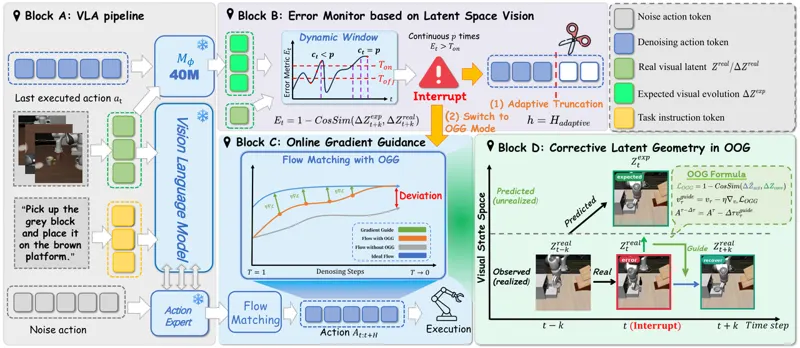
Vision-Language-Action (VLA) foundation models have recently achieved strong progress in embodied intelligence. To reduce policy-call frequency while preserving temporal coherence, most generative policies adopt an action chunk mechanism, executing multiple future actions in an open-loop manner under a fixed action horizon. However, this "predict-then-blindly-execute" paradigm sacrifices closed-loop reactivity: in contact-rich physical interactions, even small local perturbations can rapidly amplify within the open-loop blind spot, leading to compounding errors and ultimately task failure. To address this limitation, we propose VLA-Corrector, a lightweight corrective inference framework for action-chunked VLA policies. Without modifying the backbone policy weights, VLA-Corrector introduces a lightweight Latent-space Vision Monitor (LVM) that continuously compares predicted and actual visual feature evolution, enabling online detection of visual dynamics deviations. Once persistent deviation is detected, the system triggers a truncation event, discards the remaining stale actions, and invokes corrective replanning via Online Gradient Guidance (OGG). The detect-and-correct mechanism of VLA-Corrector naturally induces an event-triggered adaptive action horizon: it preserves long-horizon execution when the current chunk remains reliable, and invokes short-horizon corrective replanning when execution begins to drift. In doing so, VLA-Corrector mitigates the trade-off imposed by static horizons between execution robustness and policy-call frequency. It can be integrated into different VLA models without further retraining the VLA backbone, interrupting compounding errors while preserving much of the efficiency benefit of action chunking and substantially improving robustness in long-horizon, contact-rich robotic manipulation tasks.

VLARobotic Manipulation
Yi Pan, Miao Pan, Qi Lu · 746 views · Jul 2, 2026
Hiking in the Wild: A Scalable Perceptive Parkour Framework for Humanoids

Hiking in the Wild: A Scalable Perceptive Parkour Framework for Humanoids

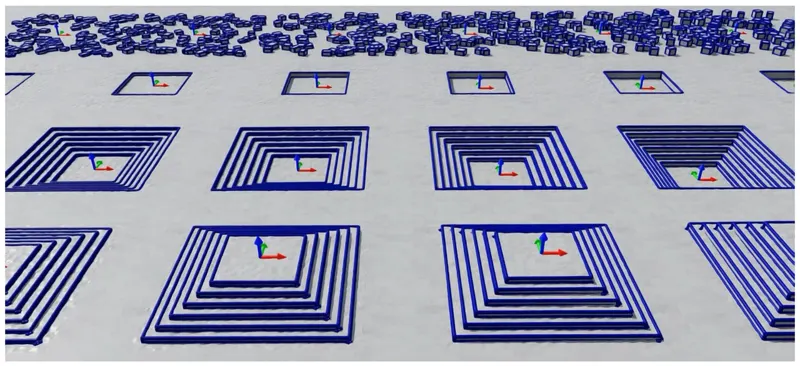
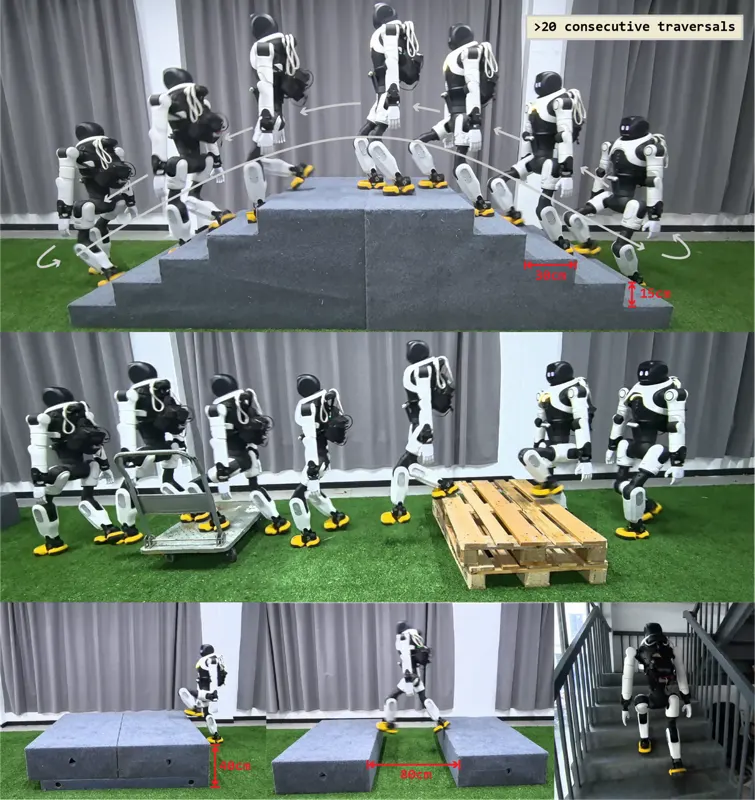
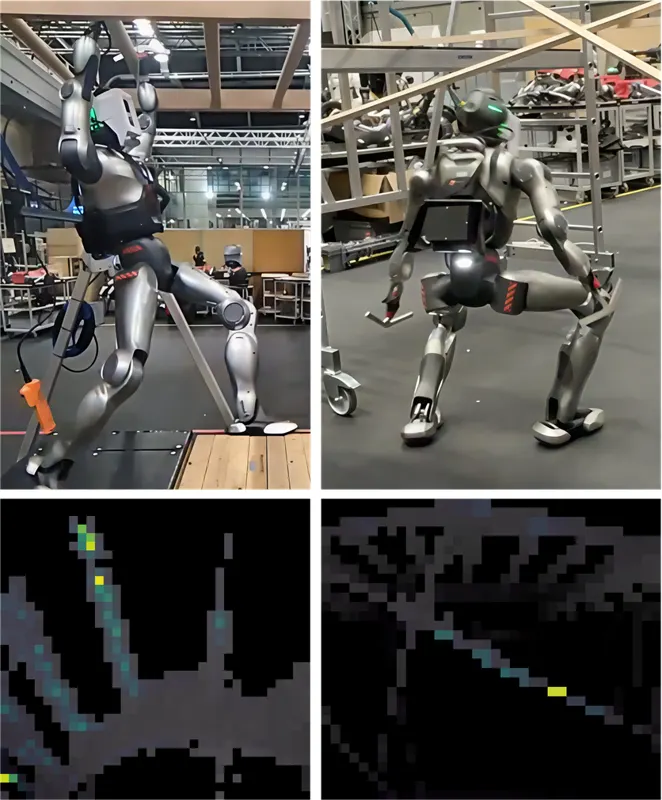
Achieving robust humanoid hiking in complex, unstructured environments requires transitioning from reactive proprioception to proactive perception. However, integrating exteroception remains a significant challenge: mapping-based methods suffer from state estimation drift; for instance, LiDAR-based methods do not handle torso jitter well. Existing end-to-end approaches often struggle with scalability and training complexity; specifically, some previous works using virtual obstacles are implemented case-by-case. In this work, we present Hiking in the Wild, a scalable, end-to-end parkour perceptive framework designed for robust humanoid hiking. To ensure safety and training stability, we introduce two key mechanisms: a foothold safety mechanism combining scalable Terrain Edge Detection with Foot Volume Points to prevent catastrophic slippage on edges, and a Flat Patch Sampling strategy that mitigates reward hacking by generating feasible navigation targets. Our approach utilizes a single-stage reinforcement learning scheme, mapping raw depth inputs and proprioception directly to joint actions, without relying on external state estimation. Extensive field experiments on a full-size humanoid demonstrate that our policy enables robust traversal of complex terrains at speeds up to 2.5 m/s. The training and deployment code is open-sourced to facilitate reproducible research and deployment on real robots with minimal hardware modifications.

HumanoidHiking
Shaoting Zhu, Ziwen Zhuang, Mengjie Zhao · 982 views · Jan 12, 2026
RoboGesture: Real-Time Semantic-aligned Co-Speech Gestures Generation for Humanoid Interaction

RoboGesture: Real-Time Semantic-aligned Co-Speech Gestures Generation for Humanoid Interaction

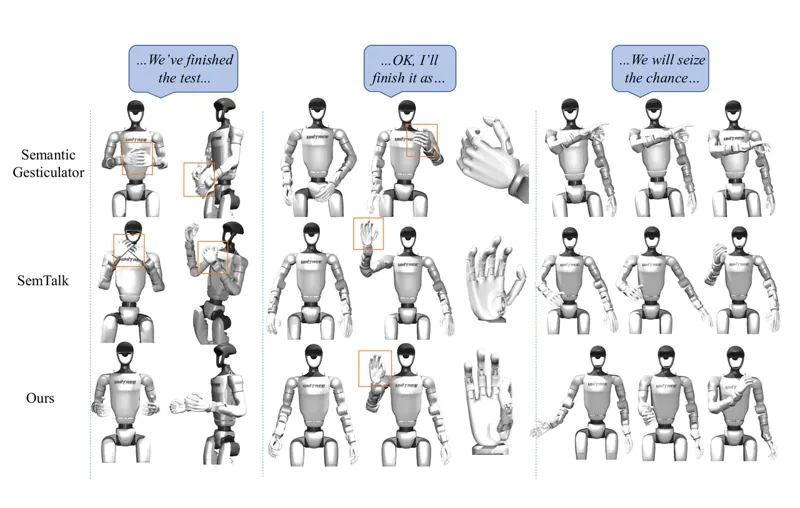
Enabling humanoid robots to respond to human speech with synchronized and semantically meaningful gestures is fundamental to natural human-robot interaction. However, this task faces three critical barriers: the scarcity of semantically rich datasets, the "modality eclipse" where models ignore audio cues in favor of kinematic inertia, and the sim-to-real gap regarding physical safety. We propose RoboGesture, a robot-centric framework that co-designs data, modeling, and control to power a complete interactive human-humanoid system in which the robot listens, responds, and gestures in real time. We first establish the RoboGesture dataset featuring over 300 gesture categories and develop an automated pipeline to synthesize large-scale collision-free, robot-specific audio-motion pairs. Our architecture features a Hierarchical Semantic-Acoustic Aligner that extracts multi-granular prosodic and semantic cues directly from raw audio tokens. These cues drive a Streaming Conditional Motion Generator based on a diffusion transformer with conditional flow matching. To ensure high responsiveness, we introduce Anti-Inertia CFG Masking, which prevents the model from collapsing into repetitive historical patterns by compelling it to proactively mine control signals from the audio modality. Finally, an MPC-based safety filter ensures real-time, collision-free execution on physical hardware. Experiments on a Unitree G1 humanoid demonstrate that RoboGesture generates safer, more rhythmic, and more semantically appropriate responses compared to state-of-the-art baselines.

MPCSim-to-Real
Wang, Zifan, Ren, Ziang, Shi, Pengyang · 1.5k views · Aug 27, 2026

As an Amazon Associate, we earn from qualifying purchases.