Skip to content
Fashion-3DLR: A Controllable 3D Garment Generation Using Pairwise Fashion Elements for Intelligent Design

Fashion-3DLR: A Controllable 3D Garment Generation Using Pairwise Fashion Elements for Intelligent Design

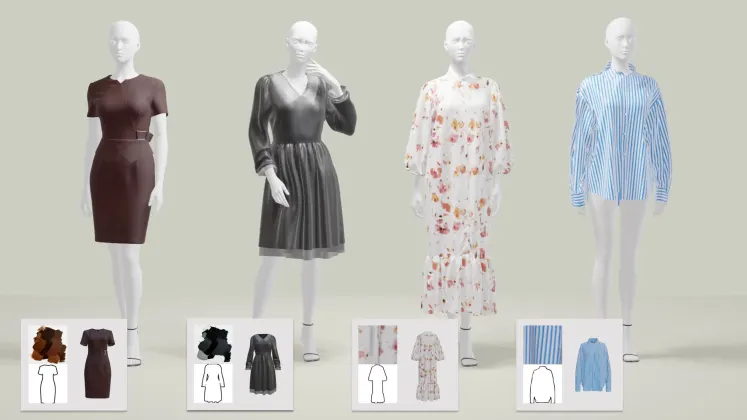
AI-generated content (AIGC) has made significant progress, with 2D generative models becoming ready-to-use tools for the digital fashion industry. However, 3D garment generation remains in its nascent stage, where in the realm of fashion, the semantic information of diverse design elements exhibits intricate coupling relationships in 3D representations, posing substantial challenges for generating diverse 3D garments. In this work, to handle the above problem, We introduce Fashion-3DLR, a novel 3D garment generation framework that utilizes diverse design elements to create high-quality, versatile 3D garment assets. Specifically, to bridge the semantic gaps between different fashion elements, we propose a Garment Feature Fusion Diffusion Transformer (GFF-DiT) module to integrate 2D fashion design elements, e.g., sketch and texture, into latent space. Within the latent space, we then employ a rectified flow transformer to generate geometry latents, which can be decoded into various 3D garment representations, including 3D Gaussians and meshes. Furthermore, we integrate Fashion-3DLR into downstream tasks, achieving the 3D Gaussian Splatting (3DGS)-driven cloth physical simulation and mesh-based virtual try-on. Experimental results indicate that Fashion-3DLR surpass the previous state-of-the-art methods, which verify that the proposed work can generate well-structured, non-watertight garments capable of physical simulation and virtual try-on, underscoring its potential as a versatile 3D garment design tool.

3D Gaussian SplattingShenghao Yang, Hongtao Zhang, Yuhan Yi·Jul 25, 2026
Head Avatars with Dynamic Explicit Hair

Head Avatars with Dynamic Explicit Hair

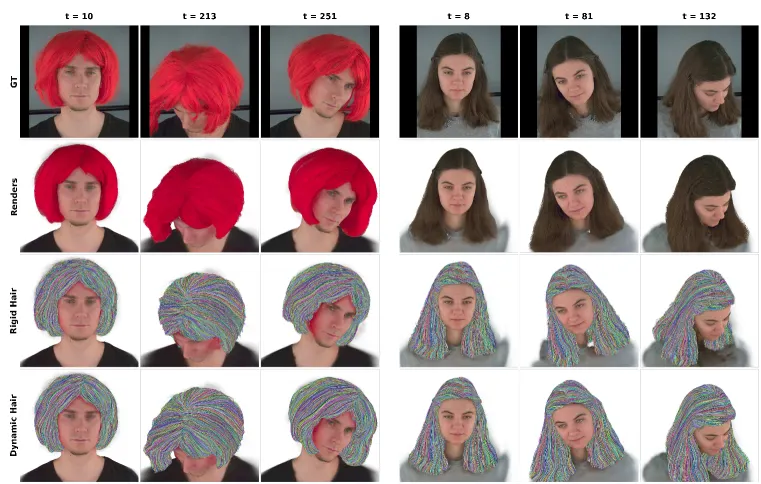
We present DynHair, a novel method for tracking and modeling dynamic hair for human head avatars. From video input, we reconstruct a dynamic head avatar with an explicit strand-based hair representation using structured 3D Gaussian Splatting. In contrast to the face region of human head avatars, which can be modeled with 3D Gaussians that are attached or generated with respect to some expressive 3D head model, hair is particularly challenging as it exhibits dynamic motion effects. Therefore, we present a novel method that models the dynamic deformations of the hair strands using a temporal network that is conditioned on angular velocity and acceleration of the head, as well as relative gravity. Specifically, an LSTM encodes the motion history and modulates per-point strand features via FiLM conditioning which further used by MLP to produce physically plausible displacements to canonical hairstyle. We jointly optimize this motion and appearance representation of the hair, with a 3DGS-based representation of the face-region, via differentiable Gaussian splatting with photometric, geometric, and physics-based supervision. As a result of our method, we retrieve hair tracking of the training video data and an animatable head avatar with controllable hair dynamics. In our experiments, we demonstrate state-of-the-art performance in terms of hair dynamics, temporal consistency, and generalization across subjects.

3D Gaussian SplattingVanessa Sklyarova, Haonan Chen, Berna Kabadayi·Jul 26, 2026
GenSplatCodec: Feed-Forward Gaussian Splatting Compression via One-Step Diffusion

GenSplatCodec: Feed-Forward Gaussian Splatting Compression via One-Step Diffusion

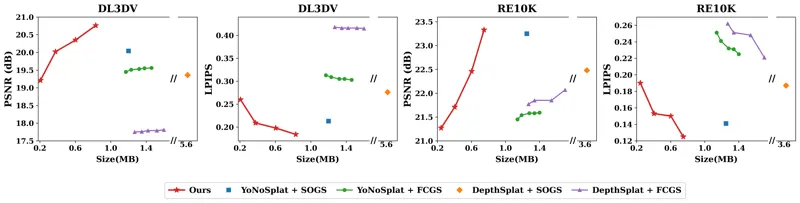
Feed-forward 3D Gaussian Splatting (3DGS) enables scalable scene reconstruction without per-scene optimization, yet produces dense Gaussians that are costly to store and transmit. Existing feed-forward Gaussian compression methods formulate decoding as deterministic representation recovery, which becomes inadequate at low bitrates when high-frequency textures and view-dependent appearance are discarded. Although generative models offer a promising alternative, using them as standalone post-processing decouples generation from the transmitted scene structure, thereby compromising cross-view consistency. To address these limitations, we propose GenSplatCodec, a unified feed-forward Gaussian codec that reformulates low-bitrate Gaussian compression as geometry-guided generative decoding. We present a detail-aware feed-forward Gaussian coding scheme within a dual-stream formulation, where the resulting compact Gaussian structural stream is complemented by a lightweight reference appearance stream. We further introduce a geometry-guided one-step generative decoding approach that jointly exploits decoded structural and appearance cues through hierarchical geometry control to reconstruct high-fidelity and view-consistent novel views. Finally, we develop a three-stage optimization strategy that stabilizes the learning of the unified codec and adapts the generative decoder to codec-derived structural and appearance cues. Extensive experiments across multiple datasets demonstrate that GenSplatCodec consistently achieves superior rate-distortion (RD) performance over existing methods.

3D Gaussian SplattingQiang Hu, Zhenlong Wu, Lei Huang·Jul 27, 2026
Try Once, Then Optimal: De-Redundified Procedure Memory for Cross-Episode Exploration Amortization

Try Once, Then Optimal: De-Redundified Procedure Memory for Cross-Episode Exploration Amortization

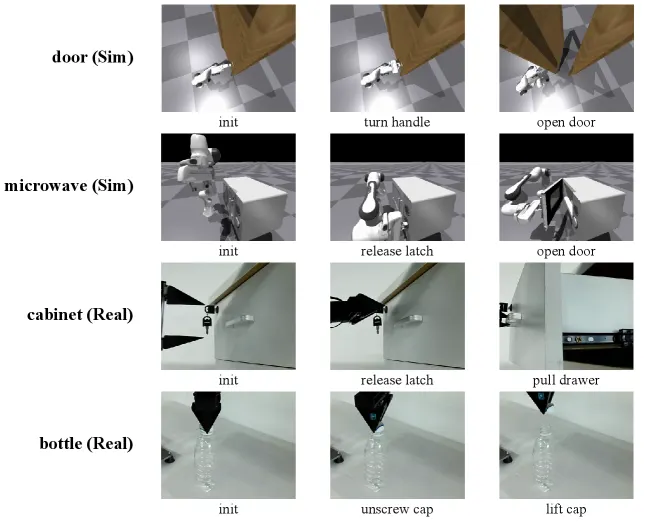
Manipulating objects with hidden internal state, such as a latched microwave, forces a robot to probe before it can act. Yet a robot that has solved an instance once re-runs the same probes whenever it encounters that instance again, because existing cross-episode memories target task success and organize reuse around states, not the object or the cost of re-exploring it. We present Instance-Oriented Memory (IOM), an object-centric framework that amortizes this exploration: from a single encounter that uncovers the hidden state, whether or not it succeeds, IOM records a short procedure for manipulating that instance, keys it on the object's identifiable features, and injects it as a soft bias on a procedure-conditioned policy. A later encounter recognizes the object and recalls its procedure instead of re-exploring. We instantiate this distillation with an off-the-shelf vision-language model (VLM) that parses each encounter into the procedure without task-specific training. Across four articulated-object tasks, two in simulation (microwave, door) and two on a real robot (bottle, cabinet), an oracle procedure memory cuts manipulation operations by 16-30% over re-exploration at non-regressing success, and the VLM instantiation recovers 69-88% of that saving out of the box. Because the procedure is a soft bias on a feedback-driven policy, an incorrect memory is recovered from rather than obeyed: success holds even when a retrieved procedure is wrong, as for ≈12% of door instances. Across all tasks the benefit is purely one of efficiency: success never regresses, and on the real robot even improves. Code will be released upon acceptance.

Vision-language modelsHaizhou Ge, Haochen Ouyang, Zhixing Chen·Jul 26, 2026
PathScale-R1: Cross-scale Reasoning for Pathological Image Analysis

PathScale-R1: Cross-scale Reasoning for Pathological Image Analysis

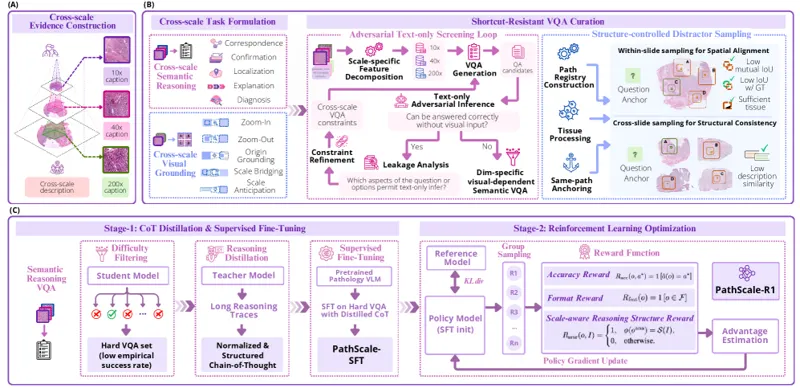
Pathological diagnosis is inherently multi-scale, requiring the integration of global tissue architecture at low magnification with cellular morphology at higher magnification. However, existing pathology benchmarks and vision-language models (VLMs) are still largely developed under single-scale settings, limiting their ability to learn clinically meaningful multi-magnification reasoning. Moreover, naively constructed visual question answering (VQA) tasks may be susceptible to text-only or superficial visual shortcuts, leading to unreliable assessments of visual understanding. To address these limitations, we introduce a benchmark and training framework for shortcut-resistant cross-scale pathology reasoning. We design an Adversarial Text-only Screening strategy for semantic reasoning questions and a Structure-controlled Distractor Sampling strategy for visual grounding questions, encouraging models to rely on cross-scale visual evidence. Based on this pipeline, we construct PathScale-VQA, a high-quality cross-scale pathology VQA benchmark with 10,373 multiple-choice questions grounded in 1,368 diagnostic paths across multiple magnification levels. Building on the semantic reasoning set, PathScale-R1 is optimized through Difficulty-driven Reasoning Distillation supervised fine-tuning followed by reinforcement learning with a Scale-aware Reasoning Structure reward, which encourages the use of evidence across magnifications. Extensive experiments demonstrate state-of-the-art performance of PathScale-R1 on cross-scale reasoning tasks and effective transfer to conventional single-scale pathology VQA. Our code is available at https://github.com/iMVR-PL/PathScale-R1.

Vision-language modelsChi Phan, Tianyi Zhang, Yufeng Wu·Jul 26, 2026
Memory for Attention: Language-Conditioned Re-Perception with a Vision–Language–Motion Map

Memory for Attention: Language-Conditioned Re-Perception with a Vision–Language–Motion Map

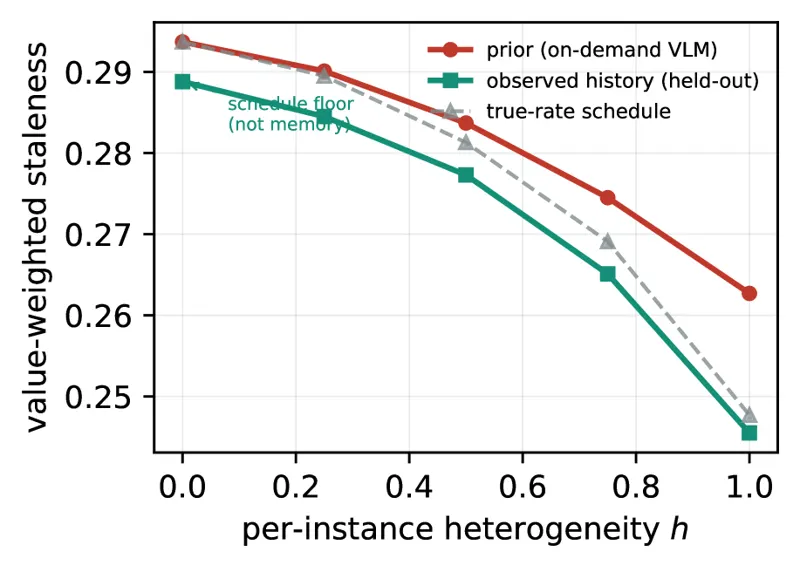
A robot carrying a persistent, behavior-annotated map faces two planning questions, and its memory answers only one well. The spatial-navigation question – how to walk around a room – we address first and report a negative: building on Vision–Language–Motion Maps (VLMM), a behavior-aware planner cost cuts a planning-time objective by ∼35% over 28 AI2-THOR scenes, but under closed-loop execution the real benefit nearly vanishes (∼4%) and an on-demand vision–language model (VLM) does as well. The resource-allocation question differs: under a limited perception budget, what should the robot re-observe now to keep its map fresh? Framing re-perception as this attention decision, we show a persistent map's memory (change-history, or even just recency of last sighting) yields the best schedule (held-out), matching an oracle, while the memoryless VLM prior is poor. Because the schedule reallocates budget toward what matters, memory's benefit concentrates on the important objects (∼1.6× the mean), and a downstream fetch task confirms fewer wasted trips; the gain grows with per-instance heterogeneity exactly as a Cauchy–Schwarz bound predicts – it equals Var(λ), the variance of root-volatility. With a real CLIP prior on rendered objects the advantage is +21–26%. The map's distinctive value appears when the task is language-conditioned: told what to track, VLMM grounds the relevant objects (open-vocabulary) and tracks their change (memory), beating even a strong relevance-weighted recency baseline (+2.5%) – so its motion channel adds value beyond a last-seen timestamp – and an on-demand VLM (+8.9%); neither language nor dynamics alone suffices. The map earns its keep not by telling the robot how to walk around a room, but by telling it what to pay attention to.

Vision-language modelsDibyendu Ghosh·Jul 26, 2026
Reasoning as a Double-Edged Sword: Architecture and Cross-Stage Robustness in Vision-Language-Action Models

Reasoning as a Double-Edged Sword: Architecture and Cross-Stage Robustness in Vision-Language-Action Models

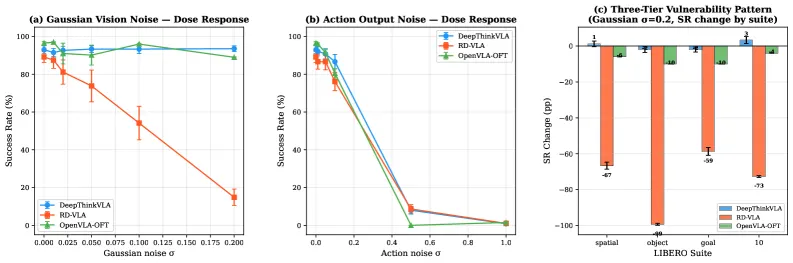
Does adding a reasoning step make a Vision-Language-Action (VLA) model more robust to perturbation? Intuitively, a policy that reasons before acting should absorb a perturbed input better than one that maps observations directly to actions. We test this premise head-on across three models that span the reasoning spectrum (no reasoning, a text chain-of-thought, and a latent iterative loop), perturbing each at the vision, reasoning, and action stages on LIBERO and SimplerEnv. Two questions organize the study: does the reasoning design shift robustness, and can the reasoning be read back at runtime as a safety signal? We find that the latent-iterative model is by far the least robust: under both stochastic noise and white-box perturbation its task success collapses, while the other two hold. This fragility is structural rather than cumulative: varying the reasoning depth at inference barely moves it. Reasoning outputs can in principle be monitored, but the monitors fail under fair tests. A plan–action consistency probe that looks near-perfect under naive evaluation falls to chance under adaptive attack. Under matched-FPR calibration, fusing it with an action-anomaly probe never lifts defended success above undefended. Scoped to these output-level behavioral probes under white-box vision-stage attack, this ceiling is a precondition that any viable defense must first satisfy.

VLAVision-language-action (VLA)Tuan Duong Trinh, Naveed Akhtar, Basim Azam·Jul 20, 2026
Closing the Loop in Humanoid VLA: Persistent 3D Object Tokens for Verifiable Loco-Manipulation

Closing the Loop in Humanoid VLA: Persistent 3D Object Tokens for Verifiable Loco-Manipulation

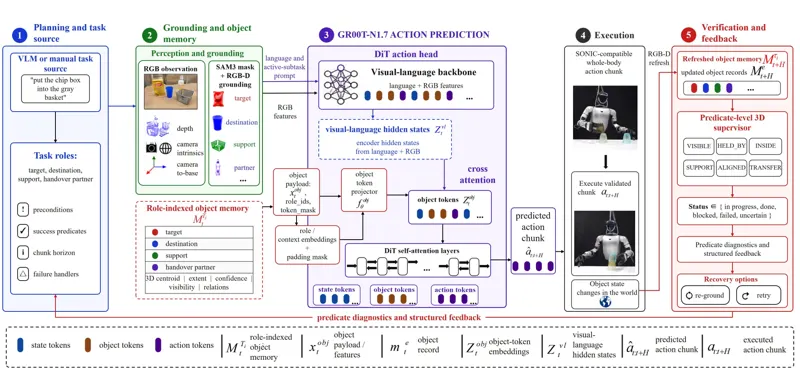
Vision-language-action policies are a promising foundation for general robot control, but long-horizon humanoid loco-manipulation requires the robot to treat task objects as persistent physical entities across movement, contact, occlusion, and recovery. We study this problem as object-state divergence: the object state used to condition a whole-body action can differ from the state used to decide whether the action achieved the intended physical relation. We propose Persistent Object Tokenization (POT), which maintains role-indexed 3D object records from RGB-D observations and converts them into object tokens for a whole-body action expert. Instantiated as POT-VLA, the same object records condition action generation and support geometric predicate checks, yielding a closed-loop execution system in which object state is both actionable and verifiable. On a Unitree G1, POT-VLA improves a matched direct GR00T-N1.7 baseline from 39/80 to 71/80 successes over eight real-world task families. In an external Being-0-aligned reference, POT-VLA achieves 44/50 successes on aligned service tasks, compared with the 37/50 success reported by the Being-0 paper. The largest gains occur on tasks requiring maintained 3D relations, suggesting that persistent object-centered state is a useful abstraction for verifiable humanoid VLA execution.

VLARGB-DUnitree G1Peng Ren, Haoyang Ge, Jiang Zhao·Jul 20, 2026
Patch Policy: Efficient Embodied Control via Dense Visual Representations

Patch Policy: Efficient Embodied Control via Dense Visual Representations

Pretrained dense visual features from Vision Transformers (ViTs) are powerful yet have been underutilized in robot learning. Modern robot policies either compress each observation into a single global token, or rely on visual backbones trained from scratch, sacrificing both fine-grained spatial detail and the benefits of large-scale visual pre-training. While there exist policies that do operate on dense patch features like large vision-language-action models (VLAs), they tend to be heavy and slow, inheriting the full cost of a billion-parameter vision-language model (VLM) backbone. We close this gap with Patch Policy, a minimal architectural extension that enables transformer-based policies to consume dense pre-trained patch tokens directly without the computational overhead of a full VLM. At its core is a block-causal attention mask that preserves the temporal causality of standard policies while letting the model attend over many patch tokens per observation, alongside other state information. Patch Policy is lightweight, fast, and highly effective. Across four simulated and three real-world environment suites, our method achieves a 40% relative improvement over policies using state-of-the-art global-pooled representations. Furthermore, it surpasses fine-tuned OpenVLA-OFT by 18% while using roughly 0.7% of the parameters. We believe Patch Policy provides a pipeline for the robotics community to readily leverage continuing progress in visual representation learning, without sacrificing the training efficiency or inference speed required for high-frequency, reactive control. Videos can be viewed at https://patch-policy.github.io

Patch PolicyDense Visual RepresentationDINOv2Gaoyue Zhou, Zichen Jeff Cui, Ada Langford·Jul 20, 2026
A Few Words Go a Long Way: Language Guided Robot Policy Synthesis

A Few Words Go a Long Way: Language Guided Robot Policy Synthesis

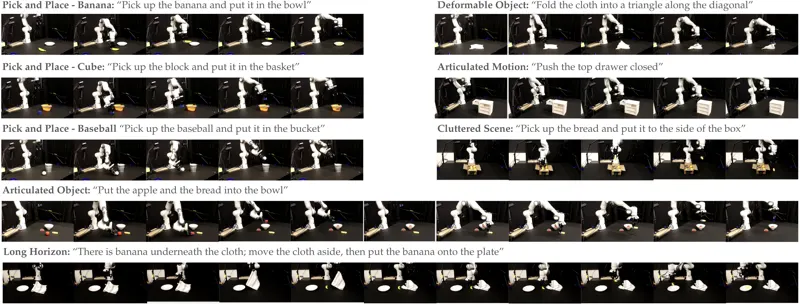
While vision-language-action models have demonstrated impressive zero-shot manipulation capabilities, they remain fundamentally black box policies that are difficult to interpret, adapt, or correct when they inevitably fail. In this work, we propose ARCHITECT, a framework that treats robot policy acquisition as an interactive program synthesis task. ARCHITECT leverages the reasoning capabilities of LLM coding agents to synthesize modular robot programs that utilize a suite of perception and control tools. Unlike end-to-end models where distribution shift leads to unpredictable, cascading failures, our modular architecture allows users to isolate failures and localize feedback at the level of abstraction required. We introduce an iterative process where a human supervisor provides natural language corrections to steer the policy. These corrections are grounded in the policy code by program execution traces and distilled into a persistent skill library, a form of long-term in-context learning which enables the agent to accumulate a repertoire of reusable, interpretable behaviors. In a benchmark evaluation on a Franka Panda robot, ARCHITECT outperforms state-of-the-art VLA models and program synthesis baselines on complex, long-horizon tasks, including articulated object manipulation and cloth folding. Our results demonstrate that the synthesized skill library enables the system to transfer to novel tasks with decreasing human intervention, providing a steerable and data-efficient alternative to black-box robot learning. Website: https://robo-architect.github.io/

VLAVision-language-action (VLA)Daphne Chen, Archit Ritesh Jain, Eric Goossen·Jul 26, 2026
MulRobBench: A Decision-Level Benchmark for Safe and Security-Policy-Compliant Multimodal UAV Agents

MulRobBench: A Decision-Level Benchmark for Safe and Security-Policy-Compliant Multimodal UAV Agents

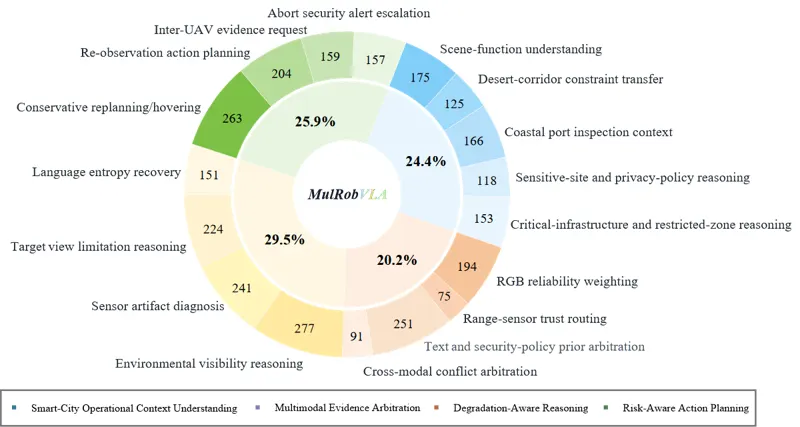
Smart-city airspace is transforming Uncrewed Aerial Vehicles (UAVs) from passive sensing platforms into cyber-physical decision makers that must follow operational rules under degraded observations and ambiguous language. Existing UAV and multimodal benchmarks evaluate perception, navigation, collaboration, and reasoning, but few assess whether physical evidence, protocol constraints, and action risk remain coupled during critical decisions. We introduce MulRobBench, an offline, protocol-conditioned benchmark for Vision-Language-Action (VLA) UAV agents in smart-city environments. MulRobBench integrates real UAV multimodal observations, protocol-level security policies, and action-level cyber-physical safety into a unified evaluation framework. The benchmark contains 3,024 samples spanning 17 task taxonomy nodes and 12 scoring dimensions across four stages: operational context understanding, multimodal evidence arbitration, degradation-aware reasoning, and risk-aware action planning. Evaluation combines semantic scoring with structural diagnostics, including policy compliance, format compliance, unsafe actions, parsing failures, and dimension-level validity. Across 17 multimodal models, the best semantic protocol-decision score reaches only 0.5141, while the best strict mean scoring-dimension accuracy is 0.1599. A controlled 20-anchor modality-ablation study changes 4-15 action selections per model, confirming that both visual and textual inputs influence decisions. Analysis identifies modality-trust selection, constraint extraction, glare, missing data, and operator shorthand as the primary causes of decision instability. MulRobBench provides a reproducible benchmark for trustworthy multimodal UAV decision making under realistic operational constraints.
VLAVision-language-action (VLA)Belal S. Alsinglawi, Weizheng Wang, Junyi Wu·Jul 26, 2026