Skip to content
Dream-RSI: Recursive Self-Improvement through Evolving Worlds

Dream-RSI: Recursive Self-Improvement through Evolving Worlds

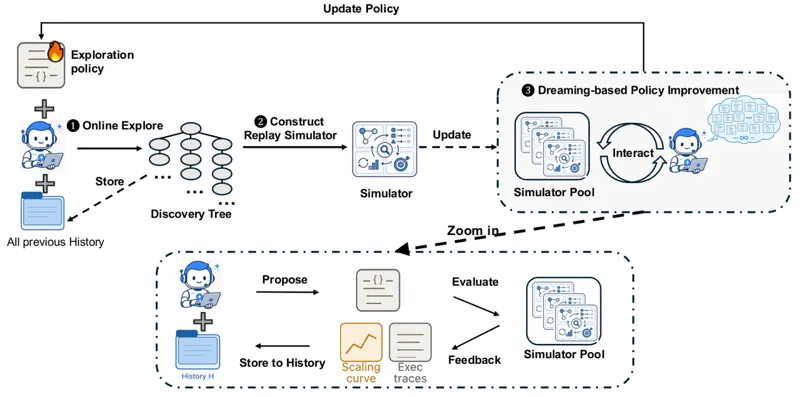
Recursive self-improvement is becoming increasingly vital for autonomous AI agents, where progress hinges on discovering high-value solutions across complex domains. The driver of this process is effective exploration, however, managing and improving exploration strategies remains a major bottleneck. Current systems face a fundamental dilemma: fixed strategies fail to adapt as search spaces scale, while online policy optimization requires navigating vast meta-search spaces under delayed and expensive feedback over long-horizon rollouts. We introduce {Dream-RSI}, a framework for scalable and recursively self-improving exploration. A lightweight orchestration layer makes exploration explicit and programmable while leaving the underlying coding agent unchanged. Our key insight is that accumulated discovery history can serve as a replay simulator over the realized search space. By performing dreaming in the replay simulator constructed from historical discovery trees, {Dream-RSI} secures immediate, low-cost off-policy feedback to evaluate and refine exploration policies without invoking repetitive, expensive online evaluations. The improved policy is subsequently redeployed online to drive further discovery, continuously expanding the simulator pool in a self-improving loop. Across algorithm engineering, mathematical optimization, and GPU kernel engineering, {Dream-RSI} achieves competitive or improved discovery quality while substantially reducing discovery cost in several settings.

Recursive self-improvementWorld Models
Tong Zheng, Xidong Wu, Zheng Zhang · 1.2k views · Sep 14, 2026
ReST-RL: Reinforcing LLM Reasoning through Unified Self-Training and Value-Guided Search

ReST-RL: Reinforcing LLM Reasoning through Unified Self-Training and Value-Guided Search

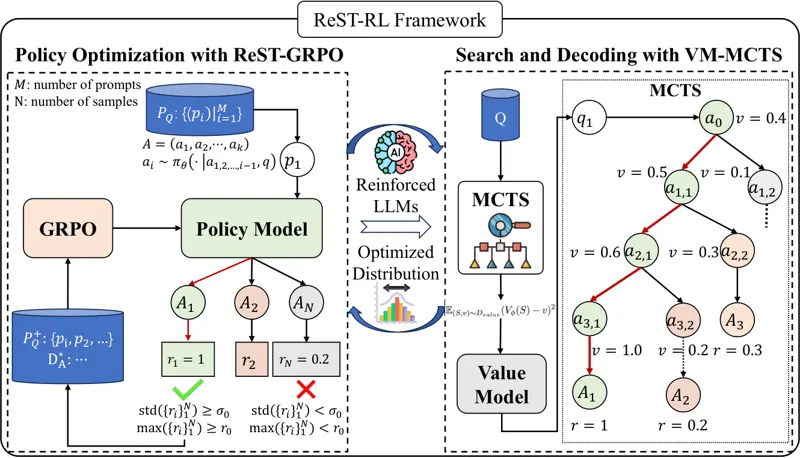
GRPO is the representative RL method for improving LLM reasoning, yet it only ever sees one sparse reward at the end of a whole trajectory: when the rewards inside a sampled group land close together, the group-relative advantage collapses into noise and the policy learns almost nothing. ReST-RL reconnects policy optimization and value-guided search into a single self-training pipeline. Stage one, ReST-GRPO, first filters out low-information prompts by reward standard deviation, then draws prefixes from each prompt's highest-reward trajectory under a discrete exponential distribution and uses them as fresh online-GRPO starting contexts. A selected prefix is context only; its suffix is re-sampled and optimized rather than imitated. Stage two, VM-MCTS, runs MCTS under the now-static policy to self-collect value targets and trains a value model that predicts expected terminal reward. At inference the same model both allocates the tree search through UCT and ranks completed candidates in a Best-of-N fashion, so search and verification share one state-value scale. On coding benchmarks including APPS, BigCodeBench and HumanEval, Qwen3-8B moves from 0.503 to 0.689 average. In matched policy-value controls, ReST-GRPO + VM-MCTS reaches 0.642 on APPS-500 while GRPO + VM-MCTS reaches only 0.538, so the stage-one distributional shift survives value learning. End-to-end accounting puts ReST-GRPO at 1,752 GPU-hours against 2,080 for GRPO, hitting a 9% gain in 71 hours instead of 207. A value model trained only on code trajectories also transfers to MATH, Omni-MATH and GPQA-Diamond without target-domain tuning.

Reinforcement LearningGRPO
Sining Zhoubian, Dan Zhang, Jie Tang · 759 views · Aug 27, 2025
RelateAnything: Real-Time Open-Vocabulary Relation Prediction From Any Inputs

RelateAnything: Real-Time Open-Vocabulary Relation Prediction From Any Inputs

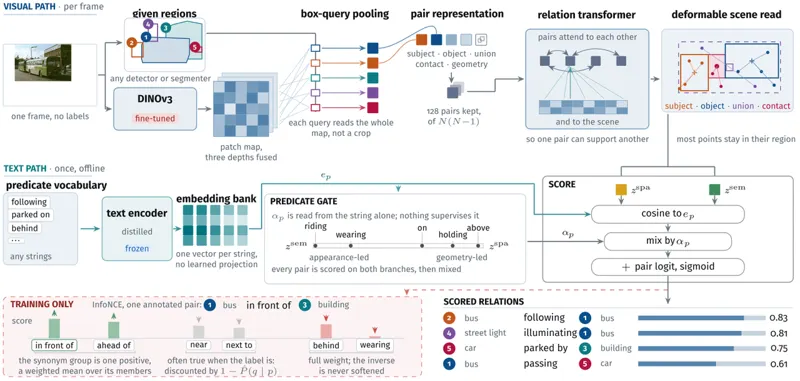
Open-vocabulary detection accepts any class list at inference, and promptable segmentation returns regions without class names: the taxonomy has left the model and become an input. Relation prediction has not. Scene-graph models are still trained and evaluated on the 50 or 56 predicates of one annotation style, their relation head conditioned on object labels and so tied to one detector. Three obstacles explain this, none primarily modelling: no relation corpus is both free-text and verified, a label-conditioned architecture cannot accept a vocabulary it was not trained on, and the standard metric rewards agreement with the training corpus, so a larger vocabulary scores as a regression. We present RelateAnything, a 53M-parameter model taking an image and regions from any source and returning scored relations over a predicate vocabulary supplied at inference as strings. Object labels are never an input, so the region source can change without retraining, and the vocabulary is a bank of text embeddings, not a learned classifier. It runs at 20 ms/frame. Training over 19,103 predicates requires positive-unlabeled supervision and a text encoder that separates antonyms, which contrastive encoders embed at cosine 0.95. To supply the supervision we build RA-4M, 474k images and 4.3M relations over 10,102 free-text predicates, generated against numbered box markers and geometrically verified. To measure it we build OV-SGG-Bench, six axes scored across datasets that the priors standard recall rewards cannot satisfy. On three cross-dataset benchmarks and a fourth zero-shot, RelateAnything has 2.3-3.5x the mean recall of the strongest open-vocabulary method of comparable scale, margins that survive a real detector, and leads a 3B-VLM scene-graph model on both metrics at under 2% of its parameters. In-domain measurement overstates transfer gains ~5x. Model, corpus and benchmark are public.

Scene Graph GenerationOpen-vocabulary
Neau, Maëlic · 818 views · Sep 11, 2026
Show-Harness: Just a VLM Agent Can Play Robots

Show-Harness: Just a VLM Agent Can Play Robots

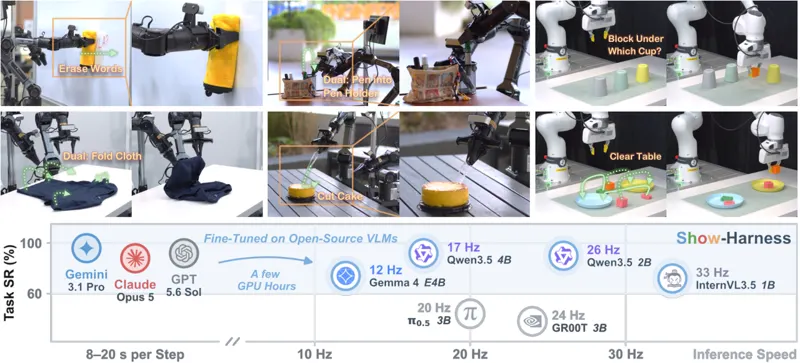
Foundation vision-language models (VLMs) exhibit broad intelligence about the world, yet translating this intelligence into robot control remains challenging. We present Show-Harness, an Embodied Harness that enables VLMs to "play" robots through a compact semantic interface linking intent to action. Show-Harness exposes discrete semantic action units that VLMs can naturally reason over, while embodiment-specific interpreters deterministically ground them into local robot actions, keeping the VLM directly responsible for fine-grained physical decisions. Through the same interface, Show-Harness demonstrates the feasibility of (1) directly unlocking closed-source frontier VLMs for zero-shot robot control, and (2) adapting small-scale open-source VLMs for low-cost deployment with just a few GPU-hours of fine-tuning. We further develop GUMI (GUI Manipulation Interface), which extends the same semantic action space to GUI-based demonstration collection, allowing humans and agents to "play" robots across embodiments without specialized teleoperation hardware. Extensive experiments show that Show-Harness-equipped VLM agents generalize robustly across tasks, embodiments, and environments, outperforming representative agentic and VLA paradigms. These results suggest that the right interface can unlock substantial embodied capability from foundation VLMs, without requiring additional model capacity or costly embodiment-specific pretraining.

Vision-language modelsAgentic Harness
Yanzhe Chen, Zechen Bai, Zhijun Cao · 1.2k views · Sep 9, 2026
Memory as Plans: World-Action Modeling with Memory-Grounded Planning

Memory as Plans: World-Action Modeling with Memory-Grounded Planning

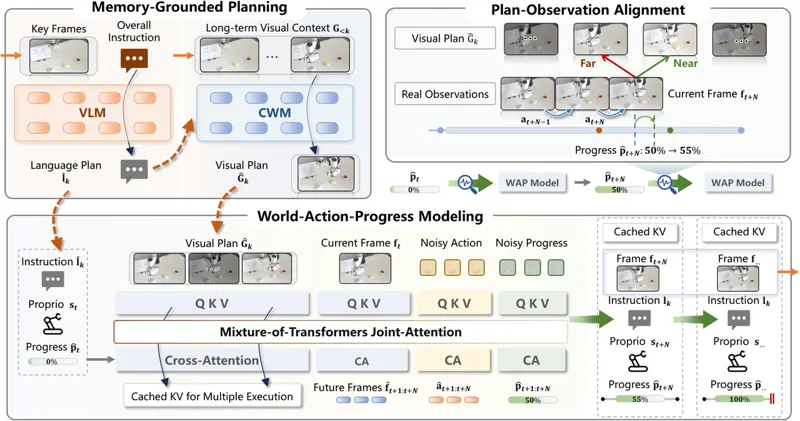
Most robot policies predict actions from the current observation or a short fixed window, yet long-horizon manipulation is non-Markovian: the evidence a decision needs may already be out of view. MaP-WAM treats memory as planning-time evidence instead of executor input. Completed segments are stored as structured multimodal records pairing a language instruction with sparse visual context (8 uniformly sampled frames per segment); a fine-tuned Qwen3.5-4B language planner proposes the next segment-level language plan, and a causal world model initialized from WAN-2.2-5B turns the long-term visual context into a matching visual plan. The two form a memory-grounded plan that conditions a World-Action-Progress executor, a Mixture-of-Transformers extension of a video DiT that jointly predicts action chunks, future visual latents, and execution progress, with progress as a first-class modality. Because the executor only sees a fixed-length plan prefix, its context stays constant as history grows, and block-causal attention makes both planning and execution KV-cacheable; plan-observation alignment calibrates recursively predicted progress against visual-plan frames, and a progress gate (threshold 0.95) triggers segment transitions that write resampled real observations back into memory. On RMBench MaP-WAM reaches 83.3% average success over nine memory-dependent tasks (best baseline LingBot-VA 77.1%), and 78.0% on two real Franka Research 3 tasks (88% Find Button, 68% Press Buttons), while a full-context executor runs out of memory at 1700 history frames and WAP holds an approximately constant 827 ms per action chunk. Limitations: segment structure is taken from benchmark annotations rather than discovered automatically, and plan-observation alignment uses a lightweight training-free pixel-difference metric.

World-action modelsLong-Horizon Memory
Sizhe Zhao, Haozhe Xie, Weiyu Zhao · 854 views · Sep 10, 2026
IMLE-VLA: Fast Single-Step Action Generation for Vision-Language-Action Policies

IMLE-VLA: Fast Single-Step Action Generation for Vision-Language-Action Policies

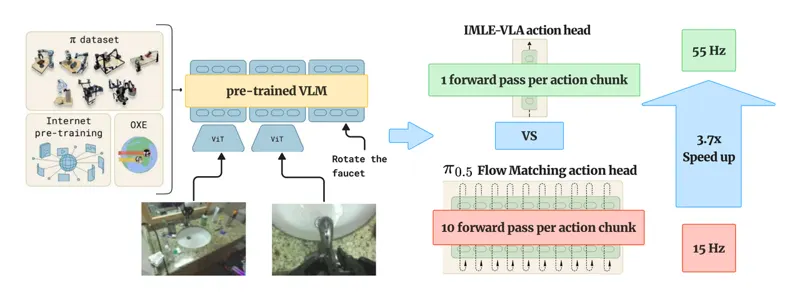
Vision-language-action (VLA) policies leverage pretrained vision-language backbones to achieve strong cross-task generalization. A leading design couples this backbone with a dedicated continuous action head trained via diffusion or flow matching. However, such heads rely on iterative multi-step sampling, for example 10 Euler steps in π_0.5. This creates an inference bottleneck that produces stop-and-go movement in the robot and slower task completion. We introduce IMLE-VLA, which replaces the iterative action head with a single-step conditional generator trained via conditional Implicit Maximum Likelihood Estimation (cIMLE). The cIMLE objective promotes multimodal action coverage, avoiding the mode collapse of naive regression heads while eliminating multi-step sampling entirely. When IMLE-VLA is applied to π_0.5, it increases inference frequency 3.67x (55 Hz vs. 15 Hz), enabling up to 11x higher action throughput. On the 40-task LIBERO benchmark, IMLE-VLA achieves the highest average success rate (98.0%) among all baselines while leading in inference frequency. Under the test-time perturbations of LIBERO-plus, IMLE-VLA retains π_0.5's robustness while other baselines degrade sharply, confirming that the cIMLE head preserves generalization. Real-world experiments on a Franka Emika Panda across four tasks demonstrate smoother motion (2.2x to 3.0x lower jerk) and faster task completion, with IMLE-VLA outperforming π_0.5 on every task and reducing average VLA inference time per episode by 3.9x to 6.6x. Videos and code are available at https://kianhk6.github.io/IMLE-VLA/

VLAEfficient Inference
Hosseinkhani, Kian, Peng, Qinhe, Shramko, George · 1k views · Sep 10, 2026

As an Amazon Associate, we earn from qualifying purchases.