Skip to content
VT-Bridge: Bridging Pretrained Foundation VLAs to VTLAs via Lightweight Residual Adaptation

VT-Bridge: Bridging Pretrained Foundation VLAs to VTLAs via Lightweight Residual Adaptation

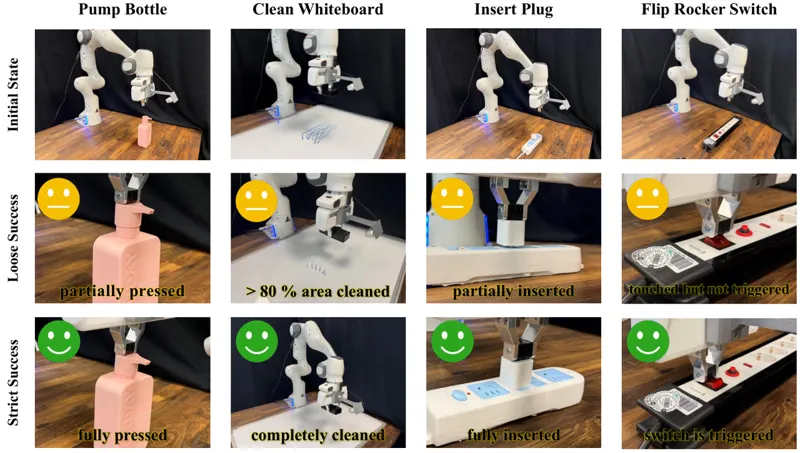
Vision-Tactile-Language-Action (VTLA) models have demonstrated clear advantages over Vision-Language-Action (VLA) models in contact-rich manipulation. However, developing VTLA models is severely constrained by the massive amounts of vision-tactile data and computational resources required. To address this bottleneck, we propose VT-Bridge, a lightweight residual adaptation strategy that bridges pretrained foundation VLAs to VTLAs. Rather than training a VTLA model from scratch or modifying the original architecture of a pretrained VLA, VT-Bridge employs an identical lightweight residual-adapter architecture across VLA backbones and uses backbone-specific weights to refine actions at the robot execution frequency. This design substantially lowers the data and training barriers. Specifically, it requires up to 50 vision-tactile demonstrations per task to fine-tune a VLA backbone and train a 0.98M-parameter residual adapter. Experiments with three representative VLA backbones (π₀, π_0.5, and SmolVLA) across four contact-rich manipulation tasks further demonstrate its consistent effectiveness across VLA architectures. On average, VT-Bridge raises the task completion rate from 11.7% with task-level VLA fine-tuning alone to 62.9%. Together, these findings demonstrate the broad applicability, effectiveness, and accessibility of VT-Bridge for contact-rich manipulation. The project page is available at https://hoxnocha.github.io/vt-bridge-web/.

Tactile SensingVLA
Yansong Wu, Tuo Yang, Rongping Zhao · 315 views · Sep 18, 2026
SuperNav: An Agentic Navigation System for Any Task in Any Scene

SuperNav: An Agentic Navigation System for Any Task in Any Scene

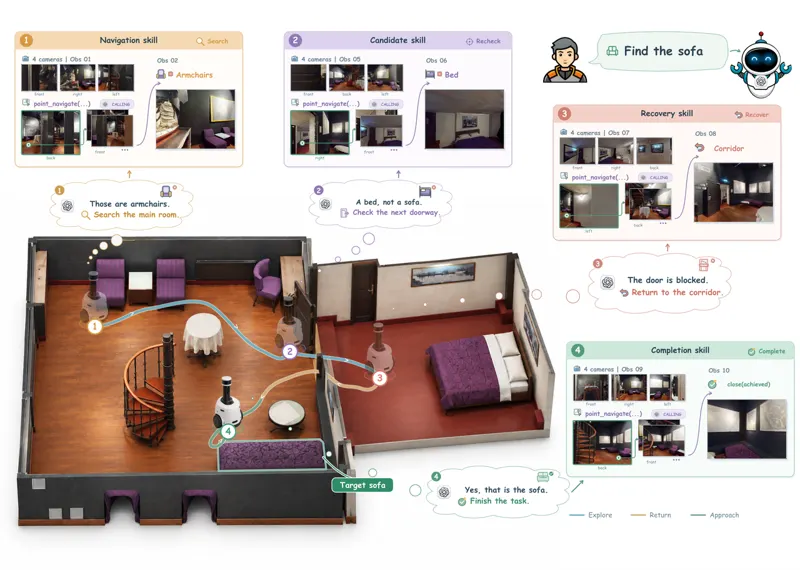
General-purpose service robots need navigation systems that can handle diverse human requests in unfamiliar environments, combining task generality with scene generality. Some existing methods fine-tune multimodal large language models (MLLMs) to predict navigation actions, making their behavior dependent on the coverage of navigation training data and potentially limiting generalization to new requests and environments. Our key insight is to let the MLLM focus on interpreting requests, understanding scenes, and making decisions while preserving its general-purpose capabilities and delegating motion execution to navigation tools. To realize this idea, we introduce SuperNav, which equips a pretrained MLLM with a specialized agent harness without navigation-specific fine-tuning of the MLLM. Our harness supports these decisions with Navigation Skills, agent-oriented Tools for physical interaction, and task-progress and context management. A unified visual-point interface connects decision-making to motion by allowing the model to specify destinations directly in images and revise its decisions from execution feedback. Together, these components support sustained navigation across different task requirements and environments. SuperNav outperforms four evaluated baselines on instance-level, multi-object, and demand-driven tasks. Category-level evaluation on HM3D and deployment on a real quadruped robot further demonstrate its applicability across environments. Project Page: https://zju3dv.github.io/SuperNav/

Object NavigationEmbodied Agent
Jinkai Zhang, Jingyi Xu, Yuanhong Yu · 463 views · Oct 8, 2026
TacitVLA: Reasoning Vision-Language-Action Models Without Reasoning Latency

TacitVLA: Reasoning Vision-Language-Action Models Without Reasoning Latency

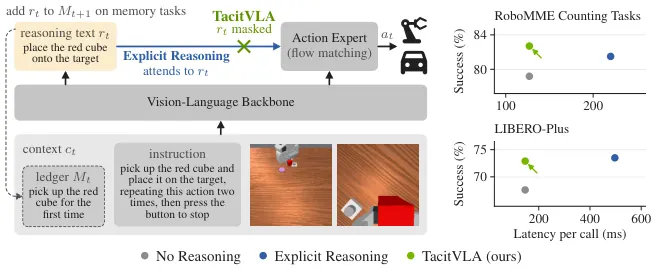
Textual reasoning before acting has improved vision-language-action (VLA) models, but at the cost of latency: every action conditioned on the reasoning text must wait for autoregressive decoding. We show that actions do not need to wait for or condition on the generated reasoning to benefit from it, because the reasoning supervision already improves the backbone representation. We introduce TacitVLA, a reasoning VLA whose action expert never attends to the reasoning it generates for the current call. On long-horizon tasks where the reasoning text also serves as episodic memory, it can generate each entry during action execution rather than before acting. We evaluate it in a controlled study on four benchmarks spanning manipulation and autonomous driving, memory and non-memory tasks: RoboMME, RMBench, LIBERO, and PhysicalAI-AV. On all four, TacitVLA matches the performance of its explicit-reasoning counterpart at up to 3.4x lower latency, and matches the latency of the same architecture trained without reasoning at up to +17.1% success. In absolute terms, it surpasses the best previously published results on the RoboMME Counting suite (82.7% vs. 66.8%) and RMBench (77.5% vs. 56.5%), and reaches 72.9% on LIBERO-Plus and a 52.5% scene score on the public split of the PhysicalAI-AV closed-loop driving challenge. Project page: https://tacitvla.github.io.

VLAEmbodied Reasoning
Jack Lu, Yurong You, Boyi Li · 514 views · Oct 13, 2026
ASENA: Self-evolving Agents for Embodied Navigation

ASENA: Self-evolving Agents for Embodied Navigation

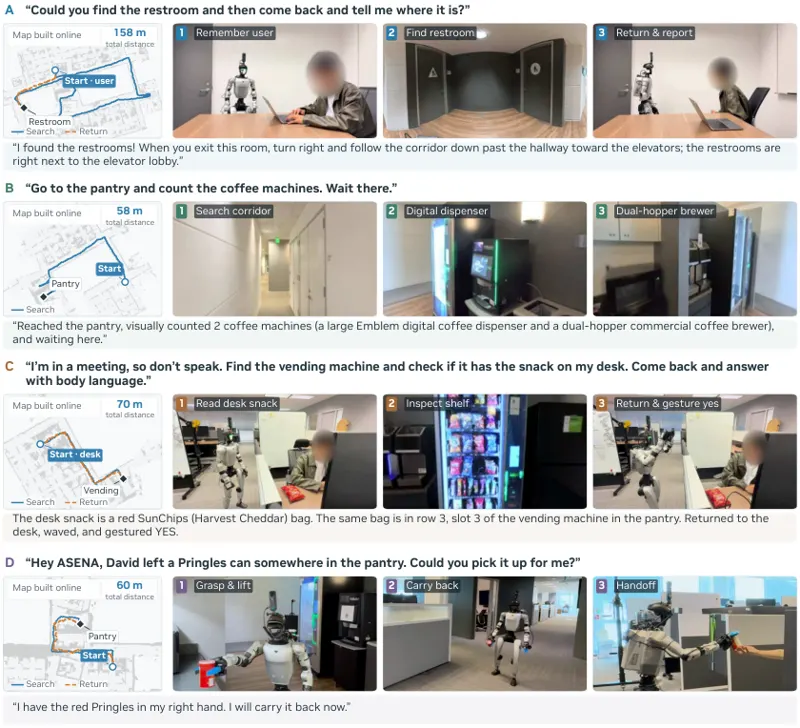
We present ASENA, an embodied agent system that enables general-purpose coding agents to program humanoid navigation, manipulation, and interaction. Through a unified robot harness, agents read sensor data, write and execute programs, inspect recorded outcomes, repair failures, and reuse notes and executable skills while keeping their model weights fixed. We also introduce ASENA-VLN, a 4B monocular navigation policy that serves as an optional tool within this programmable system. ASENA-VLN predicts body-frame trajectories for both extended routes and short-horizon behaviors. Its shared vision-language decoder is trained on route instructions, visual question answering, and a newly curated dataset of geometry-derived atomic navigation tasks. As a standalone policy, ASENA-VLN achieves state-of-the-art success rates of 68.7% on R2R and 70.2% on RxR. When integrated with a coding agent, learned navigation improves ASENA's success rate by 11 percentage points on both agentic benchmarks and reduces execution time. Persistent workspace evolution uses simulator feedback to improve success over ten passes through recurring 100-task subsets. Success increases from 72% to 98% on R2R and from 65% to 89% on RxR. On embodied question answering, ASENA achieves state-of-the-art accuracy with fewer interaction steps. On a Unitree G1, we demonstrate search, visual inspection, spatial reasoning, synthesized gestures, and mobile manipulation combining object pickup, carrying, and handoff without a pre-built map. These demonstrations illustrate how online programming extends robot behavior beyond route following and predefined skills.

Vision-language navigationEmbodied AI
An-Chieh Cheng, Isabella Liu, Edmund Bu · 417 views · Sep 30, 2026
LongHarness: Stateful Evidence Management for Agentic Reasoning over 100M-Token Corpora

LongHarness: Stateful Evidence Management for Agentic Reasoning over 100M-Token Corpora

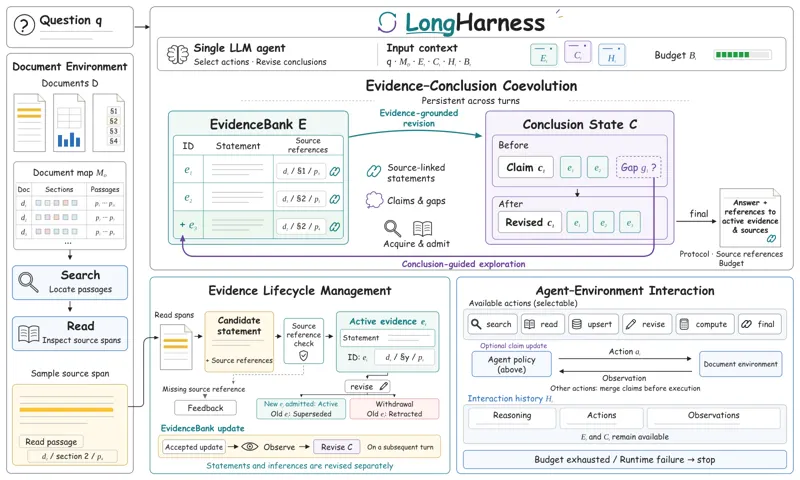
Corpus-level long-context reasoning requires agents to acquire and integrate evidence across document collections that exceed their context windows. Existing agent harnesses enable incremental access to these corpora, but acquired evidence and evolving conclusions often remain entangled in a growing interaction history. This implicit state management can lead to two coupled failure modes: unbounded exploration, where retrieval expands the interaction history without resolving decision-relevant information gaps, and evidence-state drift, where previously acquired evidence or subsequent corrections fail to inform the current conclusion. We present LongHarness, a model-agnostic harness that makes the interaction between acquired evidence and evolving conclusions explicit. Its core mechanism, Evidence-Conclusion Coevolution, uses unresolved conclusions to guide exploration toward missing information, while newly acquired evidence strengthens or revises the conclusions that directed the search. LongHarness couples this process with Evidence Lifecycle Management, which keeps accumulated evidence current and traceable throughout the interaction. Together, these mechanisms focus retrieval on remaining information needs and keep conclusions aligned with current evidence. We evaluate LongHarness on OfficeQA Pro V1 and V2, AA-LCR, and LongBench v2 using GLM-5.3-Flash and Qwen3.8-Flash. Compared with direct reasoning using the same backbone, LongHarness improves GLM-5.3-Flash exact match on OfficeQA Pro from 15.8% to 60.2% on V1 and from 4.4% to 61.1% on V2. Against state-of-the-art agent harnesses, it surpasses Claude Code by 12.0 percentage points on V1 and Codex by 18.9 points on V2. With Qwen3.8-Flash, LongHarness reaches 61.7% on V1, outperforming Claude Code by 8.3 points and Codex by 12.0 points.

Agent HarnessLong-Context Reasoning
Songtao Huang, Zhijie Zhong, Xiaohan He · 513 views · Oct 9, 2026
PanTact: Teaching Whole-Body Dexterity with a Wearable Contact Interface

PanTact: Teaching Whole-Body Dexterity with a Wearable Contact Interface

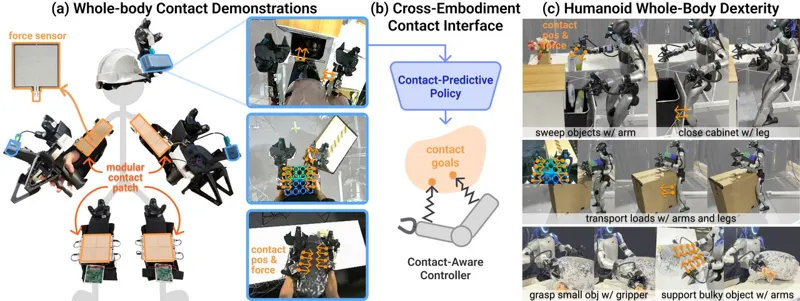
PanTact treats contact, not joint trajectories, as the transfer currency from people to humanoids. Wearable patches are assembled magnetically from 44x44 mm FSR modules; a custom 50x50 mm PCB streams 16 channels at 1 kHz over a CRC-checked RS-485 daisy chain, one Vive tracker per patch maps sensor centers into the world frame, and contact states are binarized against a per-channel adaptive baseline with threshold max(0.35 beta, r_min). The policy observes body-masked 3D egocentric point clouds, both wrist images and proprioception, and at 10 Hz predicts an action chunk of H=16 steps containing a look-at point, EEF poses with gripper widths, and per-sensor contact goals (binary state plus 3D position). A soft-minimum proximity d(p,q) with T = 0.02 m hands each active contact to whichever robot surface is currently nearest, and active goals are offset by delta along the pressing direction to form virtual goals that generate pressing force, so the G1 holds objects without any tactile sensor on its body. Three control formulations trade off differently: training-free upper-body IK, WBIK whose dense reference is executed by SONIC, and a sparse contact tracker trained with PPO over 4096 simulation environments for 30k iterations (50 Hz, 29 joints, S=8 upper-body / S=16 whole-body contact slots). On a 29-DoF Unitree G1: Grasp-and-Embrace reaches 85% with upper-body IK and 80% with the sparse tracker against 0% for Humanoid UMI; Sweep-and-Stow reaches 90.63% end to end while Humanoid UMI++ scores 18.75% on each stage and 0% end to end; Carry-and-Push is 90% versus 40%. In simulation replay, adding contact goals lowers contact distance for all three controllers at almost no cost in EEF accuracy.

Whole-Body ManipulationTactile Sensing
Xu, Xiaomeng, Zhang, Han, Ruan, Zhian · 604 views · Oct 8, 2026
LifelongCrossNav: Persistent 3D Semantic Memory for Cross-Floor Multi-Object Navigation

LifelongCrossNav: Persistent 3D Semantic Memory for Cross-Floor Multi-Object Navigation

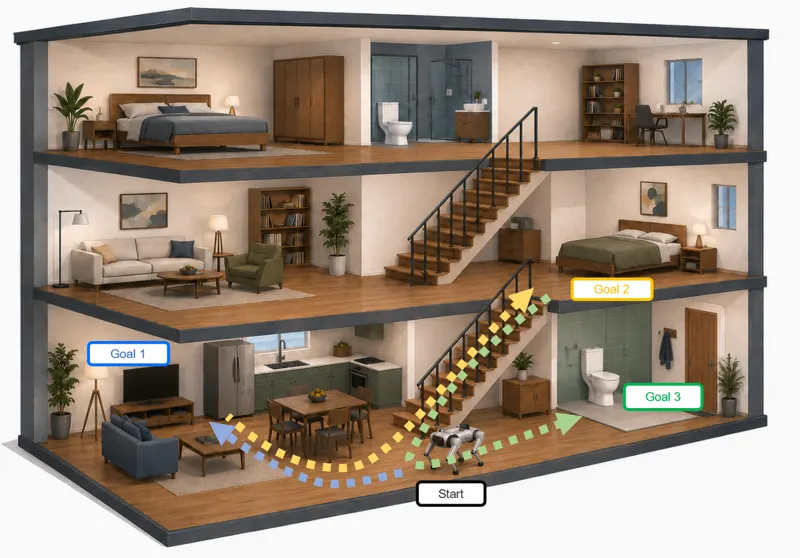
Object-goal navigation has made substantial progress in semantic perception and exploration, yet persistent memory for multi-object navigation and cross-floor navigation are still commonly addressed separately. We present LifelongCrossNav, a framework for sequential multi-object ObjectNav in unknown multi-floor indoor environments. Within each episode, the agent receives an ordered sequence of object-goal queries while continuously maintaining a shared sparse 3D semantic voxel memory. This memory incrementally accumulates geometric structure, traversability states, and vision-language features, allowing subsequent object-goal queries to retrieve previously acquired scene information without rebuilding the map. To support persistent search across floors, LifelongCrossNav combines support-aware 3D traversability mapping, stair-specific perception, and direction-aware stair traversal. A unified navigation policy coordinates same-floor frontier exploration, live and historical point-of-interest retrieval, stair navigation, and target-object search and approach. We further introduce HM3D-MFMON, a benchmark for sequential Multi-Floor Multi-Object Navigation built on HM3D scenes, including a dedicated subset in which completing the full sequence of object-goal subtasks requires at least one floor transition. Experimental results show that LifelongCrossNav consistently outperforms a representative planar persistent semantic-map baseline on HM3D-MFMON, demonstrating that persistent 3D semantic memory and cross-floor traversability modeling effectively support sequential multi-object navigation in multi-floor environments. Project page: https://flageval-baai.github.io/LifelongCrossNavPage.

Object-Goal NavigationSemantic Memory
Zehui Li, Zihao Sun, Jiawei Xu · 380 views · Aug 7, 2026
See-and-Reach: Precise Vision-Language Navigation for UAVs within the Field of View

See-and-Reach: Precise Vision-Language Navigation for UAVs within the Field of View

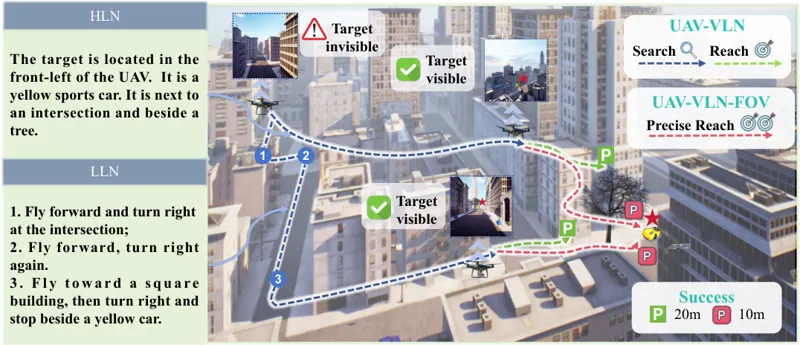
UAV Vision-Language Navigation (UAV-VLN) is typically formulated as a holistic search-and-reach problem, where long-range target discovery and final target approach are optimized and evaluated jointly. This formulation makes it difficult to assess a critical capability of aerial embodied agents, namely whether a UAV can accurately ground a visible target and translate vision-language evidence into precise 3D motion once the target enters its field of view. To address this limitation, we introduce UAV-VLN-FOV, a target-visible navigation task that isolates the see-and-reach stage and enables a more diagnostic evaluation of terminal reaching ability. We further propose 3DG-VLN, a vision-language waypoint prediction framework guided by dynamic 3D direction cues to enhance fine-grained visual grounding and spatial direction alignment for precise target reaching. Specifically, 3DG-VLN adaptively processes high-resolution front-view and downward-view observations to preserve fine-grained visual and geometric details for target grounding. It also updates the target-relative direction online during closed-loop navigation, allowing the agent to maintain spatial alignment with the target and reduce accumulated direction drift. To support this task, we construct a dedicated high-resolution benchmark which contains 2,717 trajectories with target-oriented high-level instructions, high-resolution front-view and downward-view egocentric observations, and continuous 3D waypoint annotations. Experiments show that 3DG-VLN outperforms competitive UAV-VLN baselines, achieving a 13.82% improvement in success rate. Real-world trials further demonstrate the potential of 3DG-VLN for practical see-and-reach navigation. The source code and benchmark are available at https://github.com/xuefanfu/3DG-VLN.

Vision-language navigationUAV
Fanfu Xue, En Yu, Yantian Shen · 310 views · Jun 18, 2026
Recursive Game Creator: An Agentic Product-Level Experience-Oriented Game Harness

Recursive Game Creator: An Agentic Product-Level Experience-Oriented Game Harness

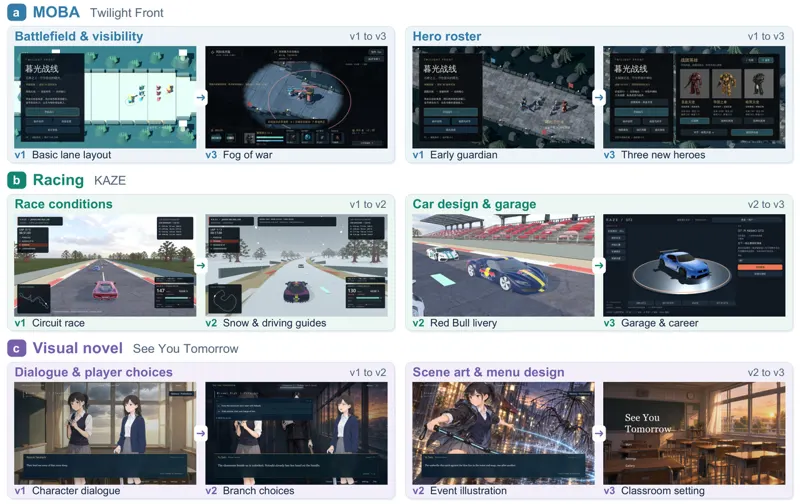
Recent game design agents have made substantial progress in generating playable games. However, program correctness does not ensure an enjoyable experience for players. We present Recursive Game Creator, an experience-oriented harness to advance agentic game development from rough game prototypes into entertaining games. Recursive Game Creator organizes recursive development around four components: Designer, Builder, Player, and Reviewer. The Designer translates user instructions and Reviewer's feedback into detailed plans. The Builder turns these plans into candidate games. The coding-native Player creates and executes reusable policies through programmatic interfaces to efficiently collect diverse gameplay trajectories, mitigating evaluation bias caused by slow GUI-based collection. The Reviewer uses carefully designed trajectory-based metrics to induce player preferences, integrating with visual evidence and explicit textual preferences to evaluate games against game-specific criteria. Finally, the Reviewer accepts the better version and provides improvement reviews for the next round, closing the recursive loop. Our method achieves state-of-the-art overall performance of 77.89 on GameCraft-Bench. On GameASG-Bench, it achieves a strict task success rate of 53.2%, a 34.1% improvement over the same-model baseline, and the highest mean runtime-check pass rate at 93.4% among compared methods. A user study shows longer playtime and higher ratings. Code is coming soon.

Agentic Game DevelopmentRecursive self-improvement
Jiajun Chen, Haoyu Wu, Mingda Jia · 445 views · Oct 6, 2026

As an Amazon Associate, we earn from qualifying purchases.