Skip to content
DONIC: Generalist Dexterous Bimanual Tracking Control from Human Demonstrations

DONIC: Generalist Dexterous Bimanual Tracking Control from Human Demonstrations

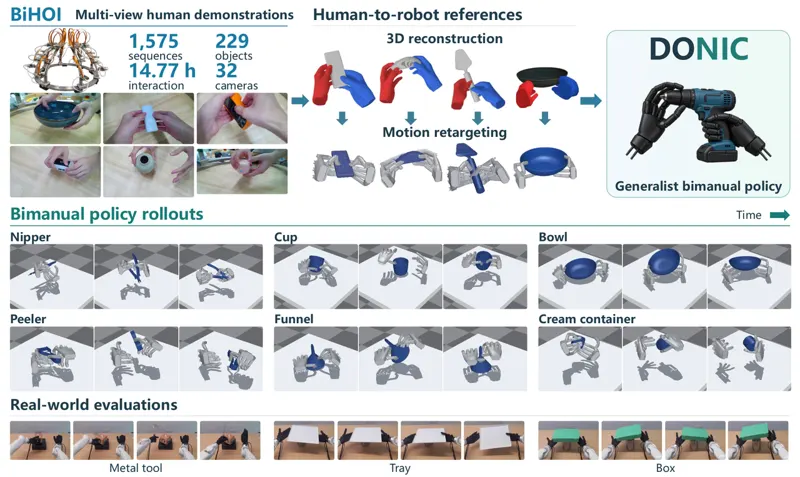
Despite recent progress in dexterous reference tracking, existing models focus primarily on single-hand manipulation and a limited range of interactions, leaving the bimanual dexterous behaviors common in real life unaddressed. The scarcity of contact-rich bimanual manipulation data and the increased complexity of coordinating contacts make developing a generalist bimanual tracker particularly challenging. Therefore, we present 1) DONIC, the first generalist bimanual tracker jointly trained across operation categories and human-motion sources, together with 2) BiHOI, a multi-view dataset of 1,575 sequences spanning 229 objects and emphasizing sustained bimanual interaction, where reconstructed interactions are retargeted into robot references. DONIC combines proximal policy optimization with behavioral cloning in a feedback loop that recycles verified successful executions into training demonstrations. An object-centered per-hand reward maintains object-motion feedback while supervising each hand according to its reference contact role. Clip-Centered Advantages remove reference-dependent advantage offsets while preserving within-trajectory differences. Together, these designs enable one single policy to learn coordinated manipulation across heterogeneous references. Without finetuning, a single checkpoint achieves 86.79% success on unseen trajectories of training objects and 57.32% on held-out objects, surpassing the state-of-the-art bimanual tracking baselines by 77.36 and 45.73 percentage points.

Dexterous ManipulationBimanual Manipulation
Mingze Sun, Ziang Cao, Yuan Fei · 241 views · Oct 21, 2026
Temporal Visuo-Tactile Learning for Dexterous Grasp Stability

Temporal Visuo-Tactile Learning for Dexterous Grasp Stability

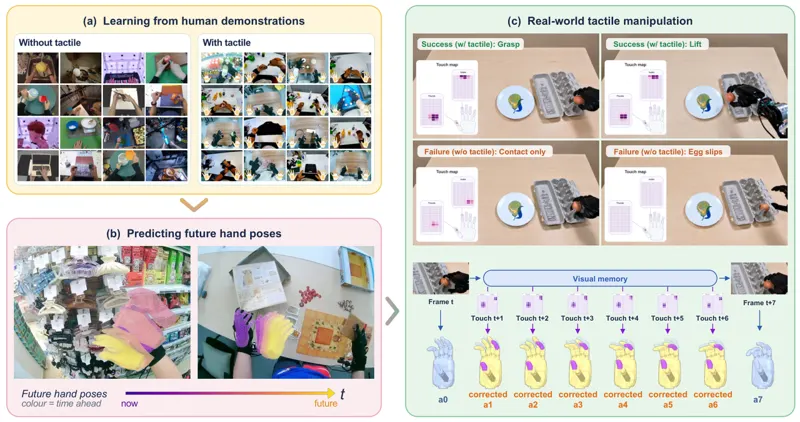
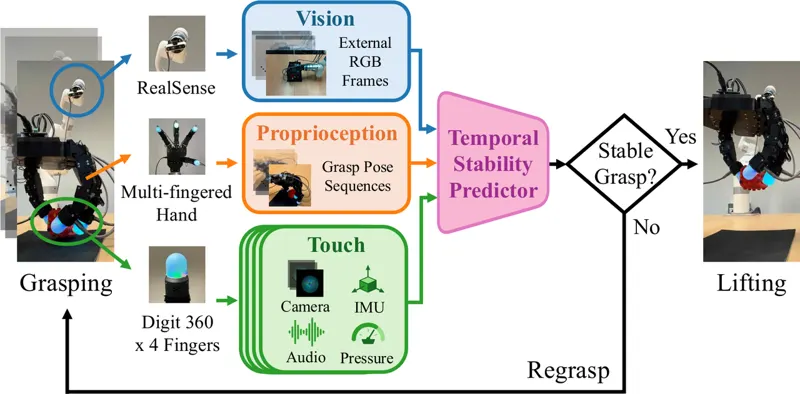
Most robotic grasping research picks a pose from vision and closes a parallel gripper, while humans rely on fingertip touch and almost never drop things. The LASR Lab at TU Dresden reframes the question as "is this multi-fingered grasp stable before we lift?" and answers it with data. They mount four Digit 360 sensors on the fingertips of a 16-DoF Tilburg Hand on a 7-DoF xArm7 and automatically collect 10,000 grasp trials over 200 objects (105 rigid, 95 deformable, 1.9-244 g), recording external RGB-D, proprioception and four tactile streams (camera, audio, IMU, pressure) throughout each grasp. Stability labels come from SAM 3 measuring post-lift object height and agree with manual verification on 92.34% of trials. The predictor consumes a 3-second window anchored at grasp initiation: 16-frame RGB and tactile clips go through pretrained VideoMAEv2-Base, 100-step proprioception and 224-step audio/IMU/pressure go through Transformers, fingertip features are fused across modalities, time and fingers by weight-shared factorized attention, and everything is aggregated by attention fusion into a post-lift stability probability. Under 5-fold object-disjoint cross-validation, vision+proprioception+touch reaches 83.55% and removing touch costs 3.99 points (79.56%). Tactile spatial resolution matters monotonically (79.40% at 1x1 up to 83.55% at 112x112), and freezing touch to its final frame costs 2.07 points, so the useful signal is high-resolution and dynamic. Deployed as an online lift-or-regrasp gate (threshold 0.95, up to five regrasps) on 20 objects excluded from training, the visuo-tactile gate reaches 82.0% success among executed lifts, 10.5 points above a non-tactile gate. The ~1.2 TB dataset is public on OPARA.

Dexterous ManipulationTactile Sensing
Ken Nakahara, Aleksei Buvailik, Prokhor Kotov · 651 views · Oct 7, 2026
DexTacWAM: A Visuo-Tactile World-Action Model for Dexterous Manipulation

DexTacWAM: A Visuo-Tactile World-Action Model for Dexterous Manipulation

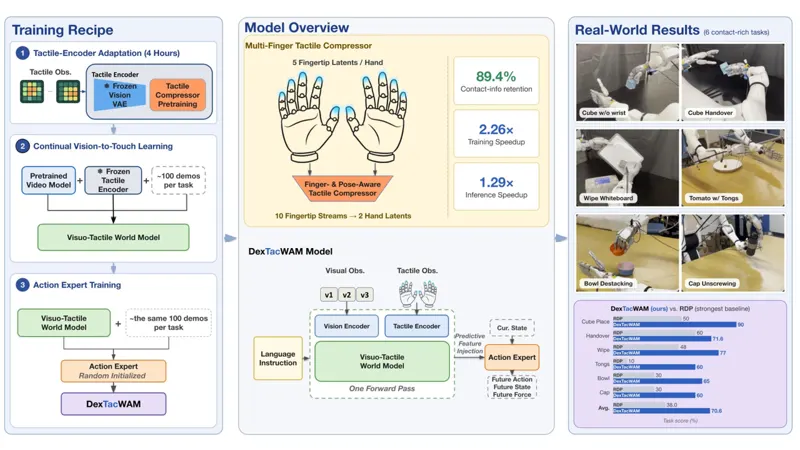
Dexterous manipulation depends on contact dynamics that are often only partially observable from vision. Recent World-Action Models (WAMs) couple predictive video world modeling with action generation, but remain largely vision-centric and therefore cannot directly model these contact dynamics. We present DexTacWAM, a visuo-tactile WAM that encodes each fingertip independently, aggregates the resulting features through a finger- and pose-aware tactile compressor, and injects the tactile latent into a video diffusion world model for joint visuo-tactile world modeling. Across six contact-rich dexterous manipulation tasks on a 22-DoF bimanual platform, DexTacWAM achieves the highest score on every task, averaging 70.6 versus 38.0 for the strongest baseline. Ablations attribute the gain to modeling contact evolution as part of the predicted world state rather than tactile conditioning alone: removing tactile world modeling reduces the four-task mean from 74.7 to 26.6 while keeping the same tactile features and action expert. After four hours of tactile-encoder adaptation with a frozen pretrained vision VAE, our continual vision-to-touch learning extends the pretrained video model to touch using roughly 100 demonstrations per task without tactile midtraining, while retaining visual prediction quality within 0.5 dB of vision-only counterparts. The compressor retains 89.4% of pre-fusion contact recall while enabling 2.26x faster training and 1.29x faster inference. Together, these results show that pretrained video priors can be extended to distributed multi-finger contact dynamics in a data- and compute-efficient manner.

Dexterous ManipulationWorld-action models
Haoran Yuan, Zekai Wang, Boning Shao · 888 views · Sep 21, 2026
N₀-Foundation: Towards the Age of Tactile Intelligence

N₀-Foundation: Towards the Age of Tactile Intelligence

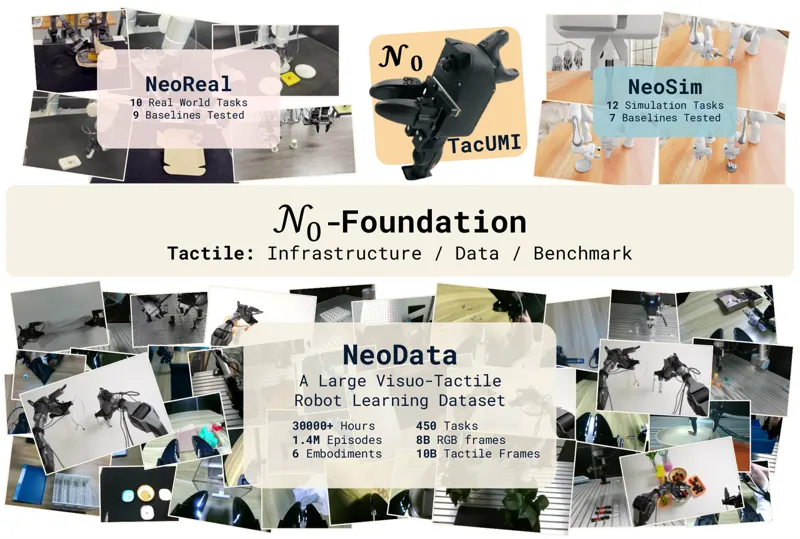
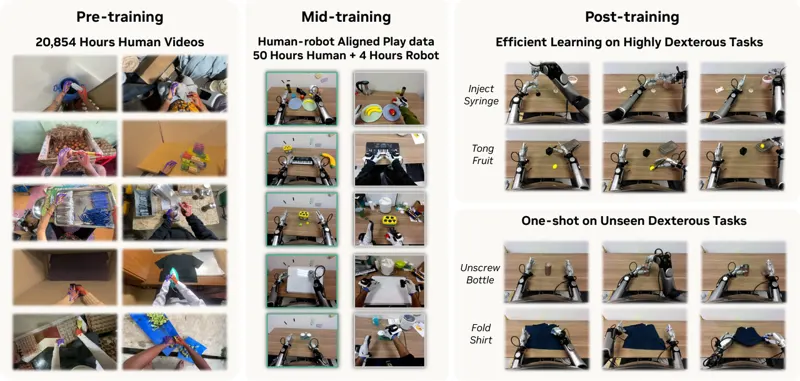
We present N₀-Foundation, a paradigm for tactile-enabled embodied manipulation, which integrates tactile sensing hardware, large-scale multimodal data, tactile representation learning, and standardized evaluation. First, we engineer the infrastructure for scalable data collection, including a vision-based tactile sensor, a tactile Universal Manipulation Interface (UMI), and a synchronized visuo-tactile data collection system supporting both robot embodiments and UMI-based demonstrations. Leveraging this infrastructure, we construct NeoData, which contains more than 30000 hours of synchronized visual and tactile demonstrations, spanning six embodiments, 450 tasks, and billions of paired RGB and tactile frames collected through a mixture of real-robot teleoperation and UMI-based demonstrations. To facilitate open research, we further release OpenNeoData, a 5000-hour open-source subset of NeoData. The dataset addresses a central limitation of existing manipulation corpora, critical for deformable-object manipulation, precise assembly, delicate force control, and sustained surface interaction. Capitalizing on the large-scale, heterogeneous tactile measurements, we propose NeoForce, a visuo-tactile representation model that learn transferable tactile representations across different sensor designs. To enable systematic evaluation of tactile embodied models built upon our infrastructure, datasets and tactile representations, we further propose a comprehensive benchmark, which combines the real-world NeoReal suite and the simulated NeoSim suite for standardized evaluation. Experiments across both suites show that policies benefit from the physical contact state rather than from the device-specific appearance of the tactile signal. We release the dataset, the representation, and the benchmark, aiming at supporting future work on tactile-enabled embodied manipulation.

UMIVLA
NeoteAI Team, Fudan TEAI Team · 1.2k views · Aug 30, 2026
Pre-training Visual Dexterity in Simulation

Pre-training Visual Dexterity in Simulation

Large-scale pre-training has made robot policy fine-tuning increasingly data-efficient, but this progress has largely been driven by datasets and embodiments built around simple parallel-jaw grippers. Dexterous, multi-fingered hands remain comparatively data-starved because real teleoperation is costly to scale, while human hand video is off-embodiment and requires lossy pose estimation and retargeting. We introduce Simulation Pre-training for Dexterity (SPD), a pre-training framework for dexterous manipulation that uses data entirely collected in simulation. In SPD, humans manipulate virtual objects inside a VR headset, enabling on-embodiment trajectories and robot-free collection. With the help of five operators, we collect 75 hours of multi-task dexterous manipulation over one week, and use it to pre-train a causal transformer on a sequence modeling objective. We study the benefits of simulation pre-training on real-world tasks by fine-tuning on 1-2 hours of physical demonstrations on a 56-DoF bimanual dexterous setup. We find that our approach outperforms training behavior cloning policies from scratch, showing that simulation teleoperation is a viable pre-training source for real-world dexterous manipulation. We perform ablation studies, measuring the benefits of history conditioning and short action chunks for reactive control.

Sim-to-RealDexterous Manipulation
Sarthak Kamat, Adam Rashid, Satvik Sharma · 835 views · Aug 16, 2026

As an Amazon Associate, we earn from qualifying purchases.