PAPER DEEP DIVE
MERLoc: Robust Robot Localization in Dynamic Environments with Pose-Based Retrieval over 3D Gaussian Splatting References
Robots operating in previously mapped spaces must localize accurately despite moving people and rearranged objects. Most localization pipelines match the query against a sparse set of captured reference images retrieved by appearance, which is brittle under scene change and repeating structures. We present MERLoc, which turns a single metric 3D Gaussian Splatting scan into a dense Functional Reference Memory. Reference views are sampled over the navigable space for the robot's morphology and sensors at a target density and rendered offline. Pre-encoding them for the chosen off-the-shelf localizer removes the reference encoder from inference. A pose-based retrieval strategy then selects references by spatial proximity and viewing direction rather than appearance, sidestepping visual ambiguities whenever a prior exists. Across one classical and four learned localizers in simulated and real dynamic scenes, pose-based retrieval matches or outperforms appearance retrieval in most cases, even when the latter is gated by the same prior. On real data, it lowers position RMSE by 15-60 % in nine of ten backend/split combinations, and the rendered memory outperforms real-image caches posed by Structure-from-Motion. The system runs onboard a Jetson Orin NX at 5 Hz, enabling a navigation policy to successfully traverse a hallway with people roaming and rearranging objects.
Authors: Michael Baumgartner, Dario Mylonopoulos, Sammy Christen, Markus Gross, Moritz Bacher
Code status: No public code repository was found. The paper text, author pages, GitHub, and project-page searches did not reveal a verifiable implementation, so this page does not provide a speculative repository link.
One-sentence summary
MERLoc turns a metric 3D Gaussian Splatting scan into a functional reference memory by rendering the viewpoints a robot can actually occupy, then uses the previous pose or wheel odometry to retrieve nearby views with a compatible camera orientation. The contribution is not another absolute-pose network: it changes the reference-selection problem from appearance-only visual place recognition to a spatially constrained retrieval problem, while leaving the relative localization backend replaceable.
The main failure begins before relative pose estimation
Visual localization can fail without producing an obviously broken optimizer result. Feature matching and pose estimation may both complete, and the system may return a numerically plausible transform, while the selected reference image depicts a different corridor or a different room that happens to look similar. Repeated textures, repeated furniture, and moving people create strong perceptual aliases. Once an aliased image enters the localizer, the downstream model is solving the wrong relative-pose problem, and a highly confident answer can be worse than an explicit rejection.
Prior systems often address this problem inside the appearance domain by clustering co-visible images, using sequence descriptors, or applying a pose prior after a global image search. MERLoc instead places the robot's continuity at the front of the retrieval pipeline. A robot does not teleport between frames, so its approximate current location is a strong candidate constraint. The system first gathers references within a radius of that prior, ranks them by viewing-direction compatibility, and only then sends a small spatio-visually coherent set to the localization backend.
This design preserves the value of mature visual estimators. ALIKED, LightGlue, PnP, MonST3R, Reloc3r, VGGT-Omega, and pi-cubed can operate without per-scene retraining. The paper focuses on how to construct, encode, retrieve, and deploy the reference memory rather than claiming that a new end-to-end network has solved metric localization.
From a scan to a robot-usable reference memory
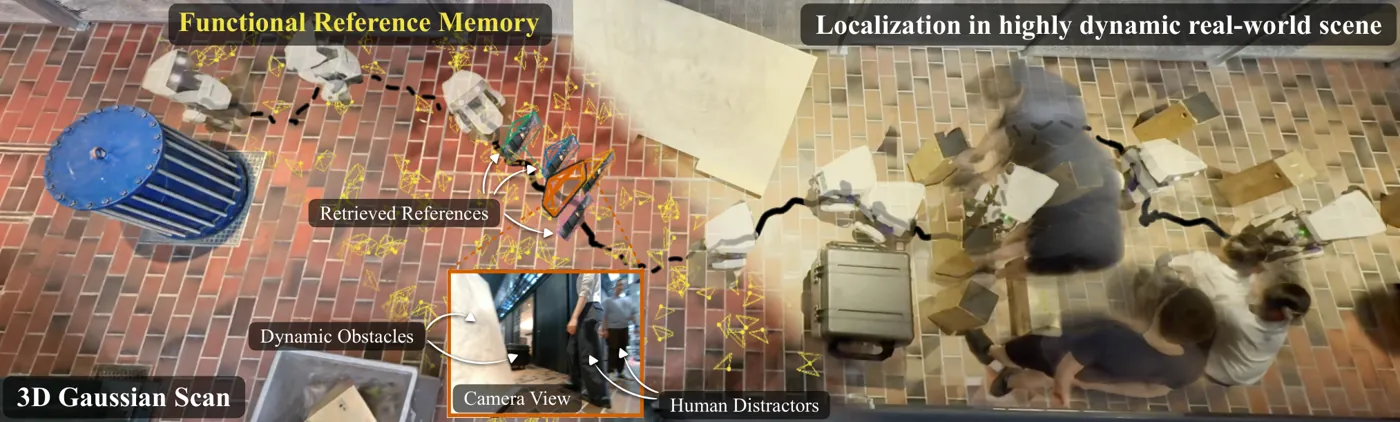
The input is a high-quality 3D Gaussian Splatting reconstruction with metric scale and at least a coarse collision mesh. In the real experiment, a handheld LiDAR-and-camera scanner captures both assets together; in simulation, the scene model provides them. The Gaussian representation renders appearance and depth, while the collision mesh determines where the floor and obstacles are and where the robot body can pass. Keeping those roles separate avoids asking the renderer to infer free space and traversability from radiance alone.
Preprocessing rasterizes the collision mesh into a two-dimensional occupancy grid. A cell survives only if it has floor support and sufficient vertical clearance. The system erodes cells near obstacles according to a safety margin and removes connected regions that are too small to support a useful observation. This converts the geometric question "is there a point in space?" into the operational question "can the robot stop here and localize from here?"
The next step samples poses uniformly over the navigable area and within a camera-height band. The band is tied to robot morphology and sensor mounting rather than treated as a universal scene constant. In Arena, TurtleBot uses a band from 5 cm to 32.9 cm and Boxer uses 5 cm to 23.4 cm. HM3D and the real scene use 20 cm to 1.2 m so that one memory can cover several camera placements. The band thickness directly controls the number of views and the storage cost.
Let the height band be $B=[b_{\min},b_{\max}]$. Its thickness is:
$$\begin{equation} D=b_{\max}-b_{\min} \end{equation}$$For a target density $\rho$ over navigable area $A$, the number of reference poses is governed by:
$$\begin{equation} N=\rho A D \end{equation}$$The default density is 1,000 poses per cubic meter. More density can improve the chance that a useful viewpoint exists nearby, but it also changes query quality and disk usage. Uniformly raising density over a warehouse or a complete building quickly becomes impractical, so the paper treats density as an allocation parameter that can vary by region.
Offline encoding is what makes online retrieval affordable
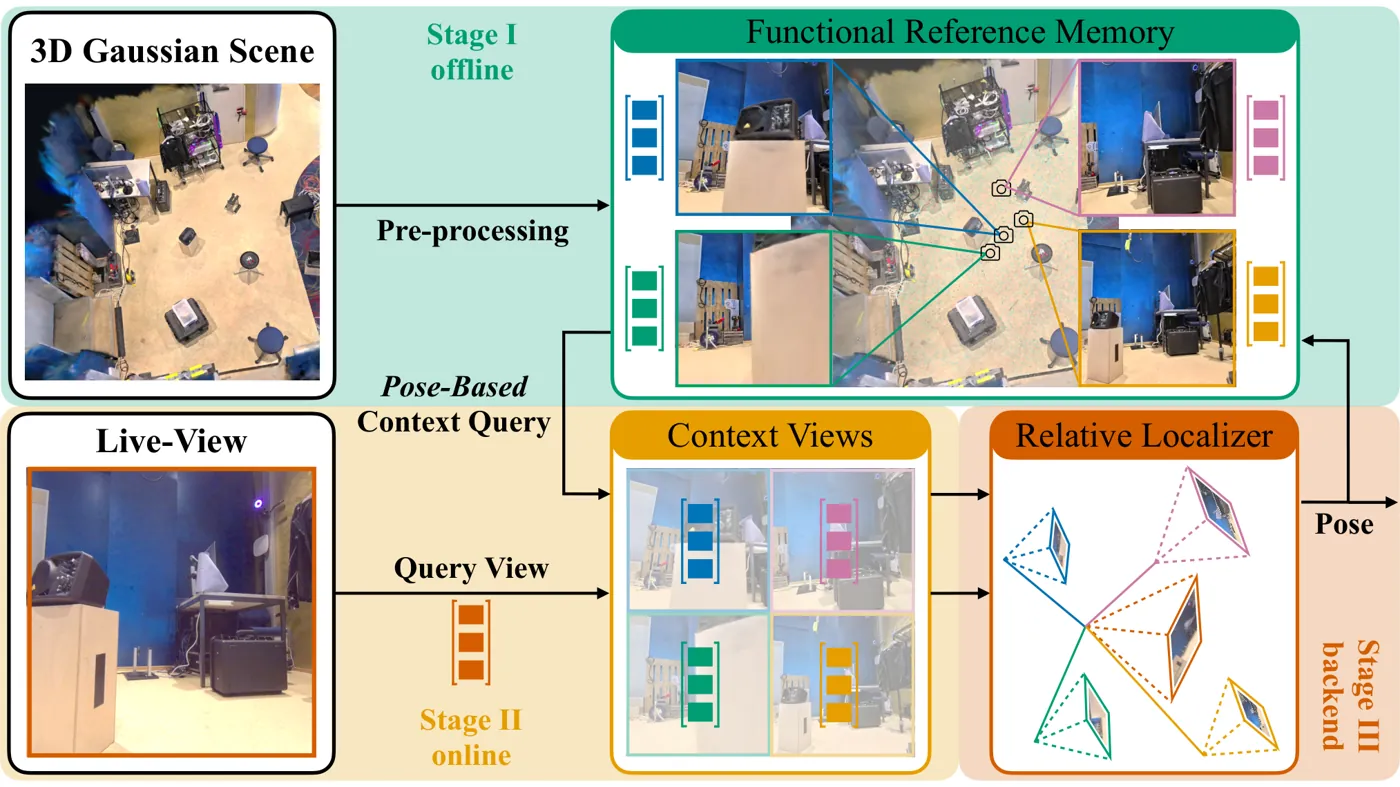
At every sampled pose, the system renders color and depth using the target camera intrinsics, then converts the result into the representation expected by the chosen backend. The classical backend stores sparse keypoints, descriptors, depth-lifted 3D points, and the reference pose. Learned backends store precomputed visual latents and, when needed, depth. Every reference also receives an appearance descriptor used for initialization, recovery after repeated failures, and cases where the spatial neighborhood contains too few candidates.
The expensive encoding is deliberately moved offline. An online query should not run ALIKED again over four or eight rendered images, nor recompute DINO features for every candidate on every frame. The paper measures roughly 70 ms for one ALIKED encoding and roughly 200 ms for one DINO encoding. Repeating those operations at query time would consume the latency budget before the localization backend itself had run.
The reference-memory size follows directly from pose count and per-pose payload:
$$\begin{equation} S_{\mathrm{FRM}}=\rho A D\left(S_R+S_{\mathrm{ID}}\right) \end{equation}$$Here $S_R$ is the backend-specific cost of one encoded reference and $S_{\mathrm{ID}}$ is the appearance-descriptor cost. The equation exposes three deployment facts: storage grows linearly with mapped area, with height-band thickness, and with density. The paper's conservative configuration uses a 1 m band and about 120 MB per square meter for the classical backend. The 14.2 square meter real scene therefore needs about 1.7 GB, of which roughly 16 MB per square meter is appearance descriptors. Reducing the band to 10 cm and choosing 100 to 1,000 poses per cubic meter lowers the estimate to roughly 1.2 to 12 MB per square meter.
Retrieve a spatial neighborhood, then match observation direction
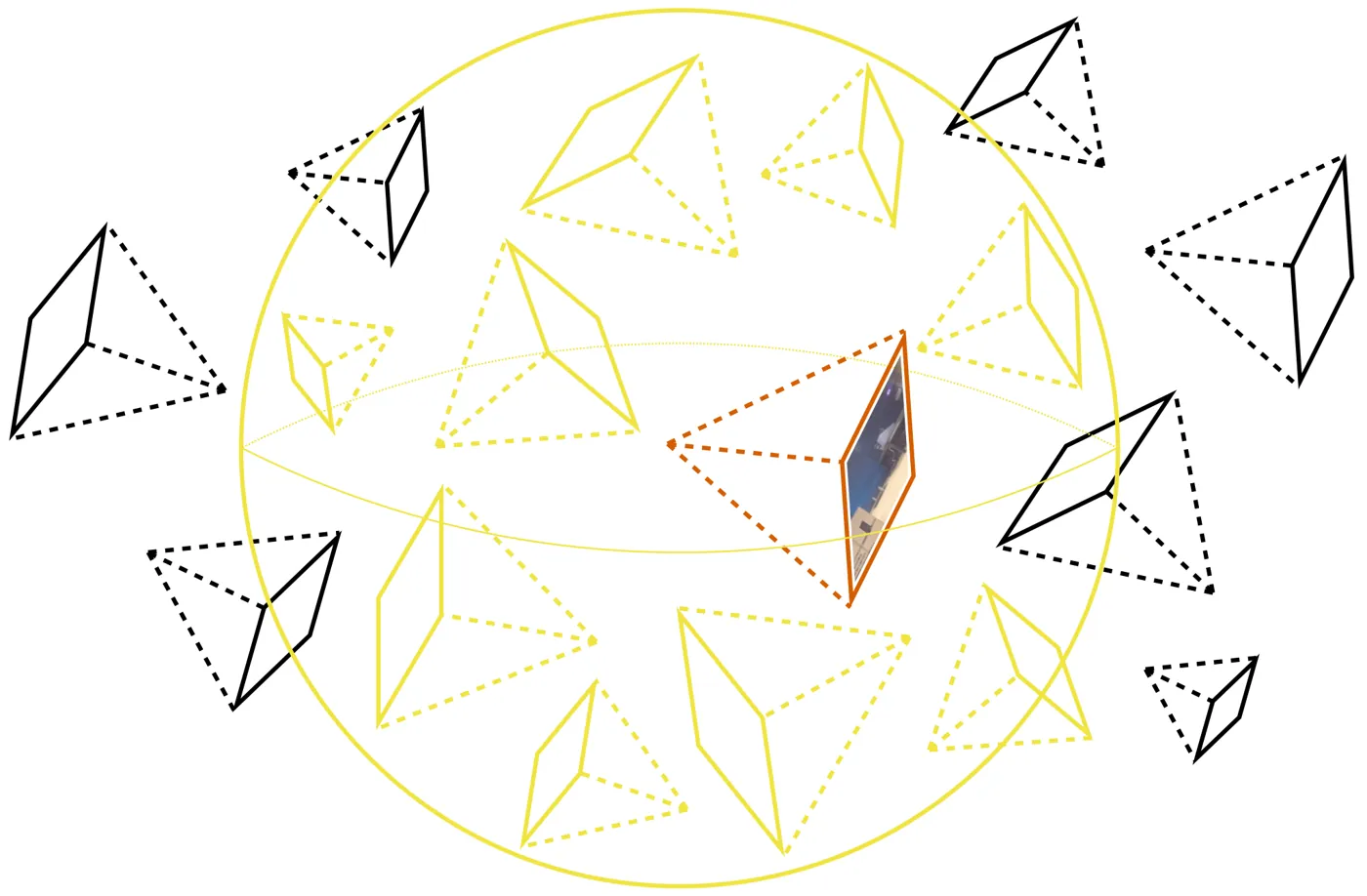
At query time, the previous localized pose or a forward-propagated odometry pose serves as the prior. A k-d tree over reference positions returns every pose inside radius $R$. If $t_i$ is a reference position and $\mathrm{prior}$ is the current prediction, the candidate set is:
$$\begin{equation} C_R=\{r_i:\lVert t_i-\mathrm{prior}\rVert\leq R\} \end{equation}$$Spatial proximity alone is insufficient because the robot may be looking in the opposite direction at the same location. MERLoc therefore compares the query camera's forward axis with each candidate's forward axis:
$$\begin{equation} \mathrm{orient}(q,r_i)=\cos(\mathbf{f}_q,\mathbf{f}_i) \end{equation}$$The system retains the top $P=64$ candidates by orientation score and selects the nearest $K$ among them. The order matters: orientation is the first constraint, while distance breaks ties among views that already face the correct way. The default search radius is 1.5 m, the classical backend receives four references, and learned backends receive eight.
Recovery behavior is explicit. At initialization, after five consecutive failures, or when fewer than $K$ candidates exist inside the radius, the system temporarily switches to NetVLAD appearance retrieval to obtain a new global hypothesis and then resumes pose-based selection:
$$\begin{equation} \mathrm{fallback}=\left(f_{\mathrm{fail}}\geq 5\right)\lor\left(\lvert C_R\rvert<K\right) \end{equation}$$This does not require wheel odometry for every experiment. The previous estimated pose can provide an autoregressive prior, and that is the setting used for the main evaluations. When odometry is available, its propagated pose can provide a more stable prior; the real corridor navigation experiment uses this form.
flowchart LR
    A[3DGS scan and collision mesh] --> B[Navigable space]
    B --> C[Morphology-aware pose sampling]
    C --> D[Render color and depth]
    D --> E[Pre-encode functional memory]
    E --> F[Pose-prior radius query]
    F --> G[Orientation top-P]
    G --> H[Nearest K references]
    H --> I[Classical or learned localizer]
    I --> J[Metric robot pose]
    J --> F
Five localization backends share one retrieval interface
The classical backend follows an hloc-style pipeline. ALIKED extracts query features, LightGlue matches them against four pre-encoded references, and pairwise essential-matrix RANSAC removes gross mismatches. The system merges all two-dimensional-to-three-dimensional correspondences, runs joint PnP with RANSAC, and refines the result with Levenberg-Marquardt. PnP uses a 4-pixel reprojection threshold and requires at least 15 inliers per reference; a frame that cannot satisfy those conditions is counted as a failure.
MonST3R and Reloc3r are two-view feed-forward methods, but they are used differently. MonST3R predicts pointmap matches between the query and each reference, lifts the matches to metric 3D using reference depth, and solves PnP over the combined correspondences. Reloc3r directly regresses the rotation and translation direction from the query to each reference and performs motion averaging. Both methods naturally produce scale-normalized relative outputs, but known reference poses and depths allow MERLoc to place the result back in scene coordinates at metric scale.
VGGT-Omega and pi-cubed consume multiple references and the query jointly. They predict camera centers for the image set, and the system uses a similarity-aware Umeyama alignment to map those centers onto the known reference poses, thereby recovering the query camera in the scene frame. Pi-cubed additionally uses reference poses, intrinsics, and rendered depth. All learned backends use public weights and are evaluated without fine-tuning on the test scenes.
The engineering significance is the common interface. The retrieval layer stays fixed while each backend stores its preferred reference representation. A deployment can choose the classical method for speed or a learned method for a condition in which it offers better robustness, without redesigning the scene memory or the query logic.
The evaluation separates coverage from accepted-pose accuracy
The paper reports Recall at 5 cm and 5 degrees together with positional RMSE over valid frames. Recall is computed over all ground-truth frames, so any frame for which the backend does not produce output counts as a miss. This combines coverage and correctness in one number. RMSE is computed only on accepted outputs and therefore exposes wrong answers that still pass the backend. Neither number is sufficient alone: a method can increase recall by accepting more difficult frames while also increasing tail error.
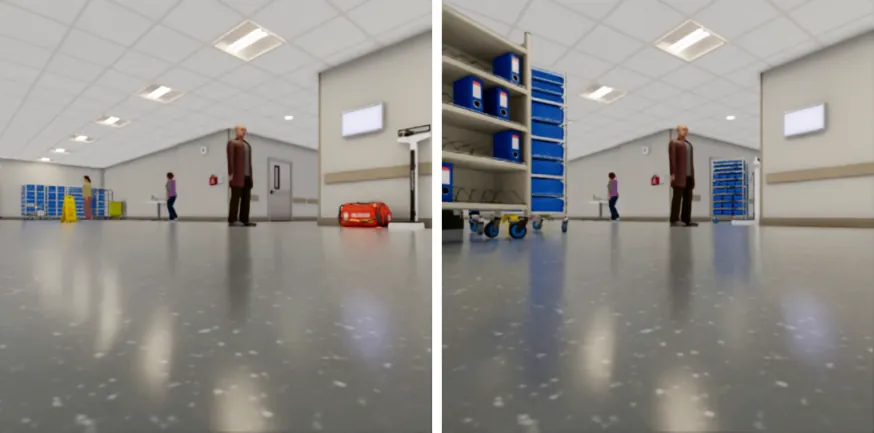
The Arena Rosnav evaluation contains a 384 square meter hospital region with 53 movable objects and a 273 square meter warehouse with 75 movable objects. Robot trajectories are approximately 97 m and 98.5 m. HM3D varies crowd size from 4 to 24 people to test how dynamic occlusion affects retrieval. The real localization experiment uses a 14.2 square meter motion-capture volume with a roughly two-minute static sequence and a roughly three-minute dynamic sequence, collected at 30 Hz and queried at 10 Hz.
The real experiment creates a harder mismatch than a typical synthetic occlusion test: the scan is captured after both sequences, by which time objects have already been moved. The static and dynamic queries are therefore compared against a reference memory whose real geometry has changed from the start. This tests robustness to object rearrangement rather than only adding temporary masks or noise.
| Item | Value | Role |
|---|---|---|
| Occupancy grid | 5 cm | Extract navigable cells from the collision mesh |
| Obstacle safety distance | 5 cm | Erode cells near obstacles |
| Minimum clearance | 1.8 m | Reject low or non-traversable space |
| Minimum connected area | 0.5 m squared | Remove unusable isolated regions |
| Reference density | 1000 per cubic meter | Primary control for coverage and storage |
| Query radius | 1.5 m | Form the initial spatial candidate pool |
| Orientation shortlist | P = 64 | Keep references facing the query direction |
| Context references | Classical K = 4; learned K = 8 | Input to the relative backend |
| Classical reprojection threshold | 4 px | PnP inlier test |
| Minimum inliers per reference | 15 | Reject unreliable classical estimates |
| Maximum keypoints per reference | 256 | Bound memory and matching cost |
| Fallback trigger | 5 failures or fewer than K candidates | Temporarily run NetVLAD retrieval |
| Real captured area | 14.2 square meters | Objects moved before reference scanning |
| Real queries | 2 min static; 3 min dynamic | 10 Hz localization requests |
Scene-change experiments: the prior keeps the whole context closer
Arena tests two distinct error sources. Appearance retrieval can return references far from the true pose, and the retrieved set can also contain near-duplicates rather than a useful spread of viewpoints. The paper reports a median VPR reference distance of 0.78 m from ground truth and a 1.01 m median separation among references. Pose-based retrieval reduces these figures to 0.28 to 0.37 m from truth and 0.36 to 0.49 m apart. The improvement is therefore not just a lucky top-1 ranking; the entire context becomes more concentrated around the actual observation.
Across the five backends, four improve over ordinary VPR and pose-gated VPR-plus when MERLoc is used, while MonST3R is close to tied. This cross-backend behavior matters because it indicates that the gain comes primarily from retrieval rather than from one visual model happening to prefer rendered imagery. The paper also observes that several learned backends degrade sharply under ordinary VPR, supporting the argument that spatial plausibility is a more relevant constraint for robot localization than descriptor similarity alone.
Larger crowds expose the limits of appearance retrieval
In HM3D, crowd size increases from $G=4$ to $G=24$. For four of the five learned backends, MERLoc loses no more than seven recall points across that change. The pose context limits matching to nearby, correctly oriented references and prevents a person crossing the view from completely rewriting a global image descriptor. Reloc3r is a clear exception, falling from 62.1 percent recall to 32.6 percent.
VPR and VPR-plus are less stable. Under those two appearance retrieval modes, all backends decline more, and Reloc3r falls to 6.8 percent and zero respectively. MERLoc is therefore not a guarantee of robustness for every backend. It shifts part of the problem from "anyone entering the view can change the global retrieval result" to "can the relative backend exploit a locally coherent reference set?" The paper also reports a smaller P10-to-P90 spread across disturbance samples with MERLoc, indicating more predictable behavior.
Real motion capture: strong aggregate gains, with explicit exceptions
The real query-to-rendered-reference setting provides the most direct test of the paper's claim. With the classical backend, the static split moves from 87.3 percent recall and 9.6 cm error under VPR to 88.9 percent and 6.3 cm under MERLoc. The dynamic split moves from 83.0 percent and 17.9 cm to 86.4 percent and 8.2 cm. Dynamic error falls by more than half while recall rises, so the result is not obtained by accepting fewer frames.
Most learned backends also benefit. MonST3R's dynamic split changes from 64.5 percent recall and 13.2 cm under VPR to 68.9 percent and 7.4 cm under MERLoc. Reloc3r changes from 61.4 percent and 40.4 cm to 77.8 percent and 16.3 cm. The important interpretation is not that MERLoc replaces the backend, but that a better spatial context lets the same backend expose more of its localization capability.
The exceptions are reported directly. VGGT-Omega's dynamic RMSE improves from 51.1 cm to 43.4 cm, but its static recall drops from 73.9 percent to 69.0 percent. Pi-cubed's dynamic recall decreases from 79.8 percent to 78.2 percent, and its RMSE worsens from 29.7 cm to 34.8 cm. This is the only one of the ten real backend/split combinations in which MERLoc increases positional error. Across those ten combinations, RMSE improves in nine by 15 to 60 percent. The correct conclusion is a strong aggregate trend, not a universal guarantee for every backend and split.
| Backend | Split | Retrieval | Recall | RMSE |
|---|---|---|---|---|
| Classical | Static | MERLoc | 0.889 | 6.3 cm |
| Classical | Static | VPR | 0.873 | 9.6 cm |
| Classical | Dynamic | MERLoc | 0.864 | 8.2 cm |
| Classical | Dynamic | VPR | 0.830 | 17.9 cm |
| MonST3R | Dynamic | MERLoc | 0.689 | 7.4 cm |
| MonST3R | Dynamic | VPR | 0.645 | 13.2 cm |
| Reloc3r | Dynamic | MERLoc | 0.778 | 16.3 cm |
| Reloc3r | Dynamic | VPR | 0.614 | 40.4 cm |
| VGGT-Omega | Dynamic | MERLoc | 0.746 | 43.4 cm |
| VGGT-Omega | Dynamic | VPR | 0.730 | 51.1 cm |
| pi-cubed | Dynamic | MERLoc | 0.782 | 34.8 cm |
| pi-cubed | Dynamic | VPR | 0.798 | 29.7 cm |
Why rendered references can beat a cache of real images
The paper also compares the classical pipeline on two caches built from real captured images with COLMAP poses. The single-camera cache contains 323 views at approximately 18 views per cubic meter; the four-camera cache contains 1,160 views at approximately 66 views per cubic meter. Both caches come from the same scene and scanning session, so the comparison is not explained by giving the rendered memory access to a different environment.
On the four-camera cache, VPR produces 69.7 percent recall and 20.5 cm error on the static split, and 60.0 percent recall and 43.6 cm error on the dynamic split. The same classical backend with MERLoc on the rendered memory reaches 88.9 percent and 6.3 cm static, and 86.4 percent and 8.2 cm dynamic. The authors explain that real-image coverage follows the operator's capture trajectory, while the rendered memory can systematically fill viewpoints at robot-accessible positions and camera heights. Better viewpoint structure can outweigh the appearance gap between rendered and real queries.
Even when the rendered memory is reduced to 10 references per cubic meter, the classical backend with ordinary VPR still has higher recall than the real four-camera cache. This reinforces that structure in reference space matters more than simply adding photographs. The result should not be generalized too far: it comes from a 14.2 square meter scene with two moving distractor people, and the paper attributes the smaller simulation-to-real gap partly to the scene's limited visual aliasing.
Navigation, retrieval latency, and deployment limits
The real corridor navigation experiment deploys only the classical backend on a Jetson Orin NX at 5 Hz and uses odometry to propagate the pose prior. Two runs specify four goals and three goals, with about 30 m between goals. The robot reaches every goal while people move through the space and objects are added or moved. This is a qualitative end-to-end validation rather than a large navigation benchmark, but it shows that the localization output can support a real control loop.
Pose retrieval takes about 4 ms, compared with about 40 ms for VPR retrieval, an order-of-magnitude reduction in that stage. Retrieval is not the whole runtime: network inference in the learned backends remains dominant. Eight references offer a useful accuracy-versus-latency balance for most learned methods, but only the classical backend reaches the navigation policy's 5 Hz requirement with four references.
Memory also constrains the context size. MonST3R and pi-cubed run out of GPU memory at 16 references, and multi-view feed-forward models often fail to work reliably with only one or two references. The paper therefore does not claim that learned backends dominate the classical backend. For real-time closed-loop deployment on the tested hardware, the classical pipeline remains the recommended choice. Learned backends are better suited to more compute or conditions in which classical feature matching breaks down.
Limitations and failure boundaries
First, the system depends on a high-quality metric 3D Gaussian scan and a collision mesh. Geometric errors, scale drift, or unscanned regions become permanent blind spots in the reference memory. The rendered-to-real domain gap also includes sensor noise, exposure, reflections, and material differences. The paper does not characterize how localization degrades as image quality or scan fidelity are gradually reduced.
Second, the real experiment is small. Outdoor seasonal change, direct sunlight, night lighting, and large open spaces are not evaluated. The dynamic experiment mainly tests people and movable objects; it does not imply that every form of long-term environmental change is handled automatically. Covering a full building would also make the conservative 120 MB per square meter configuration significant, so narrower height bands, hierarchical density, or compression are needed for larger deployments.
Third, the design intentionally avoids pose-jump or temporal-consistency gating. This keeps the failure logic simple and well defined, but a backend that always returns a numerically valid pose will never trigger the five-failure fallback, even after that pose has drifted. Autoregressive retrieval remains exposed to prior drift, and the oracle-prior results show that substantial headroom remains.
Fourth, the benefit depends on the backend. Reloc3r still degrades sharply with larger crowds, and pi-cubed becomes worse in dynamic RMSE. Learned backends also face memory and speed constraints. MERLoc improves the question of which references are selected, but it cannot make a relative localizer robust when that model is poorly matched to the current visual conditions.
Conclusion
MERLoc can be understood as a scene-memory interface: one 3D scan becomes a controllable, encodable, queryable set of multi-view references, and robot continuity enters candidate selection. The real experiments improve positional RMSE in nine of ten backend/split combinations by 15 to 60 percent, while the classical backend combines high recall with sub-10 cm dynamic error. Most learned backends also outperform appearance retrieval under scene changes and crowd disturbances, despite the exceptions documented above.
The most useful lesson is not to discard visual place recognition. Appearance retrieval remains appropriate for initialization and global relocalization, while pose-based retrieval is appropriate for high-frequency candidate selection during continuous operation. MERLoc connects the two with explicit fallback rules and designs the reference memory around robot morphology and storage budget. That framing is closer to deployable spatial memory than simply enlarging a generic image database.
Key quote: "Because the reference memory is rendered rather than captured, it remains editable and extensible after the scan." This points to the method's longer-term potential: environmental change does not necessarily require recapturing every reference. Movable objects could be segmented and their occupied regions rerendered, or changed areas could be updated incrementally.
SOURCE LINKS