PAPER DEEP DIVE
FineDex: Bridging Fine-Grained Human-Object Interaction Generation to Dexterous Humanoid Manipulation
Dexterity is, at its core, finger-level control, yet existing dexterous manipulation and human-object interaction (HOI) generation methods rarely let one specify how an interaction is performed: five-fingered hands are often reduced to grippers, or finger usage is copied from individual human demonstrations. We present FineDex, a framework that makes finger-level intent both expressible and executable. FineDex learns coordinated human body, hand, and object motions that follow fine-grained instructions on hand selection, individual fingers, and contacts with articulated objects. To bridge generation and execution, FineDex leverages generated interactions as actionable priors for an agent that discovers physically feasible contact strategies through practice in a physics-based digital twin. By adapting at test time without per-instance retraining, FineDex generalizes across fine-grained instructions and object configurations. Experiments demonstrate state-of-the-art HOI generation quality and fine-grained controllability, substantial improvements in dexterous manipulation success, and successful deployment on a real dexterous humanoid robot.
The central argument
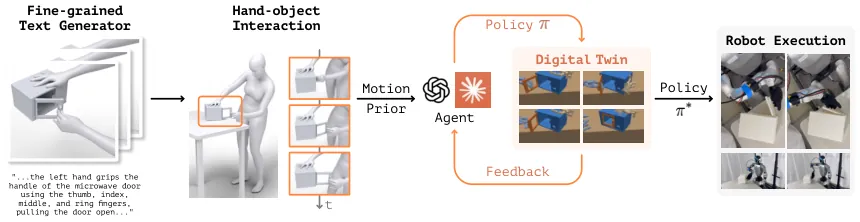
FineDex asks a question that sits between motion generation and robot control: if a person says “press the lever with your left index finger,” can a system first represent the human interaction faithfully and then find a contact program that a dexterous humanoid can actually execute? The paper separates those responsibilities instead of assuming that a generated human trajectory can be retargeted and replayed. A conditional diffusion generator expresses what a human would do; an agent working with randomized physical digital twins determines how the robot can realize it.
The distinction is not cosmetic. Direct replay of the generated interaction succeeds in only 6.2% of floating-hand trials and 13.3% of Unitree G1 trials. With generation, contact-program search, and practice in the digital twins, success rises to 75.0% on the floating hands and 42.2% on the G1. FineDex therefore treats generated motion as an actionable prior, not as a command sequence. Practice is where human intent becomes physically grounded.
The work is authored by Yujia Zeng, Yuxin Chen, Yuzhen Song, Runhan Huang, Chensheng Peng, Yiyang Shao, Koushil Sreenath, Masayoshi Tomizuka, and Yilun Du, with affiliations at UC Berkeley and Harvard. It was submitted on 25 November 2026. The official code repository currently says only that code will be released soon, so this analysis does not claim to inspect an implementation or map paper modules to source files.
Core judgment: FineDex is valuable because it refuses to equate a human-like motion with an executable robot behavior. It preserves finger-level intent as a generator constraint, then lets physical practice decide which contact program should survive.
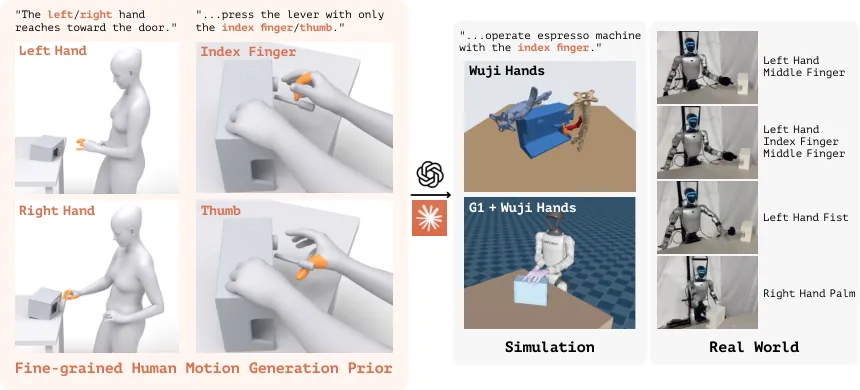
Why “which finger” changes the problem
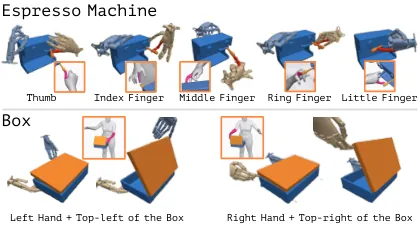
A conventional grasp benchmark often measures whether an object moves to a target. FineDex also asks which hand acts, which finger makes contact, where on an articulated object contact occurs, and whether disallowed fingers or the palm remain clear. The same coffee machine can be operated by a left or right hand and by a thumb, index, middle, ring, or little finger. The same box can require a left-hand contact on its top-left region or a right-hand contact on its top-right region.
Those distinctions make the problem harder at both ends of the pipeline. The generator must coordinate the body, both hands, and the object rather than synthesize fingers as an afterthought. The executor must respect robot kinematics, hand topology, wrist reachability, collision constraints, and object dynamics. A human wrist pose that looks natural may be outside the robot’s workspace, while a human finger that never touches an object can still imply a useful contact for a robot with a different hand.
FineDex introduces FingerBench to expose this gap. One track evaluates hand and finger selection. Another evaluates contacts on articulated objects, including counterfactual instructions that ask for a finger the human demonstrator did not use. Physical execution adds task-success and fine-grained-contact metrics. This prevents a visually plausible but semantically wrong motion from receiving credit merely because the object moves.
The two-stage system
flowchart LR
    A["Language, object geometry, hand and finger constraints"] --> B["Joint body-hand-object diffusion"]
    B --> C["Reference trajectory plus finger-control trajectory"]
    C --> D["Masked fusion of commanded finger channels"]
    D --> E["Finger-specific contact refinement"]
    E --> F["Human interaction prior"]
    F --> G["Agent proposes contact programs"]
    G --> H["Parallel randomized physical digital twins"]
    H --> I["Rank by success, progress, penalties, prior deviation"]
    I --> J{"Stable and goal-reaching program?"}
    J -- "No: refine" --> G
    J -- "Yes" --> K["Transfer to floating Wuji hands or Unitree G1"]
    K --> L["Open-loop execution without online replanning"]
There are two different feedback loops in this diagram. The dual-trajectory loop inside generation modifies the commanded fingers during denoising while preserving unrelated body, object, and hand channels. The digital-twin loop operates at the task level and changes wrist poses, contact locations, approach directions, closure behavior, and timing. Keeping these loops separate makes their failure modes observable: poor finger control is a generation problem, while an unreachable wrist or unstable push is an execution problem.
Stage one: generate a fine-grained interaction
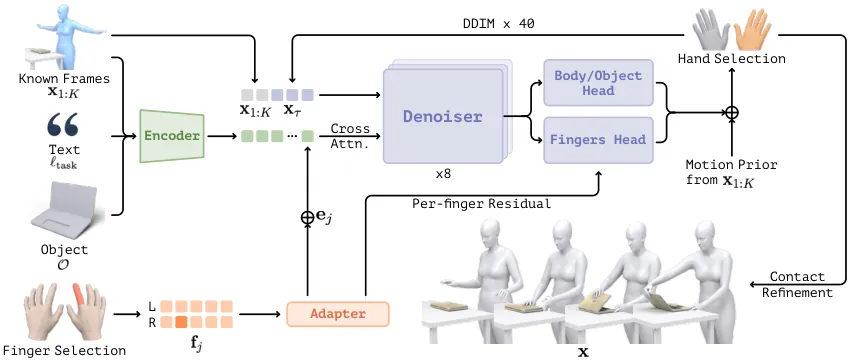
The generator represents an interaction as a temporal sequence containing the human root, body joints, both dexterous hands, the articulated object’s base transform, and its joint angle. This full-state model matters because opening a coffee machine is not a hand animation placed next to an independently animated object. Contact, wrist motion, finger flexion, and object rotation evolve together.
Equation 1: interaction sequence
$$ \mathbf{x}=\{\mathbf{x}^{t}\}_{t=1}^{N} $$
At every frame, the rigid object state is represented by an $SE(3)$ transform:
Equation 2: articulated-object pose
$$ \mathbf{T}^{\mathcal{O}}_{t}\in SE(3) $$
The model conditions on language, point features sampled from the object surface, an object-state token, and anatomical anchor tokens distributed across the fingers. The language identifies the requested hand and action. Geometry exposes plausible contact surfaces. The object-state token encodes the relative base pose and hinge configuration, while anatomical anchors give the network stable places through which finger-specific controls can be injected.
The conditional diffusion objective is written as:
Equation 3: conditional motion distribution
$$ p_{\phi}(\mathbf{x}\mid\ell,\mathcal{O},\mathbf{x}^{1:K}) $$
Here, $\ell$ is the instruction, $\mathcal{O}$ is the articulated object, and $\mathbf{x}^{1:K}$ are known context frames. Instead of predicting absolute motion from noise alone, the denoiser predicts a residual over a damped constant-velocity extrapolation. Root, body, and object channels receive the extrapolated base, while finger channels initially hold the last context pose. The paper writes the clean-motion prediction as:
Equation 4: residual clean-motion prediction
$$ \widehat{\mathbf{x}}_{0}=\mathcal{P}(\mathbf{x}^{1:K})+D_{\phi}(\mathbf{x}_{s},s;\mathcal{C}) $$
$\mathcal{P}$ is the extrapolated base, $D_{\phi}$ is the denoising residual, and $\mathcal{C}$ contains the conditioning memory. This residual formulation gives the model a strong kinematic and object-motion scaffold while reserving capacity for the interaction details that actually require synthesis.
Finger adaptation without retraining the backbone
Directly interpolating finger joints is a weak solution because a local curl can drag the palm, wrist, or neighboring fingers into implausible configurations. FineDex instead trains a lightweight adapter on synthetic finger edits. A control token carries finger identity and keyframe curl targets. The adapter injects corrections into the corresponding anatomical anchors while the pretrained diffusion backbone remains frozen.
At inference, two denoising trajectories begin from the same initial noise. The reference trajectory receives task text and hand-selection guidance. The control trajectory receives the additional finger constraints. Their clean-motion predictions are blended only on the commanded finger channels:
Equation 5: masked dual-trajectory editing
$$ \widehat{\mathbf{x}}_{0}^{\mathrm{edit}} = \widehat{\mathbf{x}}_{0}^{\mathrm{ref}} + \mathbf{M}_{\mathcal{F}}\odot \left( \widehat{\mathbf{x}}_{0}^{\mathrm{ctrl}} - \widehat{\mathbf{x}}_{0}^{\mathrm{ref}} \right) $$
The mask $\mathbf{M}_{\mathcal{F}}$ is the key control. It permits the commanded fingers to move toward the edited prediction while leaving the body, object, other fingers, and the opposite hand under the reference trajectory. The ablation confirms that this separation is load-bearing. A single-trajectory condition reaches 41.2% on task A1 and produces $11.9^{\circ}$ of unintended finger motion. The dual trajectory reaches 92.5% and reduces leakage to $0.0^{\circ}$.
Correct articulation alone does not guarantee that a fingertip touches the intended part. FineDex therefore optimizes temporal offsets on the acting wrist and fingers after sampling. The objective combines attraction to the target surface, penetration avoidance, exclusion of non-designated contacts, and smoothness:
Equation 6: finger-specific contact objective
$$ \min_{\boldsymbol{\Delta}}\quad \mathcal{L}_{\mathrm{touch}} +\mathcal{L}_{\mathrm{pen}} +\lambda_{e}\mathcal{L}_{\mathrm{excl}} +\lambda_{a}\mathcal{L}_{\mathrm{smooth}} $$
The touch term pulls distal pads of designated fingers toward the moving part during contact frames. The penetration term keeps the acting hand outside the object, the exclusion term suppresses contact from the palm and non-designated fingers when the instruction is exclusive, and the smoothness term limits extra wrist and fingertip acceleration. The refinement changes only the acting arm and fingers, leaving the other hand, torso, and object fixed. This is how the system can create contacts that do not exist in the original human demonstration.
Does the generated prior hold up?
On ARCTIC, FineDex reports a bimanual FID of 0.65, R@3 of 0.701, MM-Dist of 4.02, wrist error of 58.3 mm, and foot-skating speed of 0.0030 m/s. Its whole-body FID is 1.61. For comparison, EmbodyHOI reports a whole-body FID of 2.32, while Text2HOI reports a bimanual FID of 1.51.
| Method | Bimanual FID ↓ | Bimanual R@3 ↑ | Bimanual MM-Dist ↓ | Whole-body FID ↓ | Wrist error / mm ↓ | Foot skating / (m/s) ↓ |
|---|---|---|---|---|---|---|
| EmbodyHOI | 5.13 | 0.576 | 5.24 | 2.32 | 77.9 | 0.0064 |
| Text2HOI | 1.51 | 0.523 | 5.54 | — | 92.4 | — |
| MAD-HOI | 5.63 | 0.583 | 5.45 | — | 104.8 | — |
| HOIDiNi | 8.22 | 0.477 | 6.30 | 23.65 | 151.6 | 0.0462 |
| FineDex | 0.65 | 0.701 | 4.02 | 1.61 | 58.3 | 0.0030 |
These are generation metrics, not proof that the robot will complete a task. They do show that the prior is useful as a prior: it is closer to the demonstrated interaction while maintaining low penetration and foot skating. A downstream policy that receives drifting feet or wrists misaligned with the object must spend its physical practice budget repairing errors that the generator should never have introduced.
Stage two: compile intent into a contact program
Retargeting begins with an interaction mesh over hand and object keypoints in the object frame. FineDex preserves Laplacian coordinates while enforcing joint limits and non-penetration. The output supplies wrist and finger references, but the authors explicitly avoid treating those references as the only executable answer. The generated interaction mainly contributes hand roles, approach directions, contact configurations, and the desired object articulation.
A contact program divides the object motion into opening or closing segments. It specifies the manipulating hand and object plan, a part-relative wrist pose and finger configuration for each segment, the supporting hand’s behavior, and parameters for approach, pressing, timing, and closure:
Equation 7: contact-program representation
$$ \pi=(m,\kappa_{1:S},b,\boldsymbol{\eta}) $$
Candidates come from three sources. Some contacts are extracted from the generated interaction. Others are synthesized as pushes or hooks from object geometry. A third group comes from a human grasp library built only from non-test ARCTIC sequences. Geometric candidates are ranked by their ability to produce the desired articulation and by how close they remain to the generated contact. Designated hands and fingers restrict which programs are admissible, while the prior guides contact selection and support-hand placement.
The planning agent receives the instruction, object state, rendered interaction keyframes, and structured contact descriptors. It proposes candidate programs and predicts their outcomes. Each candidate is run in parallel digital twins under randomized dynamics. The agent then receives task outcomes, contact statistics, and failure renders, and uses those observations to refine the next set of programs. This is test-time adaptation without per-instance policy training.
Programs are ranked first by empirical success. Ties are broken by articulation progress, execution penalties, and deviation from the generated human prior. The four strongest goal-reaching candidates receive additional randomized rehearsals, after which one program is committed. The execution is open loop: the selected program runs without online replanning.
Preparing the physical scene
The digital twin also chooses a robot stance before selecting the final object placement. The stance maximizes the fraction of reachable, collision-free wrist poses. The object is then placed at the transform implied by the chosen stance:
Equation 8: object placement relative to robot stance
$$ (\mathbf{T}^{\mathcal{P}})^{-1}\mathbf{T}^{\mathcal{O}}_{1} $$
This step is easy to miss, but it is central to the reported real-world result. The system does not assume the robot can reach every human demonstration in an unchanged workspace. It searches for a scene configuration that is favorable to the robot’s kinematics, then transfers a program that has already shown a higher empirical success rate in simulation. The tradeoff is that deployment depends on being able to reset or place the object at the selected configuration.
FingerBench and fine-grained control
FingerBench separates two questions that ordinary success rates conflate. Did the robot move the object, and did it use the requested hand and finger? FineDex reaches 83.9% on Switch and 100.0% on Still hand-selection tasks. No baseline in the paper exceeds 8.0% on Switch. On the finger-specific generation track, FineDex scores between 37.0% and 92.5% across A1 through A5.
| FingerBench measure | FineDex result | Interpretation |
|---|---|---|
| A1 / A2 | 92.5 / 91.2 | Strong index and thumb control |
| A3 / A4 / A5 | 37.0 / 73.4 / 45.6 | Exclusion and small-finger control remain uneven |
| B1 / B2 / B3 / B4 | 55.8 / 60.1 / 64.9 / 57.4 | Counterfactual articulated contacts are possible but imperfect |
| Switch / Still | 83.9 / 100.0 | Hand selection is much stronger than the baselines |
| FC-SR / Robo-SR | 21.9 / 19.2 | Physics execution is the harder stage |
The paper also provides a striking baseline result on counterfactual finger contact: FineDex reaches 64.9%, while the strongest baseline reaches 0.8%. The gap does not mean the problem is solved. A3 reaches only 37.0%, showing that keeping adjacent fingers clear while making contact with the middle finger is substantially harder than moving the index finger or thumb.
Physical execution exposes another drop. FineDex achieves 21.9% FC-SR and 19.2% Robo-SR, although the paper frames both as more than doubling the strongest baseline. Those numbers are far below the hand-selection scores, which is a useful warning against evaluating only generated motion. The correct semantic contact can still fail once closure timing, friction, reachability, and controller tracking enter the loop.
What the ablations establish
The contact-IK ablation reveals why a geometric fingertip target is insufficient. Without the full contact objective, 97.9% of trials contain unintended contact from “Other” hand regions. The full objective reduces that rate to 41.5%. It is still high, but the comparison shows that penetration, exclusion, and smoothness constraints are doing essential work. A correct fingertip point can coexist with a palm or neighboring finger touching the object.
The prior’s semantic quality matters as much as its existence. Instructions alone produce 40.2% task success and 19.4% FC-SR. Adding an unedited prior lowers the numbers to 29.7% and 15.2%, because its suggested contacts can conflict with the requested finger. Editing the prior to the designated finger restores task success to 40.3%, raises FC-SR to 24.4%, and makes 60.5% of successful trials use that finger. The experiment is a direct warning that a helpful visual prior can become a harmful execution prior when it ignores the instruction.
Practice is equally consequential. Direct replay reaches 6.2% on floating hands and 13.3% on the G1. FineDex without practice reaches 19.5% and 11.7%. One practice round raises success to 43.8% and 25.0%; two rounds raise it to 57.0% and 30.5%; the full system reaches 75.0% and 42.2%. The paper notes diminishing returns after roughly six rounds, so repeated simulation is not free, but skipping it discards most of the system’s advantage.
Object variation is a more sobering test. FineDex reaches 70.3% overall on floating hands versus 63.4% without a prior, and 39.4% versus 36.6% on the G1. Across 174 shifted configurations, the comparison is 54.8% versus 50.0%. The largest floating-hand gain appears under object-size variation, where FineDex reaches 68.9% versus 59.6%. The prior helps, but placement shifts expose the limits of an open-loop program and a fixed precomputed stance.
Only 21% of committed programs directly reuse generated contacts. This is one of the paper’s most informative statistics. Most successful executions adapt the contact or choose an alternative from the generated, geometric, or grasp-library candidates. The generator is therefore not a trajectory oracle; it narrows search by describing human intent and plausible contact. Removing both the prior and the grasp library lowers success to 59.4% on floating hands and 28.9% on the G1.
Real humanoid transfer
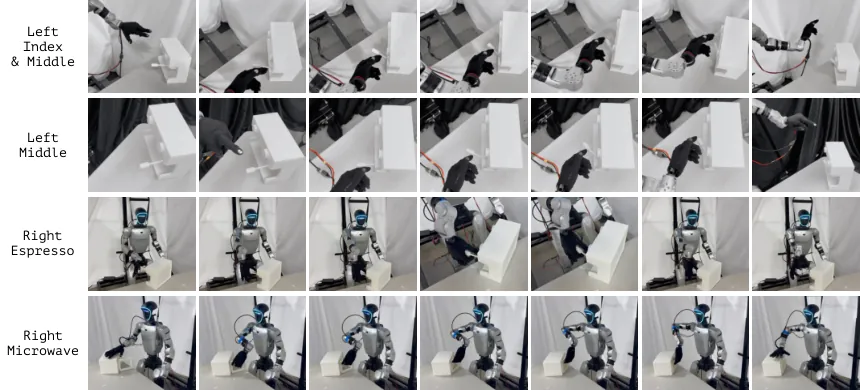
The real platform is a Unitree G1 equipped with Wuji Hand 2.2. Full FineDex with GPT-6 Astra reaches 75.0% on floating hands and 42.2% on the G1. Claude Fable 5.2 reaches 77.3% and 46.9%. The similarity across planners suggests that the two-stage framework is not tied to one language model, although the paper does not provide a broad model sweep or enough variance reporting to rank the planners as a separate contribution.
A concrete G1 case study performs a left-middle-finger program successfully in five consecutive attempts. That is important evidence of transfer, but it should be read alongside the aggregate 42.2% to 46.9% success range. The authors identify limited arm reach and imperfect wrist tracking as major failure modes. A five-attempt success demonstrates that a practiced program can survive on hardware; it does not show that arbitrary finger programs are robust across scenes.
How it differs from replay and imitation
Direct retargeting treats the human wrist and finger trajectories as the target. FineDex treats them as evidence about hand roles, contact, approach, and object motion. The executor is then allowed to adopt a geometric push, a hook, or a library grasp if that program is more reliable. This is why FineDex can use the same prior with different embodiments and why most final programs differ from the generated contacts.
Compared with end-to-end imitation, the method avoids collecting a large robot dataset for every object configuration. The expensive learning happens in human-interaction generation, while adaptation happens at test time through language-model planning and simulation. The cost moves rather than disappears: each deployment may require many candidate programs, parallel physics rollouts, additional rehearsals, and a vision-language model in the loop. The paper does not report wall-clock latency, energy use, or the operational cost of that search.
Limitations and open engineering questions
The authors state four important limitations. Enforcing designated-finger constraints lowers task success. Limited arm reach and imperfect wrist tracking remain major G1 failure modes. Real behaviors are open loop, with no online feedback. Closing that loop is left to future work. These limitations define the distance between a successful research demonstration and a dependable dexterous robot.
Independent limitations follow from the experimental design. Performance depends on ARCTIC coverage and the quality of the fine-grained annotations. Counterfactual instructions are generated through post hoc optimization and execution search, but complex objects, extreme hand poses, and underrepresented finger-object combinations may still fall outside the learned distribution. The modest gain across 174 shifted configurations suggests that a digital-twin stance can compensate for some variation without providing general closed-loop recovery.
The implementation is not yet public. The repository contains only a coming-soon notice, so training schedules, adapter details, simulator randomization ranges, physics parameters, controller gains, and failure-render prompts cannot be independently checked. The paper’s conceptual decomposition and evaluation protocol can be assessed now; reproducibility claims must wait for code and assets.
Implications for embodied systems
First, finger-level language should not be compressed into a single “grasp the object” label. Hand identity, finger identity, contact region, exclusion constraints, and object motion need separate channels because they constrain different parts of generation and execution. Second, human motion should be represented as a prior over relationships, not as a canonical joint trajectory. That framing lets the system preserve intent while changing the physical realization.
Third, physical practice must be evaluated together with semantic compliance. Optimizing only task success can select an effective but wrong-finger program. Optimizing only similarity to a human demonstration can select an attractive trajectory that the robot cannot reach or stabilize. FineDex’s ranking combines empirical success, articulation progress, execution penalties, and deviation from the prior so that both dimensions remain visible.
Fourth, benchmarks should include counterfactual finger instructions. Human datasets rarely contain a natural demonstration of every finger pressing every object part, but users can still ask for those combinations. FineDex explores them through contact refinement and digital-twin adaptation, while FingerBench measures whether the resulting behavior still respects the instruction. This is a more informative test than another round of ordinary grasp success.
Conclusion
FineDex connects fine-grained human-object interaction generation to dexterous humanoid manipulation through a deliberately staged system. Its generator combines body, both hands, and articulated-object state; it conditions on text, geometry, and anatomical anchors; it edits specified fingers through dual trajectories; and it refines designated fingertip contacts against object surfaces. Its executor turns the resulting interaction into contact programs, lets an agent practice them in randomized parallel digital twins, and transfers the selected program to floating hands or a G1.
The headline result is the contrast between replay and grounded search: 6.2% / 13.3% becomes 75.0% / 42.2% when the generated interaction is treated as a prior rather than a command. The same evidence also makes the limitations clear. Finger constraints reduce success, G1 reach and wrist tracking remain bottlenecks, placement variation produces only modest gains, and real execution is open loop. FineDex is therefore best understood as a strong architectural argument and a substantial experimental step, not as a finished solution for reliable humanoid dexterity.
Paper: arXiv:2611.34884; Project page: finedex.github.io; Code: zyjOrz/FineDex. The repository is marked as coming soon, and this analysis does not claim to inspect the official implementation.