PAPER DEEP DIVE
StereoVLM: Binocular Vision-Language Models for Metric 3D Spatial Reasoning
Vision-language models (VLMs) exhibit strong semantic understanding but remain limited in their ability to reason about metric 3D space in the physical world. Existing VLMs typically infer 3D scene structure from one or more images without known camera calibration or cross-view geometric constraints. This makes metric 3D inference inherently ambiguous and leaves it unclear whether their spatial predictions are grounded in visual evidence or driven primarily by semantic priors. In contrast, calibrated stereo provides explicit cross-view geometry that resolves this ambiguity and offers a more reliable foundation for metric 3D perception and geometric generalization. We investigate how VLMs can learn transferable 3D representations directly from calibrated binocular observations. To this end, we introduce StereoVLM, the first geometry-aware binocular VLM for metric 3D spatial reasoning. StereoVLM follows a hierarchical learning paradigm spanning from cross-view correspondence and disparity estimation to calibration-conditioned metric depth perception and semantic spatial reasoning. We further find that disparity supervision generalizes substantially better than direct binocular depth supervision on unseen environments. To evaluate these capabilities, we introduce Stereo3D-Bench, a comprehensive benchmark across three levels, from point-level geometry to object-level spatial reasoning. StereoVLM-8B achieves 95.17% depth accuracy (δ₁) and a 66.98 average object-level score on Stereo3D-Bench. Intervention results further indicate that the model's performance on Stereo3D-Bench benefits from valid cross-view geometry and cannot be explained solely by additional visual tokens or semantic priors. Hierarchical geometric supervision also yields average gains of 3.54 points across five spatial benchmarks and 4.3 percentage points in RoboCasa manipulation success.
Paper metadata: Chi Yan, Guoyang Zhao, Wentao Yuan, Yixiao Ge, Yanning Zhou, and Dan Xu; HKUST and XPENG Robotics. Paper: https://arxiv.org/abs/2611.27915v1. Project page: https://xpeng-robotics.github.io/stereovlm/.
Code status: At the time of this reading, the public GitHub repository identified by the project page contains website assets but no training, inference, weight-release, or data-generation implementation. The project-page code and model links are also unavailable. The reported experiments can therefore be traced through the paper and appendix, but not reproduced from released source code.
One-sentence summary
StereoVLM gives a vision-language model calibrated left-right views, focal length, and baseline, then trains through correspondence, disparity, and metric depth before moving to language-grounded 3D objects and manipulation targets. Its central result is that supervising disparity is a more transferable route to unseen-scene metric depth than supervising depth directly.
Why a second image is not automatically a geometric sense
Vision-language models can describe a cup, locate it in an image, and explain what a robot should do with it. Those capabilities do not establish where the cup is in meters relative to the robot. A manipulation system needs a physically grounded coordinate for the target, not merely a sentence that says the target is present.
Most spatial VLMs address this gap through monocular depth, reconstructed scene tokens, or a separate stereo network whose output is passed to a language model. Monocular cues carry scale ambiguity because object size, perspective, and familiar layouts can all substitute for geometry. A modular stereo pipeline can provide metric estimates, but its errors and representations remain partially disconnected from the language reasoning that follows.
A calibrated stereo camera supplies a stronger physical relation. Once the cameras are rectified and synchronized, the horizontal displacement of a corresponding point is tied to distance through the focal length and camera baseline. The question is whether a vision-language model can learn to use that relation, rather than treating the second image as another source of semantic texture.
StereoVLM is built around this distinction. A model may improve when given two images and still fail to use binocular geometry. It might rely on the left image, exploit scene priors, or benefit from additional visual tokens. The authors therefore combine hierarchical stereo supervision with diagnostic controls that damage the right view while holding the checkpoint, question, calibration, and decoding process fixed.
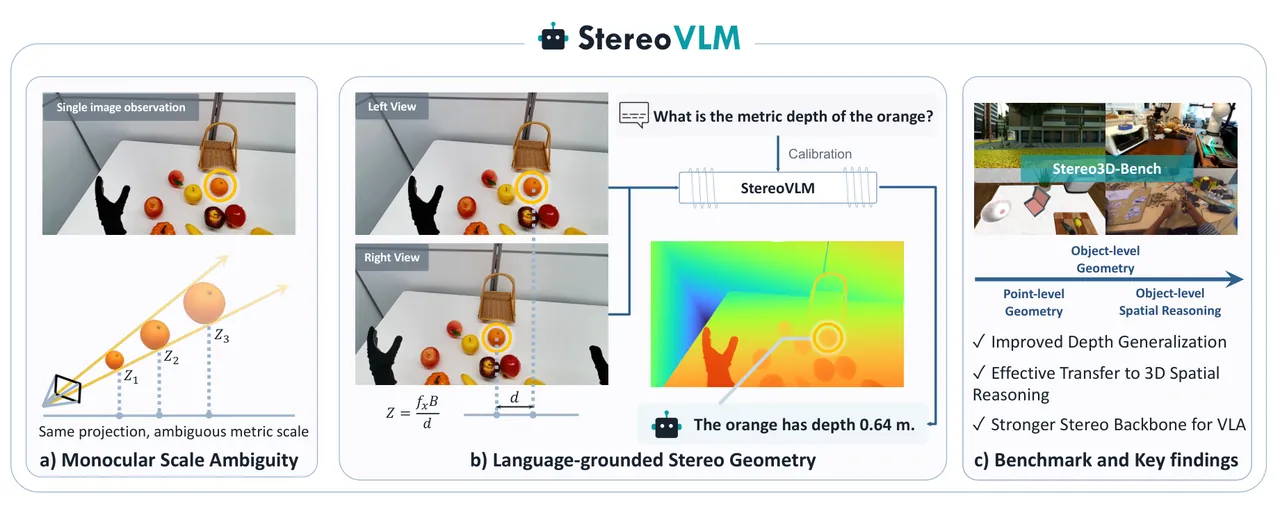
Figure 1: The paper's overview. A language-specified point becomes a calibrated binocular measurement, and the learned geometric representation is transferred to spatial reasoning and robot action.
The work is relevant to robotics because metric depth is only one part of the problem. A useful representation must also connect a distance to the object named by an instruction, preserve its extent and orientation, and remain stable when the policy encounters a new kitchen layout. StereoVLM evaluates that chain from pixels to points, from points to objects, and from objects to task targets.
Benchmark design: ask for geometry, then test whether geometry was used
Stereo3D-Bench contains eight tasks in three groups. Point-level geometry asks for the right-image correspondence of a queried left pixel, its horizontal disparity, or its metric depth. Object-level geometry applies the same three ideas to a language-referred object. Object-level spatial reasoning asks for an oriented 3D box or for the object named by a manipulation instruction.
The hierarchy prevents a model from receiving credit solely for making a dense depth map. A complete response can require pixel correspondence, semantic selection, metric scale, 3D extent, heading, and task relevance. The task-target score is stricter than box overlap alone: the predicted object label must be correct and the oriented-box interaction-over-union must reach 0.25.
The main split uses DROID, Xperience-10M, FSD, and RoboCasa. DROID contributes aligned sensor depth, Xperience-10M contributes released metric stereo-depth annotations, FSD contributes rendered disparity without physical metric calibration, and RoboCasa contributes simulator disparity and depth. FSD is consequently restricted to correspondence and disparity tasks.
There are 2,017 point-level pairs and 1,556 object-level pairs in the main split, producing 94,546 question-answer instances. The split is built at the source-unit level rather than by randomly mixing frames. DROID is separated by scene, Xperience-10M by recording identifier, and RoboCasa holds out five of its 24 task identities. This limits obvious train-test leakage before annotations are generated.
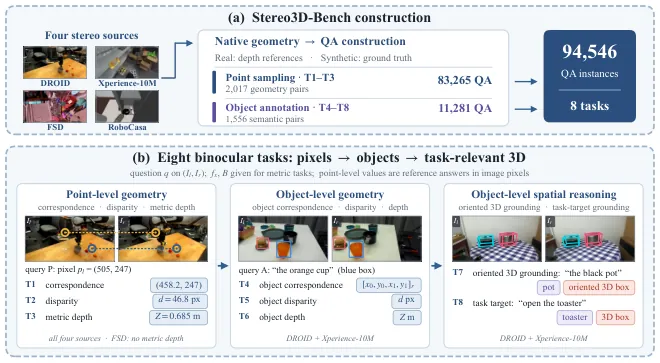
Figure 2: Stereo3D-Bench combines four stereo sources, a validity-constrained annotation pipeline, and tasks at point, object, and task-target levels.
The benchmark's answer construction matters as much as its task list. For real data, S2M2 is not used to create the reference answer. It acts as an independent consistency check: a pixel is retained only when depth recovered from S2M2 agrees with the source-native depth reference within ten percent. Numerical benchmark answers still come from the native reference.
$$\frac{\left|Z_{\mathrm{S2M2}}(\mathbf{p}_{l})-Z_{\mathrm{native}}(\mathbf{p}_{l})\right|}{Z_{\mathrm{native}}(\mathbf{p}_{l})}\leq 0.10. \tag{1}$$This filtering choice reduces the chance that every benchmark target inherits the bias of one stereo estimator. It also exposes a limitation: agreement between two imperfect references is not proof of physical correctness, especially around reflective objects, transparent surfaces, and depth discontinuities. The authors retain manual review for benchmark questions, but the denominator of the benchmark remains a constructed measurement rather than a metrology instrument.
The model: one autoregressive interface for geometric and semantic answers
StereoVLM takes an ordered pair $(I_{l},I_{r})$, a text question $q$, and, when required, camera calibration as input. It produces every answer as a token sequence. A correspondence, disparity, depth, 2D box, oriented 3D box, and target label all share the same autoregressive interface. The model therefore does not add a different prediction head for each task family.
$$p_{\theta}(a\mid I_{l},I_{r},q)=\prod_{t=1}^{T}p_{\theta}(a_{t}\mid I_{l},I_{r},q,a_{<t}). \tag{3}$$Here $\theta$ denotes the learned parameters, $a_{t}$ is the token at step $t$, and $a_{<t}$ is the generated prefix. Structured geometry is serialized into text and scored by the same next-token objective as natural-language answers. This uniformity simplifies the instruction interface, but it also means that numerical resolution is limited by tokenization and answer formatting.
Metric-depth prompts provide the horizontal focal length $f_{x}$ and baseline $B$ explicitly. The model is not asked to hallucinate camera scale from one scene. It must use the supplied calibration together with the image-space displacement. For a left-image point $\mathbf{p}_{l}$, disparity is defined as the difference between its horizontal coordinate and the coordinate of the matching point in the rectified right image:
$$d(\mathbf{p}_{l})=u_{l}-u_{r}. \tag{4}$$Given the positive disparity, the left-camera optical-axis depth follows from the standard rectified stereo relation:
$$Z(\mathbf{p}_{l})=\frac{f_{x}B}{d(\mathbf{p}_{l})},\qquad d(\mathbf{p}_{l})>0. \tag{5}$$These equations explain why correspondence, disparity, and depth are related without being interchangeable. Correspondence tests whether the model can find the same physical point across views. Disparity expresses that match as a horizontal displacement. Depth combines the displacement with camera calibration. A model trained only on the final depth number has fewer observable constraints on the intermediate geometry.
Object-level supervision connects semantic masks to the same metric frame. Qwen3 proposes objects, SAM3 generates masks, and DAM supplies region descriptions used to reject semantically inconsistent proposals. For each retained object, valid pixels are back-projected into the rectified-left camera:
$$\mathcal{P}_{i}=\left\{Z_{\mathrm{native}}(\mathbf{p})\,\mathbf{K}_{l}^{-1}\tilde{\mathbf{p}}\;\middle|\;\mathbf{p}\in\mathcal{M}_{i}\cap\mathcal{V}\right\}. \tag{2}$$$\mathcal{M}_{i}$ is the object mask, $\mathcal{V}$ is the set of pixels that survive geometric and semantic filtering, $\mathbf{K}_{l}$ is the left intrinsic matrix, and $\tilde{\mathbf{p}}=(u,v,1)^{\top}$ is a homogeneous pixel coordinate. The point cloud is used to estimate object extent and orientation, then transformed back into the rectified-left camera frame.
The result is a hierarchy that remains geometrically connected. A language phrase selects an object, its mask supplies image support, the depth reference lifts those pixels into 3D, and the resulting box becomes a structured answer. The five object-level scores are meant to expose where this chain breaks: matching, representative disparity, depth, oriented volume, and task-target grounding are reported separately.
Training: interleaving geometry with general capability
The final models initialize from Qwen3-VL-Instruct at 2B and 8B, train all parameters for 3,000 steps, use a learning rate of $1\times10^{-5}$, warm up for three percent of optimization, and use an effective batch size of 64. Stereo images are presented at $800\times320$, preserving a wide aspect ratio for horizontal correspondence while controlling the visual-token budget.
Only 25 percent of the final instruction mixture is stereo supervision: 15 percent point-level geometry and 10 percent object-level stereo semantics. The other 75 percent contains monocular and video instructions covering general visual language, localization, spatial reasoning, tracking, and robot instructions. This mixture tries to preserve broad model capability while adding a new geometric interface.
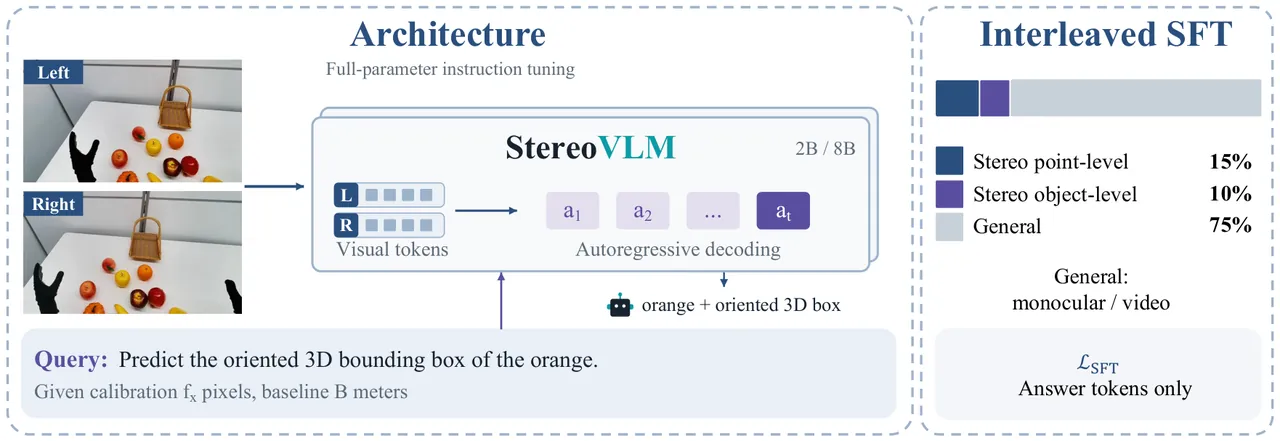
Figure 3: A shared vision-language model receives ordered stereo views and calibration-conditioned questions; point and object stereo instructions are interleaved with general multimodal data.
Training uses the same answer schema as the benchmark but different numerical supervision. FoundationStereo supplies training targets, with source-native references used where available to identify reliable regions. Benchmark answers are not generated by FoundationStereo, and its agreement check is separate from the S2M2 filter used for benchmark eligibility. That separation reduces direct circularity between the supervision source and the benchmark reference.
The hierarchy is a curriculum of task complexity, not a frozen sequence of separately trained modules. Point and object instructions are sampled in one optimization stream. The model shares parameters across correspondence, disparity, depth, object boxes, and task grounding, so the transfer between levels is learned through the mixed objective rather than through an external handoff.
Supervised fine-tuning minimizes the negative log-likelihood of answer tokens over the mixed instruction distribution:
$$\mathcal{L}_{\mathrm{SFT}}(\theta)=-\mathbb{E}_{(x,a)\sim\mathcal{D}_{\mathrm{mix}}}\left[\sum_{t=1}^{T}\log p_{\theta}(a_{t}\mid x,a_{<t})\right]. \tag{6}$$No explicit symbolic constraint forces the model to compute $f_{x}B/d$ inside its hidden state. The relation is learned from paired prompts and structured answers. The authors therefore test consistency between direct depth and depth recovered from predicted disparity, vary the baseline in text, and perturb the right camera's extrinsics. These experiments ask whether the model's behavior follows stereo geometry beyond fitting separate output formats.
flowchart LR
    L[Left image] --> V[Shared vision-language model]
    R[Right image] --> V
    Q[Task query plus fx and baseline] --> V
    V --> C[Point correspondence]
    V --> D[Point disparity]
    V --> Z[Point metric depth]
    C --> S[Cross-view geometric supervision]
    D --> S
    Z --> S
    S --> M[Object mask and representative depth]
    M --> B[Oriented 3D box]
    B --> T[Manipulation-target grounding]
    T --> P[Downstream policy representation]
The diagram is intentionally a source-specific path: the shared model learns point correspondence and disparity before those signals support object depth, oriented volume, and target grounding. It does not depict an external stereo network feeding frozen scene tokens into a separate VLM.
Control experiments: does the matching right view carry the gain?
Correct stereo is the benchmark condition. Four controls alter only the right view. Single-left removes it, zero-right substitutes a black image, duplicated-left copies the left image into both slots, and shuffled-right substitutes another sample's right image. All controls preserve a natural image in the duplicate case or a plausible real image in the shuffle case, so the model cannot succeed merely by counting visual tokens.
StereoVLM-2B reaches disparity MAE 4.12 pixels, point-depth $\delta_{1}$ 94.51 percent, and object-level average 64.43 under correct stereo. Removing the right image degrades those values to 9.07, 80.82, and 40.26. A black right view produces 9.31, 79.70, and 39.81. A shuffled right view produces 12.22, 70.16, and 32.49.
Duplicating the left image is the most destructive control: disparity MAE becomes 32.85, depth $\delta_{1}$ falls to 7.40 percent, and the object average collapses to 8.18. The second slot is still filled with a visually rich image, but it contains no valid cross-view displacement. The model's performance therefore depends on the correspondence structure of the right view, not just on the number or naturalness of image patches.
This control does not identify the exact internal computation. The model may attend to matching edges, infer horizontal shifts through language tokens, or combine both strategies. It does establish a behavioral dependency: replacing a matched right image with an unmatched natural image produces a systematic breakdown across point and object tasks.
Result 1: disparity supervision transfers better than direct depth
The controlled depth comparison is the paper's strongest causal evidence. Three variants start from the same Qwen3-VL-2B checkpoint and use the same 234K rectified stereo pairs with an identical optimization budget. The monocular variant receives only the left image. The binocular-depth variant receives the pair and predicts depth directly. The binocular-disparity variant predicts disparity, and evaluation converts it to depth with the supplied calibration.
| Supervision | Main $\delta_{1}$ up | Main MAE down | OOD $\delta_{1}$ up | OOD MAE down |
|---|---|---|---|---|
| Monocular depth | 77.91 | 14.08 | 51.00 | 26.08 |
| Direct binocular depth | 87.26 | 10.09 | 45.89 | 24.64 |
| Binocular disparity, converted to depth | 91.07 | 8.68 | 74.92 | 18.65 |
On the main split, direct binocular depth appears clearly better than monocular depth: $\delta_{1}$ rises from 77.91 to 87.26 percent and MAE falls from 14.08 to 10.09 centimeters. The ordering reverses out of domain. Direct binocular depth drops to 45.89 percent, below the monocular variant's 51.00, while disparity supervision remains at 74.92 percent with 18.65 centimeter MAE.
The 29.03-point OOD gap between disparity-derived and direct binocular depth is larger than a simple scale adjustment. A plausible interpretation is that direct training lets the model lean on training-set layout and object-size priors. Those priors help on the main distribution but disappear when the scene changes. Disparity supervision instead requires an image-space match that remains meaningful when familiar objects and arrangements are absent.
The experiment does not prove that every stereo VLM should output disparity as an intermediate text token. It does show that supervision target changes whether added binocular input generalizes. Reporting only the main-split improvement from 77.91 to 87.26 would hide the reversal from 51.00 to 45.89. The OOD column is the more decision-relevant result for a robot expected to enter unfamiliar environments.
Result 2: better pixels and better task targets
StereoVLM-8B obtains correspondence MAE 3.80 pixels, disparity MAE 3.76 pixels, and point-depth $\delta_{1}$ 95.17 percent on the main benchmark. Under the same stereo-input protocol, GPT-6 Astra reports 9.27, 7.55, and 75.96. StereoVLM-2B also improves over that baseline, reaching 4.09, 4.12, and 94.51, so the benefit is not confined to the larger model.
Object-level results show a similar pattern but with a different bottleneck. StereoVLM-8B averages 66.98 across five semantic tasks and achieves 37.70 oriented-box mIoU with 51.28 target joint success. GPT-6 Astra averages 47.61, reaches 17.92 box mIoU, and succeeds on 12.82 percent of target-grounding questions. The target gap is therefore much larger than the average semantic gap.
| Model | Correspondence MAE down | Disparity MAE down | Depth $\delta_{1}$ up | Object average up | 3D box mIoU up | Target success up |
|---|---|---|---|---|---|---|
| Qwen3-VL-2B | 73.37 | 66.92 | 16.11 | 7.17 | 0.00 | 0.00 |
| Qwen3-VL-8B | 46.87 | 41.25 | 21.47 | 9.12 | 0.12 | 0.00 |
| GPT-6 Astra | 9.27 | 7.55 | 75.96 | 47.61 | 17.92 | 12.82 |
| StereoVLM-2B | 4.09 | 4.12 | 94.51 | 64.43 | 36.06 | 48.72 |
| StereoVLM-8B | 3.80 | 3.76 | 95.17 | 66.98 | 37.70 | 51.28 |
Scaling from 2B to 8B adds 0.66 percentage points of point-depth $\delta_{1}$, 2.55 points of object average, and 2.56 points of target success. Point-level geometry is close to saturation on this benchmark, while oriented localization and semantic selection still improve. The paper does not test larger scales, so the pattern should not be extrapolated into a general scaling law.
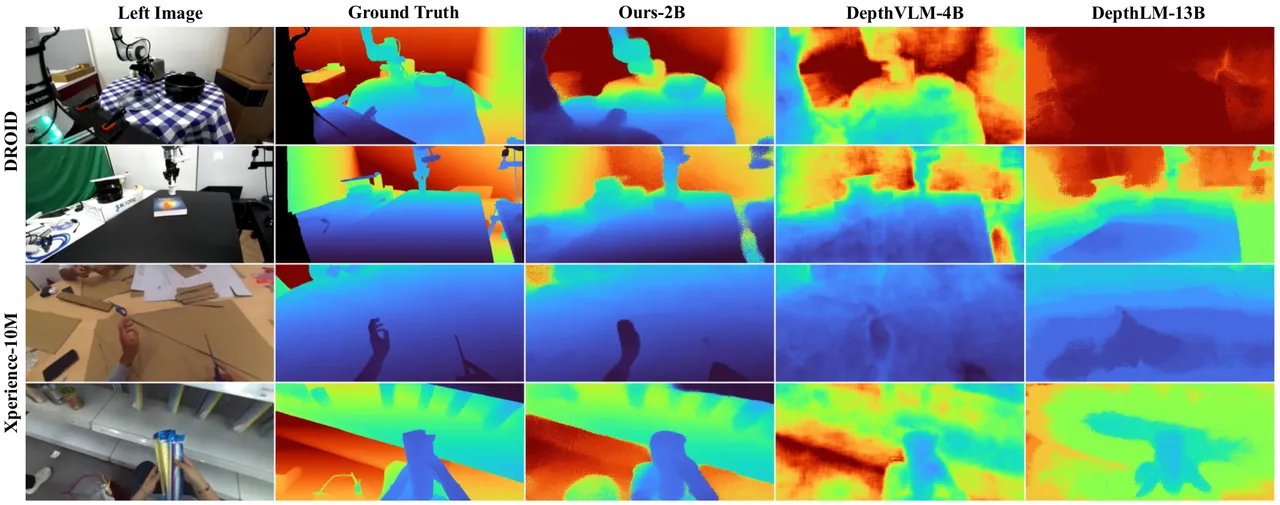
Figure 4: Qualitative depth comparisons on Stereo3D-Bench. The paper highlights preservation of foreground structure and object boundaries against larger depth-specialized baselines.
The qualitative figure supports the numerical claim that object boundaries are part of the target. A smooth depth field can have a low global error while erasing the separation between a manipulable object and the surface behind it. The authors show examples where StereoVLM-2B retains foreground structure with substantially fewer parameters than the compared depth-specialized models, although visual examples are not a substitute for a boundary-specific error distribution.
Do disparity and direct depth agree inside one model?
The paper compares direct depth with depth derived from disparity at the same jointly trained checkpoint. StereoVLM-2B reaches $\delta_{1}$ 94.51 with direct depth and 94.46 with disparity-derived depth; StereoVLM-8B reaches 95.17 and 95.15. The near agreement suggests that joint training produces two behaviorally compatible output paths.
The direct path is marginally better on the main split: the 2B MAE differs by 0.05 centimeters and the 8B by 0.17. At 8B, direct depth has 29.93 centimeter root-mean-square error versus 32.63 for disparity-derived depth. The main benchmark therefore does not establish the converted path as the most precise route. Disparity's decisive advantage appears in the separate OOD supervision experiment.
Agreement also does not prove that an explicit disparity map exists inside the model. Separate token paths may fit both answers while sharing only distributed features. A hidden-state probe, intermediate-map decoding experiment, or intervention on attention between corresponding regions would be needed to identify the internal mechanism.
What disappears without point-level supervision
Removing point-level geometry instructions lowers the StereoVLM-2B object correspondence mIoU from 86.06 to 83.39 and object disparity two-pixel accuracy from 53.92 to 32.33 percent. Object-depth $\delta_{1}$ drops from 97.39 to 91.52, oriented-box mIoU from 36.06 to 26.24, and target joint success from 48.72 to 46.15.
The largest degradation is on object disparity, followed by oriented volume. Both require geometry that is not recoverable from a label or a semantic box alone. Target success changes much less, indicating that instruction following, label selection, and output formatting remain additional bottlenecks. The ablation supports a contribution from low-level geometry without claiming that every object-level failure is caused by depth.
Late-stage evidence: calibration, transfer, and operation
The authors test baseline sensitivity by changing the nominal $B$ in text while keeping images, focal length, and queried pixel fixed. Across 200 DROID pairs and 200 in-house robot pairs, predicted median depth changes approximately linearly with the supplied baseline. This behavior is consistent with $Z=f_{x}B/d$ and indicates that the model is not completely ignoring calibration text.
Extrinsic perturbation reveals a more fragile boundary. Independent rotations and translations of the right camera affect performance unevenly, with several translation changes producing larger errors than rotations because they directly alter the expected disparity field. A language model cannot reason its way around a corrupted geometric input. Synchronization, calibration, and rectification remain physical prerequisites for the method.
Across five external spatial benchmarks, the average rises from 47.94 to 51.48 when stereo geometry instructions are added. Omni3D gains 8.21 points, DA-2K 2.37, OmniSpatial 2.48, MindCube 3.71, and VSI-Bench 0.92. The breadth suggests some transfer beyond the exact Stereo3D answer formats, though the gains are uneven and VSI-Bench changes only modestly.
RoboCasa provides a downstream manipulation test. The same GR00T policy architecture is initialized with different vision-language representations, and RoboCasa is removed from representation-training data to reduce task leakage. The plain Qwen3-VL-2B initialization reaches 34.9 percent success, the general instruction model reaches 38.1, and the stereo-geometry representation reaches 42.4.
The 4.3-point improvement is meaningful but not deployment evidence. It is measured in simulation over 24 kitchen tasks with 50 demonstrations and 50 evaluation rollouts per task. Contact dynamics, real sensor noise, policy variance, and sim-to-real transfer remain outside the main claim. The result supports geometric representation as a useful policy input, not StereoVLM as a complete manipulation system.
Unified inference versus modular pipelines
The appendix compares StereoVLM-2B with two modular approaches that first run FoundationStereo and then pass reconstructed information to a frozen VLM. The unified model reaches an object semantic average of 64.43, compared with 35.81 for a localization-style pipeline and 5.07 for the direct-input pipeline.
On one H200 at batch size one, StereoVLM-2B has 0.643 second average latency. The two modular pipelines take 2.212 and 0.920 seconds. These values depend on implementation, hardware, and output parsing, but they establish a useful engineering point: a single model can avoid an additional full stereo forward pass in this setup.
The tradeoff is precision and control. Tokenized numerical outputs are constrained by tokenization, decoding, and schema validity. A modular geometric system can attach continuous optimization, uncertainty estimates, and physical consistency checks more directly. The experiment favors the unified design on accuracy and measured latency; it does not show that modular geometry has no role in safety-critical deployment.
What the appendix adds about geometric reference quality
Figure 5 places native depth, S2M2-derived depth, and FoundationStereo results in a common coordinate frame. The purpose is to show where the independent references agree and where a stereo estimator introduces a different depth field. This matters because the benchmark's admissibility filter depends on S2M2 agreement, while the training labels use FoundationStereo.
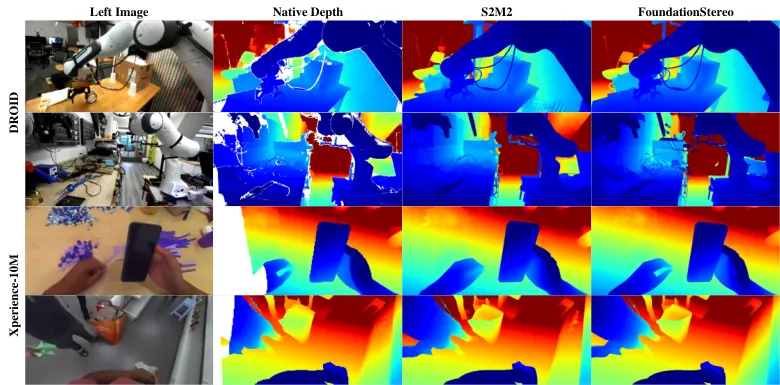
Figure 5: Appendix examples aligning native source depth with S2M2 and FoundationStereo. Agreement is checked in the same image coordinates rather than inferred from summary statistics.
A consistency mask can remove pixels where two estimators disagree, but it can also create a selected subset that is easier than the original scene. Figure 6 visualizes agreement regions and edge bands. If most retained pixels lie away from object boundaries, the benchmark may underrepresent the jumps that matter for grasping, collision avoidance, and occlusion reasoning.
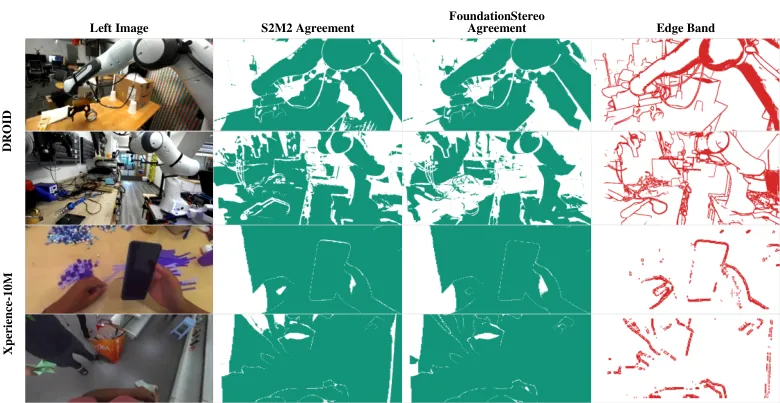
Figure 6: Agreement masks and edge-band diagnostics reveal where depth references diverge, with red regions concentrated near discontinuities.
The visible concentration near depth edges is a useful warning about the reported averages. A model can improve broadly while remaining unreliable at the exact boundary between a target and its background. The paper reports overall metrics and qualitative examples, but it does not provide a separate benchmark table for transparent, reflective, thin, or heavily occluded objects.
Limitations
The authors explicitly limit the claim to controlled benchmarks and simulated kitchen tasks. Their evaluation relies on calibrated, synchronized stereo cameras. Real deployments encounter rolling shutter, motion blur, dirt, exposure changes, stereo dropout, and calibration drift. The extrinsic experiment demonstrates sensitivity rather than solving robust online calibration.
The second stated limitation is the simulation-to-reality gap. RoboCasa is not a physical robot evaluation. The 42.4 percent downstream success rate also indicates substantial room for improvement even inside simulation. Friction, deformation, contact-rich manipulation, safety constraints, and hardware timing are not covered by the representation experiment.
The authors further note that difficult visual conditions remain unresolved. This is not a minor caveat for stereo. Lens contamination or low texture can remove the correspondence evidence on which disparity depends. The method has no fallback policy proposed for a camera that becomes misaligned or loses synchronization during operation.
An independent limitation concerns benchmark construction. Object boxes are derived from learned masks, semantic filtering, depth back-projection, gravity alignment, and manual review. Each stage can introduce correlated errors. Native depth and S2M2 agreement is an eligibility check, not ground-truth metrology. The benchmark is carefully constructed, but it is not an absolute measurement standard.
A second independent limitation is output representation. Geometry is serialized into text and judged after parsing. Invalid answers receive zero on semantic tasks and remain in depth denominators, which is a strict and reasonable protocol. Yet some improvement may come from learning valid answer formats rather than more precise geometry. A continuous regression head or geometry-specific tokenization could separate format skill from spatial skill.
Reproducibility is also incomplete. The public repository does not expose inference, training, weights, or data generation. The paper contains enough detail to follow the design and compare the figures, but not enough public code to audit prompt construction, loss masking, parsing, point grouping, or the implementation of right-view controls.
Finally, the external benchmark gains are not uniform. VSI-Bench adds less than one point, and OOD point-depth $\delta_{1}$ is about 70 percent rather than near the main-split result. The evidence supports transfer to some spatial tasks, but it does not show that a single stereo instruction mixture has solved open-world metric perception.
Assessment
The most important design choice is not the use of Qwen3-VL or the number of parameters. It is the supervision chain: a shared multimodal model is asked to establish point correspondence, express disparity, recover calibrated depth, attach that geometry to named objects, and ground the object named by a task. Each level is evaluated rather than assumed from the previous one.
The right-view controls give the paper its strongest mechanistic argument. The same checkpoint with a mismatched natural right image performs much worse than it does with the matched view. This makes "binocular input" an experimentally testable dependency instead of a model-description label.
The OOD supervision result is the most transferable lesson for robot-learning teams. Direct metric-depth regression can exploit scene priors and look stronger on a familiar split, then reverse when the environment changes. Disparity provides an intermediate image-space quantity that remains tied to camera geometry. For data design, that suggests collecting and preserving cross-view correspondence before collapsing everything into scalar distance labels.
The claim should remain bounded. StereoVLM improves several benchmark scores and a simulated policy, but it still depends on clean calibrated cameras, remains well below perfect OOD depth, and has no released implementation. Its contribution is a strong formulation of geometry-aware multimodal supervision, not a solved perception stack for real robots.
Conclusion
StereoVLM shows that adding a second image is insufficient unless the training objective makes the model responsible for the relation between views. By interleaving point geometry, object geometry, and general vision-language instructions, it produces a shared model that performs cross-view matching, metric depth, object localization, and task-target grounding more effectively than general VLM baselines in the reported experiments.
The paper's 45.89 to 74.92 OOD depth result is the key practical signal. If it holds under broader conditions, it argues for preserving disparity as a supervised intermediate rather than asking a language model to infer metric scale directly. The next test is real-robot robustness: online calibration, synchronized sensing, boundary-aware depth, uncertainty, and contact-rich manipulation must all be addressed before the representation can support dependable deployment.