PAPER DEEP DIVE
AlphaAnything: Extending Pretrained RGB Generators to RGBA
AlphaAnything extends pretrained RGB generators to RGBA directly in their original latent space without RGBA reconstruction pretraining. It inserts LoRA modules into the generative transformer, attaches an alpha branch to the frozen RGB VAE decoder, and uses unidirectional RGB-to-alpha feature sharing plus an Endpoint-Aware Alpha Loss. The design preserves RGB decoding for any fixed latent and supports both text-to-RGBA and image-to-RGBA generation.
Paper Metadata
Title: AlphaAnything: Extending Pretrained RGB Generators to RGBA
Authors: Qijie Wang, Zhixin Xu, Zhe Li, Haowei Zhu, Honghao Qiao, Bo Peng, Dawei Li, and Bin Wang.
Paper and code: arXiv 2610.32413; WLuLi/AlphaAnything; project page. This analysis corresponds to public commit 3ca0b11904c059d562bf837743ec1b512c8042a3. On November 22, 2026 the repository published code, training-data information, and checkpoints. FLUX.2 has both training and inference support. The Qwen route currently exposes an inference adapter, while upstream RGB weights remain subject to their original licenses.
Topics: transparent image generation, RGBA layers, alpha matting, diffusion transformers, frozen VAE adaptation, and generative image editing.
One-Sentence Summary
AlphaAnything extends a pretrained RGB generator without replacing its latent space or its VAE decoder. It keeps the original RGB latent and frozen decoder, attaches a trainable, one-way RGB-to-alpha feature bridge, and trains diffusion LoRA plus the alpha branch with an endpoint-aware loss. Alpha supervision reaches the generator through frozen decoder features, while the RGB result for any fixed latent remains exactly unchanged.
The Difficult Part Is Preservation, Not the Fourth Channel
Adding transparency to an image generator appears to require a simple format conversion: move from three output channels to four. The actual problem touches the complete generative stack. A text encoder supplies a condition, a diffusion transformer produces a latent, and a VAE decoder maps that latent to pixels. If the system replaces the RGB VAE with a jointly trained four-channel tokenizer, it also changes the scale, statistics, and reconstruction behavior of the latent space. The generator must relearn how that space represents color, typography, material, and fine structure while it learns opacity.
Prior transparent-layer methods generally follow one of three routes. A dedicated RGBA VAE encodes color and alpha together, after which a compatible generator predicts the joint latent. A preserved RGB generator predicts an additional alpha latent or channel, usually with a new tokenizer or head. An image-editing route treats background removal and alpha matting as paired image-to-image translation. Each route can produce useful transparency, but each introduces a cost: a changed RGB latent, a new generation head, or a large editing fine-tune whose alpha objective may compromise appearance.
The paper begins with evidence that this cost is easy to hide behind aggregate RGBA scores. The authors reconstruct the RGB content of 295 source images using both the original RGB VAEs and the RGBA VAEs used by comparison methods. The RGBA tokenizers lose measurable color and perceptual fidelity. On the Qwen-Image-Edit comparison, LPIPS rises from 0.03807 to 0.05197 and CIEDE2000 rises from 1.917 to 2.078. On FLUX.1-dev, LPIPS rises from 0.01216 to 0.04762 and CIEDE2000 from 2.109 to 3.240. The FLUX.1 change is particularly large.
Such degradation matters more in transparent graphics than in ordinary image synthesis. Transparent assets often contain lettering, logos, thin strokes, glass highlights, hair, and antialiased edges. A small color shift can alter a brand color or reduce text legibility. A soft alpha edge can create a white fringe, dark halo, or contaminated glow after the layer is placed on a new background. A generator that trades its appearance prior for opacity may satisfy a numerical alpha metric while failing the editable-asset workflow that motivated the task.
AlphaAnything therefore asks a different question. Rather than finding room for a fourth channel, it asks how opacity can receive strong supervision from a shared latent without changing the pretrained image path. The answer is a frozen VAE decoder with a trainable side branch, a one-way feature bridge, and a loss that allows alpha gradients to shape the diffusion transformer even though no RGB decoder parameter is updated.
Training on RGBA Layers While Generating in the Original RGB Latent
Each training example is an RGBA foreground layer. Let the color image be $I_c$ and the opacity map be $a$. The paper forms an RGBA tensor and passes it through the original RGB VAE encoder:
$$\widetilde I_c=\operatorname{Pad}(I_c,a),\qquad z_0=E(\widetilde I_c).\tag{1}$$Here $E$ is the pretrained RGB encoder, and the padding operation expands its input to accept the alpha channel. The important consequence is that alpha contributes to the training target latent but does not define a separate latent space. The generator still predicts the representation expected by the original VAE. It is not trained to speak a newly invented four-channel language.
At inference, the generator maps noise and a text or image condition $c$ to a latent. The frozen RGB decoder and the new alpha head then produce appearance and opacity:
$$z=G_{\theta_0,\psi}(\epsilon,c),\qquad \widehat I_c=D(z),\qquad s=H_\phi(z;D).\tag{2}$$$\theta_0$ denotes frozen diffusion-transformer parameters, $\psi$ denotes trainable low-rank adaptation parameters, $D$ is the frozen RGB VAE decoder, and $H_\phi$ is the trainable alpha branch. The RGB decoder receives only $z$. The alpha branch receives $z$ plus intermediate features produced by $D$. There is no path from the alpha branch back into the RGB decoder's feature stream.
The fixed-latent preservation property can be stated directly:
$$D_{\mathrm{aug}}^{\mathrm{RGB}}(z;\phi)=D(z),\qquad \frac{\partial D_{\mathrm{aug}}^{\mathrm{RGB}}}{\partial\phi}=0.\tag{3}$$For any latent passed to both decoders, the RGB outputs are identical regardless of how well the alpha branch is trained. This is a structural guarantee, not a penalty that becomes approximately true when a loss weight is small. It protects the decoder function, but it does not freeze the generative distribution. Alpha gradients still enter the predicted latent through the frozen decoder's activations and then update the diffusion LoRA. The model can therefore learn latents that are easier to decode into correct opacity while retaining the original mapping from a latent to RGB pixels.
This distinction between parameter freezing and gradient isolation is central. Freezing a decoder prevents its weights from changing. It does not prevent a downstream loss from differentiating through the frozen function. AlphaAnything deliberately preserves that derivative path. The stop-gradient and coupled-decoder ablations later show that both halves of the design are necessary: cutting the gradient limits opacity accuracy, while adding alpha-to-RGB feedback damages foreground fidelity.

Figure 1: Paper Figure 1. AlphaAnything extends pretrained text-generation and image-editing backbones to transparent layers while retaining the original RGB appearance route.
Why a Separate Alpha Latent Creates New Burden
A separate alpha latent seems like the least invasive extension because the RGB generator and RGB tokenizer can remain untouched. The model then predicts two latent sequences, one for appearance and one for opacity, and a modified decoder consumes both. This approach preserves the RGB decoder interface only if the alpha decoder is carefully synchronized, but it introduces a new prior that must be learned from scratch. The generator now has to represent transparency in a latent coordinate that has no large-scale pretrained data behind it.
A joint RGBA VAE avoids two latent streams by encoding all four channels into a single representation. It can be more internally consistent, yet it changes the geometry of the pretrained latent. A direction that previously encoded a subtle color variation may now be shared with opacity or a material boundary. Large RGB weights must adapt to the new coordinate system, and the decoder may spend capacity reconstructing color rather than preserving it. The measured RGB reconstruction gap is a direct warning that better RGBA coverage does not imply better appearance preservation.
AlphaAnything locates opacity at the decoding side of the original latent. The generator remains responsible for the structure of the transparent object, including where its silhouette lies, but it does not need an independent alpha tokenizer. The alpha head reads multi-scale RGB decoder features and predicts a score map. Those features already contain object boundaries, local contrast, texture, and semantic grouping learned from a much larger RGB corpus.
The tradeoff is that opacity must be inferred from appearance evidence. This often works well for text, products, people, animals, and visible glass contours, because their boundaries are represented strongly in RGB. It is less certain for fully transparent material, regions nearly identical to the background, or optical effects whose appearance changes with the unseen background. The architecture reduces the cost of adaptation, but it does not remove the ill-posed nature of alpha extraction.
For a creative tool, this tradeoff is often favorable. Users already choose a base model for its color, typography, and visual style. A transparency feature that silently changes those qualities is difficult to trust. Preserving the RGB function creates a stable contract between the original model and its RGBA extension. New alpha modules can be updated or replaced while prompts that depend only on RGB retain a known decoding path.
The One-Way Feature Bridge
The public implementation places the main bridge in alphaanything/modules/alpha_decoder.py. RGBToAlphaLoCon begins at line 47 and applies a low-rank convolutional transform from frozen RGB decoder features into the alpha path. RGBToAlphaCrossAttention begins at line 112 and lets alpha queries retrieve information from RGB keys and values. Both modules consume frozen features. Neither writes its result back into the RGB feature stream.
For an RGB decoder feature $q_\ell$ at stage $\ell$, the residual bridge can be written as:
$$\bar q_\ell=q_\ell+\gamma_\ell B_{\phi,\ell}^{3\times3}\left(A_{\phi,\ell}^{1\times1}(h_\ell)\right),\qquad q_{\ell+1}=U_{\phi,\ell}(\bar q_\ell).\tag{4}$$$A_{\phi,\ell}^{1\times1}$ projects the feature into a compact rank, and $B_{\phi,\ell}^{3\times3}$ expands it back to an alpha-channel representation. The gate $\gamma_\ell$ controls the amount injected at that stage, while $U_{\phi,\ell}$ is the alpha decoder's own upsampling or residual block. The factorization resembles LoRA, but it is applied to convolutional feature paths rather than transformer projections.
The implementation uses alpha widths $(256,256,192,128,96)$ over five stages, rank 64, scaling 64, and stage gates $(1,0.75,0.5,0.25,0.25)$. Each stage contains two residual blocks, cross-attention uses eight heads, and the final score head has 128 channels. Earlier stages retain higher spatial resolution and receive stronger feature transfer. Later stages contain more semantic abstraction but poorer localization, so their gates are reduced.
This schedule matches the dual nature of alpha prediction. A soft edge, thin letter stroke, or strand of hair requires accurate local positioning and therefore benefits from early high-resolution features. Deciding whether a region belongs to the foreground object requires broader context and can use later semantic features. The cross-attention path complements the convolutional bridge by letting alpha tokens search the RGB representation for relevant appearance evidence instead of relying only on a fixed neighborhood.
alphaanything/models/flux2_klein/vae.py combines the frozen VAE with the staged alpha decoder. Its forward structure is the practical definition of unidirectional sharing: RGB features branch into alpha, while alpha tensors never merge back into the RGB output. Auditing this file is more informative than inspecting a diagram alone, because the exact order of feature extraction, residual injection, attention, and decoding determines whether the preservation guarantee holds.
flowchart TD
    C["Text or image condition plus noise"] --> L["Pretrained DiT with trainable LoRA"]
    L --> Z["Original RGB latent"]
    Z --> D["Frozen RGB VAE decoder"]
    D --> RGB["RGB pixel output"]
    D --> F["Frozen multi-scale decoder features"]
    Z --> A["Trainable alpha decoder"]
    F -->|"one-way LoCon and cross-attention"| A
    A --> ALPHA["Alpha score map"]
    RGB --> LOSS1["RGB flow-matching loss"]
    ALPHA --> LOSS2["Endpoint-aware alpha loss"]
    LOSS1 --> L
    LOSS2 -->|"gradient through frozen features"| Z
    Z -->|"alpha gradient updates LoRA"| L
    LOSS2 -->|"parameter updates"| A
Figure 2: Training graph reconstructed from paper Figure 2 and the public code. Frozen parameters remain in the alpha gradient path to the latent and LoRA.
Joint Training of the Generative Path and the Alpha Path
Training uses a clean latent obtained from the RGBA training layer and a noise sample for flow matching. The interpolation and target velocity are:
$$z_\sigma=(1-\sigma)z_0+\sigma\epsilon,\qquad v^\ast=\epsilon-z_0.\tag{5}$$The diffusion transformer predicts a velocity, from which the model derives an estimate of the clean latent:
$$\widehat v=v_{\theta_0,\psi}(z_\sigma,\sigma,c),\qquad \widehat z_0=z_\sigma-\sigma\widehat v.\tag{6}$$The clean estimate is not only compared with the clean latent. It is also passed through the frozen RGB decoder and alpha branch. RGB decoding encourages the predicted latent to remain on the appearance manifold understood by the original VAE. Alpha decoding supplies an additional objective that can modify the latent through the frozen decoder's Jacobian. The combined objective is:
$$\mathcal L=\mathbb E\left[\|\widehat v-v^\ast\|_2^2+\lambda_{E\alpha}w(\sigma)\ell_{E\alpha}\left(H_\phi(\widehat z_0;D),a\right)\right].\tag{7}$$$a$ is the ground-truth alpha layer, and $w(\sigma)$ scales the alpha objective by diffusion time. At high noise, the clean-latent estimate is unstable and a strong pixel-level alpha constraint may reward accidental structure. At low noise, the estimate is accurate enough for edge supervision to provide useful signal. This coupling is why the alpha loss is part of the generative training objective rather than a post-hoc decoder loss.
alphaanything/training/losses.py implements the combination in flow_ea_loss. alphaanything/training/flux2_klein.py around line 59 organizes dense RGB targets, clean latents, RGBA decoding, and the two losses. The public configuration uses rank 64 for the DiT LoRA, LoRA alpha 128, Gaussian initialization, and zero dropout. The paper appendix describes a 16-GPU main experiment with effective batch size 16. The repository README defaults to eight GPUs, one sample per device, and gradient accumulation 2, also producing an effective batch of 16. These two settings should not be conflated when reporting the paper protocol.
The stop-gradient ablation isolates the importance of the latent path. Detaching $\widehat z_0$ before alpha decoding leaves the RGB flow objective active and continues to train the alpha head, but prevents alpha errors from updating the diffusion LoRA. On FLUX.2, Soft IoU falls from 0.8296 to 0.8146 and SAD rises from 46.3572 to 59.8725. On Qwen, Soft IoU falls from 0.9223 to 0.9014 and SAD rises from 30.3820 to 37.0486. The decoder-side branch alone cannot recover all the lost opacity structure.
The coupled-decoder ablation tests the opposite mistake. If alpha features are allowed to modify the RGB path, even with all pretrained RGB parameters frozen, foreground RGB L1 rises from 0.1155 to 0.1349 on FLUX.2 and from 0.0746 to 0.2435 on Qwen. The results support a narrow but strong conclusion: opacity supervision should reach the generator, but opacity features should not rewrite the appearance decoder.
An Endpoint-Aware Objective for Soft Boundaries
Most alpha pixels are near zero or one. A direct L1 loss can therefore be dominated by large, easy regions while giving weak structure to the narrow semitransparent boundary. The network may learn a hard mask that covers the right area but loses antialiasing, soft glass, hair, or translucent cloth. The paper introduces a Fisher-style coordinate transform:
$$\chi(a)=\frac{2}{\pi}\arcsin\sqrt a.\tag{8}$$This transform changes sensitivity near the two endpoints. Errors on values close to zero or one are not treated as negligible simply because their raw difference is small. The authors then aggregate residuals separately at the transparent and opaque ends. With $g_i$ representing a local gradient-related weight, the endpoint terms and alpha loss are:
$$R_0=\sqrt{\operatorname{mean}\left((1-a_i)g_i\right)},\qquad R_1=\sqrt{\operatorname{mean}\left(a_i g_i\right)},\qquad \ell_{E\alpha}=R_0+R_1.\tag{9}$$$R_0$ emphasizes mistakes near transparency, and $R_1$ emphasizes mistakes near opacity. Square-root aggregation prevents a small set of difficult boundary pixels from being averaged away by a much larger set of easy pixels. The $\sqrt{\cdot}$ is not a cosmetic nonlinearity: it changes how local errors are pooled before optimizing the alpha branch and the generator.
The temporal weight is:
$$w(\sigma)=\min\left\{1,\frac{0.5^2}{\sigma^2+10^{-4}}\right\}.\tag{10}$$It is close to one at low noise and decays quickly at high noise. Together with the transformed coordinate and endpoint groups, this objective lets the model spend supervision on the difficult transition while avoiding unreliable pixel targets early in the flow trajectory. The paper reports the gradient with respect to the predicted velocity in the appendix:
$$\nabla_{\widehat v}\left[w(\sigma)\ell_{E\alpha}\right]=-\sigma\,w(\sigma)K^\top J_s^\top\nabla_s\ell_{E\alpha}.\tag{11}$$$K$ represents the local mapping from the estimated latent to the alpha input, and $J_s$ is the Jacobian of the alpha score map with respect to its internal features. The expression exposes the actual training channel: opacity error reaches the velocity prediction through frozen decoder features. A strong alpha metric is therefore not enough to explain the method. The scale and timing of this gradient determine whether the diffusion path learns useful transparent structure.
The EA-versus-L1 ablation supports the objective. On FLUX.2, endpoint-aware loss raises Soft IoU from 0.8179 to 0.8296 and lowers SAD from 53.2542 to 46.3572. On Qwen, Soft IoU rises from 0.8830 to 0.9223 and SAD falls from 49.2356 to 30.3820. The larger Qwen gain may reflect its editing pretraining, decoder features, or alpha-head optimization, but the same direction on both backbones makes a generic boundary effect plausible.
Data and Evaluation Design
The training corpus contains 8,963 curated RGBA text samples and roughly 180,000 image-to-RGBA pairs from PrismLayersPro. The text set spans transparent objects, lettering and graphic elements, natural subjects, materials, and visual effects. The image-to-RGBA examples pair a source image with a target layer description and an extraction instruction. The task is not to reproduce the complete input image. It is to isolate the described foreground element as a transparent layer.
The evaluation sets are kept separate from training. RGBA-Text contains 294 English prompts and is used for reference-free CLIPScore, Aesthetic Score, and ImageReward. AlphaTest contains 402 prompts and adds FID. RGBA-Image contains 735 target layers from 295 source images and reports six reference-based metrics: foreground RGB L1, Soft IoU, SAD, LPIPS, Alpha Grad, and Alpha Conn. The authors state that the two new benchmarks are not used for training and that prompts were screened against training captions for exact duplicates and long shared sequences.
Text-to-RGBA experiments cover FLUX.1-dev, FLUX.2 Klein Base 9B, Qwen-Image-2512, and LongCat-Image. Image-to-RGBA experiments use FLUX.2 Klein Base 9B and Qwen-Image-Edit-2511. Each backbone keeps its native conditioning interface, latent layout, scaling, token packing, and sampler. This consistency matters because a single alpha head should not force every generator into a new text-conditioning pipeline.
The comparison also includes AlphaVAE, LayerDiffuse, OmniAlpha, and Qwen-Image-2.1 where applicable. These systems differ in base model, tokenizer, training data, and interface, so the table should be read as a system-level comparison rather than a controlled architecture-only experiment. AlphaAnything's value is supported both by its main scores and by its internal ablations, which isolate fixed-latent preservation, gradient propagation, feature direction, and alpha loss.
| Method | Backbone | CLIPScore ↑ | Aesthetic ↑ | ImageReward ↑ |
|---|---|---|---|---|
| LayerDiffuse | Dedicated transparent model | 0.8542 | 5.4505 | 0.5921 |
| AlphaVAE | FLUX.1-dev | 0.8306 | 5.2679 | 0.5159 |
| OmniAlpha | Qwen-Image-Edit | 0.8508 | 5.2850 | 0.7535 |
| Qwen-Image-2.1 | Qwen | 0.8465 | 5.3011 | 0.6189 |
| AlphaAnything | FLUX.1 | 0.8353 | 5.5256 | 0.7588 |
| AlphaAnything | FLUX.2 | 0.8656 | 5.5125 | 0.9752 |
| AlphaAnything | Qwen Image | 0.8684 | 5.5240 | 0.9477 |
| AlphaAnything | LongCat | 0.8657 | 5.5295 | 1.0013 |
Table 1: RGBA-Text results on 294 prompts, from paper Table 1. Every AlphaAnything backbone exceeds the listed baselines on ImageReward.
On RGBA-Text, LongCat reaches ImageReward 1.0013, followed by FLUX.2 at 0.9752, Qwen at 0.9477, and FLUX.1 at 0.7588. The strongest baseline in the table is OmniAlpha at 0.7535. Aesthetic scores are tightly packed around 5.51 to 5.53 for the AlphaAnything variants, while CLIPScore remains between 0.8353 and 0.8684. The method therefore does not appear to gain transparency by abandoning text alignment or appearance quality.
AlphaTest changes the evaluation distribution and adds reference-image FID. LongCat records FID 74.9846, CLIPScore 0.8413, Aesthetic 5.7171, and ImageReward 1.5050. FLUX.2 records 75.1796, 0.8442, 5.6352, and 1.4464. Qwen records 75.8076, 0.8342, 5.6799, and 1.3758. The LongCat ImageReward advantage over OmniAlpha is 0.3060 with a 95 percent BCa interval of $[0.2715,0.3435]$ over 10,000 paired bootstrap resamples. The interval excludes zero, which reduces the chance that the gain is produced by a few unusual prompts.
| Method | FID ↓ | CLIPScore ↑ | Aesthetic ↑ | ImageReward ↑ |
|---|---|---|---|---|
| AlphaAnything FLUX.1 | 77.3089 | 0.8096 | 5.7105 | 1.2880 |
| AlphaAnything FLUX.2 | 75.1796 | 0.8442 | 5.6352 | 1.4464 |
| AlphaAnything Qwen Image | 75.8076 | 0.8342 | 5.6799 | 1.3758 |
| AlphaAnything LongCat | 74.9846 | 0.8413 | 5.7171 | 1.5050 |
Table 2: AlphaTest results on 402 prompts, from paper Table 2. Appearance metrics are averaged over lossless black and white composites.
Image-to-RGBA is the stricter test of local fidelity because it begins from a real source image and requests a specific layer. The Qwen Image Edit variant reaches Soft IoU 0.9223, SAD 30.3820, LPIPS 0.0136, Alpha Grad 27.5221, and Alpha Conn 30.0584. The FLUX.2 variant reaches Soft IoU 0.8296, SAD 46.3572, and LPIPS 0.0207. Neither result supports a claim that one backbone dominates every metric, but the gap from prior image-to-RGBA systems is large enough to reveal a real improvement in opacity structure.
OmniAlpha's row is particularly useful for scale. Its RGB L1 is slightly lower than FLUX.2's at 0.1052 versus 0.1155, yet its Soft IoU is 0.6881 and SAD is 178.4325. This illustrates why foreground color and alpha overlap must be reported together. A model can produce a plausible-looking foreground while failing to separate its silhouette from the source background. The Qwen AlphaAnything variant combines the lowest RGB L1 in the table with the best alpha and perceptual metrics.
| Method | RGB L1 ↓ | Soft IoU ↑ | SAD ↓ | LPIPS ↓ | Alpha Grad ↓ | Alpha Conn ↓ |
|---|---|---|---|---|---|---|
| OmniAlpha | 0.1052 | 0.6881 | 178.4325 | 0.0911 | 70.8791 | 176.9433 |
| Qwen-Image-2.1 | 0.0868 | 0.6932 | 181.5245 | 0.0830 | 81.6191 | 166.0596 |
| AlphaAnything FLUX.2 | 0.1155 | 0.8296 | 46.3572 | 0.0207 | 69.5947 | 46.0840 |
| AlphaAnything Qwen Edit | 0.0746 | 0.9223 | 30.3820 | 0.0136 | 27.5221 | 30.0584 |
Table 3: RGBA-Image reference metrics from paper Table 3, evaluated over 735 layers from 295 source images.
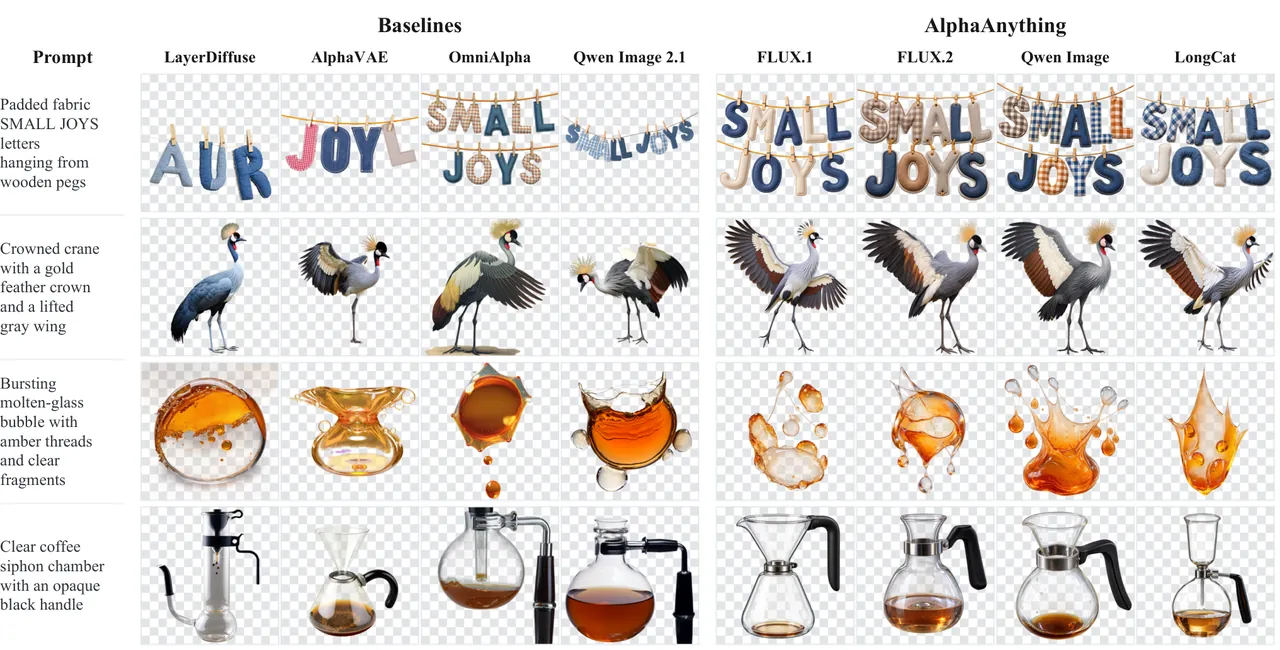
Figure 3: Paper Figure 3. Matched text-to-RGBA examples with transparent glass, graphic lettering, and a natural subject.
Preserving RGB Details and Avoiding Cross-Branch Contamination
The reconstruction study connects the architectural argument to visible image quality. A jointly trained RGBA VAE can show deviations in small letterforms, color transitions, and texture even before the generator is involved. The original RGB VAE is optimized only for color reconstruction, while the RGBA VAE must also encode opacity. Capacity and objective pressure can move the decoder away from pure appearance fidelity.
AlphaAnything does not avoid this problem by asking the alpha branch to reconstruct the entire RGBA image. It keeps the original RGB decoder bytes unchanged and adds a separate alpha path. The paper's Figure 7 compares RGB detail preservation during image-to-RGBA extraction, with clearer letter shapes than OmniAlpha and a coupled-decoder variant. The quantitative coupled-decoder ablation supplies the corresponding controlled evidence, because all pretrained RGB parameters remain frozen in both settings.
The property can be tested without any generative sampling. Feed an identical latent tensor into the original VAE and the extended decoder, disable alpha output, and compare the RGB tensors element by element. This is a useful deployment regression because an alpha update should not alter the RGB path. It does not prove that every generated image remains identical, since training can change the latent distribution, but it isolates decoder responsibility from generator responsibility.
The distinction matters for debugging. If an RGB regression appears in the fixed-latent test, the bridge has leaked information or the decoder wrapper has changed normalization and shape behavior. If fixed-latent output is identical but generated RGB changes, the cause lies in the trained latent distribution, LoRA update, loss balance, or sampling path. Separating these cases prevents an alpha-head bug from being misdiagnosed as a base-model degradation.

Figure 4: Paper Figure 5. RGB reconstruction comparison. AlphaAnything avoids retraining a joint RGBA tokenizer by attaching opacity to the frozen decoder.
Human Preference and Statistical Evidence
Automatic alpha and perceptual metrics can miss whether a transparent layer looks usable after compositing. The appendix reports pairwise human evaluation on image-to-RGBA. Against Qwen-Image-2.1, FLUX.2 wins 90.48 percent after ties are excluded and records 72.37 percent with ties adjusted. Against OmniAlpha, the corresponding values are 77.78 and 63.51 percent.
The Qwen Edit AlphaAnything variant is stronger in the reported pairs. It wins 96.00 percent against Qwen-Image-2.1 after excluding ties, or 79.49 percent with the adjusted formula. Against OmniAlpha, it reaches 100.00 and 80.56 percent. Human evaluation does not replace the reference metrics, but it indicates that the numerical improvements are visible enough for raters to prefer the output.
The appendix also tests inference seeds 42, 43, and 44. Qwen Image Edit ranks first on all six RGBA-Image metrics in each run, with mean Soft IoU $0.9236\pm0.0023$ and LPIPS $0.0132\pm0.0009$. LongCat records ImageReward $1.0040\pm0.0023$ on RGBA-Text and $1.5146\pm0.0094$ on AlphaTest. These per-seed results support the main conclusions without turning a single selected seed into the entire evidence base.
Bootstrap analysis resamples prompts for text evaluation and source-image clusters for RGBA-Image. LongCat's ImageReward gain over OmniAlpha is 0.2771 on RGBA-Text with a 95 percent interval $[0.2282,0.3296]$, and 0.3060 on AlphaTest with interval $[0.2715,0.3435]$. All six Qwen Image Edit differences on RGBA-Image favor AlphaAnything; the Soft IoU gain over OmniAlpha is 0.2350 with interval $[0.2115,0.2605]$. The intervals describe input-sampling uncertainty for the saved runs and are more informative than a bare table rank.
Inference Cost and Trainable Parameters
The alpha branch adds work at decode time, not at every diffusion sampling step. The paper measures FLUX.1 RGB decoding at 0.149 seconds and RGBA decoding at 0.247 seconds, with peak memory rising from 2.297 to 2.389 GB. End-to-end overhead is 0.445 percent because the complete sampling process dominates. FLUX.2 moves from 0.148 to 0.249 seconds and from 2.299 to 2.386 GB, for 0.244 percent overhead.
Qwen moves from 0.138 to 0.239 seconds and from 2.118 to 2.331 GB, producing 0.228 percent overhead. LongCat moves from 0.148 to 0.247 seconds and from 2.297 to 2.389 GB, for 0.427 percent. The decode time nearly doubles in these measurements, but the full generator plus sampler remains much more expensive. Systems with very few sampling steps, large decode batches, or constrained memory may see a different balance.
The trainable-parameter table provides another view of adaptation cost. FLUX.1 uses 179.306M DiT LoRA parameters plus 12.436M alpha parameters. FLUX.2 uses 111.149M plus 12.436M; Qwen uses 94.372M plus 12.253M; LongCat uses 39.322M plus 12.436M. The alpha head remains near 12M across backbones, while LoRA size follows the transformer configuration.
This is substantially smaller than full fine-tuning, but it is not a lightweight inference-only addition. Training 20,000 steps on multiple large backbones requires serious GPU memory and data throughput. The public README's eight-GPU recipe improves accessibility, yet reproducing four backbones, multiple ablations, human evaluation, and all image-to-RGBA comparisons still requires a substantial experimental program.
| Backbone | RGB decode s | RGBA decode s | RGB memory GB | RGBA memory GB | End-to-end overhead |
|---|---|---|---|---|---|
| FLUX.1 | 0.149 | 0.247 | 2.297 | 2.389 | 0.445% |
| FLUX.2 | 0.148 | 0.249 | 2.299 | 2.386 | 0.244% |
| Qwen Image | 0.138 | 0.239 | 2.118 | 2.331 | 0.228% |
| LongCat | 0.148 | 0.247 | 2.297 | 2.389 | 0.427% |
Table 4: Inference overhead from paper Table 17. The additional alpha work occurs during the decode stage.
How the Paper Maps to the Public Code
alphaanything/models/flux2_klein/vae.py is the place to inspect the frozen RGB path and staged alpha decoder. The implementation determines which features are exposed to alpha, where low-rank convolution and cross-attention are applied, and whether any alpha tensor can modify RGB decoding. A code-level audit should compare the original VAE forward path with the augmented path before trusting the preservation claim.
alphaanything/models/flux2_klein/lora.py at line 18 implements DiT LoRA. The reported configuration uses rank 64, alpha 128, Gaussian initialization, and dropout 0. The paper's trainable-parameter table reflects the selected target modules and transformer depth. The alpha branch is much more stable across backbones because it follows the same multi-stage bridge design.
alphaanything/modules/alpha_math.py is the numerical counterpart of Equations 8 through 10. The Fisher coordinate begins around line 18, the endpoint loss around line 53, and the noise weight around line 72. Reading these functions clarifies details that a paper summary often omits, including numerical stabilizers, reduction order, and the exact handling of local gradient weights.
alphaanything/training/flux2_klein.py around line 59 connects dataloading, condition construction, clean latents, noisy latents, velocity prediction, RGBA decoding, and optimization. alphaanything/training/losses.py packages flow matching and endpoint-aware alpha supervision into the training objective. Together, these files show that the alpha path is not a detached postprocessor: its loss is part of the same backward graph that updates the generative LoRA.
The repository status should be read literally. FLUX.2 has training and inference support. Qwen currently emphasizes an inference adapter. Upstream RGB checkpoints retain their own licenses. A user who wants to reproduce the paper must verify model access, data access, and commercial-use terms separately. Open source code is not a blanket license for every base model or dataset.
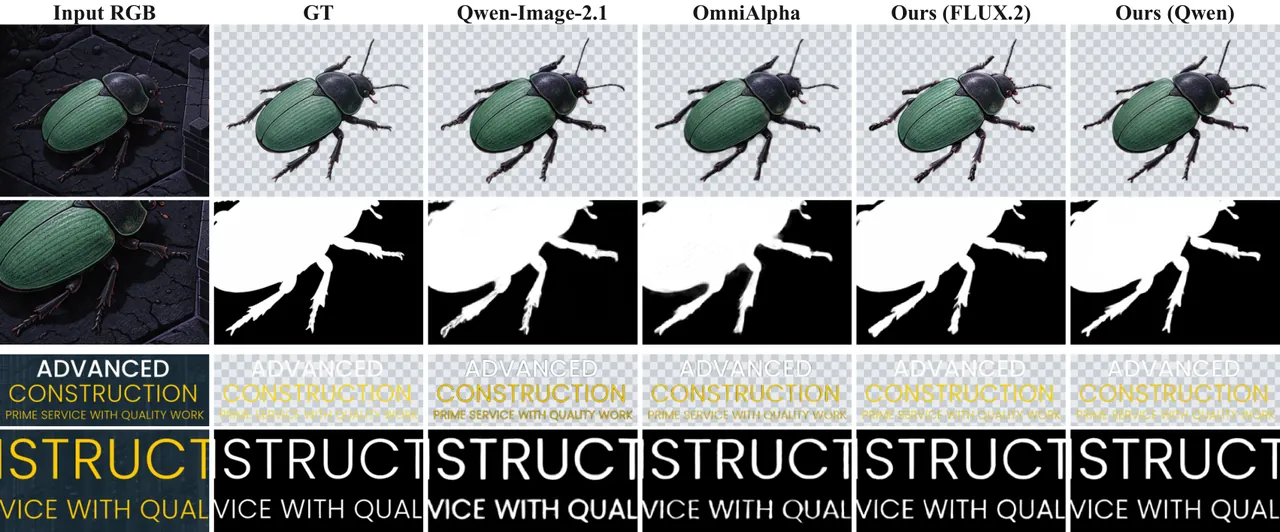
Figure 5: Paper Figure 4. Image-to-RGBA examples covering an insect, poster lettering, thin edges, and foreground color preservation.
Why This Matters for Image-Generation Products
Transparent output is a workflow primitive, not merely an alternate file format. A poster designer needs to move a title as a separate layer. An e-commerce pipeline needs to extract a product and place it on a controlled background. A game or video team needs reusable characters, effects, and props. Text-to-RGBA can generate an editable element directly, while image-to-RGBA can turn an existing composition into source material. Both reduce manual masking and edge repair.
AlphaAnything makes transparency an extension of a strong RGB model rather than a reason to abandon it. A service can retain the base model's prompt understanding and visual quality, then attach the decoder-side alpha branch for users who need transparency. The fixed-latent RGB property gives the service a versionable regression contract. Updating the alpha head should not silently change RGB decoding for the same latent.
The product boundary remains clear. High-quality RGBA data and accepted benchmarks are scarce. Prompt text such as transparent glass does not specify which local pixels are clear material, reflection, highlight, or shadow. Complex posters contain intersecting objects that are hard to separate without region-level controls. Hair, motion blur, compression artifacts, and physically based transparency introduce ambiguity that a single score map may not resolve.
The most useful next research steps are therefore in data, supervision, and interaction. Multi-scale boundary consistency, connected-region constraints, joint uncertainty over foreground color and alpha, and compositing-aware perceptual losses could improve difficult materials. User guidance such as masks, reference layers, or object-level instructions could make extraction more predictable. The architecture leaves room for these additions because the RGB path remains isolated.
Limitations Stated by the Authors
High-quality RGBA data remain scarce. The authors explicitly state that transparent-image datasets, accepted benchmarks, and metrics are less mature than their RGB counterparts. Training examples come from curated or synthetic layer-construction pipelines, and the distribution cannot cover every real transparent material or optical interaction.
Evaluation coverage is limited. The main evidence uses RGBA-Text, AlphaTest, RGBA-Image, and an additional AIM500 comparison. These sets measure prompt alignment, aesthetics, human preference, alpha overlap, boundary structure, and perceptual fidelity, but they do not capture every requirement of design, film, e-commerce, or interactive editing. The authors call for larger datasets and metrics that jointly evaluate appearance, transparency, and compositing quality.
Base-model and data licensing constrain deployment. The public release gives different levels of support for different backbones. FLUX.2 includes training and inference; Qwen is primarily an inference adapter; upstream RGB weights still need to be loaded under their own terms. Practical use requires checking code, checkpoint, training-data, and output-usage licenses separately.
Independent Risks and Open Questions
Fixed-latent preservation does not guarantee fixed sampling trajectories. Alpha supervision updates the diffusion LoRA, so the latent produced from the same seed can change over training. The method preserves the decoder response for a given latent, not every image from every checkpoint. Production reproducibility still requires pinned weights, samplers, seeds, and preprocessing.
Alpha supervision can still bias the latent toward easier masks. The RGB decoder cannot be rewritten, but the generator can learn latents that produce more separable boundaries. If alpha loss is too strong, it may flatten texture, alter reflections, or reduce the richness of partially transparent objects. The reported RGB loss and time weighting are intended to balance this pressure, but the paper does not provide a complete sensitivity study for every backbone.
Alpha metrics do not equal compositing quality. Soft IoU and SAD measure overlap and absolute error. Alpha Grad and Alpha Conn measure gradient and connectivity. They do not fully capture color spill, shadow behavior, refractive transparency, or how a layer looks on arbitrary backgrounds. LPIPS on black and white backgrounds helps, but a production metric should also test colored and textured composites.
The shared-feature design favors visible structure. Text, animals, products, and clear silhouettes provide strong RGB evidence. Fully transparent material, regions with colors similar to the background, or objects whose appearance depends on the unseen background may be underdetermined. The model can confuse highlights with opacity or collapse soft glass into a hard boundary.
Decode overhead depends on the serving regime. The reported end-to-end overhead is below half a percent because diffusion sampling takes most of the time. If future generators use very few steps, decode larger batches, or run under tighter memory constraints, the 12M alpha branch and staged attention may become a larger fraction of cost.
Audit and Reproduction Checklist
First, test fixed-latent RGB equality. Call the original VAE and the augmented decoder on identical tensors, disable alpha output, and compare shape, normalization, maximum absolute error, and perceptual distance. A failure here points to a structural leak or a wrapper inconsistency, not to a generative loss tradeoff.
Second, inspect gradient flow. Run the full model, a detached-latent variant, and a variant that removes alpha loss. Confirm that alpha-head parameters, LoRA parameters, and frozen VAE parameters receive the expected gradients or remain untouched. The stop-gradient claim is only meaningful if the full path truly differentiates through the frozen decoder to the latent.
Third, unit-test the endpoint-aware loss. Use all-zero alpha, all-one alpha, a single soft pixel, hair-like thin lines, and smooth glass boundaries. Check the two endpoint terms, noise weighting, finite gradients, and direction of improvement. Then correlate training loss with Soft IoU, SAD, Alpha Grad, and compositing LPIPS rather than assuming one scalar predicts every downstream requirement.
Fourth, report appearance and alpha separately. A useful evaluation includes fixed-latent RGB equality, generated foreground color error, multiple background composites, alpha overlap, alpha boundary, and human preference. Reporting only ImageReward or a single black-background image can hide exactly the failures that matter when a transparent layer is reused.
Conclusion and Outlook
AlphaAnything's contribution is not the mechanical addition of an alpha channel. It is a deliberate separation of parameter and gradient roles when a pretrained RGB generator is extended to transparency. The latent space and frozen decoder preserve appearance. A one-way decoder feature bridge learns opacity. The endpoint-aware loss sends alpha supervision through frozen activations back to the diffusion LoRA. The design avoids both a dedicated alpha latent and a jointly retrained RGBA tokenizer.
The experiments support the claim across multiple backbones. AlphaAnything improves ImageReward on the text benchmarks and substantially reduces SAD, LPIPS, and boundary errors for image-to-RGBA. The Qwen Edit variant reaches Soft IoU 0.9223 and SAD 30.3820. Fixed-latent preservation, stop-gradient, coupled-decoder, and EA-versus-L1 ablations identify which parts of the architecture produce the gain.
The limitations are equally important. RGBA data, benchmarks, and metrics remain immature. A frozen appearance decoder cannot make an underdetermined transparent region observable. A shared latent can still shift toward structures that are easier to mask. In production, AlphaAnything is a strong starting point for editable asset generation, not a guarantee of physically correct transparency or a replacement for final artistic review.
The next step should connect richer physical and compositing supervision to the existing one-way bridge. Data must include real glass, liquid, smoke, hair, shadows, and multiple layers. Evaluation must measure appearance, opacity, and the result on varied backgrounds. Systems must keep fixed-latent regression tests, gradient-path tests, and license checks. Those pieces are required before transparent generation becomes a dependable production tool.
SOURCE LINKS