

Model SystemsPython
Heretic
A training-free behavior editor combining ARA/abliteration, Optuna, pluggable scorers, and reproducible manifests; it changes refusal boundaries rather than proving broad capability preservation.
A reviewed field guide to robotics, embodied AI and agent software, arranged by what each repository actually does.
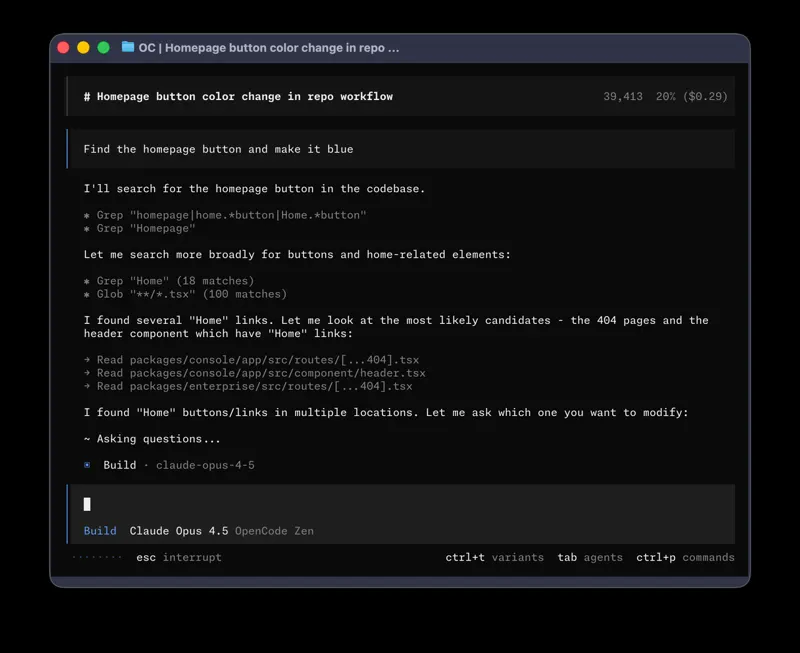
anomalyco/opencode (formerly sst/opencode, 210k stars, MIT) splits the coding agent into a client layer and a server layer: the server exposes OpenAPI 3.1 plus an SDK generated from the spec, and the TUI is just one remote frontend of it, so a single session can be driven from a terminal, an IDE, GitHub Actions and ACP clients such as Zed. More than 75 providers plug in through the AI SDK and Models.dev, OpenCode Zen offers a curated gateway of models tested before listing, the 35+ built-in LSPs ship disabled with docs stating they are not always a net win, skills resolve from .opencode, .claude and .agents roots, and permissions are a three-state allow/ask/deny. It is the most engineering-first branch of open-source coding agents: interface before UI.
Four collections and twelve task-based domains cover the full catalog. Domains, tags and search compose.
Start with the work a repository performs, then search by repository, technology, lab or topic.
Train, serve and run models faster, smaller and cheaper.
Inference serving, quantization, fine-tuning, caching, speculative decoding, model routing and local/edge execution.
A training-free behavior editor combining ARA/abliteration, Optuna, pluggable scorers, and reproducible manifests; it changes refusal boundaries rather than proving broad capability preservation.
Strata is an open-source local inference engine built on llama.cpp/ggml that runs the 125-billion-parameter Qwen3.8-Flash-Next MoE model on consumer gaming PCs with as little as 12GB VRAM, using tiered expert caching (GPU→RAM→SSD) and guess-and-check speculative decoding to achieve 53-94 tokens/second.
As an Amazon Associate, we earn from qualifying purchases.