
OPEN SOURCE DEEP DIVE
OmniVoice gives 646 languages a shared voice model
OmniVoice places 646 languages inside one zero-shot speech model, combining a Qwen3 language backbone with non-autoregressive masked diffusion over eight acoustic codebooks. This article examines the architecture, the different limits of voice cloning and voice design, the 102-language evidence, long-form inference costs, and the layered licensing attached to its code, weights, and tokenizer.
Speech systems usually become less ambitious as they become more useful. A production voice model may sound excellent in English and Mandarin, yet the same request in a language with a few hours of transcribed audio can collapse into unstable rhythm, missed syllables, or a borrowed accent. OmniVoice attacks that tradeoff directly. It places 646 languages, including hundreds of low-resource languages, inside one zero-shot text-to-speech model trained on roughly 581,000 hours of open speech data.
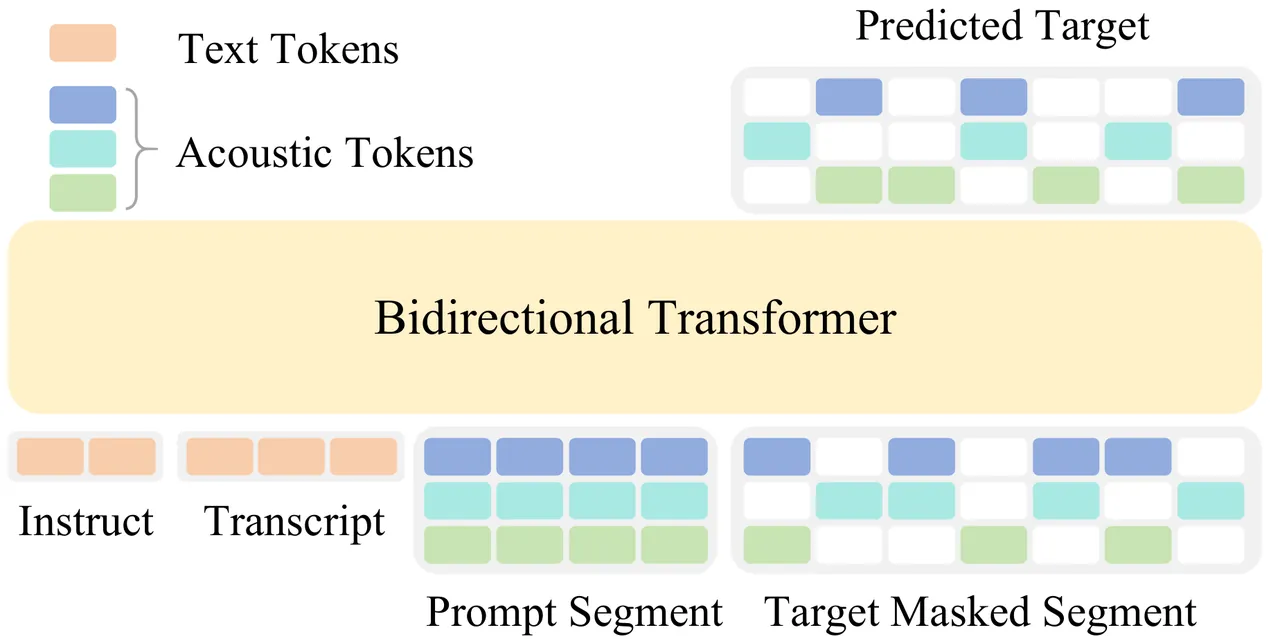
The number alone is not the story. The interesting claim is architectural: one small model learns a shared mapping from text and reference audio to acoustic tokens, instead of assembling a separate pipeline or checkpoint for every language. OmniVoice starts its backbone from Qwen3-0.6B, uses a Higgs audio tokenizer with eight codebooks, and produces 24 kHz speech through non-autoregressive masked diffusion. That combination changes where the hard engineering work lives.
Why a broad language count is still difficult
Massive multilingual datasets are not flat. A few languages contribute thousands of hours, while much of the tail contributes less than ten. Train on the raw distribution and the model sees an enormous amount of English, Mandarin, and other high-resource speech while receiving only occasional glimpses of smaller languages. OmniVoice applies language-level resampling to pull the long tail into training more often. A smoothing parameter keeps some of the original imbalance, since making every language equally frequent would spend too much capacity on tiny datasets and degrade the languages that already have better coverage.
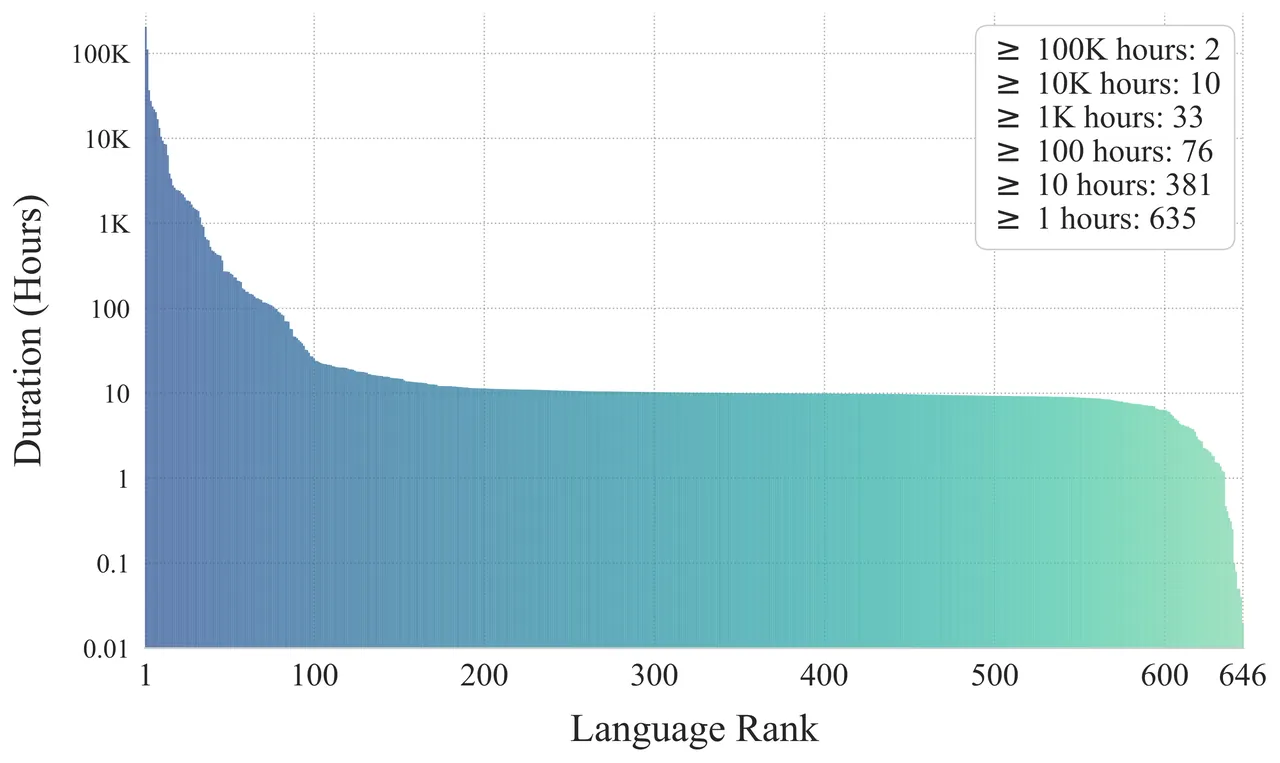
The team assembled the corpus from 50 open datasets rather than recording one clean studio collection. Common Voice, FLEURS, Emilia, GigaSpeech 2, the Meta Omnilingual ASR Corpus, and regional speech sets all carry different microphones, accents, transcript conventions, and noise. OmniVoice runs speech restoration on degraded material and applies rule-based filtering for invalid transcripts. That is useful preparation, not a guarantee of clean supervision. It also explains why the model includes prompt denoising: a reference recording may contain room noise or reverberation, and the model should copy the speaker rather than preserving the acoustic accident as part of the voice.
A single model from text to acoustic tokens
Many strong TTS systems separate the problem into stages. A text model first predicts semantic speech tokens; a second model turns those tokens into acoustic codes; a vocoder reconstructs the waveform. Each stage is easier to train in isolation, but errors compound. If the first model loses a phoneme or chooses the wrong prosodic shape, later stages usually cannot recover the intended sentence.
OmniVoice removes that intermediate handoff. Text and the target acoustic-token sequence enter the same Transformer. The target positions begin masked, and each decoding pass predicts tokens across all eight codebooks using the visible text, the reference audio, and the already revealed acoustic context. The model then chooses which positions to reveal next and repeats. The default is 32 steps; 16 steps trade some quality for speed. Although generation is iterative, it is not left-to-right autoregression. A pass can condition on the whole target span, so later words can influence where earlier pauses and stresses belong.
This is what “single-stage” means in practice: one learned model connects text conditioning to multi-codebook acoustic prediction. The waveform still requires a tokenizer decoder, so there is not literally one neural network between characters and sound. What disappears is a separately trained semantic-to-acoustic generation stage, along with the interface where information is most easily lost.
| Part of the path | OmniVoice design | Practical consequence |
|---|---|---|
| Text and prompt conditioning | Both enter a shared bidirectional Transformer | One model learns language and acoustic context together |
| Generation order | Non-autoregressive masked diffusion over the target sequence | Global context is available, at the cost of multiple decoding passes |
| Speech representation | Eight acoustic codebooks from the Higgs tokenizer | Fine detail is represented more densely than a single code stream |
| Output | 24 kHz waveform after token decoding | The sample rate describes the output format, not a guarantee of studio-quality source audio |
| Backbone initialization | Qwen3-0.6B weights before speech training | The model inherits a strong text prior and reaches better intelligibility early |
The masking schedule is the architectural unlock
Single-stage codebook prediction has a training-efficiency problem. Earlier systems often mask one codebook layer at a time and compute loss only on that layer. The sampling pattern looks orderly, but each update supervises a narrow slice of the full time-by-codebook matrix. OmniVoice instead masks entries independently across both time and codebook dimensions, with a random masking ratio per example. On average, half the matrix contributes to the loss. The update is much denser, and the model is forced to predict relationships across codebooks rather than learning one layer while treating the others as invisible targets.

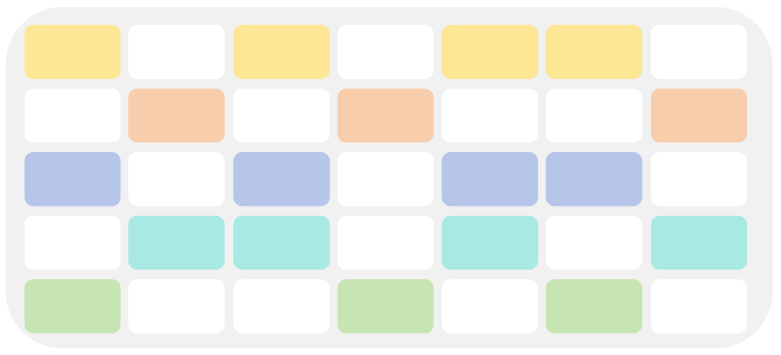
The ablation is unusually clear. On LibriSpeech-PC, with the same Emilia training setup, the full-codebook schedule reports 1.57% WER. A SoundStorm-style schedule reaches 3.00%, and a MaskGCT-style schedule reaches 2.04%. The benefit is not merely “more random masks.” When the team keeps full-codebook masking but computes loss on only one codebook, WER regresses to 2.85%. Dense prediction, not the visual irregularity of the mask, is doing the work.
The second unlock is initialization. Non-autoregressive speech models can produce convincing prosody while making surprisingly basic word errors. OmniVoice keeps a standard Transformer shape so it can load pretrained Qwen3 language weights before adapting to bidirectional speech modeling. In the reported ablation, the initialized checkpoint reaches 1.57% WER on LibriSpeech-PC, while random initialization remains at or above 2.52% after several learning-rate adjustments. The result suggests that speech training should not have to rediscover all of a language’s spelling, ambiguity, and text structure from the relatively smaller speech objective.
Three controls that are often mistaken for one
OmniVoice can clone a voice from a short reference, design a voice from attributes, or choose an unspecified voice automatically. These modes share one API, but their reliability depends on different conditions.
Cloning is the strongest path because it matches the model’s main training task. A reference clip of about 3 to 10 seconds usually works best. Clean, single-speaker audio is more useful than a longer recording containing music, room changes, or several people. Beyond roughly 20 seconds, inference slows and the extra variation can make the selected identity less stable. A transcript is optional; if omitted, the system can recover one with Whisper, but an accurate supplied transcript is safer for specialized names and unusual words.
Cross-language cloning is not accent neutralization. A Mandarin reference speaking English will generally produce English with a Mandarin-influenced accent. That behavior can be a feature for an authentic multilingual brand voice, but it is the wrong tool when the product requires a native-sounding target accent. In that case, select a reference in the target language.
Voice design accepts descriptions such as female, young adult, low pitch, whisper, or a named English accent. It requires no real speaker and can be useful for characters, prototypes, and privacy-preserving narration. The repository is candid that design training is concentrated in Chinese and English. It can generalize, but unusual attribute combinations and low-resource target languages need listening tests. When a reference and an instruction disagree, the reference often dominates; when they agree, the instruction can reinforce the desired dialect or style.
Automatic voice selection is the zero-configuration option. It is convenient for checking language coverage or generating temporary multilingual narration. It is not a good way to maintain a recognizable brand voice across sessions. Without a reference, very short outputs can also be unstable, so one- or two-second clips should use a prompt if consistency matters.
| Mode | Input contract | Best use | Do not assume |
|---|---|---|---|
| Voice cloning | 3 to 10 second reference, optional exact transcript | Authorized brand or character voices, personalized speech | The target language will erase the reference accent |
| Voice design | Text attributes such as age, pitch, accent, or whisper | New fictional voices and narration without a source speaker | Every attribute combination is equally stable outside Chinese and English |
| Auto voice | Target text only | Quick multilingual demos and temporary reading | The same speaker identity will remain fixed between requests |
The text interface adds finer controls for content that needs them. Tags such as [laughter], [sigh], and question or surprise markers can shape delivery. Chinese polyphonic characters can be corrected with numbered pinyin, and English names can be overridden with CMU phonemes. Min Nan currently requires Tâi-lô romanization rather than Chinese characters. Text normalization should be explicit for numbers, and the paper is straightforward that long numeric strings and mathematical expressions remain difficult. A production pipeline should convert dates, currencies, identifiers, and formulas into forms a speaker would naturally say.
What the multilingual evidence actually supports
On familiar benchmarks, OmniVoice is competitive at both ends of the quality stack. It reports 1.30% WER and 0.729 speaker similarity on LibriSpeech-PC. Seed-TTS English reaches 1.60% WER and 0.741 similarity; Seed-TTS Chinese reaches 0.84% CER and 0.777 similarity. Across MiniMax’s 24-language set, the averages are 2.850% WER and 0.830 similarity. These are strong results, but they are still results on selected test sets, produced by the model’s authors and evaluated through chosen ASR systems.
The 102-language FLEURS evaluation is more informative about breadth. OmniVoice reports an average 4.00% CER, compared with 5.11% for the ground-truth recordings passed through the same measurement chain, and 0.788 average speaker similarity. It places 82 languages below 5% CER, versus 75 for the human reference. The important claim is not that synthetic speech universally beats real speech. A text-to-speech model can be easier for an ASR system because its pronunciation is standardized, while real recordings contain noise, disfluency, and dialect variation. The paper itself says performance has crossed the measurement capability of existing ASR in some cases.
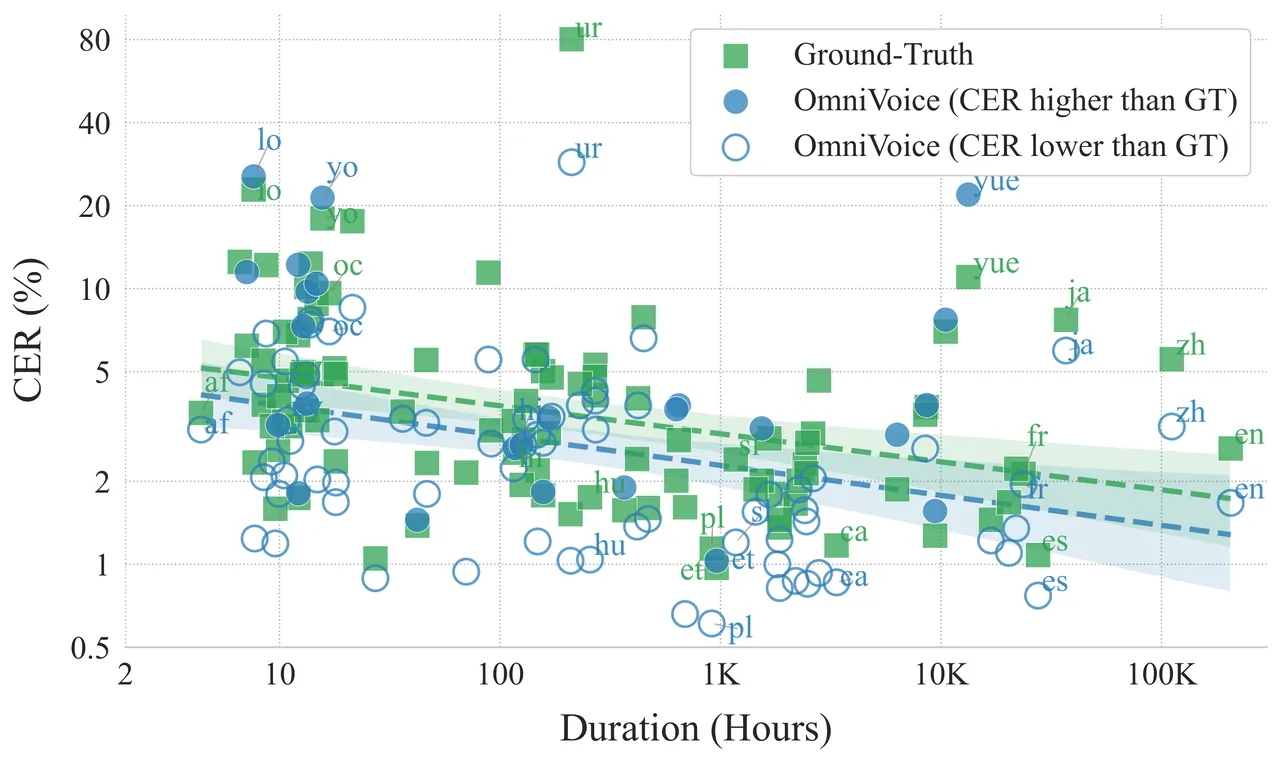
Cantonese exposes why. In the MiniMax table, OmniVoice has 17.709% WER when Whisper-large-v3 judges the output. Re-score the same generated speech with SenseVoice-Small and the number falls to 2.273%. The synthesis did not change; the evaluator did. For low-resource and non-Latin languages, an ASR score is partly a test of the recognizer’s vocabulary, normalization, and tokenization. Any adoption decision should therefore combine automated intelligibility with native-speaker listening and task-specific sampling.
Long speech and the real cost of inference
OmniVoice supports arbitrarily long text by splitting when the estimated output exceeds 30 seconds. Each chunk targets about 15 seconds of speech, after which the pieces are joined with a cross-fade. This keeps memory from growing with article length and is more practical than asking one diffusion pass to cover an entire chapter. It also creates a continuity problem. Speakers do not reset their breath, emotion, or sentence-level emphasis at fixed 15-second boundaries. The model can carry context, but long-form production still needs paragraph-aware chunking and a full listen-through.
The public interfaces are a Python API, a local Gradio demo, a single-item CLI, and a batch CLI. There is no official production REST server. A team that wants an online service must add authentication, request queues, object storage, concurrency control, monitoring, and model isolation. Hardware support includes NVIDIA, Apple MPS, and Intel Arc XPU, but FlashInfer acceleration is NVIDIA-only. That makes OmniVoice unusually portable for a model of this size, though “runs” and “serves at acceptable latency” are different milestones.
| Paper speed test | Batch | RTF | Reading |
|---|---|---|---|
| 16 steps, H20, 3 second prompt to 10 second output | 1 | 0.0319 | About 3.2% of the generated duration on this setup |
| 16 steps, same setup | 8 | 0.0224 | Batching amortizes fixed model overhead |
| 32 steps, same setup | 1 | 0.0598 | The default quality setting roughly doubles decoding work |
| 32 steps, same setup | 8 | 0.0414 | Better throughput does not by itself prove low first-audio latency |
The README also advertises an RTF as low as 0.025 and a “40x faster than real time” figure. That is not the same experiment as the paper’s H20 table. Treat both as vendor-reported operating points, then measure on the hardware and text distribution you will actually serve. For interactive speech, time to first audio, tail latency, and recovery after a failed request matter as much as aggregate real-time factor. A cache for the processed reference voice can help repeat use, but many active speakers turn cache size and VRAM into the next constraint.
Three licenses, one voice-rights problem
OmniVoice’s code is Apache-2.0. The pretrained weights are listed on Hugging Face as CC-BY-NC and remain subject to training-data constraints. The bundled Higgs audio tokenizer uses the Boson Higgs Audio 2 Community License, which adds attribution obligations and an extended-license requirement at certain product scale thresholds. A commercial team should inspect code, weights, and tokenizer separately. The GitHub license does not override the model card, and an open-source repository does not grant unlimited rights to every training recording.
Voice cloning also creates rights that sit outside software licensing. A realistic imitation can be used for impersonation, fraud, or false endorsement even if the code is legally obtained. OmniVoice’s documentation prohibits those uses, but technical products need enforceable controls. Real-person voices should have verifiable consent. Uploaded audio needs a clear retention and training policy. Public-facing synthesis should carry provenance or disclosure where appropriate. A takedown and incident-response path is part of the system, not a policy page added after launch.
What OmniVoice changes, and what remains to prove
The strongest reason to study OmniVoice is not a single WER. It is the demonstration that a non-autoregressive, multi-codebook speech model can benefit from a pretrained language backbone and dense full-codebook masking while scaling to hundreds of languages. The design removes a semantically lossy stage and keeps inference cheap enough to be practical on a single modern GPU under the reported conditions. It gives low-resource language work a shared starting point rather than hundreds of disconnected small models.
It is not yet a universal multilingual voice engine. Coverage varies in depth, voice design is concentrated in Chinese and English, automatic metrics are sensitive to ASR choice, and long-form speech still needs careful chunking. The weights and tokenizer licenses narrow some commercial paths. The responsible first evaluation is therefore straightforward: pick the languages and accents the product needs, test same-language and cross-language prompts, include numbers and proper nouns, compare 16 and 32 steps, measure first-audio latency, and have native speakers judge naturalness rather than relying on one leaderboard.
Used within those boundaries, OmniVoice is a serious open foundation model for multilingual speech. It suggests that broad language coverage and zero-shot cloning do not have to be separate research programs. The remaining work is the ordinary, difficult work of turning a shared model into trustworthy coverage language by language.
The project is available at k2-fsa/OmniVoice. The technical report is arXiv:2604.00688, and weights and usage notes are on Hugging Face. This article is based on repository commit 4d5ed0f, including the README, usage and training documentation, core model code, tokenizer references, and the technical report. The published metrics were not independently rerun for this review.
SOURCE LINKS