BLOG
IEEE Spectrum's Video Friday collected fourteen robotics clips this week. Nearly all of them show robots working in the real world rather than in a render. Agility's Digit drags a couch across a living room; SteadyTray's ReST-RL hierarchical reinforcement learning keeps unsecured payloads level on a Unitree G1, generalizing zero-shot sim-to-real across objects and external force disturbances; Figure argues that a robot in every home is a safety-and-cost problem rather than a data-and-compute one; CMU's APEX replaces choreographed motion with adaptive full-body maneuvers. NC State builds teardrop-shaped liquid-crystal elastomer soft robots that leap for as long as infrared light is on, with no battery, controller, or onboard sensing, and the University of Tokyo fits the musculoskeletal humanoid Musashi-W with a three-layer joint-covering skin carrying 44 pressure- and stretch-sensitive elements. DEEP Robotics' Lynx M20S hauls grape baskets in Turpan, where summer ground temperatures exceed 50 degrees Celsius, while ROBOTIS' first OH! GYM! student cohort goes from simulated motions to a physical AI Sapiens K1 in one month. The edition also carries the September-to-November event calendar: Humanoids Summit Seoul, IROS 2026, and CoRL 2026.
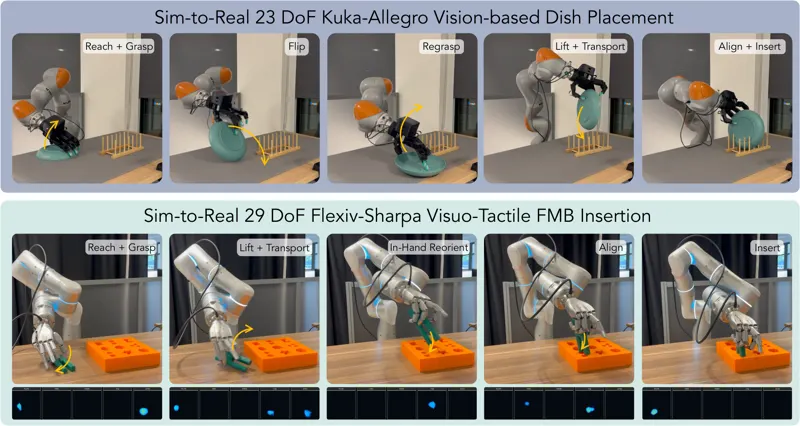
Meta Reality Labs Research open-sourced Project SuperDex, a unified dexterous-manipulation simulation platform built on a custom contact-first physics engine with soft-body/rod/non-convex contact support, VR teleoperation for synthetic data, and a Gymnasium-style RL stack that achieved zero-shot sim2real shape sorting.
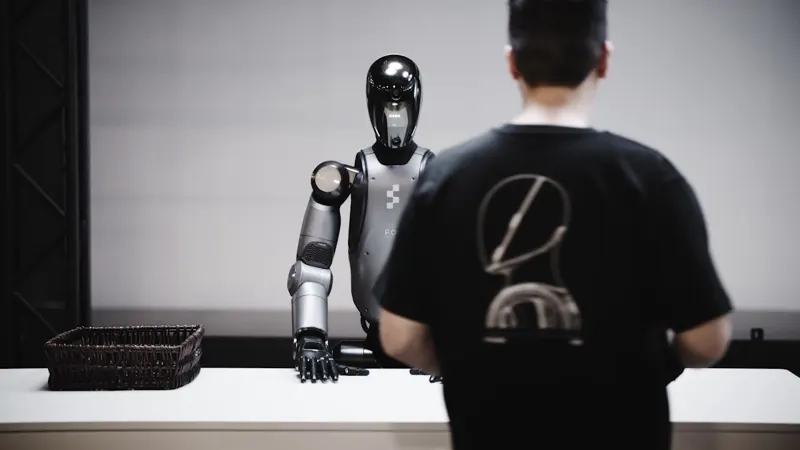
Figure AI's Helix VLA model achieves first humanoid multi-fingered autonomous laundry folding. Same architecture seamlessly transitions from logistics to household chores with data-only change.
ADEPT pre-trains one dexterous policy on 16 primitives, post-trains specialists without forgetting, and deploys zero-shot on Kuka-Allegro and Flexiv-Sharpa, 2-14x faster than gripper pipelines.