
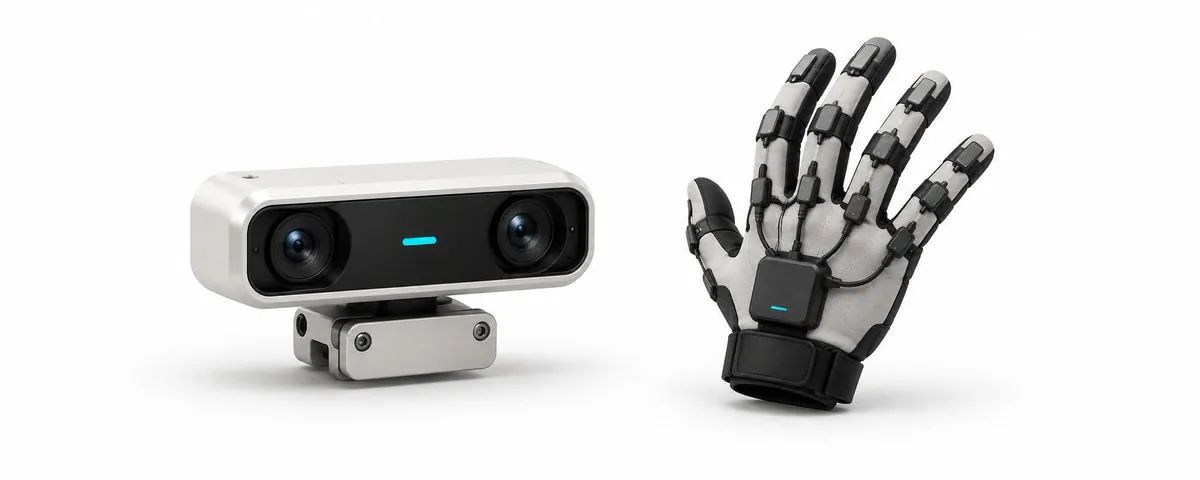
The State of Robotics Data In 2027
A supply-side snapshot from 180 conversations and 47 vetted producers, covering robotics-data pricing, the stereo shortage, tactile bottlenecks, and the hours needed to earn $1 million.
A market snapshot taken from 180 conversations
Source: The State of Robotics Data In 2027, Sam Padilla, X Long Article, November 8, 2026.
What labs are buying, what they pay, and where robot data goes in 2027.
Robotics is attracting more companies, more capital, and more data buyers than ever. At the same time, the kind of data that laboratories actually want is changing quickly. Established companies from adjacent AI markets are entering the space, competition is becoming more intense, and the easiest forms of supply are already losing value.
This analysis comes from an unusually large set of direct conversations. Sam Padilla held 180 meetings in 46 days. After publishing a post-mortem of his previous company, Eidon AI, he spoke with investors, researchers, and founders across robotics. He also vetted 47 data producers through ByCrux and collected their detailed data specifications. That work was combined with the industry map he built with Varun Nair at Robotics Map.
The result is not a statistically representative census. It is a market snapshot from the supply side, cross-checked against buyers, investors, public announcements, funding activity, and producer inventory. The central conclusion is that demand is still growing, but the quality bar is rising fast. Mono egocentric video has become a commodity. Stereo capture is becoming the minimum useful baseline. Tactile data is the next frontier, even though it remains expensive, fragmented, and scientifically unresolved.
What one hour of robotics data is worth
Prices in this article are best estimates drawn from conversations and research. The market is famously opaque, so they should be treated as directional ranges rather than public price lists.
The value of one hour of robotics data depends on five primary factors: modality, geography, environment, exclusivity, and annotation. Modality is the largest determinant because it defines what information the recording contains and how difficult it is to capture. The other four factors move the price up or down inside the range established by the sensor stack.
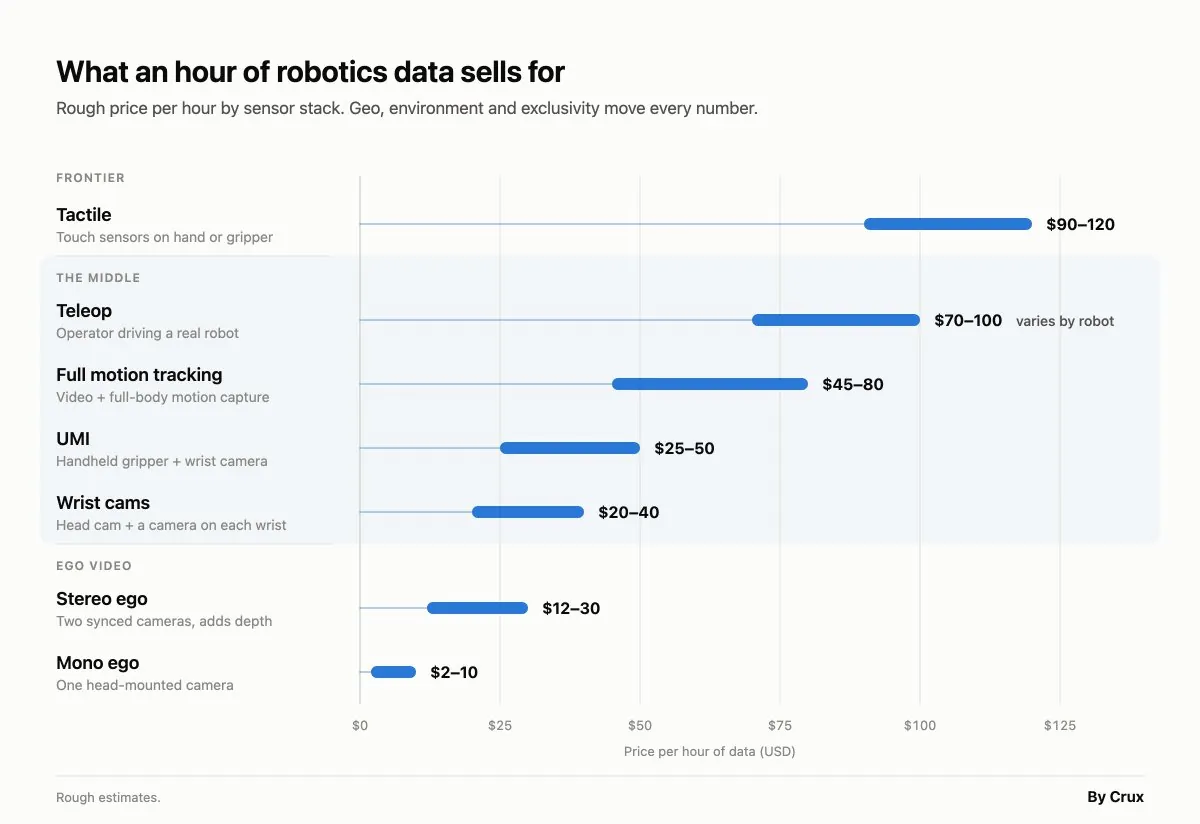
| Data modality | What is captured | Estimated price per hour |
|---|---|---|
| Tactile | Touch sensors on a human hand or robot gripper | $90 to $120 |
| Teleoperation | An operator drives a real robot while recording observations and actions | $70 to $100, depending on the robot |
| Full-body motion tracking | Video plus full-body kinematics | $45 to $80 |
| UMI | A handheld parallel gripper plus wrist camera | $25 to $50 |
| Wrist cameras | A head camera and one camera on each wrist | $20 to $40 |
| Stereo egocentric video | Two synchronized cameras that add depth information | $12 to $30 |
| Mono egocentric video | One head-mounted camera | $2 to $10 |
Modality defines the ceiling
The fundamental purpose of a robotics dataset is to record motion. No two laboratories want exactly the same motions, however, and no two collectors capture them in exactly the same way. This variation is the single biggest reason an hour of training data can sell for roughly $5 or for more than $100.
On the simple end sits egocentric video. Mono egocentric video uses one camera, like a phone mounted on a person's head. Stereo egocentric video uses two lenses and sensors separated by a known baseline. Matching the two views allows depth to be estimated from the footage, giving the dataset spatial structure that a single camera cannot provide directly.
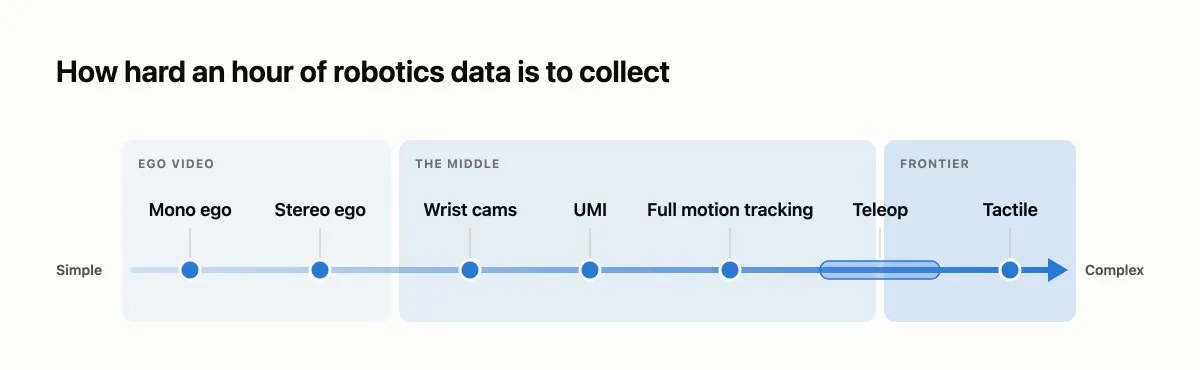
Tactile data sits at the far end. Several sensing approaches are competing, and none has emerged as the standard. Important questions remain about transferability between sensors, usability with human hands and robot end effectors, and durability after repeated contact. Even so, the industry broadly agrees that touch is the frontier.
The middle of the market combines video with additional observations that add context to pure ego video. This group includes wrist cameras, UMI-style handheld parallel grippers, full-body kinematics, and teleoperation. Their value comes from exposing the motion of the hand, gripper, or body rather than only the scene seen from the head.
The four price adjusters
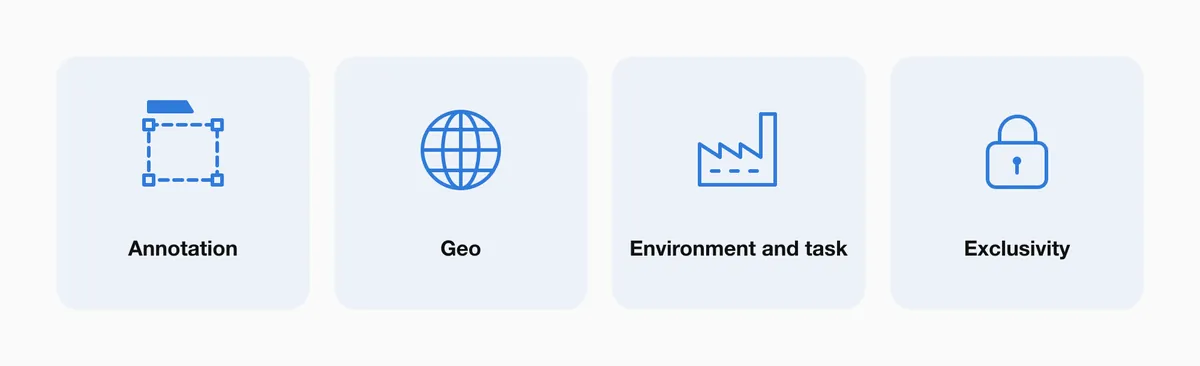
Geography. US data sits near the top of every modality range because US environments are the deployment targets for many American robotics companies. Demand is strongest for scenes that resemble the places where their robots will eventually operate. At the other end, egocentric data from India and Southeast Asia is saturated. Many buyers already have more than they need, so prices are at the bottom of the range, and some buyers have stopped purchasing that supply altogether.
Environment and task. Commercial environments are worth more than residential ones. Most historical capture happened in homes, which makes them easier to obtain and less scarce. Businesses are harder to access, so recordings of an HVAC technician, electrician, or other real work carry a premium.
Exclusivity. Exclusive data sells for a premium because the buyer is not merely purchasing a copy. It is also paying to keep the data away from competitors. A surprisingly large share of current collection operations is already tied to exclusive agreements.
Annotation. Labeled data sells for more than raw data, but annotation moves the hourly price less than many founders assume. Several companies appear to over-index on labeling as a differentiator even though the underlying sensor modality and access to the environment remain more important.
Understanding how these factors interact is more useful than memorizing a single price list. It allows a supplier to reason from first principles about where demand will move, which collection plans are not worth financing, and where investment may have durable value.
Mono is a commodity, while stereo supply is constrained
When Eidon AI started in 2024, paying people to attach phones to their heads and record ordinary tasks seemed unusual. Robotics had a large void in egocentric video, and it was not clear where useful data would come from or which capture device would dominate.
Two years later, the market has moved decisively. Several laboratories have stopped buying mono egocentric data, particularly from India, China, and Southeast Asia. Supply is saturated, and research interest has moved beyond what a single monocular view offers. Mono video was the first large-scale way to bring human experience into robot learning, but its lack of explicit depth and geometry now limits its role.
ByCruX submissions reinforce that shift. Mono ego video is still the most common supply by far, and it clusters in India, the Philippines, Pakistan, and Southeast Asia. Almost every collector who is not protected by a large, US-focused exclusive mono agreement has either moved to stereo or is actively trying to do so.
Stereo is cheap in theory and scarce in practice
Stereo raises the barrier to entry. A low-end stereo camera can cost around $200 in bill-of-materials terms. High-quality off-the-shelf systems can exceed $1,000. Equipping 100 collectors with stereo hardware can therefore require roughly $50,000 before paying for labor, operations, rejected recordings, or processing.
That hardware barrier explains the unusual state of supply. About one quarter of the producers vetted by ByCruX list stereo. Only two had meaningful stereo available off the shelf, with roughly 1,750 hours between them. Most others collect to order or operate under exclusive agreements.
Many collectors have used revenue-sharing or exclusivity deals to finance their stereo rollout. Buyers and data partners pay part of the hardware cost in exchange for privileged access to future supply. This makes the market look busy while leaving little inventory available to a new buyer who wants to purchase immediately.
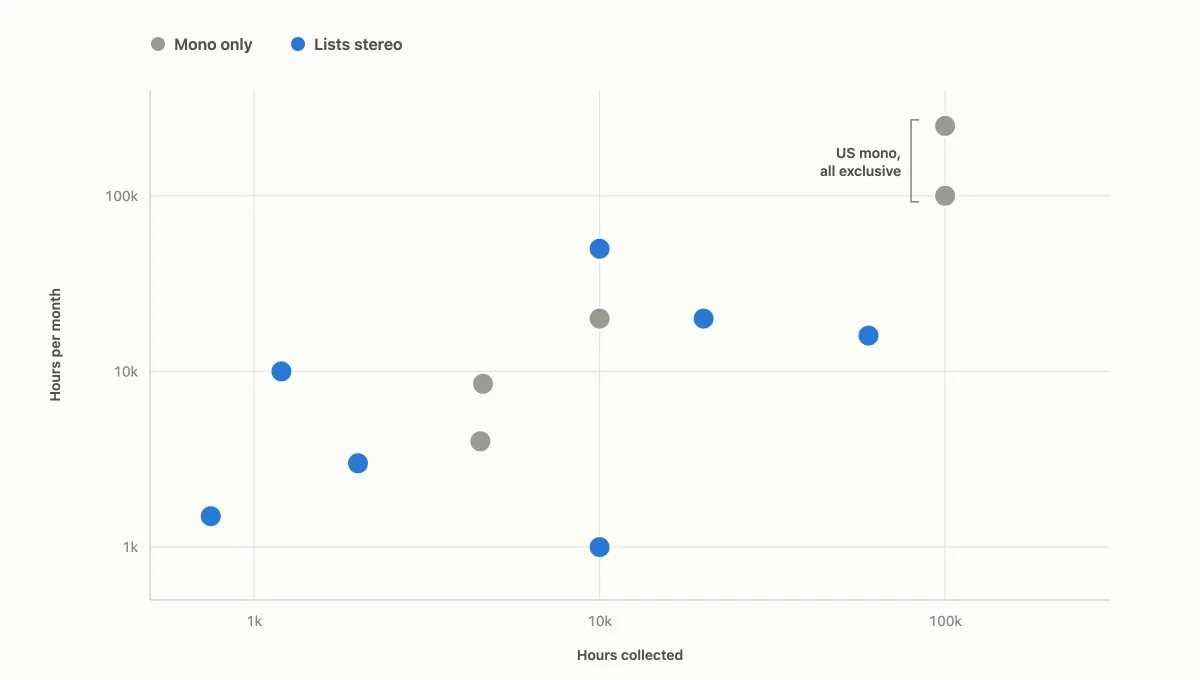
The shortage creates a second market opportunity. Stereo camera manufacturers that understand data collection economics and can support the workflow around their hardware face strong demand. The problem is not only selling a camera. Collectors need stable synchronization, calibration, field support, durable mounting, and a supply chain that can survive deployment to many locations.
The concise market position is therefore not simply "stereo is better." It is: stereo has become the new baseline, very little stereo data is available without a relationship, and reliable suppliers are difficult to find. The hardware transition has turned an information product into an operations business.
Tactile data is the next frontier
Tactile is what many buyers are now searching for, and it is likely to dominate the next phase of robotics data competition. During an earlier evaluation of Eidon Gloves, quotes for tactile data reached $120 per hour. Demand is high, but supply is thin.
Most tactile datasets today are small, research-oriented, and built around different sensors. They are large enough to fine-tune an existing model, as demonstrated by work such as T-Rex: Tactile-Reactive Dexterous Manipulation, or to train a narrow policy. They are nowhere near large enough to pretrain a general robot foundation model.
This moment resembles egocentric video a few years ago. Building a corpus large enough to pretrain on seemed absurd, yet the field now has open-source ego video datasets measured in 100,000 hours. Tactile collection is far more complex, but the race is on to create the first corpus large enough to support pretraining alongside video.
Why tactile is harder than video
Video records a scene from a distance. Tactile records physical contact through hardware that sits between the human or robot and the object. The signal is therefore tied to the sensor, calibration, mounting geometry, sampling rate, and material properties of that hardware. There is no standard sensor, and it remains an open research question how well a model trained on one tactile device transfers to another.
The practical constraints are equally severe. Tactile gloves can be bulky and reduce dexterity. The durability of most gloves has not been independently tested across large collection programs. A pair can cost $4,500 to $8,000. Deploying 100 collectors therefore requires $450,000 to $800,000 in hardware, roughly ten times the cost of a stereo rollout.
The unit economics expose the risk. At $100 per hour, each pair must generate 45 to 80 hours of accepted sales just to recover its hardware cost. That calculation excludes labor, rejected takes, processing, maintenance, replacement, and the cost of managing a distributed workforce.
Many collectors now claim to produce tactile data, but producing clean, reusable, well-documented contact data at scale is difficult. The ambiguity also creates an opportunity for capture hardware companies. Prices should fall as manufacturing scales, while current pricing makes the hardware economics attractive if buyers are willing to pay for usable data.
The market is maturing
Large companies outside traditional robotics are moving into physical AI data. Defined.ai expanded into the category at CES. DoorDash launched a product that pays couriers to record tasks such as folding laundry for AI and robotics training. Other data, cloud, and annotation companies are examining the space because the underlying operational patterns resemble businesses they already understand.
Late-stage funding has also accelerated. XDOF raised $70 million in June and was reported to be discussing another round at a $1.2 billion valuation. Mecka raised a $60 million Series B in October. Micro1, one of the largest LLM data vendors, says robotics already represents more than $100 million of its annual run rate.
These numbers do not mean every data startup has a durable advantage. They show that buyers and investors now believe robotics data is large enough to support substantial companies. They also raise the cost of competing without a differentiated supply position.
The "data services" category on the Robotics Map has become the third-largest group, behind only robot builders and deployers. New participants enter almost every week. Companies that already sell operational data or CAD to AI laboratories are extending their broker networks into robotics. Polyshares, for example, announced a robotics partnership with Amelia Robotics.
The pattern points to a simple conclusion from the 180 meetings: the two remaining moats in robotics data are hardware and relationships. Processing, quality control, operations, annotation, visualization, and simulation tooling all matter. They are valuable capabilities, but they are increasingly table stakes. A competitor can build or buy most of them. It is much harder to reproduce a fleet of calibrated capture devices and the trusted access that gets a collector into valuable environments.
This is why companies with laboratory relationships are trying to monetize them, and why the aggregator side of the market is becoming crowded. The relationship layer is valuable because it solves access. It becomes fragile when many brokers compete for the same limited supply.
The economics of reaching $1 million in revenue
There is growing discussion that robotics is close to solving its data problem. The argument has merit. Millions of hours of egocentric video have been created in only a few years. Mono video is now abundant and cheap, stereo is becoming the baseline, and tactile remains far earlier in its supply curve than ego video was in 2024.
Abundance, however, does not answer where a new supplier should invest. A useful test is the number of accepted hours needed to generate $1 million in revenue. The result depends heavily on price per hour, but it also reveals the tradeoff between volume and collection complexity.
| Modality | Illustrative price | Hours needed for $1M | Market implication |
|---|---|---|---|
| Mono ego | $5 per hour | 200,000 hours | Extremely high volume, thin and declining margins |
| Stereo ego | $20 per hour | 50,000 hours | Four times less volume than mono, with commercial hardware available |
| Wrist cameras | $30 per hour | 33,000 hours | Adds hand-level context without a fully instrumented robot |
| UMI | $37.50 per hour | 27,000 hours | Captures gripper motion and viewpoint with portable hardware |
| Full-body motion | $60 per hour | 17,000 hours | Higher information density, but a more complex capture operation |
| Teleoperation | $85 per hour | 12,000 hours | Robot-specific action data at a premium price |
| Tactile | $100 per hour | 10,000 hours | Low volume requirement, but unsolved hardware and transfer questions |
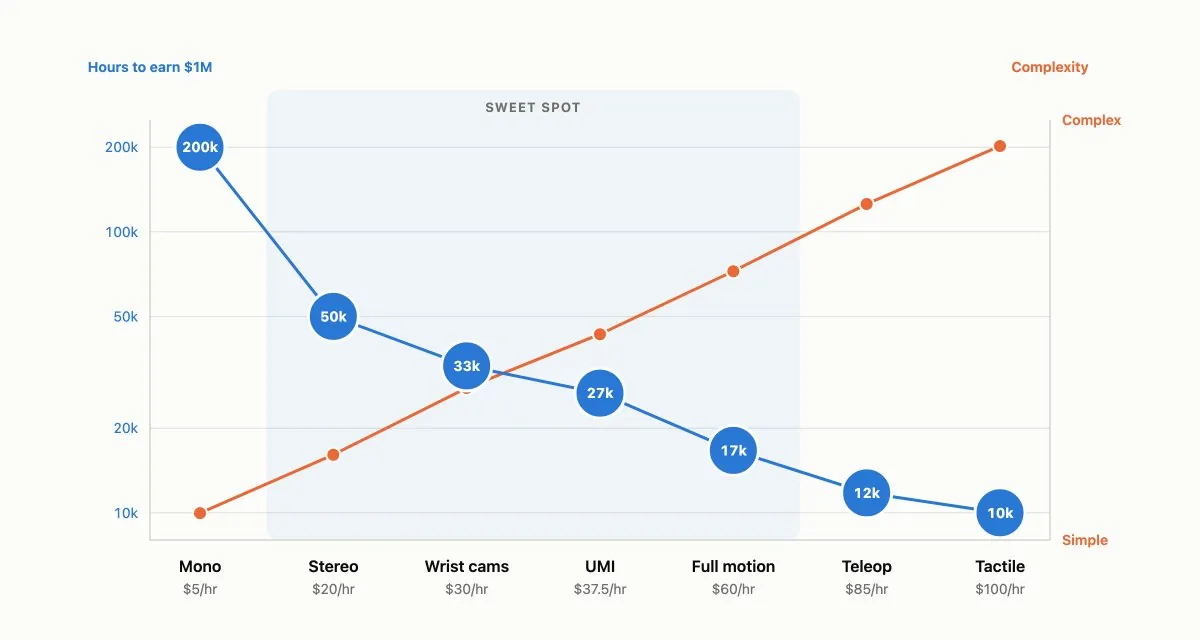
At $5 per hour, mono requires 200,000 accepted hours to reach $1 million. That is a volume business with extremely thin and likely declining margins. At $100 per hour, tactile reaches the same revenue with only 10,000 hours, but the hardware is expensive and immature, and buyers still do not know how well tactile models will transfer between sensors.
The middle is the most economically sensible bet today. Stereo, wrist cameras, UMI, and full-body motion tracking need roughly four to twelve times fewer hours than mono to reach the same revenue. Their hardware exists, ships now, and costs far less than a large tactile deployment. They also produce data structures that align with current robot learning needs.
The investment conclusion is not that tactile should be ignored. It is that the timing differs by layer. Mono is commoditized. Stereo and the instrumented middle are investable now. Tactile has the highest upside precisely because the hardware, data format, transfer learning, and scalable operations remain unresolved.
What changes by 2027
Demand is not slowing down, but the bar is rising. Buyers are no longer paying the same price for every hour of recorded human activity. They want geometry, action context, calibrated hardware, valuable environments, exclusivity where it matters, and increasingly touch.
The market is also becoming more crowded. Large data vendors, crowdsourcing platforms, hardware companies, aggregators, and specialized collection networks are converging on the same opportunity. The window to build a strong robotics data business remains open and will probably stay open into next year, but it will not stay open indefinitely on the current terms.
For robotics teams, the practical lesson is that data acquisition is now a systems problem. A dataset is not defined only by the number of hours. It is defined by the sensor stack, calibration, environment, task distribution, metadata, rights, and the relationships that made collection possible.
For suppliers, the lesson is that the cheapest collection method is unlikely to become the best business. Mono established the market, but stereo created a hardware and operations barrier. Tactile has created an even larger barrier. The companies that win the next phase will be those that turn that barrier into reliable, repeatable supply before the market finishes maturing.
Original source: The State of Robotics Data In 2027 by Sam Padilla, published November 8, 2026. Supporting links include Robotics Map, Capture Hardware, and T-Rex.
Source:Sam Padilla / Xhttps://x.com/theSamPadilla/status/2119497107446878510