
Robotic Arms in Four Stages: Open Source, Data Collection, Humanlike Design, Mass Production
How imitation learning, data scaling, human demonstrations, and deployment pushed robotic arms from costly lab tools to open, seven-axis, production-ready platforms.
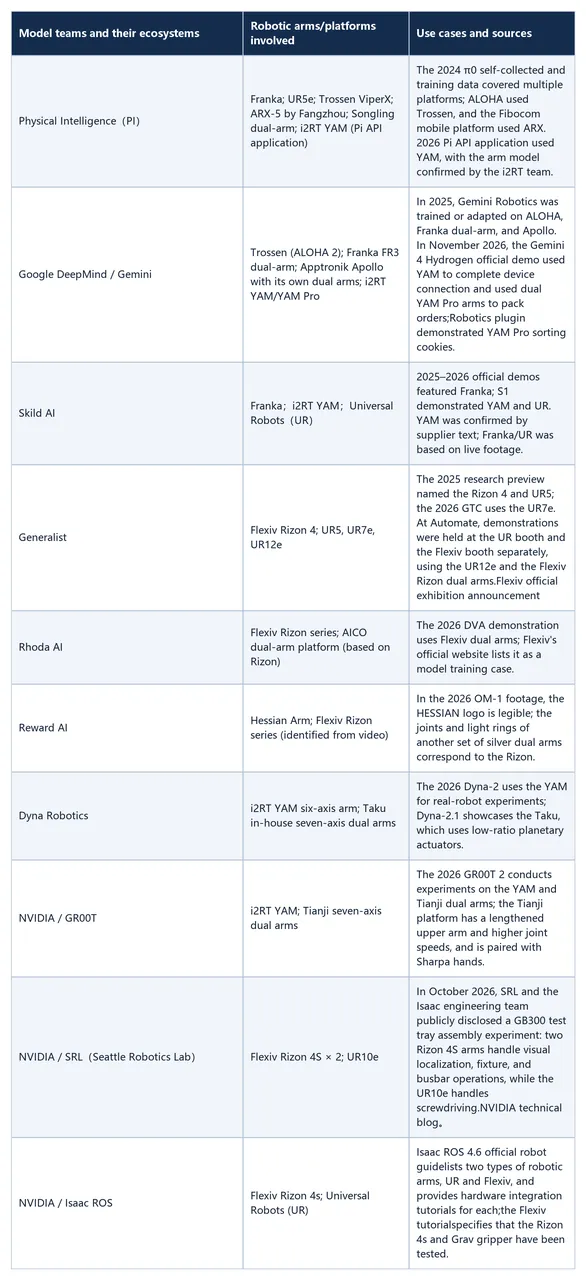
At CoRL 2026 in November, the spotlight landed on GR00T 2. Jim Fan described the moment with a line that spread quickly: “This is not the robot winter; this is the robot summer.” Yet the model did not arrive alone. Tianji, i2RT YAM, Sharpa, Galaxea, Tashan, and other hardware teams formed the physical layer beneath the launch, from robot bodies to data-collection stations.
A few days later, the conference made the point explicit with a workshop called Everything Beneath the Policy. Hardware, once treated as the engineering residue left after the interesting model work, was placed at the center of the academic agenda. That shift is the subject of this article.
Embodied AI has spent the past four years producing a stream of models, demonstrations, and benchmark claims. The carrier that connects those algorithms to the physical world is still the machine. Each new modeling capability creates a new hardware requirement. Better hardware makes the next experiment possible, produces more useful data, and exposes constraints that send algorithm teams back to the drawing board. The robotic arm sits directly inside that feedback loop.
The history of embodied hardware is not a race toward one final robot. It is a sequence of attempts to make the physical interface fit the data and policies available at that moment.
| Stage | Algorithmic trigger | Hardware response | New bottleneck |
|---|---|---|---|
| Open source breakout | Imitation learning and accessible research stacks | Low-cost servo arms and reusable dual-arm workstations | Reliability, support, and toolchain quality |
| Data collection at scale | Generalist policies trained across many embodiments | Purpose-built leader arms, low-friction interfaces, and integrated cells | Uptime, throughput, and cost per valid hour |
| Humanlike design | Human video and wearable data entering training | Seven-axis geometry, spherical wrists, force control, and dexterous hands | Embodiment gap and dynamic response |
| Production deployment | Policies moving from demos into customer operations | Batch consistency, serviceability, and long-life components | Quality systems and field reliability |
01. Open source breaks the old price-performance bargain
After ChatGPT accelerated interest in large models at the end of 2022, imitation learning for robotic manipulation moved from a specialist research topic into the mainstream of embodied AI by 2023. The algorithms were becoming easier to reproduce. The hardware was not.
Research labs had a familiar menu of choices. Franka Panda, UR5, Sawyer, and KUKA LBR iiwa offered mature performance and development support, but the purchase price was high. Low-cost servo arms such as Trossen WidowX reduced the entry cost, but often transferred engineering burden to the researcher. Teams could spend weeks fixing mounting details, communication problems, calibration routines, or unreliable grippers before testing the policy they actually cared about.
The missing product was not simply a cheaper arm. It was an arm with a narrow enough gap between purchase, integration, and useful experimentation. It had to be affordable, stable enough to run repeatedly, and open enough for a lab to connect its own perception stack, controller, and learning code.
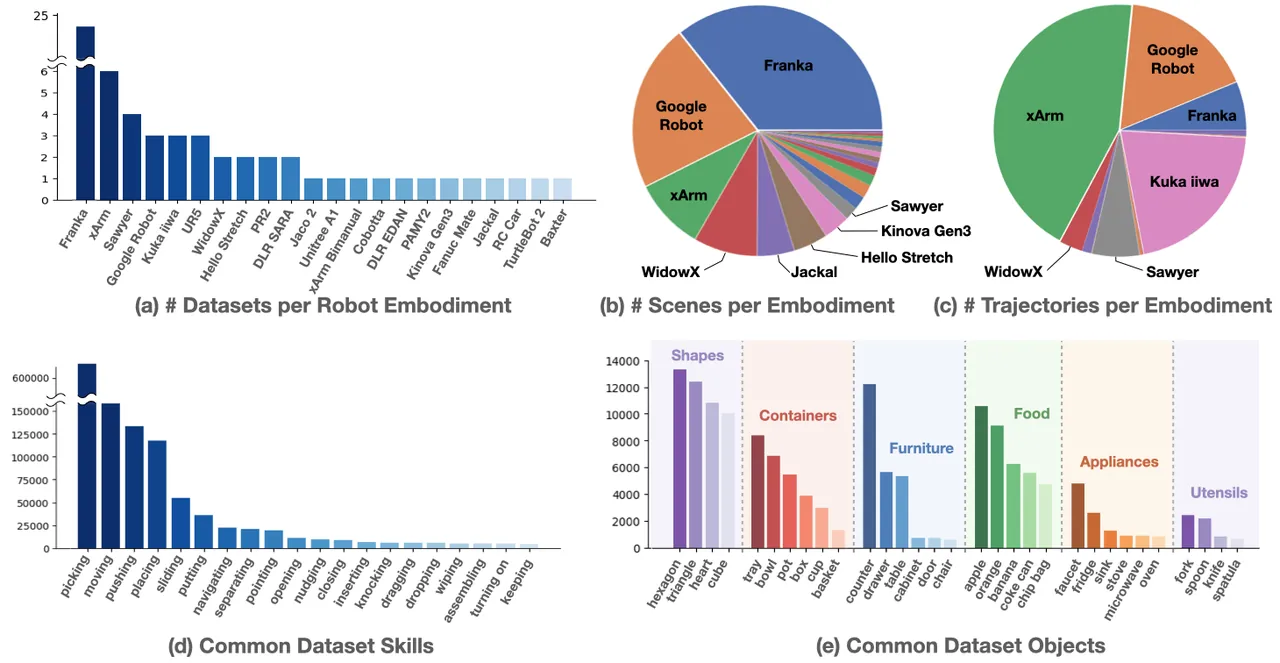
Open X-Embodiment made the fragmented state of the field visible. Released in 2023, the collection brought together 60 existing datasets. Franka appeared in the largest number of sub-datasets, while xArm and Google Robot accounted for a larger share of trajectories. Those two views matter because they measure different things: breadth of adoption and volume of experience are not the same.
Large companies could escape the market constraint by building their own platform. Google's RT-1 used 13 Everyday Robots mobile manipulators and collected continuously for 17 months, accumulating about 130,000 task trajectories. That arrangement produced an unusually consistent data engine, but it also illustrated the problem: the robot was not sold as general research equipment, and the program was eventually discontinued. Other labs could imitate the paper, not the data environment that made it possible.
For universities, the decisive features were more concrete. Franka Panda placed torque sensors in all seven joints. Its FCI interface could exchange commands and robot state at 1 kHz, while libfranka and ROS tools provided a practical software path. Researchers could perform torque-level control, record feedback, and separate a policy failure from an execution failure. That combination explains why an expensive arm became a standard even when cheaper alternatives existed. Franka Research 3 continued the same research-oriented product line.
The market then split into two unattractive poles. Research-grade systems became luxury equipment. Franka Research 3 was publicly listed at roughly US$30,000, while UR5e was roughly US$37,000. Building a dual-arm setup with those arms alone could approach US$60,000 to US$70,000. At the other end, inexpensive servo arms could move the joints but did not always provide the reliability, feedback, or tooling needed to support serious experiments.
“I saw labmates using it while cursing at it,” i2RT co-founder Dillion recalled when describing the low-cost options available to researchers. By 2024, end-to-end policies could already complete complex manipulation on inexpensive hardware, but the surrounding system remained brittle. i2RT saw an opportunity to improve both the arm and the toolchain. Its YAM platform eventually chose planetary reduction joints as a compromise among cost, performance, and reliability rather than optimizing for a single specification.
Flexiv entered the same procurement conversation from another direction. For groups that needed seven axes, force control, and a complete development interface, Rizon offered a research-capable arm without forcing them to build every layer from scratch. The choice was no longer only “cheap or excellent.” Research teams began to ask which vendor could provide a usable balance of capability, software, and support.
ALOHA pushed the logic further. Using Trossen WidowX and ViperX arms, it created a two-master, two-slave teleoperation system for roughly US$20,000. Combined with the ACT algorithm, the platform reproduced fine manipulation tasks such as threading zip ties and inserting batteries. The important product was not a single arm. It was a complete learning apparatus that a lab could build and modify.
When Mobile ALOHA videos showed the system cooking shrimp and entering an elevator in early 2024, demand moved beyond the research community. Trossen CEO Anish Shah later said the company had been earning only US$1 million to US$2 million a year. In the month after the video spread, incoming quotation requests reached roughly US$9 million. A research demonstration had become a commercial signal.
AgileX experienced the same pull from a different starting point. Mobile ALOHA used its TRACER mobile base. AgileX was already developing arms internally, and the surge in attention accelerated the product's release. Labs that had purchased bases became potential arm customers. After a year or two, users asked for higher payloads and more flexible kinematics, pushing the company toward a seven-axis design.
This was the first clear demonstration of the open-source multiplier. When a frontier method produced a compelling result on a specific setup, that setup became the default starting point for the next wave of labs. Open code spread the method. The hardware specification spread with it.
02. Data collection turns the arm into production infrastructure
In 2024, data collection stopped being a side activity attached to individual papers. Generalist policies needed far more demonstrations, across more tasks and embodiments, than a single lab could comfortably generate. The robotic arm became infrastructure.
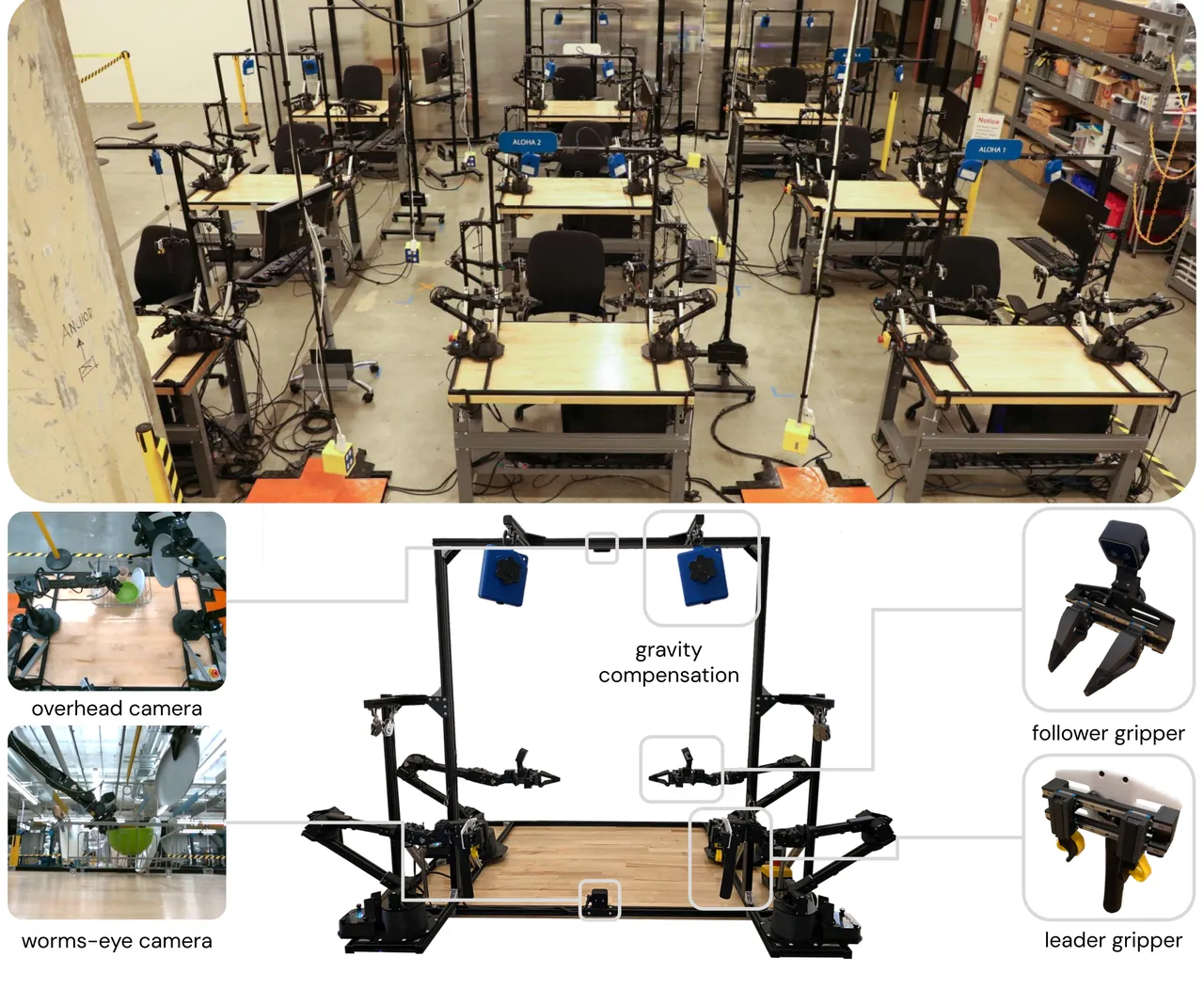
ALOHA 2 showed how much performance remained in the human interface. Its updated master-slave station replaced the leader gripper with low-friction rails and lighter motors. The force required to open the master hand fell from 14.68 N to 0.84 N, reducing operator effort by more than an order of magnitude. The system also adopted more durable gravity compensation and required operator and machine IDs to be logged with each collection session, making errors and batch differences traceable.
At the end of 2024, Physical Intelligence released π0. Its pretraining corpus included about 10,000 hours of self-collected dexterous manipulation data across seven robot configurations and 68 tasks. The configurations ranged from Franka and UR5e single arms to Trossen and ARX dual-arm and mobile manipulation systems. Public datasets such as Open X-Embodiment, BridgeData V2, and DROID were mixed into the same training process.
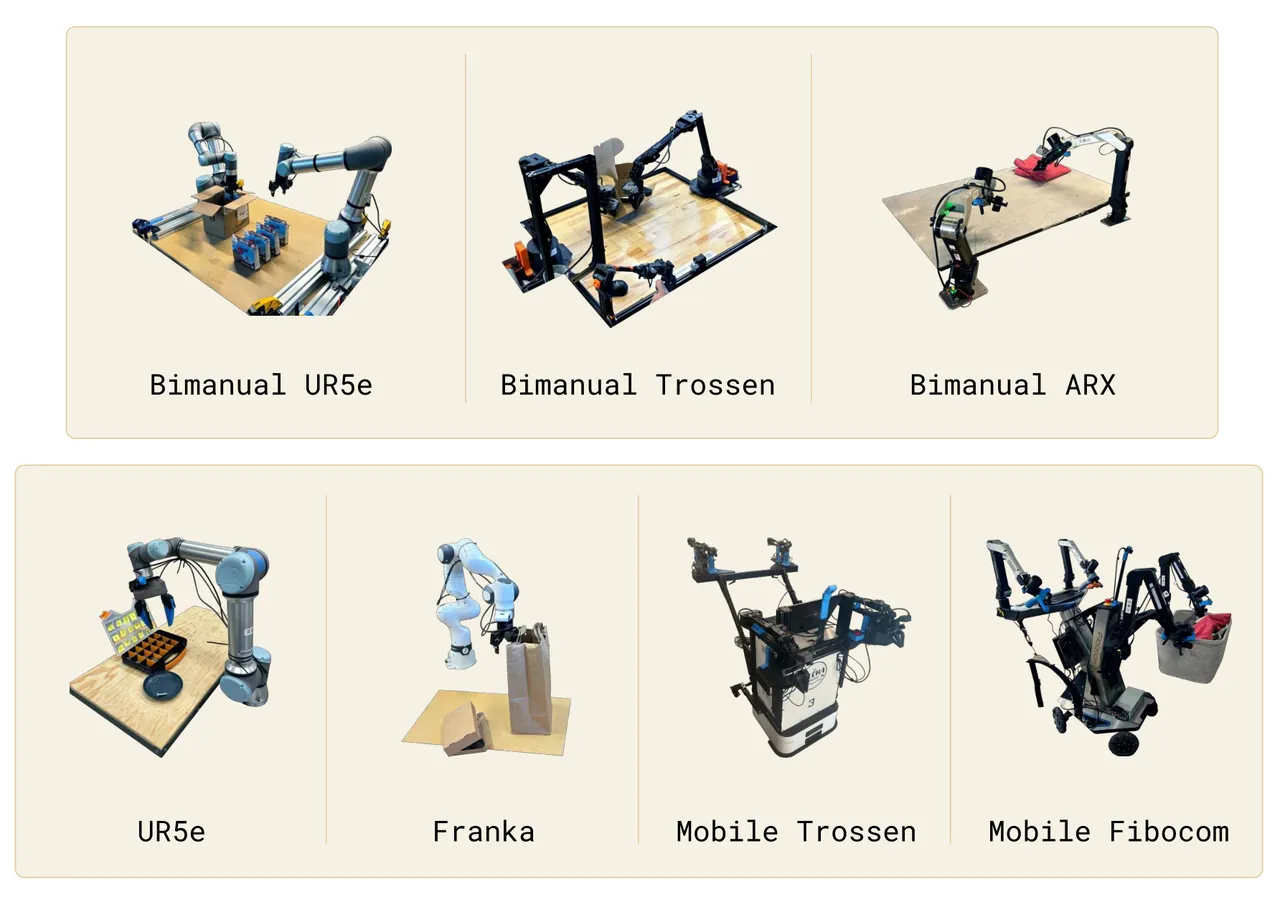
The consequence was not merely that Trossen and ARX appeared in a famous model paper. It was that lower-cost arms entered the same training system as expensive research platforms and took on tasks such as folding laundry, clearing tables, and packing boxes. A vendor could earn technical credibility by becoming part of a shared model's data and evaluation surface rather than by publishing an isolated hardware benchmark.
Large-scale data collection also became the first embodied workload that demanded both scale and duration. The algorithm was tested through simulation and real-robot evaluation cycles. The hardware was tested through hundreds or thousands of executions a day. These are different failure regimes. A robot can succeed in a polished demo and still be unusable as a station that must survive a queue of paid operators.
The i2RT team described data collection as the first scaled deployment in a highly controllable environment. Customers care about uptime because operators are already on site. A station that breaks repeatedly is replaced quickly. At the same time, the environment is controlled enough that engineers can observe failures, patch tooling, and feed discoveries into the next hardware revision.
By November 2026, i2RT saw another increase in real-robot data-collection demand. Dillion said orders that once numbered in the hundreds were now often several hundred units, with some requests reaching the thousand-unit range. The buying question changed with the order size. Customers no longer asked only what one arm cost. They asked what it cost to collect one hour of valid, qualified data.
| Research-lab question | Data-factory question | Hardware implication |
|---|---|---|
| Can the arm expose the control interface I need? | Can a new operator become productive quickly? | Clear setup, calibration, and teaching workflow |
| Can I run one interesting experiment? | Can the station run every day without unplanned stops? | Durable motors, cables, grippers, and gravity compensation |
| What is the purchase price? | What is the cost per valid hour of data? | Throughput, yield, maintenance, and replacement policy |
| Can I modify the stack? | Can dozens of stations remain configured consistently? | Versioned software, fleet setup, and traceable hardware IDs |
That shift created new product categories. Trossen separated the teaching tool from the working arm and launched Glide, a lightweight carbon-fiber leader arm with passive balancing. On its newer WidowX, it emphasized quick line changes and maintainability. In China, AgileX bundled a mobile base and four arms into a single COBOT MAGIC configuration so a data team could start working soon after delivery.
The arm itself was no longer the product boundary. The product became a workstation: the leader interface, follower arm, cameras, mounting geometry, compute, calibration process, logging format, and support agreement. Data collection forced hardware companies to think like operations companies.
03. Human data makes humanlike geometry a practical requirement
From late 2025 into the first half of 2026, the data roadmap changed again. UMI-style handheld grippers and large collections of first-person human video began to supplement robot teleoperation. Human demonstrations were no longer only a source of labels. They became a scalable source of motion, contact, and task structure.
That created a new hardware argument for humanlike design. A human-shaped robot was previously justified mainly by the environments it would inhabit. If robots are meant to work in kitchens, hospitals, and workshops built for people, their bodies should fit those spaces. The data argument is stronger: if much of the training signal comes from human motion, reducing the embodiment gap improves the chance that a demonstration remains useful after retargeting.
The easiest place to see this is the hand. Genesis's GENE-26.5 technical report treated size, joint structure, degrees of freedom, and contact characteristics as one coupled design problem. Matching only the kinematic skeleton is insufficient if the palm is the wrong size, the fingers cannot reproduce the contact pattern, or the wrist cannot approach the object in the same way.
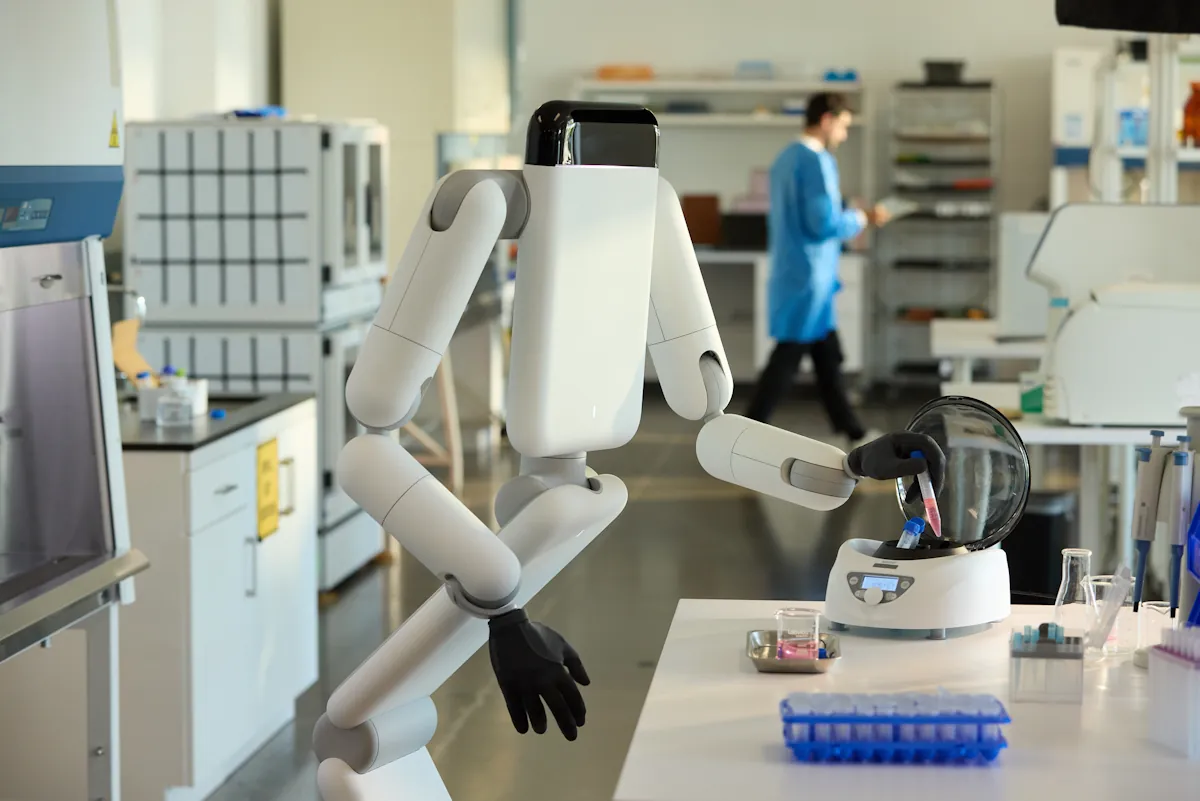
Dyna applied the same principle to Taku, a semi-humanoid robot announced in September 2026. Its upper body follows the dimensions of an ordinary person and uses two seven-degree-of-freedom arms. The goal is to keep recorded wrist, elbow, and chest poses inside the robot's reachable space as often as possible. The design starts from the distribution of human demonstrations rather than from a generic industrial workspace.
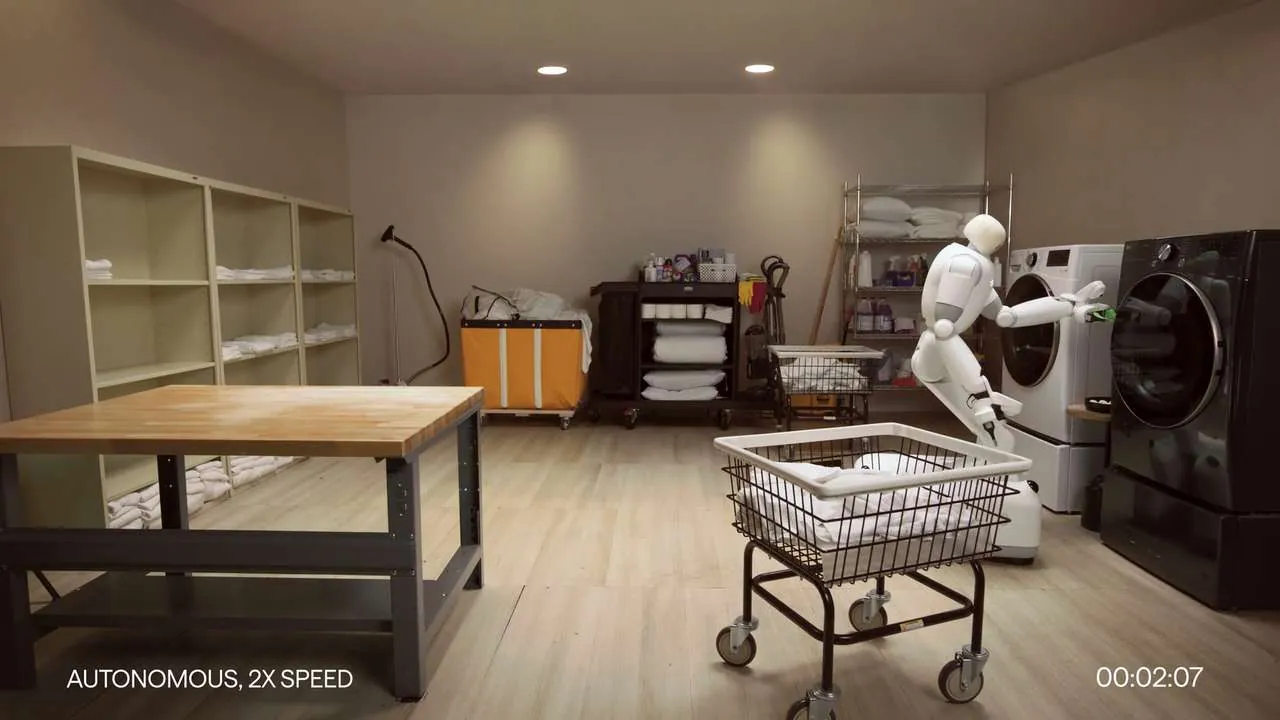
Sharpa D01, released at IROS, adopted a human-scale spherical wrist joint so the arm could use tools and perform fine manipulation in spaces designed for people. It also integrated electronic skin across the body, allowing contact with objects and with the robot's own structure to become observable. Humanlike design here is not cosmetic. It changes the control problem and the data that can be collected.
The constraints become concrete when a demonstration fails to transfer. Where is the shoulder relative to the torso? Is there enough room to cross both arms in front of the chest? Can the wrist rotate through the same range while holding a tool? Does the elbow have a feasible redundancy posture at the required speed? Human data exposes all of these questions at once.
Tianji encountered the constraint through customer demand. Traditional six-axis industrial arms could reach a point, but they could not always maneuver within humanlike operating spaces. Adding a seventh axis gives the elbow room to change posture while the end effector follows the intended path. After moving from custom projects into productized industrial arms, Tianji developed a seven-axis humanoid arm and later replaced the conventional SRS wrist arrangement with a crossed wrist. Bringing the sixth and seventh axes together shortened the wrist and made the tool assembly more compact.
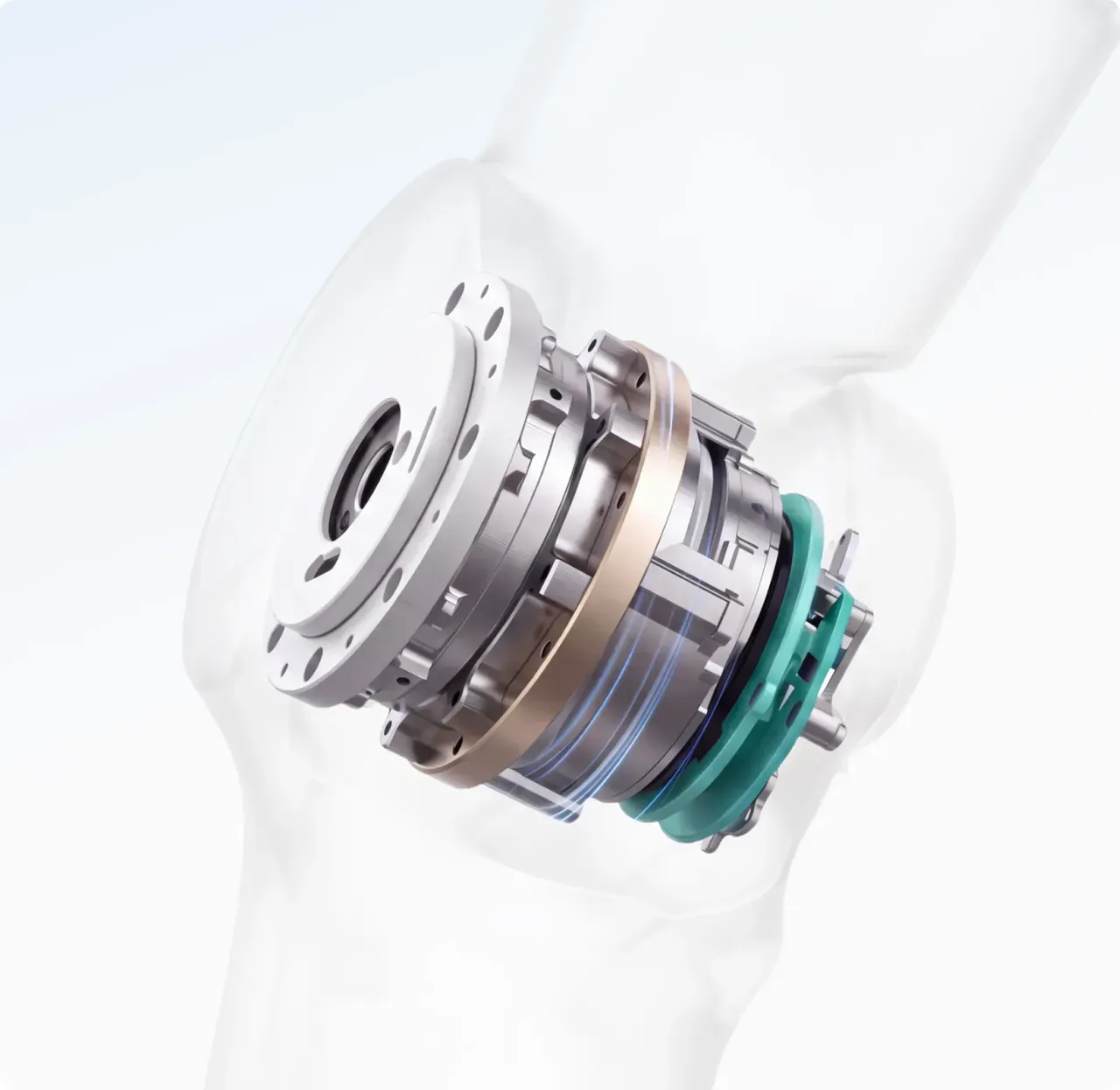
The market converged on the same direction. Tianji's Marvin series made seven degrees of freedom and joint force sensing its core configuration. GR00T 2 extended the upper arm by 112 mm and raised joint speed to 220 degrees per second to cover more human motion. i2RT moved from a six-axis base product to YAM 7, while Songling introduced the spherical-wrist PiPER-X and the seven-axis NERO.
Geometry alone is not enough. Human motions are fast, and a policy trained on them will expose delay in the controller. Tianji's May 2026 Marvin test added velocity-prediction feedforward: the upper-layer model still sent position commands, while the controller estimated target velocity and compensated in advance. On a 15 cm circular joint trajectory with a two-second period, feedforward reduced tracking lag from 45 ms to 5 ms.
Open control interfaces matter just as much. A model team needs to send actions, read state, and choose whether to command joint position, torque, or contact force. Flexiv's RDK exposes 1 kHz real-time command and state interfaces in joint and end-effector space. The controller handles lower-level coordination, gravity compensation, friction compensation, and force control so researchers can connect a policy without rebuilding the servo layer.
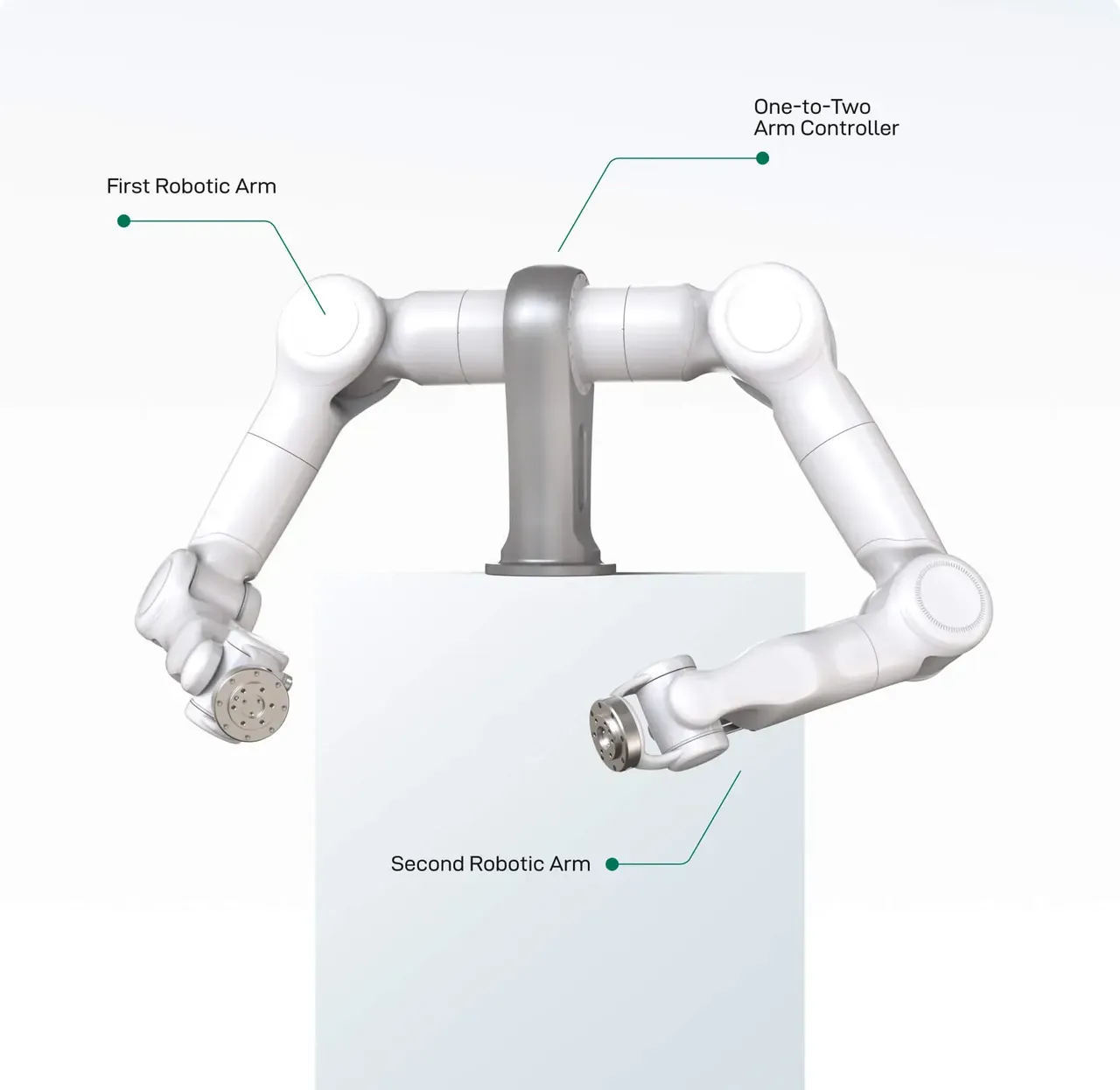
Tianji's one-to-two controller design follows the same product logic. A single controller can drive two arms, reducing the size, wiring, and cost of a dual-arm workstation. Humanlike capability is therefore distributed across geometry, dynamics, electronics, and integration. An anthropomorphic outline with a slow controller or a closed software stack does not satisfy the requirement.
End effectors are moving in the same direction. Sharpa described 2025 as a dividing line. Before it, the mainstream workload was simple pick-and-place, and parallel grippers or low-DOF hands were usually enough. As frontier labs moved toward AI-for-Science experiments, cable insertion, extraction, and in-hand manipulation in 2025 and 2026, the limits of simple grippers became visible. Hands with more than 20 degrees of freedom, distributed tactile sensing, and the ability to judge whether a grasp is stable began to move from novelty to system requirement.
The resulting ecosystem is broader than arms alone. Sharpa, Wuji, Xynova, Robot Era, and others are competing around high-DOF hands, tactile arrays, and in-hand control. The arm supplies reach and posture. The hand supplies contact and dexterity. Human data couples them into one embodiment problem.
04. Deployment brings hardware back to manufacturing fundamentals
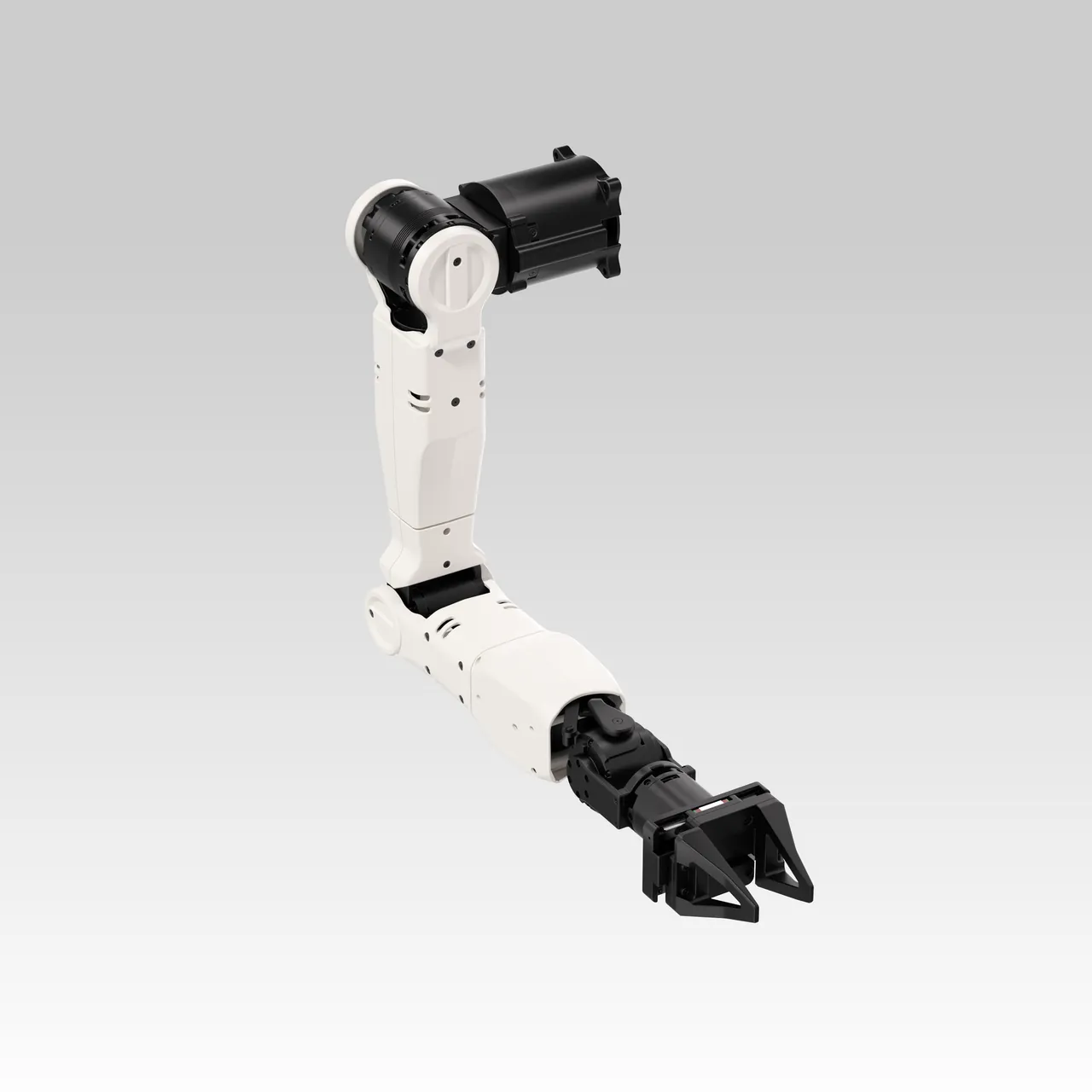
Every new requirement constrains another. i2RT offered two examples. A motor can pursue higher torque density, but torque ripple still has to remain under control. A large hollow joint can hide cables, but it adds weight and cost, especially at the wrist where volume is already scarce. YAM 7 combines a seven-axis joint layout with an external structure that routes wiring internally to balance wrist size, weight, and cable life.
Through the first half of 2026, hardware teams were still arguing mainly about requirements and product design. In the second half of the year, the dominant word became deployment. Two years of intensive data collection had stress-tested reliability. Human data had pushed configurations toward mobile manipulation and humanlike operation. The best systems were reaching the threshold where they could leave the laboratory.
Demand then rose by an order of magnitude. Vendors first had to achieve stable batch delivery. After the equipment entered a customer site, a second test began: whether small unit-to-unit differences, field failures, and maintenance processes could be managed at scale.
Tianji said it felt an order-driven “push from behind,” with embodied-business revenue growing at roughly ten times the previous year's level. Customers were no longer buying a few experimental units. They were buying in batches, which changed the qualification process. Delivery dates mattered, but so did variation across units and lots.
Procurement questions expanded from torque, repeatability, and software interfaces to quality systems, yield, consistency, and after-sales response. Some customers asked whether a supplier could reliably deliver several thousand units a year. That is a different company from one that can hand-build a strong prototype.
The problem is sharper overseas. North American customers can be especially sensitive to quality because the local supporting supply chain is thinner. If an arm fails after a day or two of use, the cross-border repair cycle can stall an entire project. The buyer may prefer to pay more upfront than accept repeated downtime. Field service becomes part of the product specification.
Deployment also reveals failures that never appear in a demo. Dyna Robotics documented one in its August 2026 report Not Just a Model, But a Product. At a Din Tai Fung location, a robot's napkin-folding output declined without a clear error in the system logs or an obvious abnormality visible to staff. The cause was a worn gripper. The policy was still producing actions, but the physical interface had changed.
Other faults accumulate slowly. York described motor zero-point drift after long operation and torque changes caused by heat. These are not dramatic failures. They are small distribution shifts in the machine itself, and they can degrade a model that was trained on the machine's earlier behavior.
Mature industries provide a useful scale for the gap. Kongsberg Automotive reported defective-parts-per-million figures of 1.6 for Fluid Control and 6.2 for Drive Control in its 2025 report. The article's comparison is that embodied-arm makers are still learning to establish this kind of quality record at much larger production volumes. FANUC publishes an MTBF of 41 years for its R-2000iB/iC series, roughly 359,000 hours at 24-hour operation. For a new embodied supplier, those numbers are not merely marketing benchmarks. They describe the operational evidence that customers expect before equipment becomes critical infrastructure.
| Deployment question | What must be measured | Why a demo cannot answer it |
|---|---|---|
| Can a batch be trusted? | Unit-to-unit variation, yield, and calibration drift | A prototype is tuned individually and receives unusual engineering attention |
| How long does performance last? | Wear, thermal drift, backlash, and end-effector degradation | Short demonstrations rarely cross the failure boundaries of production use |
| Can the system be restored? | Service time, spare parts, recalibration, and recovery rate | A paper reports capability, not the cost of keeping that capability available |
| Can the supplier scale? | Lead time, yearly capacity, process control, and support response | Orders of thousands expose operational constraints hidden by small purchases |
The requirement extends from the arm to the hand. Sharpa said overseas demand for high-DOF hands began to scale in the second half of 2026. Customers stopped opening with peak performance and started asking how long a hand could work in the real environment, how consistent backlash and temperature control would be, and whether different batches would behave the same. Evaluation had moved from research demonstration to field deployment.
Companies with prior industrial delivery experience enter this phase with an advantage. Flexiv's Rizon line, for example, inherits force-control work, manufacturing processes, and support practices developed for industrial customers. That history does not guarantee success in embodied AI, but it shortens the distance between a capable prototype and a product that can be shipped, maintained, and trusted.
Time now favors the hardware teams that can compound operational knowledge. The next battlefield is not just a stronger arm or a lower price. It is large-scale manufacturing, adaptation to messy real environments, and the handling of corner cases that appear only after thousands of units run for long periods in unfamiliar conditions.
Conclusion: the hardware moat is built through use
The deepest moat in embodied hardware is not a single patented geometry or a launch specification. In the large-model era, technologies and design concepts are copied quickly. The harder asset is product know-how produced by new embodied workloads and the ecosystem a vendor builds while working alongside downstream customers.
Between 2023 and 2026, algorithms did not simply wait for hardware to improve, and hardware companies did not independently bet on one final robot form. The two sides advanced by collision:
- Imitation learning lowered the algorithmic barrier and gave low-cost servo arms an opening.
- Data scaling turned collection into the first real endurance test, producing lighter leader arms, better cable routing, low-friction interfaces, and out-of-the-box workstations.
- Human video and embodiment-free data pushed arms toward seven-axis geometry, compact wrists, internal routing, faster control, and force-aware dexterous hands.
- Deployment in 2026 shifted attention back to manufacturing: batch consistency, wear, drift, repair, service response, and long-term availability.
This rolling coupling is why the market is unlikely to converge on one universal robotic arm. The demand space is already splitting. Trossen, i2RT, ARK, and AgileX optimize toolchains and workstations around research and data collection. Tianji works with model teams and complete-machine customers on configuration, control, and delivery. Flexiv compounds force-control and industrial deployment experience. Sharpa focuses on high-DOF hands, tactile sensing, and long-term stability.
Each segment rewards a different kind of pick-and-shovel supplier. A lab values openness and rapid modification. A data factory values throughput and uptime. A humanoid model team values reachable space and dynamic response. A production customer values consistency and service. The same arm cannot be optimal for every one of those constraints.
Embodied robotic arms are now crossing the line from laboratory instruments to manufactured products. Thousand-unit and ten-thousand-unit deliveries are no longer hypothetical for the leading suppliers. Measured against the automotive industry's tens-of-millions scale, this is still early. But the problems have already changed. The companies that can build a dependable quality record, support a growing installed base, and keep learning from field data will define the next stage of the hardware narrative.
Source: Marilyn Liu / Era of Embodied AI, “In Depth | Four Turbulent Years of Robotic Arms”. Shared through the original X post. Figures are reproduced from the cited companies and projects for commentary.
Source:Era of Embodied AI / Marilyn Liuhttps://x.com/MarilynLiu97/status/2125600231513551114