
The Great Robot Hardware Bottleneck
Andrew Kang argues that frontier-model agents are outpacing robot production, making hardware, evaluation throughput, and manufacturing capacity the next constraints on physical AI.
The missing factory problem
Source: Andrew Kang on X, published November 24, 2026 and updated November 27. This adaptation follows the complete argument, verifies the linked evidence where possible, and separates the author's investment thesis from measured results.
The robot intelligence curve is moving faster than the robot manufacturing curve. If that remains true, the next constraint on physical AI will not be model quality. It will be the number of machines available for training, evaluation, and deployment.
Andrew Kang opens with a useful StarCraft analogy. It is 2011, the clock has reached 13 minutes, and a player has executed the economy and technology plan almost perfectly. Supply lines are full, upgrades are complete, and there is enough money to build an army. Then the player notices a basic mistake: only one factory was built. The bottleneck is no longer strategy, technology, or resources. It is production capacity.
Kang argues that robotics is approaching the same moment. The last ten weeks produced a rapid sequence of demonstrations in which general-purpose frontier models, combined with software harnesses, began controlling robots and automating parts of robotics research. If that capability curve continues, it can pull forward demand for hardware much faster than humanoid and robot-arm factories can expand.
The claim is deliberately aggressive. It is not a peer-reviewed forecast, and several important figures come from company demonstrations, screenshots, or private evaluations. The value of the argument is that it connects three normally separate markets: industrial automation integration, robotics research infrastructure, and end-to-end robot intelligence. Each one can create demand for the same scarce physical asset.
Ten weeks changed the interface
The first change is that general-purpose models have started to behave like robot controllers without being trained as dedicated robotics models. Kang points to OpenAI's GPT-6 Astra and Anthropic's Claude Fable 5.2. He reports that Fable 5.2 scored 64.9% on RoboDojo Sim, where a simulated two-arm robot is controlled from camera images on tasks that were not in its training set. GPT-6 Astra scored 29.8% on the same harness.
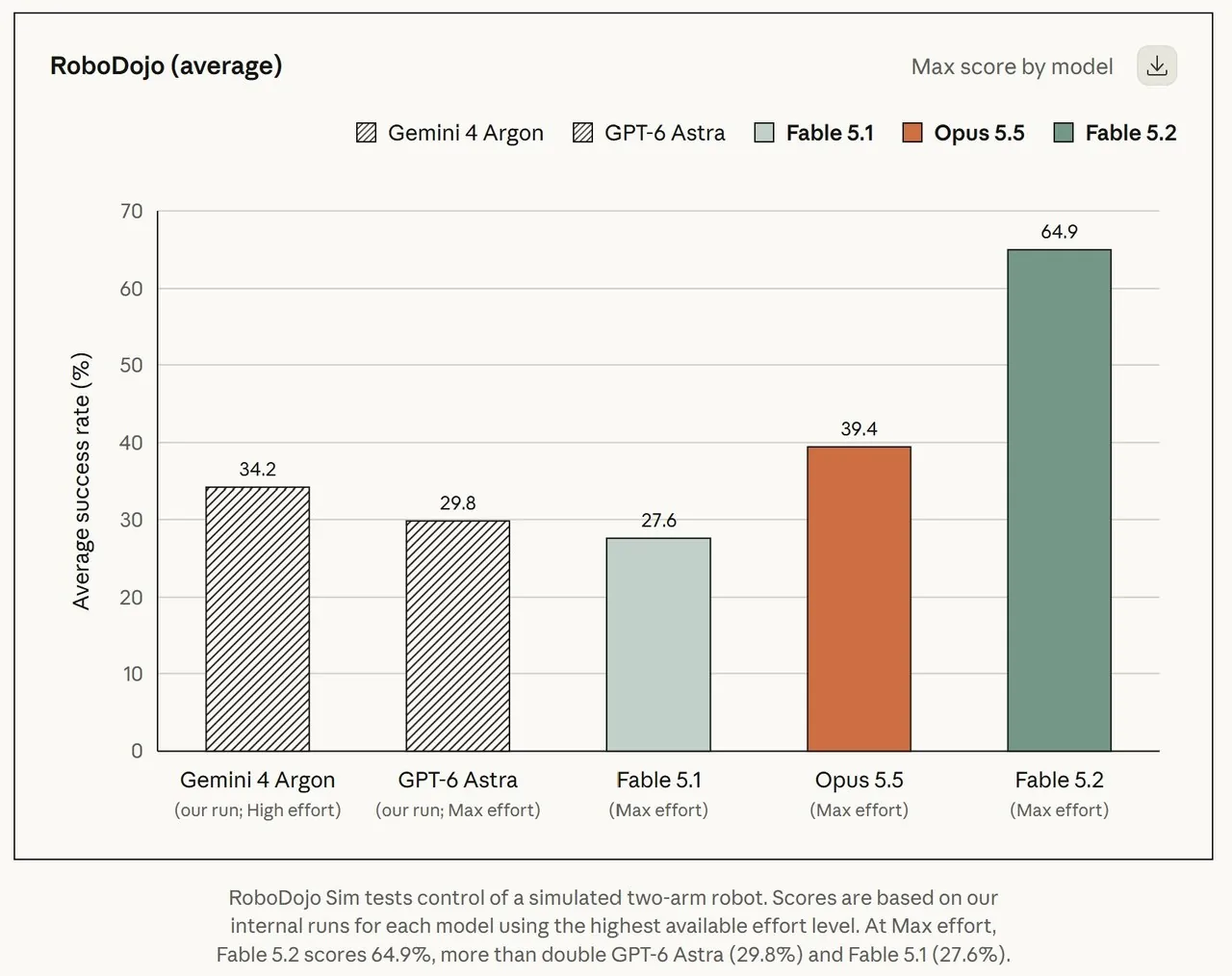
| Model in the displayed RoboDojo run | Average success rate | How to read the number |
|---|---|---|
| Claude Fable 5.2 | 64.9% | Highest score in the source chart |
| Claude Opus 5.5 | 39.4% | Previous Anthropic model in the comparison |
| Gemini 4 Argon | 34.2% | Author's own run, marked high effort |
| GPT-6 Astra | 29.8% | Author's own run, marked maximum effort |
| Claude Fable 5.1 | 27.6% | Earlier Claude generation at maximum effort |
The important signal is not that one brand beat another. It is that the interface changed. A model can observe images and robot state, reason in language or code, call tools, inspect the result, and try again. The controller is increasingly a software loop around a general reasoning model rather than a single policy trained only for one narrow task.
That distinction matters because software loops can improve quickly. A new model, a new tool, or a better failure-recovery prompt can be tested without rebuilding the robot. It also explains why so much research activity appeared in a short period. Teams are no longer asking only whether a foundation model contains a robot policy. They are asking how much robot behavior can be produced by an agent harness placed around the model.
Code as Policy is the bridge to work
The second change is a hybrid approach that Kang calls Code as Policy. Instead of forcing a neural policy to emit every motor command directly, the agent writes or modifies robot code, runs it against tests, observes failures, and iterates. The learned model supplies perception, reasoning, and task decomposition. Traditional robot software supplies calibrated motions and safety boundaries.
Kang cites two examples. At CoRL, NVIDIA reportedly used Astra to write skills through trial and error in simulation, then paired those skills with a learned policy. The result was success on 292 of 300 toy-assembly attempts. Separately, Berkeley professor Ken Goldberg is described as saying that an agent can now write the program for a typical factory task in about an hour in inspectable code.
Those examples point to a practical transition path. A factory does not need to replace every controller with an end-to-end neural network. It can let an agent generate integration code, test candidate motions, call existing perception or planning modules, and leave a human-readable program behind. The result is easier to inspect than an opaque action sequence and easier to deploy than a research policy that assumes a perfect laboratory setup.
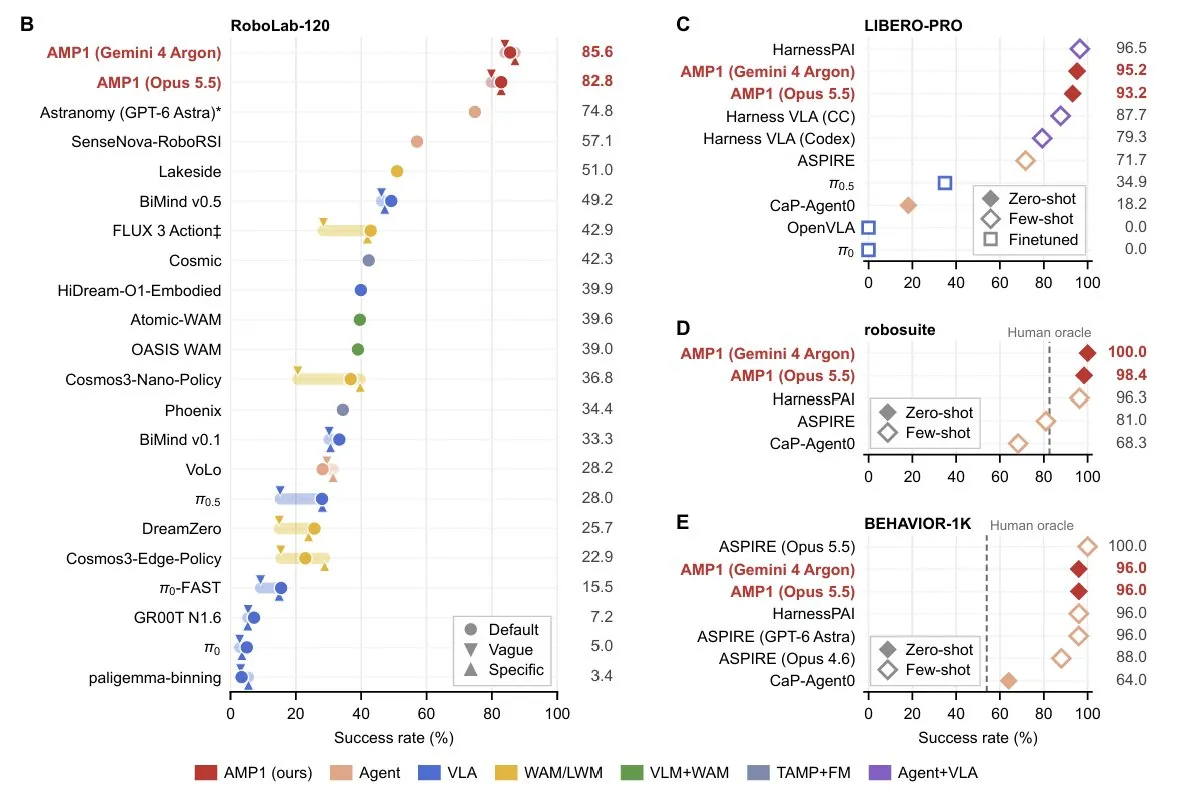
Apple's released AMP1 work provides one of the clearest public examples. In AMP1, a frontier model writes Python code that calls a persistent robot harness for perception, motion, and inspection. Apple evaluated AMP1 on several simulation benchmarks and on a set of real-world manipulation trials. The reported benchmark results place AMP1 above many VLA, world-action, and VLA plus world-model baselines.
The real-world table is more revealing, and also more sobering. Across 12 tasks, the reported average success rates were 27.8% for π0.5, 45.4% for FLUX, and 96.3% for AMP1. AMP1 was slower: its mean successful completion took 211 seconds, compared with 62 seconds for π0.5 and 44 seconds for FLUX. Several tasks required minutes of model reasoning and execution.
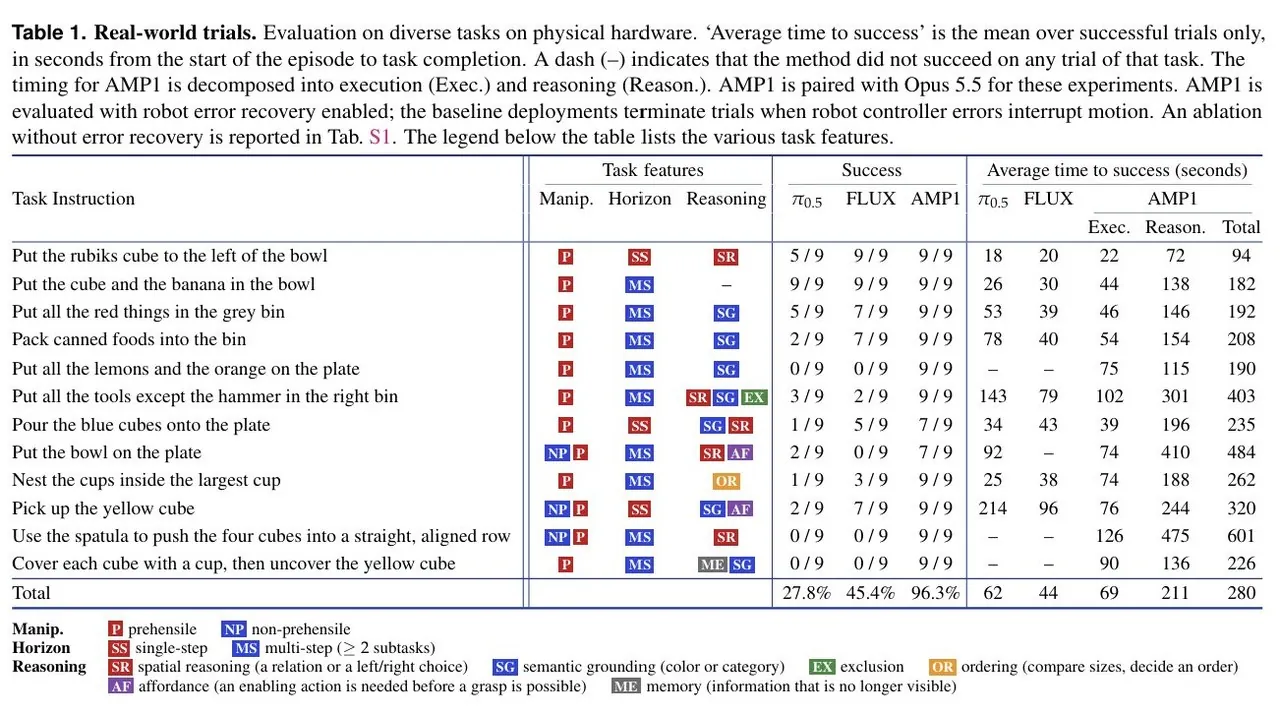
| Method in Apple's real-world trials | Average success | Mean time after success | What the result suggests |
|---|---|---|---|
| π0.5 | 27.8% | 62 seconds | Fast when it succeeds, but frequently fails on these tasks |
| FLUX | 45.4% | 44 seconds | Better coverage than π0.5, still far below dependable autonomy |
| AMP1 | 96.3% | 211 seconds | Large capability gain with a substantial reasoning and execution cost |
The result should not be reduced to “agents beat robot foundation models.” The test suite was small enough to inspect task by task. The comparison did not include every frontier closed model. Success was measured on a defined set of instructions, and high latency can be unacceptable in commercial lines even when accuracy improves. Kang acknowledges these limits before making the broader demand argument.
What survives those caveats is still meaningful: code-writing agents can recover from some controller errors that terminate conventional policy rollouts. They can use tools, re-check a scene, and change strategy. That capability may not be fast enough for every control loop, but it can be useful for setup, recovery, inspection, and tasks where a few minutes are cheaper than a failed attempt.
Driver one: integration is being compressed
Most discussion of robot demand starts with the final job: welding, picking, packing, inspection, or household work. Kang starts earlier in the value chain. Before a robot can do a job, someone must design the cell, choose sensors, write motion code, connect safety systems, tune the process, and recover from exceptions. That integration work has historically been expensive and slow.
He cites an industry gap in which 94% of American manufacturers do not use a robot, with integrators charging roughly $125 to $200 per hour. The exact market statistic is not independently established in the linked material, but the economics are familiar: for high-mix, low-volume production, the reprogramming burden can exceed the value of automating one short run. A robot that takes months to integrate is not competitive with flexible manual labor unless the process is very stable and the volume is very high.
Agent-generated robot programs attack this friction directly. Standard Bots has demonstrated an agent that turns a plain-English request into a robot program. If the generated code is inspectable, testable, and tied to a bounded workcell, the integration cycle can move from months toward days or hours. The same change also makes frequent reconfiguration more tolerable, which matters for small manufacturers that change products often.
This is the first demand multiplier. Cheaper integration increases the number of economically viable robot deployments. More deployments create demand for arms, sensors, safety equipment, and compute. The effect can arrive before end-to-end autonomy is reliable because the agent is automating engineering work around proven robot hardware.
Driver two: research itself needs robot-hours
The second multiplier is less intuitive. Even if robots never left the laboratory, the labs building physical intelligence could become enormous hardware customers. Kang observes that the market usually counts the jobs robots may perform, while ignoring the robots required to create the models that will perform those jobs.
Unitree offers a useful example. Kang reports that the company sold about 5,500 humanoids in 2025 and was on track to sell more than 15,000 in 2026, with very few deployed for productive work. Research customers can still support a large hardware business because every model experiment needs bodies, cameras, sensors, maintenance, and controlled environments.
The scale becomes clearer when an evaluation protocol is written out. Kang describes a robot policy evaluation group called @pokeandwiggle using 30 rollouts for every combination of 10 environments, 3 training-data tiers, 3 placement groups, and 2 mid-training tiers. One model therefore needs 5,400 rollouts. Comparing five models requires 27,000. Running that protocol with a handful of robots creates a scheduling bottleneck long before the evaluation is statistically complete.
The factor that makes this demand persistent is the gap between simulation and reality. A simulator can reduce the number of physical experiments, but the simulator itself needs real-world grounding data. World models can accelerate parts of research, but a model trained only in a synthetic environment still has to survive contact with friction, deformable objects, sensor drift, and damaged hardware. For tasks that require more than 99.9% reliability in deployment, small simulation errors are not cosmetic. They decide whether the system can operate without supervision.
Driving provides a useful comparison. Tesla and Waymo have collectively captured more than 10 billion miles of driving data, yet unrestricted autonomous driving is still not solved everywhere. A robot may face thousands of manipulation tasks, each requiring contact and force control. Driving has two primary continuous controls. A humanoid has dozens of joints that must be coordinated at once. The physical action space and the variety of contact-rich outcomes are much larger.
Kang's rough estimate is that a major company building omni-modal physical intelligence may need five figures of robots for training, evaluation, and iteration. That is an estimate, not a disclosed procurement plan. It is also the core of the thesis: when idea generation and code become cheap, experiments become the bottleneck, and an experiment in robotics consumes robot-hours.
Automation makes the loop even more hardware-intensive. Kang cites Google DeepMind's claim that Gemini 4 Argon helped turn around a robot model in four months by running thousands of practice attempts, reviewing failures, and adjusting the training recipe. A faster research loop does not remove physical work. It increases the number of experiments that can be proposed, which raises demand for machines capable of running them.
Driver three: end-to-end capability keeps compounding
The third multiplier is the broad improvement in end-to-end models. Kang lists several forces arriving together: frontier language models becoming capable of robot control, more robot-learning papers, venture-funded data collection, automated annotation and failure detection, faster simulation setup, and better scaling recipes. Each force makes the others more useful.
This compounding effect is why the timeline rhetoric in the article becomes aggressive. Kang suggests that digital AGI was achieved in 2026 and that physical AGI could arrive around 2028, sooner if hardware does not become the limiting factor. Those claims are forecasts, not measured results. The more defensible part of the argument is that useful predecessor models can create demand before a system deserves the label “AGI.”
That distinction matters for deployment. A robot does not need to solve every task in a building to be economically useful. It can handle a bounded set of movements under partial autonomy, call a remote operator when it is uncertain, and improve as the fleet collects data. Kang expects this combination of autonomy and teleoperation to grow before fully autonomous systems arrive. He also expects “deployment companies” that buy and operate robot fleets, analogous to compute neoclouds, to emerge as an intermediary layer.
The demand curve is therefore not one line. Integration automation creates near-term demand for proven hardware. Research creates demand for large numbers of experiment platforms. End-to-end model progress creates demand for real-world data and deployment. All three can pull from the same constrained supply of robot bodies.
The supply side is one factory
Supply is the part of the thesis that cannot be fixed by another model release. A robot factory requires tooling, suppliers, quality systems, test lines, trained staff, and a stable bill of materials. Kang argues that supply elasticity is low and that construction or expansion takes years. Even a company with strong demand cannot produce an unlimited number of robots next quarter.
The current market is also geographically concentrated. Kang reports that the world shipped about 19,100 humanoids in the first half of 2026, with more than 97% coming from Chinese vendors. China installed 59% of the world's industrial robots in the previous year, while the United States installed 38,000. These figures describe a much larger industrial base on the Chinese side, even before humanoid production is added.
Policy is tightening the constraint. Kang says the FCC placed foreign-produced advanced robotic devices, including humanoids, quadrupeds, and mobile robots, on its Covered List on July 28. He also points to a White House finding on October 28 that imports of robots, industrial machinery, and their parts threaten national security. The practical details and legal scope deserve separate analysis, but the direction is clear: procurement is becoming a national-security question, not only a price-and-performance decision.
Most American humanoid companies are not yet generally selling hardware. Kang says Tesla is keeping Optimus units for its own training, research, manufacturing, and mining work. Figure and Apptronik are described as choosing selected customers and prioritizing labor output over standard research sales. Dyna has a production backlog, and Dexmate is presented as an exception because wheeled humanoids are generally purchasable. Every one of those choices reduces the supply available to external labs.
This creates a strange market. Demand can rise while the most visible vendors appear to have no inventory. The constraint is not only manufacturing volume. It is the allocation of scarce early production among internal use, paid deployments, strategic partners, and research customers.
Robots may be priced like scarce compute
Kang's pricing argument borrows from GPUs. The industry sells fewer discrete GPUs today than it did in 2008, but the average unit price has risen by more than 100 times because the valuable configuration is no longer a commodity component. A robot with a capable model may follow a similar path. Its value is not set by motors, links, and sensors alone. It is set by the labor and learning opportunities created by a machine that can act reliably.
He uses a simple economic comparison. A conventional robot arm may generate $3,000 to $15,000 of gross margin for its seller. If that arm operates for 35,000 to 70,000 hours at a loaded labor value of $30 per hour, it can produce roughly $1 million to $2 million in gross labor value over its life. The estimate ignores maintenance, downtime, supervision, financing, and utilization risk, but it explains why an intelligent robot should not necessarily remain priced as a commodity arm.
A high upfront price may still be difficult for customers to finance. Kang therefore expects more robot labor to be sold by duration or output, similar to a robot-as-a-service lease. This shifts capital risk to the operator, but it can align payment with productive use and allow the hardware provider to retain upside from an asset whose value depends on software. If the margins become more software-like, the payback period can be short enough to justify the fleet investment.
What the evidence proves, and what it does not
The article combines public research, company claims, market data, and an investment thesis. Those categories should not be collapsed into one certainty level. The strongest evidence is that general-purpose models plus harnesses can improve performance on several robot benchmarks and selected real-world tasks. The weakest evidence is the precise timing of physical AGI, the exact number of robots each lab will buy, and the durability of future hardware prices.
| Claim | Evidence supplied | Main missing evidence |
|---|---|---|
| General models can control robots through harnesses | RoboDojo, RoboLab, LIBERO, RoboSuite, BEHAVIOR, and AMP1 real-world trials | Independent replication across more robots, sites, and unseen object sets |
| Code-writing agents can replace part of integration work | NVIDIA assembly demonstration, Standard Bots product, Goldberg anecdote | Public deployment data, error rates, engineering review time, and safety records |
| Labs will buy robots at five-figure scale | Evaluation arithmetic and research-loop examples | Actual procurement plans, utilization data, and vendor order books |
| Hardware supply remains a multiyear bottleneck | Shipment counts, production concentration, internal allocation, policy actions | Verified capacity expansion schedules and component-level supply data |
| Robot labor will increasingly be leased | Unit economics and analogy with cloud compute | Customer contracts, utilization rates, maintenance costs, and realized margins |
A skeptical reader should watch for four signals. First, do agent-harness gains transfer from a curated benchmark to new factories without task-specific tuning? Second, can reasoning latency fall enough for economically useful cycle times? Third, do labs actually accumulate large owned fleets, or do they rent time from shared evaluation facilities? Fourth, can robot makers expand production without sacrificing reliability or creating a backlog of unsupported hardware?
Those questions do not invalidate the central thesis. They define what would confirm it. If benchmark success rises while latency and integration cost fall, demand can arrive before every robot task is solved. If deployment data shows that agents still fail on small environmental changes, the hardware shortage may be delayed by a capability shortage instead.
The factories have to be built before the army
The strongest part of Kang's article is not the prediction of a particular robot market size. It is the observation that the physical AI stack has a production layer that model progress cannot bypass. Better models increase the value of a robot, which increases demand for robots, which increases the need for experiments and manufacturing. The loop can be self-reinforcing, but only if hardware exists to close it.
The StarCraft analogy returns at the end. The correct response is boring and early. Factories have to be ordered while they still look like a waste of resources. In robotics, that means qualifying suppliers, building production lines, standardizing components, and allocating machines to research before the commercial order book appears full. The model release can happen in a day. The factory cannot.
For robot builders, the implication is to treat hardware availability, fleet telemetry, and evaluation throughput as strategic assets rather than back-office costs. For labs, it is to secure robot-hours and design experiments that can run in parallel. For manufacturers, it is to test code-generating agents on bounded production tasks where generated programs can be inspected and rolled back. For investors, it is to distinguish a capability demonstration from a deployable system and then ask which physical layer becomes scarce if the demonstration generalizes.
The next robotics race may be won by teams that can turn model intelligence into reliable machine-hours. The constraint is not just who has the best policy. It is who can manufacture, instrument, maintain, and evaluate enough bodies to discover what the policy should be.
Sources and disclosure
Primary source: Andrew Kang, “The Great Robot Hardware Bottleneck,” X Article, November 24, 2026. Related evidence includes Apple's AMP1 project page, Anthropic's Claude Fable 5.2 announcement, Humanoids Daily's research overview, and the public policy and industry links cited in the original article.
Disclosure: the original author states that RoboStrategy (Nasdaq: BOT) may have investment exposure to companies mentioned in the post. This adaptation is an editorial summary and analysis, not investment advice. Company-reported benchmarks and forecasts should be independently verified before use in procurement or investment decisions.
Source:Andrew Kang / X Articlehttps://x.com/Rewkang/status/2125366945709277301