

Physical AI Is Breaking Out of the Box: Why Value Moves Into Deployment and Infrastructure
McKinsey sees physical AI creating over $1 trillion by 2035. Hardware and models absorb most funding, but deployment, operations and infrastructure may capture the durable value.
Artificial intelligence is moving out of software interfaces and into machines that act on roads, factory floors, mines, ships, warehouses, and buildings. That shift is happening faster, and across more forms of equipment, than the public conversation around humanoid robots suggests. Capital is concentrating today in general-purpose robots and autonomous vehicles, but physical AI also includes autonomous forklifts, package-sorting mobile robots, adaptive factory systems, autonomous haul trucks, and building infrastructure that continuously senses and adjusts its own operation.
McKinsey estimates that physical AI applications could generate more than $1 trillion in economic value by 2035 through productivity gains, higher quality, and greater throughput. The important strategic question is not only how large that market becomes. It is where value accumulates as the technology moves from a demonstration to a dependable operating system for the physical world. General-purpose robotics and autonomous passenger vehicles are expected to remain the largest visible applications in 2035, but intelligent factories, freight, specialized equipment, buildings, and shared infrastructure could grow around them. Within the technology stack, value may also move from hardware toward software, deployment, and field operations.
This article combines McKinsey's November 20, 2026 analysis with a strategic reading published by Chiamin Lai on X. McKinsey maps the applications, investment flows, market size, and value pools. Lai asks a narrower question with large consequences for Japan: if deployment services are the obvious entry point, does concentrating there leave the deeper technology layer under foreign control? The final section separates that argument from the McKinsey evidence and turns both into an operating agenda.
The McKinsey article is by Ani Kelkar, Bernd Heid, Christian Jansen, and Mark Patel, with Marie Houdou and Paul Rotman. Its central claim is that physical AI is no longer a laboratory category. It is becoming a general capability whose economic effects will be felt through many form factors and through the infrastructure that makes those form factors useful.
Physical AI has already left the pilot stage
The strongest evidence for physical AI is not a single humanoid demonstration. It is the accumulation of systems already doing work in structured environments where the task, safety boundary, and economic return can be defined. Mines, ports, factories, and warehouses adopted automation long before the current foundation-model cycle. The new step is that these systems increasingly use sensory input and learned representations to adapt decisions instead of following only preprogrammed scripts.
For customers, the value is practical rather than conceptual. Physical AI can substitute for or augment labor, raise throughput, improve asset utilization, reduce defects and downtime, make operations safer, shorten cycle times, and increase resilience. A robot that looks impressive but does not improve one of those measures is still an expensive demonstration. A less visible system that raises the utilization of an existing fleet can create more economic value.
The breadth is already substantial. McKinsey reports that shared autonomous vehicles worldwide provide more than 700,000 fully autonomous rides per week. Waymo alone served 500,000 paid rides per week in March 2026, doubling from 250,000 in less than a year. In mining, Caterpillar's autonomous fleet reached 690 trucks at the end of 2024 and had moved more than 11 billion metric tons of material without reported injuries; the company aims to triple the fleet by 2030. In China, EACON has deployed autonomous-driving technology on more than 2,000 haul trucks.
Shipbuilding shows the same transition entering less structured work. HII, the largest US naval shipbuilder, plans to work with GrayMatter Robotics on autonomous surface preparation, coating, and inspection, and with Path Robotics on adaptive welding. Proof-of-concept demonstrations are planned for 2026, with a full pilot in 2027. In logistics, Amazon has deployed more than one million mobile robots across more than 300 facilities, coordinated by DeepFleet, a foundation model the company expects to reduce fleet travel time by 10 percent.
These examples differ in hardware, but they share a control pattern: perception produces a representation of the environment; the system reasons over that representation; and an action changes the physical state. Conventional automation can repeat a fixed motion with great precision, but it struggles when conditions change. Generative AI can write a plan or answer a question, but it does not directly move matter. Physical AI has to close the loop between uncertainty in the world and consequences in the world.
Embodied and embedded systems create different value pools
Physical AI takes two broad forms. An embodied system is concentrated in one autonomous machine that perceives, reasons, and acts as a unit. Autonomous vehicles, humanoids, mobile manipulators, autonomous forklifts, construction machinery, and agricultural harvesters are examples. An embedded system distributes intelligence across multiple machines, sensors, and pieces of infrastructure. A closed-loop building-management system, an adaptive industrial operation, or a port coordination layer may not look like a robot, but it still senses the physical world and changes what happens in it.
The distinction matters because investors and operators often evaluate all physical AI as if it were a robot company. An embodied system requires strength in mechanical design, actuators, power, sensing, onboard compute, safety, and service. An embedded system may create value through orchestration, cloud software, communications, systems integration, and continuous optimization of existing assets. The economic moat can sit in a different layer even when the user experiences one integrated service.
The data flywheel is the real scaling mechanism
Physical AI improves through a loop. A system is deployed, encounters conditions that were absent from its training set, records the consequences of its actions, and uses that information to improve. Better performance permits broader deployment, which generates more data. The loop is easiest to establish in structured settings with repetitive tasks, clear success criteria, and contained safety risk. That is why warehouses, mines, factories, and ports are often the first commercial beachheads.
Before deployment, developers rely heavily on simulation and synthetic data. Simulations can generate geometry, kinematics, and navigation data cheaply and at scale. World Labs' Atlas, for example, reconstructs real environments and generates the sensor data a robot would receive while moving through them. Physics engines can approximate contact dynamics well enough to pretrain a model before field data is available. This is essential for rare events, dangerous scenarios, and rapid iteration.
Simulation is not a substitute for reality. When a gripper handles a deformable package or a worn component, small differences in force, friction, slip, and material behavior determine success. Those differences are learned most reliably from live operations. The most valuable data often arrives after deployment, when the machine encounters the messiness that a synthetic environment did not anticipate.
Human-collected data fills another gap, especially when a company has a small deployed fleet. Figure AI's Index app pays contributors in more than 100 countries to record everyday activities such as folding laundry. DoorDash's Tasks app pays couriers to film household chores on body-worn cameras. Uber shares camera and sensor data collected from drivers across its network with autonomy partners such as Wayve. These arrangements show that physical AI data is not only a technical artifact. It is a commercial and social contract involving consent, privacy, ownership, and reuse.
Early scale can create an advantage that later entrants struggle to reproduce. In industrial automation, companies that established a large installed base built customer relationships, service networks, application expertise, and field knowledge that sometimes outweighed a rival's superior product. Physical AI may strengthen that pattern because model improvements can be reused across domains. XPeng's VLA 2.0 foundation model was developed for driver assistance in mass-produced passenger cars, then underpinned both its robotaxis and its IRON humanoid robot. A model trained for one embodiment can become a platform for several.
Funding is growing, but it is narrowly concentrated
General-purpose robotics offers a clear view of how capital is entering physical AI. Cumulative investment reached about $38 billion, and most of it arrived in only two years. Annual funding rose from about $1 billion in 2020 to around $9 billion in 2025, then to about $21 billion in the first eight months of 2026 alone. These figures exclude autonomous vehicles, which still absorb most physical AI investment.
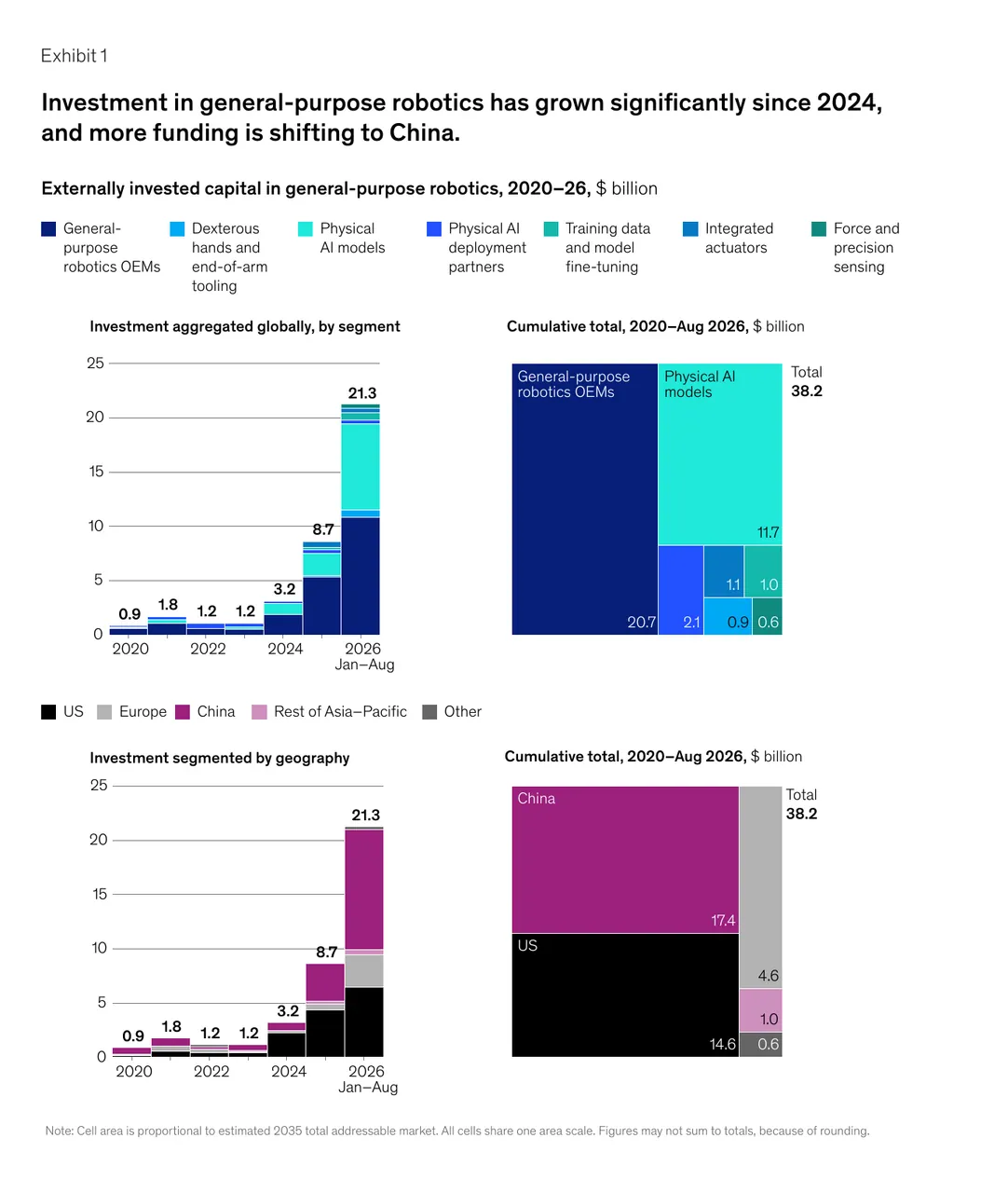
The segment split is even more revealing. Robot OEMs received about $21 billion of the cumulative total, followed by developers of physical AI foundation models at about $12 billion. Deployment partners, training-data companies, actuator suppliers, dexterous-hand developers, and force-sensing specialists together received under $6 billion. The market is therefore financing machines and models much more heavily than the services and infrastructure needed to make those machines productive at scale.
The geography is changing. The United States led cumulative funding through 2025, but in 2026, through August, China accounted for about $11 billion of the $21 billion invested, compared with $7 billion for the United States and $3 billion for Europe. Cumulatively, China has received about $17 billion, or roughly 46 percent of general-purpose robotics investment. It now accounts for more than half of global funding for robot OEMs and integrated actuators, and about three-quarters for force and precision sensing. Europe has attracted roughly $5 billion cumulatively. Its advantage is less about the scale of private capital than about component suppliers, mechatronics competence, and a manufacturing base suited to deployment.
This concentration creates a strategic asymmetry. Capital can accelerate a leading model or robot platform, but it can also leave deployment capability, data rights, and operational know-how underdeveloped. A market can appear well funded while the customer-facing work of integrating, validating, maintaining, and improving systems remains fragmented.
The 2035 market extends far beyond robots
McKinsey's 2035 revenue projection makes the breadth of physical AI visible. About $500 billion could come from autonomous passenger vehicles, at roughly $470 billion, plus general-purpose robots, at roughly $30 billion. The remaining market could be about $700 billion across a broader set of applications: trucking and freight, factories, robotic arms, fields, warehouses, drones, tractors, commercial and residential buildings, construction and mining, medical and surgical systems, consumer equipment, urban systems, forklifts, maritime operations, and other mobile robots.
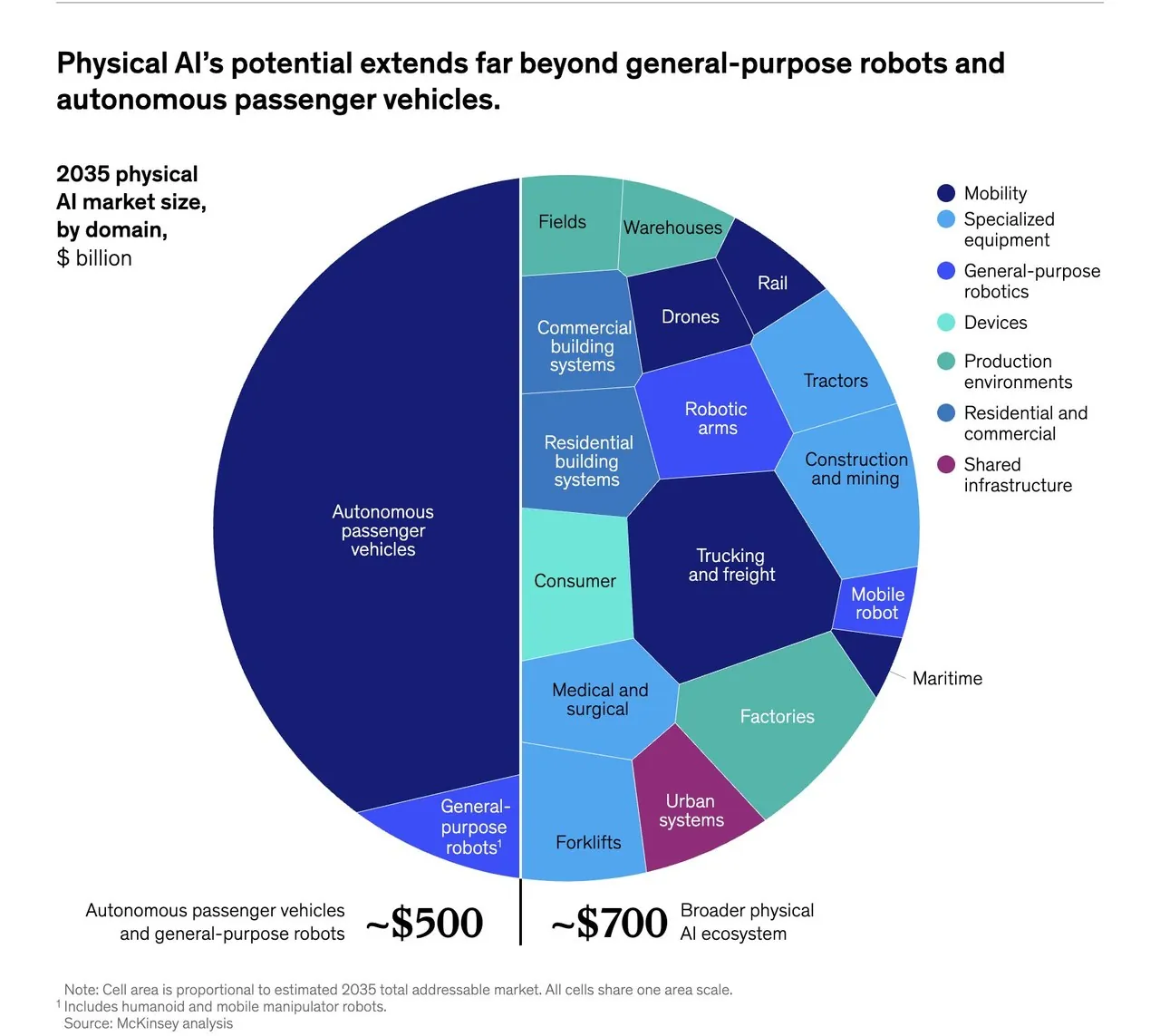
The market map changes the question from “Which robot company wins?” to “Which layers become control points in a much larger system?” A factory may buy robots from several vendors, software from a model provider, integration from a specialist, safety validation from a certification partner, and monitoring from an operations platform. The customer cares about uptime and output. Value can accrue to whoever owns the data flow, the orchestration layer, the safety case, or the relationship that keeps the whole system running.
Value will move toward deployment and operations
McKinsey divides the physical AI value chain into hardware, software, deployment, and field operations. Hardware has attracted the most investment to date and is expected to account for 30 to 40 percent of the 2035 value pool. Software is expected to account for 25 to 35 percent. Deployment, which has attracted relatively little capital, could account for 5 to 20 percent. Field operations could account for 15 to 30 percent.
The ranges are less important than the relationship. Deployment and field operations together could exceed the value of either hardware or software alone. That is a warning against assuming that the company with the most visible robot or the largest model will capture most of the economics. The hard work of making a system fit an existing operation may create a durable position even when no single hardware component is differentiated.
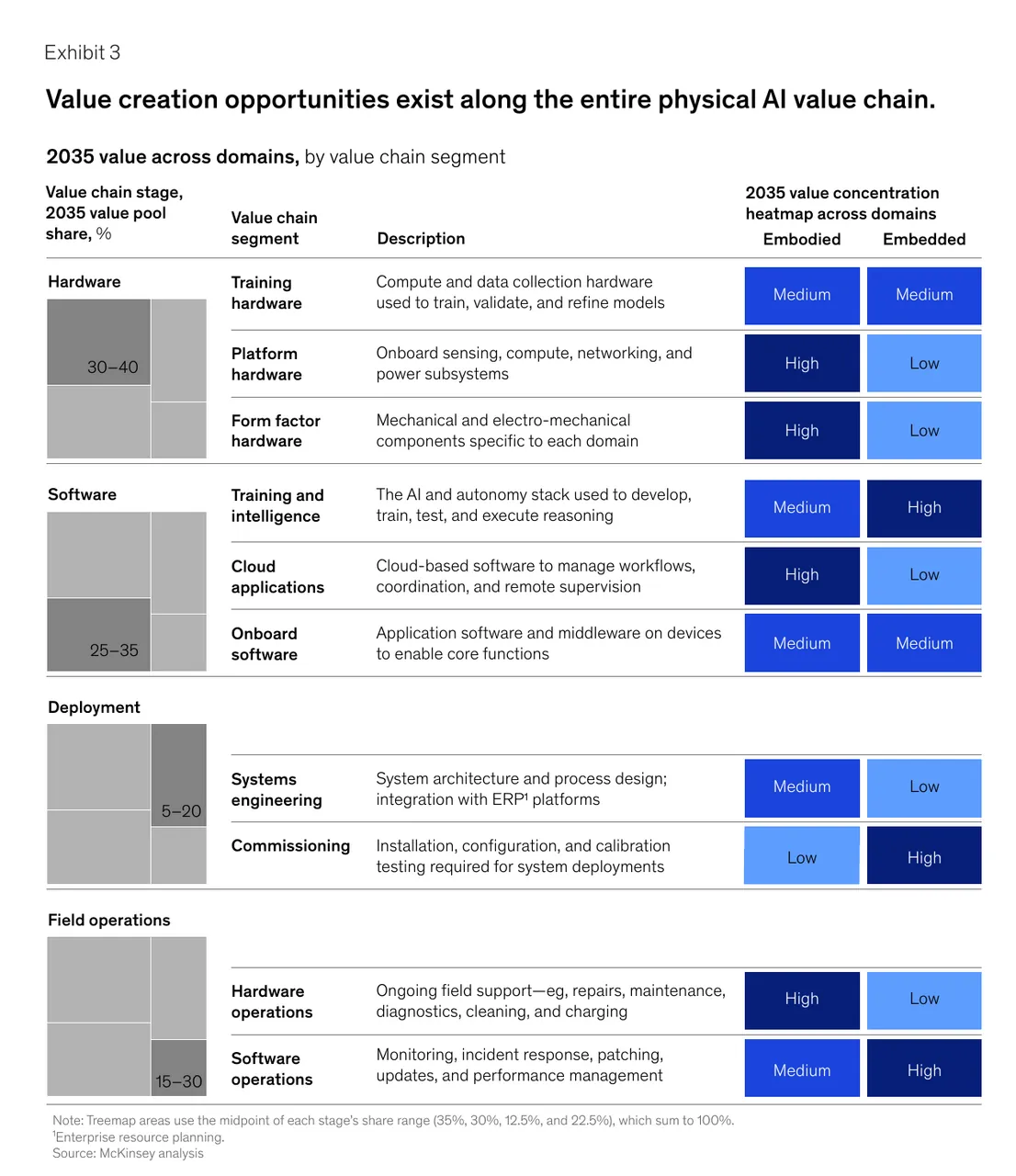
Deployment includes systems engineering, process design, integration with ERP and operational technology, installation, configuration, calibration, and acceptance testing. Field operations include repairs, maintenance, diagnostics, cleaning, charging, monitoring, incident response, software updates, and performance management. These are not peripheral services attached to a finished product. They are the mechanisms by which a physical AI system becomes reliable enough to produce economic value.
McKinsey's most concrete warning about this burden is that every dollar spent on a robot in a large transformation may require about five additional dollars for safety and infrastructure. That ratio explains why a strong demonstration can still fail commercially. It also explains why systems integrators, safety specialists, and operators can capture value even when they do not own the robot design.
History offers a useful analogy. The internet created digital businesses, but it also generated enormous value in networking, enterprise software, data centers, and cloud computing. Mobile computing created opportunities for semiconductor manufacturers, wireless infrastructure providers, and software developers alongside phone makers. Generative AI has drawn investment into semiconductors, data centers, and power generation. Physical AI may follow the same pattern: the most valuable company does not have to be the most visible machine maker.
Four opportunity areas for the physical AI economy
Model development
Vision-language-action models interpret visual data and natural language, then translate those inputs into physical actions. They are improving quickly and generalizing to more tasks and environments. It remains unclear whether VLA models alone can handle thousands of tasks in complex, constantly changing settings such as construction sites. One limitation is that they do not reliably anticipate the consequences of their actions because they lack an explicit understanding of how the physical world works.
Developers are pursuing different answers. Some use world models that simulate how an environment responds to an action. Others believe more action data will let VLA models learn the necessary structure. A growing number combine the two, using a world model to predict consequences and a VLA policy to act. The important commercial point is that model development is not only a race to a larger parameter count. It is a race to build a model that can transfer across environments without failing safely in edge cases.
Data management
Physical AI needs a data supply chain: collection, cleaning, annotation, storage, search, simulation, replay, consent management, and feedback from deployment. The value of a data platform depends on who has the right to access and use the data. Technology providers, system operators, workers, and individuals may have competing claims, especially when data collected for one purpose is reused for another. Housekeeping data from a humanoid robot could potentially improve a model used in security or defense applications.
Clear rules for consent, privacy, security, provenance, and reuse could increase data sharing and accelerate model improvement. At the same time, control over proprietary operational data may become a durable competitive advantage. A manufacturer that understands exactly how its equipment behaves under real load may have data no public web corpus can replace. The governance question is therefore not separate from the business model. It determines whether data becomes a shared utility, a private moat, or a liability.
Systems integration and implementation
Integrating autonomous vehicles, robots, and intelligent devices into an existing operation is difficult because the surrounding systems were not designed for them. Physical AI must connect to operational technology, enterprise software, data platforms, safety procedures, maintenance workflows, and human roles. The project may require redesigning a process rather than inserting a robot into the old process unchanged.
Successful implementation also requires fleet orchestration, safety validation, commissioning, and ongoing support. Providers that combine these capabilities into reliable end-to-end solutions could capture substantial value. But the phrase “systems integrator” can hide very different businesses. A low-margin installer that moves boxes and follows a vendor checklist has little leverage. An integrator that owns the operating model, data feedback loop, safety evidence, and service relationship has much more.
Enabling technology infrastructure
Simulation and digital twins help train, test, and validate systems before deployment. Edge computing, cloud infrastructure, and connectivity support real-time processing and low-latency decisions. Control and actuation systems turn decisions into physical action. Safety systems detect and contain failure. These layers become more valuable as physical AI moves into unstructured environments where the cost of a wrong action is high.
This is the area that deserves particular attention from companies that do not intend to become robot OEMs. Sensors, force and precision sensing, actuators, real-time control, functional safety, simulation, digital twins, communications, and fleet software can be sold across many robot vendors and many end markets. They also create switching costs when they become embedded in the customer's engineering process.
What the McKinsey analysis implies for operators, providers, and investors
For end users, the best first move is not to wait for a universal humanoid. Manufacturers, logistics operators, utilities, and other asset-heavy businesses should focus first on structured settings with repetitive tasks and clear payback. They should move beyond pilots where the technology is already viable, own the operational data, redesign the workflow around the system, and build the field-operations skills required to keep a fleet running.
For technology providers and OEMs, the central choice is where to build capability and where to partner. Safety, uptime, dexterity, and cost constrain every form factor, not only humanoids. A company that cannot credibly solve all of those issues may create more value through a partnership than through vertical integration. The partner's contribution should be evaluated on reliability and data feedback, not merely on whether it makes the demonstration look complete.
For investors, the market requires a wider lens than model benchmarks and hardware specifications. Capital has concentrated in a small number of robot makers and model developers. The next question is whether a company can scale economically, build a defensible position, and generate recurring revenue from software and services. Regional differences matter too. Europe's component suppliers and regulatory clarity may be more valuable in some segments than a large consumer-market story.
McKinsey's conclusion is that success will depend on more than advanced machines and models. It will depend on integration into complex environments, reliable operation, and continuous improvement through real-world data. This is a useful correction to the tendency to treat physical AI as a hardware race. The machine is necessary, but the operating system around it determines whether the investment pays back.
Lai's interpretation: deployment is necessary, but it can become a subordinate position
Chiamin Lai read the McKinsey article as evidence of a large service opportunity, especially for Japanese companies. His reading is consistent with the value-chain shift: physical AI creates demand for companies that can connect models and machines to real workflows, safety requirements, data governance, and ongoing support. Japan has deep manufacturing experience, a large industrial base, and many firms capable of performing this work. It is reasonable that interest in physical AI deployment services is rising.
His concern begins after that observation. If Japanese companies concentrate too heavily on deployment support while the foundation models, world models, data platforms, control stacks, and core infrastructure remain abroad, Japan may become an effective implementation partner for another country's technology wave. The deployment layer is essential, but it may not control the standards, interfaces, or economics of the next generation. Lai argues that this deserves more attention than a simple “services are growing” story.
He notes that foundation-model development already has many competitors. The infrastructure supporting physical AI, by contrast, still has substantial room for new entrants and differentiated capabilities. That distinction is strategically important. It is one thing to install and customize someone else's robot. It is another thing to provide the simulation environment, sensors, actuators, control layer, safety system, connectivity, or operating platform that many robot makers depend on.
Lai's argument should not be read as a rejection of deployment. His post explicitly says that the role of making systems usable in the field is indispensable. The problem is concentration without a route into the underlying technology. Deployment can be a source of data and customer insight, but only if the provider captures those assets and uses them to build products, standards, or reusable infrastructure. Otherwise the work remains labor-intensive and substitutable.
The strategic risk is not that deployment work is unimportant. The risk is that deployment becomes the only position a company occupies while the reusable technology layer, and therefore the long-term control point, remains elsewhere.
RobotWorld synthesis: turn deployment into a data and product position
The McKinsey data and Lai's concern fit together. McKinsey shows that hardware and models are overfunded relative to deployment and operations. Lai shows why a company should not respond by simply selling more installation labor. The correct response is to use deployment as an entry point into a higher-value position.
A strong deployment business should capture four assets. First, it should own a structured record of the customer's operating context: layout, cycle time, failure modes, safety constraints, exception handling, and economic KPIs. Second, it should own or have clear rights to the operational data generated by the system, including failures and interventions. Third, it should convert each project into reusable software and process components rather than starting from scratch. Fourth, it should build a service relationship that continues after commissioning, when maintenance, monitoring, upgrades, and performance management create recurring revenue.
This is how an integrator can move from a project contractor to an operating platform. The same transition applies to hardware suppliers. A sensor maker that participates only in one bill of materials has a component business. A sensor maker that supplies the calibration, diagnostics, safety evidence, and data interfaces around the sensor becomes part of the control architecture.
Japan's opportunity is therefore broader than “help foreign robots enter Japanese factories.” Its industrial base can support force and precision sensing, actuators, mechatronics, machine tools, factory networks, safety systems, simulation, and on-site engineering. Those capabilities map directly to McKinsey's enabling-technology infrastructure and to the operational part of the value chain. The strategic question is whether they are combined into reusable platforms that can serve many robot vendors and markets, or remain isolated custom projects.
There is also a data-governance implication. If deployment partners do not negotiate data rights at the beginning, they may create the flywheel for the model owner while retaining neither the data nor the learning. A contract that treats integration as a one-time service can leave the customer dependent and the integrator trapped in low-margin labor. Contracts should define access to operational data, permitted reuse, model improvement rights, and the ability to benchmark performance across deployments.
The same logic applies at the level of national industrial policy. A country does not need to win every robot platform or foundation model to have a strong position. It can build critical components, safety and validation capabilities, data infrastructure, integration standards, and operating software that many platforms must use. The goal should be interdependence with control points, not self-sufficiency in every layer.
A practical agenda for the next physical AI cycle
For an end user, start with a narrow operational problem with a measurable outcome and a controlled environment. Establish the safety case, data rights, baseline KPIs, exception process, and service model before scaling the fleet. Treat the first deployment as a data and process asset, not a procurement trophy. Measure uptime, intervention rate, cycle time, quality, utilization, and total cost of ownership rather than only the robot's demonstrated capability.
For a technology provider, decide which control point is defensible. A proprietary model, a data pipeline, a sensor, a safety layer, a fleet orchestration system, or a service network can all be valid positions, but each requires different investment and proof. Avoid entering a crowded layer without a plan to accumulate reusable data or switching costs.
For an investor, separate a compelling demonstration from a scalable business. Look for evidence that the company can deploy repeatedly, support the fleet after commissioning, retain useful operational knowledge, and earn recurring revenue. The largest near-term market may be in visible robots, but the more durable returns may sit in the unglamorous work that makes those robots reliable.
Physical AI will reshape industries, but the biggest opportunities may emerge in places that receive little attention today. Autonomous passenger vehicles and humanoids will remain the symbols. Intelligent factories, freight, specialized equipment, buildings, and shared infrastructure may carry much of the economic breadth. The value will move toward the companies that can integrate these systems, operate them safely, and improve them with real-world data.
The deployment layer is therefore neither a consolation prize nor a guaranteed moat. It is a gateway. Companies that treat it as a gateway to data, software, standards, and infrastructure can build a position in the next physical AI cycle. Companies that treat it only as billable installation work may help the technology scale while remaining economically dependent on the layer above them.
Sources and attribution
Primary analysis: Ani Kelkar, Bernd Heid, Christian Jansen, and Mark Patel, with Marie Houdou and Paul Rotman, “Physical AI is breaking out of the box,” McKinsey & Company, November 20, 2026. All market-size, investment, value-pool, and company-example figures in this article are from that analysis unless otherwise identified.
Strategic interpretation: Chiamin Lai, a post on X analyzing the four opportunity areas and the risk of concentrating Japanese physical AI efforts in deployment support. Lai's arguments are presented as his interpretation and are clearly separated from McKinsey's findings. The final synthesis and recommendations are RobotWorld's analysis.
Source:McKinsey & Company;Chiamin Lai (X)https://www.mckinsey.com/industries/industrials/our-insights/physical-ai-is-breaking-out-of-the-box