
Distilling Kimi-K3.1-Pro into Qwen3.8-27B: Teaching a Small Model a New Language
Together AI distills Kimi-K3.1-Pro's Lao output into Qwen3.8-27B. A 3,834-example Lao mix plus Thai retention reaches 93% of the teacher's score, and one five-language adapter tests generalization.
Together AI began with a deceptively narrow observation: Qwen3.8-27B, a popular 27-billion-parameter small language model, could produce a sensible translation of an English sentence but put it in the wrong language. Asked for Lao, it repeatedly answered in Thai. The two languages are closely related, but they use different scripts. On the 1,012-sentence FLORES-200 Lao test set, Qwen3.8-27B scored 5.5 chrF++, and only 11% of its outputs used Lao script. Kimi-K3.1-Pro scored 47.5 on the same benchmark.
That gap is a compact example of jagged model intelligence. A large model may handle a specialized task comfortably while a smaller, cheaper model fails on one narrow requirement inside an otherwise familiar workflow. Together AI therefore treated Kimi-K3.1-Pro as a teacher and distilled its Lao translation behavior into Qwen3.8-27B through supervised fine-tuning, leaving the base model and a LoRA adapter in the student.
The result was not a simple copy of the teacher. After training on roughly 3,800 teacher-generated Lao translations, Qwen3.8-27B produced Lao on 100% of the test sentences and reached 44.3 chrF++, or 93% of the teacher's headline score. More importantly, the student still translated English into Thai. That retention requirement turned out to be harder than teaching Lao: the first successful Lao run damaged Thai so severely that the model effectively learned “when asked to translate, output Lao” rather than learning the specific language requested.
The full experiment, including teacher-data generation, filtering, training, evaluation and infrastructure time, cost $260. The important contribution is not that a particular model can learn a low-resource language. It is the reproducible post-training pattern: find a capability gap with a small screen, inspect the failure mode, collect reliable teacher data, protect adjacent capabilities during continual learning, and evaluate the protected skill while the target skill improves.
Finding the capability gap
The team measured translation quality with chrF++, a 0-to-100 score based on character and word overlap with a human reference translation. The metric is useful for comparison but also exposes why translating into the wrong script is catastrophic: a fluent Thai answer has almost no character overlap with a Lao reference. The model may preserve the meaning while receiving a near-zero score for language identity.
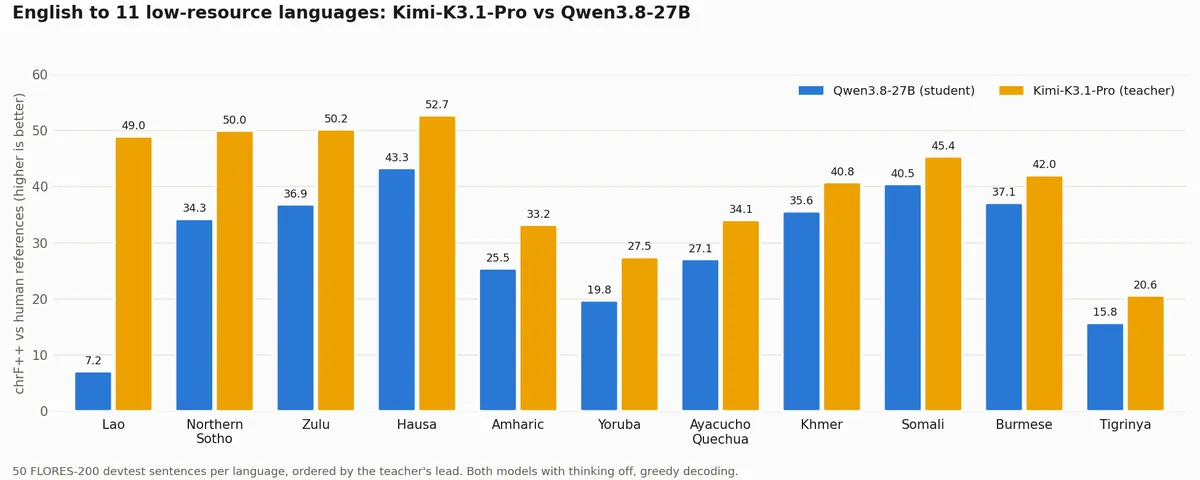
In a 50-sentence diagnostic sample, Qwen3.8-27B used Thai script in 45 responses and Lao in only 6. Its Lao score was 7.2, compared with 49.0 for Kimi-K3.1-Pro. The following example is representative. The English sentence and the base model's Thai translation are both coherent; the failure is that the requested target language was not respected.
English: “We now have 4-month-old mice that are non-diabetic that used to be diabetic,” he added.
Qwen3.8-27B: “ปัจจุบันเรามีหนูอายุ 4 เดือนที่ไม่เป็นโรคเบาหวาน ซึ่งเคยเป็นโรคเบาหวานมาก่อน” เขากล่าวเสริม
Kimi-K3.1-Pro: “ພວກເຮົາຕອນນີ້ມີໜູອາຍຸ 4 ເດືອນ ທີ່ບໍ່ເປັນໂຣກເບົາຫວານ ເຊິ່ງເຄີຍເປັນໂຣກເບົາຫວານມາກ່ອນ,” ລາວກ່າວຕື່ມ.
This distinction matters for diagnosis. If the base model could not translate the content, more data would need to teach meaning. Here it already understood the sentence and generated a reasonable translation, so the main missing capability was language selection. That diagnosis predicted a fast improvement in script identity and turned the project into a retention problem rather than a general translation-learning problem.
The sample scores differ slightly from the headline benchmark. On the 50 diagnostic sentences, Qwen scored 7.2 and Kimi scored 49.0. On the full 1,012-sentence FLORES-200 devtest set, the same models scored 5.5 and 47.5. On the 300-sentence set used during training, they scored 6.7 and 47.3. Together AI reports these slices separately rather than presenting every result as if it came from the same evaluation.
Why the team chose off-policy distillation
Distillation trains a smaller student model to reproduce behavior from a larger teacher in a selected domain. There are two broad families. On-policy distillation lets the student generate text and asks the teacher to score each student token. That requires the teacher's log probabilities on the student's trajectory and, in practice, usually requires both models to share a tokenizer. Kimi and Qwen do not share one.
Off-policy distillation takes a simpler route: the teacher generates complete outputs, and the student learns those outputs through supervised fine-tuning. It needs only the teacher's text. Together AI chose this method because every teacher call can remain an ordinary serverless chat request; the large teacher never needs to occupy a training resource, and no cross-tokenizer log-probability alignment is required.
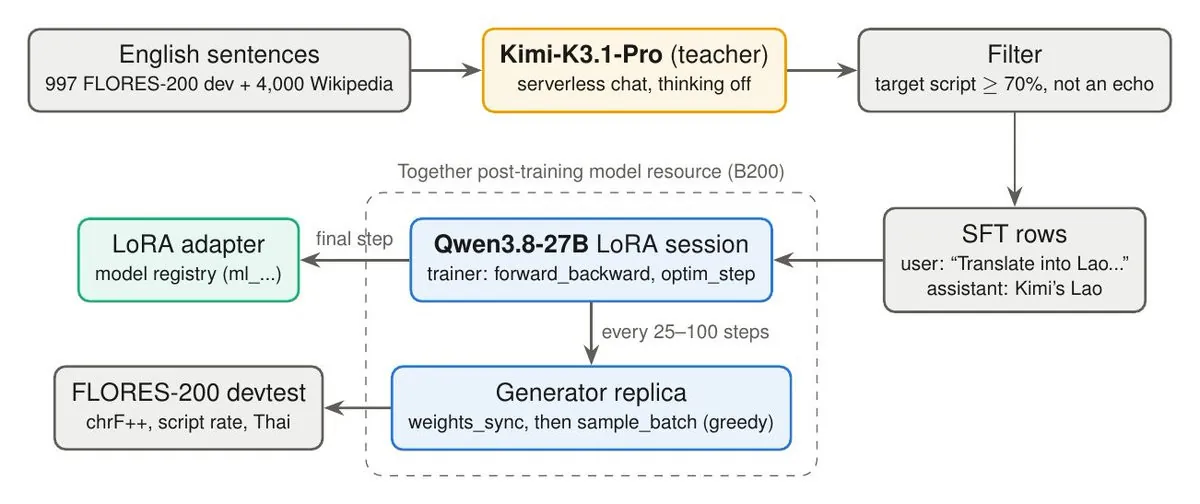
The production pipeline had five stages:
- Collect English source sentences.
- Ask Kimi-K3.1-Pro to translate them into Lao with extended thinking disabled.
- Discard any translation that is not mostly written in the target script.
- Fine-tune a LoRA adapter on Qwen3.8-27B and evaluate held-out sentences during training.
- Save the adapter to the model registry.
Together Post-Training assigned both training and generation to one model resource. The same resource trained the LoRA adapter, synchronized intermediate weights to a generator, sampled test outputs and calculated scores. This removed the need to deploy a separate inference endpoint merely to observe whether the student was improving.
Each evaluation covered four complementary signals:
- Reference translation quality: chrF++ against human Lao references on FLORES-200 devtest. The team scored all 1,012 sentences at the beginning and end of each run, and 300 sentences every 25 steps, with less frequent evaluation in the two longest runs.
- Target-script rate: the percentage of answers written mostly in Lao letters. This directly detects the original Thai-for-Lao failure.
- Thai retention: chrF++ on 300 English-to-Thai sentences, which checks whether the intervention erased a capability the student already had.
- Round-trip adequacy: Kimi-K3.1-Pro translates the student's Lao back into English, and that result is compared with the original English. This checks semantic preservation independently of reference style.
The Thai surprise
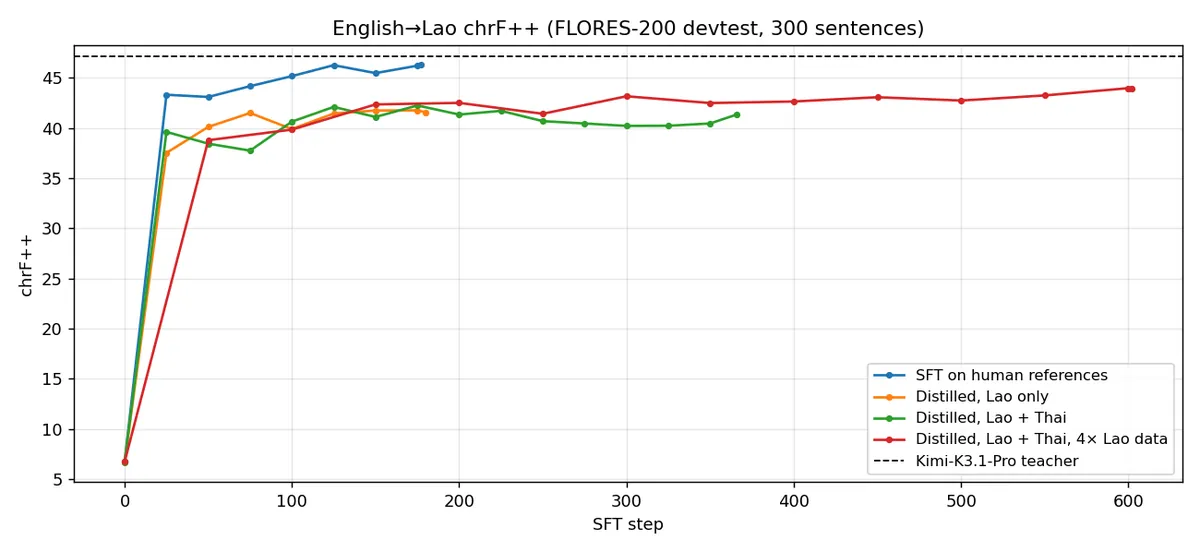
The first control trained Qwen3.8-27B on 945 human Lao references from FLORES dev, with no teacher-generated data. Lao quality jumped from 6.7 to 43.3 within 25 optimization steps. If the evaluation had stopped there, the run would have looked like the best possible outcome: it produced the highest Lao score of any student in the study.
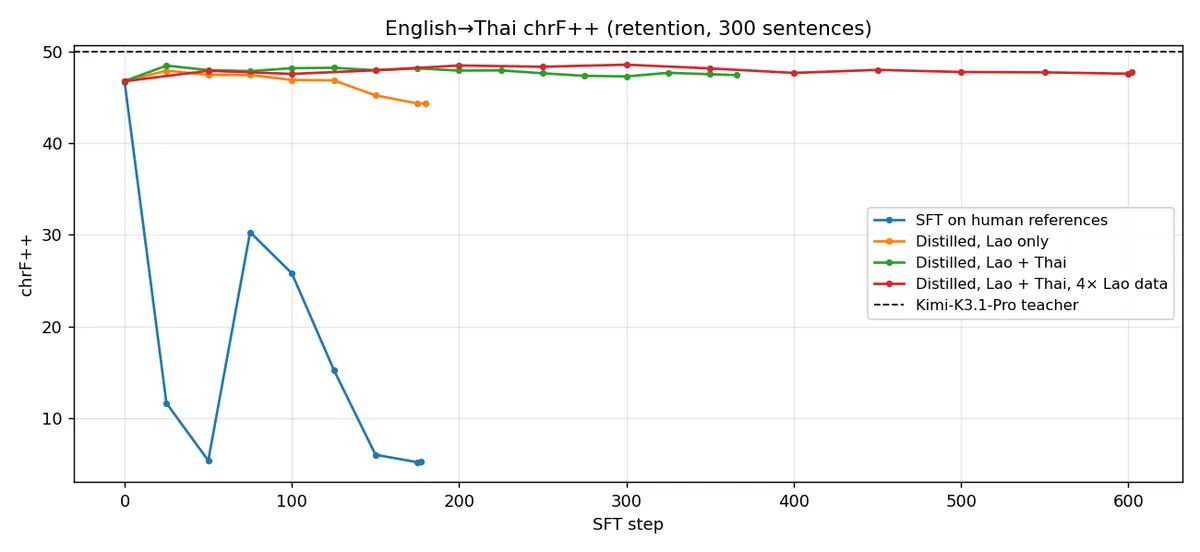
Thai told a different story. Thai chrF++ fell from 46.7 to 11.7 at the first reported evaluation and ended at 5.3. None of the Thai outputs remained in Thai script. The adapter had not learned a clean rule for “translate English into the requested target language.” It had learned a much narrower and destructive association: when the prompt asks for translation, answer in Lao.
This is a textbook continual-learning failure. Fine-tuning concentrates gradient pressure on the new examples. If the data distribution contains only Lao targets and the prompt template is nearly identical for Thai and Lao requests, the easiest low-loss solution may be to collapse both workflows onto the newly favored output language. The model can become better at the target task while losing the conditional behavior that made the task useful.
Fixing Thai without giving up Lao
The next run replaced human Lao references with 965 Lao translations from Kimi-K3.1-Pro. Teacher-generated data slowed the regression substantially. Thai remained stable for two epochs, then slipped to 44.3 in the third; 17 of 300 Thai answers were written in Lao. Better labels were not enough because the training mixture still underrepresented the adjacent capability that needed protection.
The successful intervention was simple: mix in about 1,000 Kimi-K3.1-Pro Thai translations. In the two mixed-language runs, Thai finished at 47.4 and 47.8, both above the base model's 46.7, and never fell below 47.3 at any evaluation. The extra Thai rows preserved the language decision boundary while the Lao rows moved the target capability.
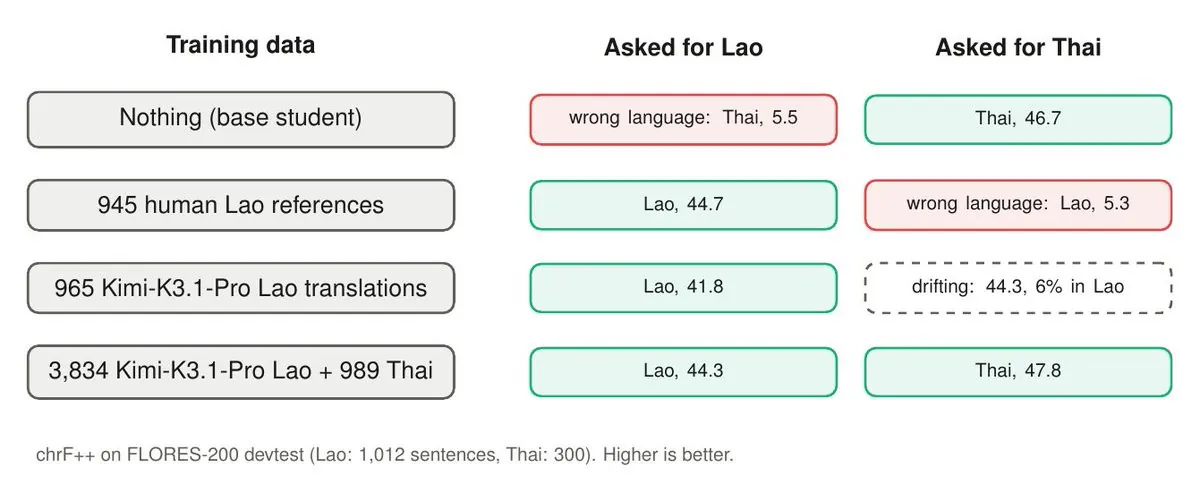
The practical rule is broader than Lao and Thai: when teaching a model a new behavior, explicitly include data for the nearby behaviors that must not regress. A protected capability should also remain in the evaluation loop. Otherwise the optimizer is free to satisfy the new objective by overwriting the old one, and the team will not notice until deployment.
Closing the remaining Lao gap
Protecting Thai left Lao below the human-reference control. With roughly 950 Lao examples each, the human-reference student reached 44.7, while the two distilled students reached 41.8 and 41.9 on the 300-sentence evaluation. Part of that difference is a metric artifact. FLORES dev and devtest were produced through the same human translation process, so a student trained on human dev references has an advantage on a human-reference metric. The teacher-distilled student instead learns Kimi-K3.1-Pro's translation style.
When judged against Kimi-K3.1-Pro's own translations, the picture reverses substantially: the distilled student climbed from 8 to 58 chrF++, while the human-reference student reached 47. The result does not mean one translation pipeline is universally better. It shows that a reference-based benchmark partly measures stylistic alignment with the reference source, not only semantic quality. This is why the team also tracked round-trip adequacy.
The bigger constraint was data supply. FLORES dev contains 997 human references and no more. Kimi-K3.1-Pro can translate arbitrary English text. Together AI added teacher translations for 3,000 English Wikipedia sentences, increasing the Lao training set from 965 to 3,834 examples. Lao rose from 41.9 to 44.3 while Thai remained intact, placing the distilled model within half a point of the human-reference run.
More unique data also beat additional passes over a small set. One epoch over the four-times-larger Lao set reached 43.2 on the 300-sentence test, compared with 41.3 after three epochs of the smaller Lao-plus-Thai set. When a student plateaus, generating more teacher coverage can be more useful than repeatedly exposing it to the same examples.
Results: 93% of the teacher while retaining Thai
Lao scores in the headline table use all 1,012 FLORES-200 devtest sentences; Thai uses 300 sentences. The best distilled run reaches 93% of Kimi-K3.1-Pro's Lao score. Measured from the base model's starting point, it closes 92% of the gap between student and teacher:
$$ \text{gap closed} = \frac{s_{\text{student}} - s_{\text{base}}}{s_{\text{teacher}} - s_{\text{base}}} = \frac{44.3 - 5.5}{47.5 - 5.5} = 0.92 $$
| Run | Training data | Lao chrF++ | Lao script | Thai chrF++ |
|---|---|---|---|---|
| Base student | None | 5.5 | 11% | 46.7 |
| SFT on human references | 945 human Lao translations | 44.7 | 100% | 5.3 |
| Distilled, Lao only | 965 Kimi-K3.1-Pro Lao translations | 41.8 | 100% | 44.3 |
| Distilled, Lao + Thai | 965 Lao + 989 Thai, from Kimi-K3.1-Pro | 41.9 | 100% | 47.4 |
| Distilled, Lao + Thai, 4× Lao data | 3,834 Lao + 989 Thai, from Kimi-K3.1-Pro | 44.3 | 100% | 47.8 |
| Kimi-K3.1-Pro teacher | Not applicable | 47.5 | 100% | 49.9 |
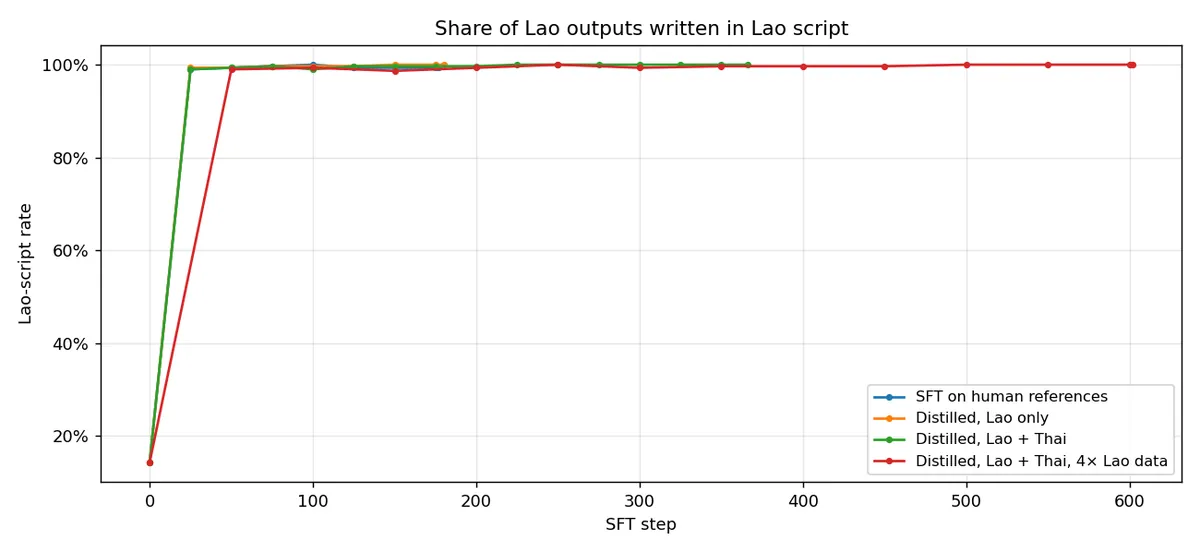
The meaning was already present in the base model's Thai output. On round-trip adequacy, that wrong-language answer scored 64.6, slightly above the human Lao references at 64.0. The final distilled student scored 65.7 and used Lao script on every test sentence. Language identity, not semantic understanding, was the dominant missing capability. This also explains why every successful run repaired the script within its first evaluation at 25 or 50 steps.
One adapter for five languages
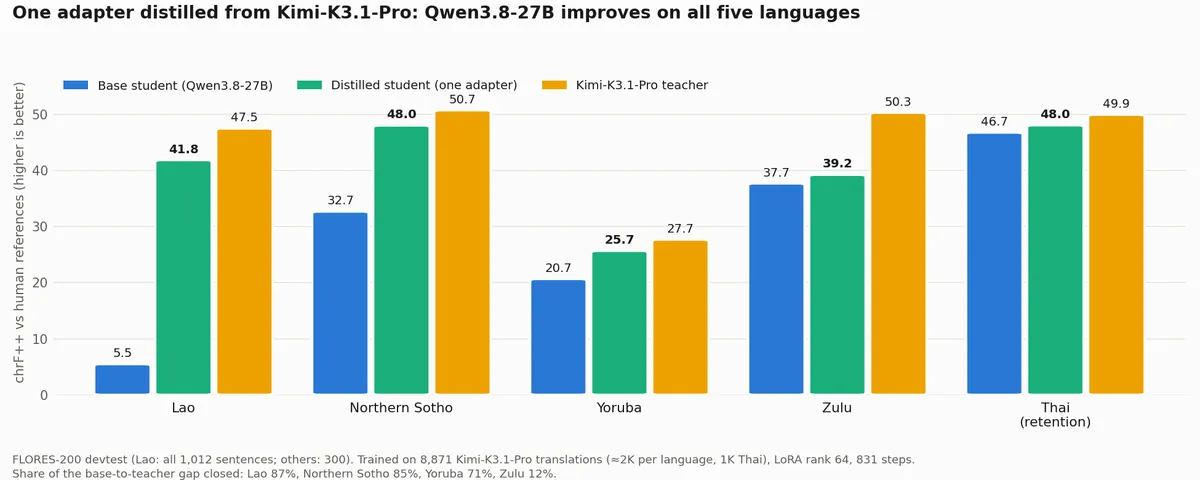
To test whether the method was specific to Lao, Together AI trained a single adapter on four acquisition languages plus one retention language. It selected Lao, Northern Sotho and Zulu because they had the three largest teacher-student gaps, added Yoruba because it was the lowest-scoring Latin-script language for both models, and included Thai to protect a closely related capability.
The mixed adapter used 8,871 Kimi-K3.1-Pro translations in total: roughly 2,000 examples each for the four target languages and about 1,000 for Thai, trained for 831 steps. Every target language improved while Thai also improved. Lao closed 87% of the teacher gap, Northern Sotho 85%, Yoruba 71% and Zulu only 12%.
| Language | Base student | Distilled | Kimi-K3.1-Pro | Gap closed |
|---|---|---|---|---|
| Lao | 5.5 | 41.8 | 47.5 | 87% |
| Northern Sotho | 32.7 | 48.0 | 50.7 | 85% |
| Yoruba | 20.7 | 25.7 | 27.7 | 71% |
| Zulu | 37.7 | 39.2 | 50.3 | 12% |
| Thai | 46.7 | 48.0 | 49.9 | Improved |
Zulu was the weakest case. Between 1% and 2% of its outputs fell into repetition loops during training. The team identifies more Zulu data or a repetition penalty as the first interventions to test. The result is useful because it shows that one adapter can improve multiple related domains without monolithic retraining, but also that languages with different failure modes need their own diagnostics rather than a single aggregate score.
A practical playbook for capability distillation
The experiment supports a concise sequence that can be reused beyond translation:
- Screen before training. Fifty sentences per language were enough to reveal where the teacher was far ahead. A small, stratified diagnostic set prevents an expensive run from starting with the wrong assumption.
- Classify the failure. Inspect whether the base model lacks knowledge, reasoning, format compliance or conditional selection. In this case the meaning was present and the language choice was wrong, so script identity could be fixed within 25 to 50 steps.
- Generate more teacher coverage after a plateau. Additional unique prompts outperform repeated epochs over a tiny data set when the teacher has broad access to source material.
- Protect adjacent capabilities explicitly. Mix in examples for the behavior that must survive and keep that behavior in the held-out evaluation. Evaluating only the target capability would have selected the run that destroyed Thai.
The same discipline applies when a post-training team is trying to add a narrow skill to a general model. A benchmark should not merely ask whether the new skill improved. It should ask which existing behavior could be traded away to achieve that improvement, include positive examples for that behavior, and measure both curves during training.
How the teacher data was generated
Every teacher call was an ordinary chat completion with thinking disabled. Translation does not need long internal reasoning, and enabling it made the teacher worse on 300 Lao test sentences: 43.5 with thinking versus 47.3 without it, while consuming about eight times as many tokens. A Lao answer without extended thinking averaged roughly 175 output tokens.
from together import Together

client = Together()
resp = client.chat.completions.create(
    model="moonshotai/Kimi-K3.1-Pro",
    messages=[{"role": "user", "content": (
        "Translate the following English text into Lao. "
        "Output only the Lao translation, with no explanation.\n\n" + english
    )}],
    max_tokens=1024,
    temperature=0.0,
    chat_template_kwargs={"thinking": False},
)
lao = resp.choices[0].message.content
The source text combined the 997 FLORES-200 dev sentences with 4,000 English Wikipedia sentences: 3,000 requested in Lao and 1,000 in Thai. Two design choices reduced label noise. First, a translation was kept only if at least 70% of its letters belonged to the target script and the answer was not an echo of the English prompt. This filter removed 4% of Kimi-K3.1-Pro's Lao outputs. Second, each retained translation became a simple chat-format SFT row with the instruction as the user message and the teacher output as the assistant target.
{
  "messages": [
    {
      "role": "user",
      "content": "Translate the following English text into Lao. Output only the Lao translation, with no explanation.\n\n<English sentence>"
    },
    {
      "role": "assistant",
      "content": "<Kimi-K3.1-Pro's Lao translation>"
    }
  ]
}
Teacher generation was cheap relative to GPU training. At Kimi-K3.1-Pro serverless prices of $2 per million input tokens and $10 per million output tokens, all 4,000 Lao translations cost $7.46. This is why off-policy distillation is attractive for a narrow domain: the expensive model is used asynchronously as a data generator, while the training job operates on cached prompt-response pairs.
Training the student on Together Post-Training
Together Post-Training divides a run between client-side orchestration and a remote model resource. The resource contains GPUs, here B200-SXM nodes, with the base model loaded. It exposes a trainer for forward-backward and optimizer steps and optionally a generator that samples from synchronized intermediate checkpoints. A session represents one LoRA adapter trained against that resource.
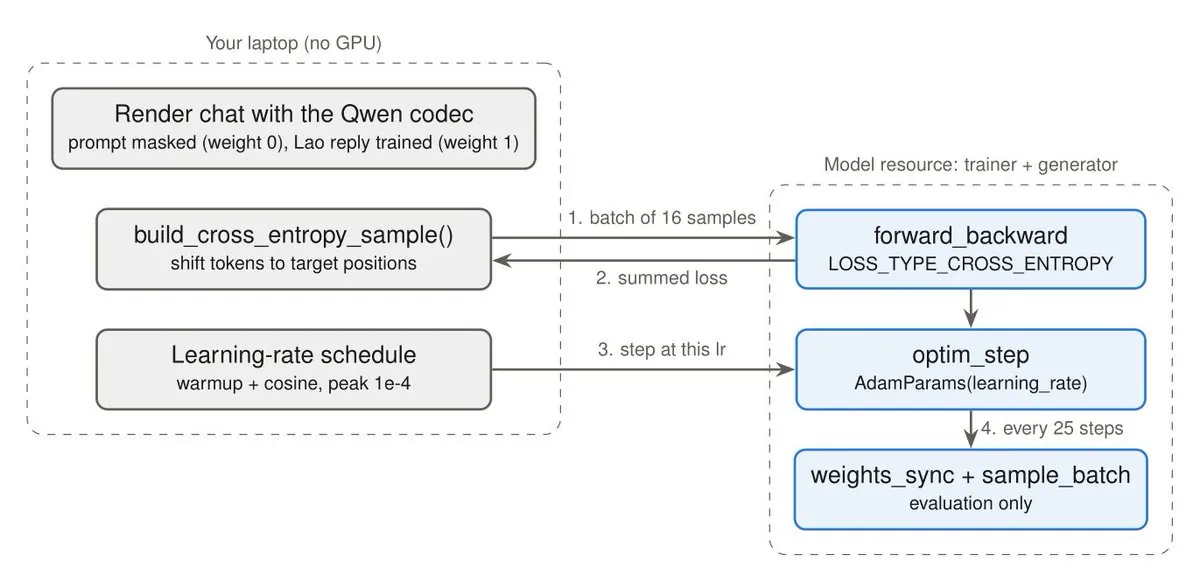
The cookbook handled three low-level details. A Qwen codec rendered chat messages with the model's own template. Conversation-sample construction masked the prompt tokens with zero loss weight and trained only on the assistant translation, including the end-of-turn token so the model learned when to stop. A cross-entropy sample builder shifted tokens into next-token targets matching the training API.
from together import Together
from together.post_training import (
    AdamParams,
    LoraConfig,
    LossConfig,
    ModelResourcesClient,
    SamplingParams,
)
from post_training_cookbook.codecs import get_codec
from post_training_cookbook.samples import make_prompt
from post_training_cookbook.sft.train import (
    TRAIN_ON_LAST,
    build_conversation_samples,
)

codec = get_codec("Qwen/Qwen3.8-27B", enable_thinking=False)
samples = [
    sample
    for row in rows
    for sample in build_conversation_samples(
        row["messages"],
        codec=codec,
        train_on_what=TRAIN_ON_LAST,
        max_length=2048,
    )
]

raw = Together().post_training.model_resources.create(
    base_model="Qwen/Qwen3.8-27B",
    lora_enabled=True,
    compute_config={
        "gpu_type": "B200-SXM",
        "num_generator_replicas": 1,
    },
    extra_body={"inactive_timeout": 1200},
)
record_in_ledger(raw.id)
wait_until_ready(raw.id)

resources = ModelResourcesClient.attach(
    model_resources_id=raw.id,
)
session = resources.create_session(
    lora_config=LoraConfig(rank=64, alpha=128),
)

for step in range(total_steps):
    batch = next_batch(samples, size=16)
    session.trainer.forward_backward(
        samples=batch,
        loss=LossConfig(type="LOSS_TYPE_CROSS_ENTROPY"),
    )
    session.trainer.optim_step(
        adam_params=AdamParams(
            learning_rate=lr_at(step),
        ),
    )

    if (step + 1) % 25 == 0:
        session.trainer.weights_sync()
        outs = session.generator.sample_batch(
            [
                make_prompt(
                    codec.encode_messages(
                        message,
                        add_generation_prompt=True,
                    )
                )
                for message in test_prompts
            ],
            num_samples=1,
            sampling_params=SamplingParams(
                max_tokens=1024,
                temperature=0.0,
            ),
        )
        score(outs)

checkpoint = session.create_inference_checkpoint()
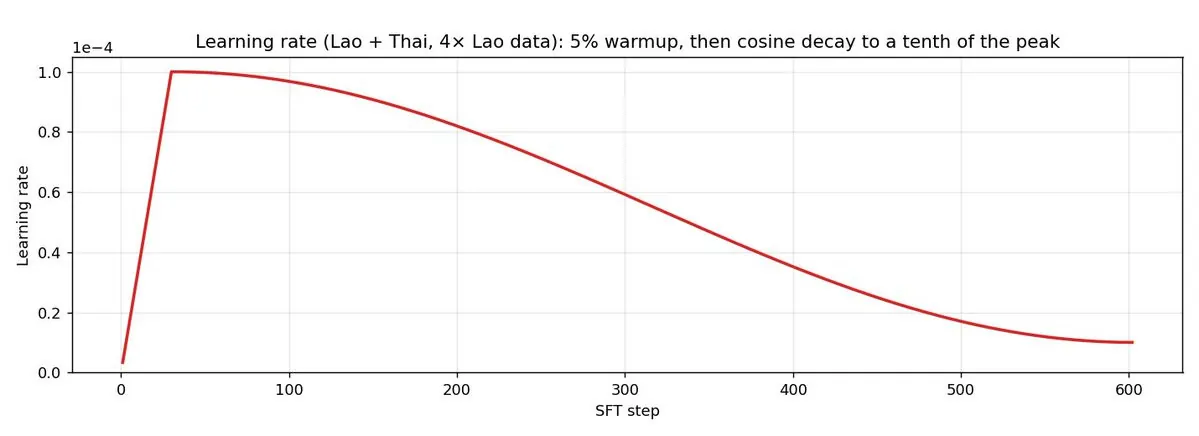
The optimizer used LoRA rank 64, the maximum supported for Qwen3.8-27B, with alpha 128. It ran a peak learning rate of 1e-4, 5% warmup and cosine decay to one tenth of the peak, with batch size 16. Because the model resource also hosted a generator replica, the same session could evaluate intermediate weights without deploying a separate inference service.
Test sets, time and cost
The article reports slightly different scores in different sections because it uses three evaluation slices. Keeping them explicit avoids mixing a quick diagnostic with the final benchmark.
| Slice | Used for | Base Lao | Teacher Lao |
|---|---|---|---|
| 50 sentences per language | The 11-language screen | 7.2 | 49.0 |
| 300 devtest sentences | Evaluations during training, and Thai | 6.7 | 47.3 |
| All 1,012 devtest sentences | Start and end of each run, and headline results | 5.5 | 47.5 |
FLORES-200 devtest was never used for training and remained the held-out test set throughout. The full set cost more to evaluate, so the training loop used 300 sentences for frequent checkpoints and reserved all 1,012 for the beginning and end of each run.
All experiments in the article cost about $260 when B200 training is included. The teacher data accounted for only $7.46 for 4,000 Lao translations. The first training step of every run took 2.5 to 3 minutes while the model resource started. After startup, a batch-16 step took a median of 2.6 to 3.2 seconds, and evaluating 300 sentences on the generator took about 20 seconds.
The best Lao run held its resource for 46 minutes: 33.7 minutes of optimization, 7.1 minutes across 30 evaluation passes, and the remainder starting the session, saving the adapter and shutting down. The important operational lesson is that the teacher was not the expensive part. Startup, evaluation cadence and resource lifetime dominated the practical bill for a run of this size.
What the loss curves reveal
The appendix plots cross-entropy in nats per trained token on each epoch. Only assistant translation tokens carry loss; prompt tokens are masked out. Training loss drops sharply at every epoch boundary because the model sees rows it has already encountered. Held-out quality does not follow those drops, which is why the team evaluates chrF++ continuously rather than treating lower training loss as sufficient evidence.
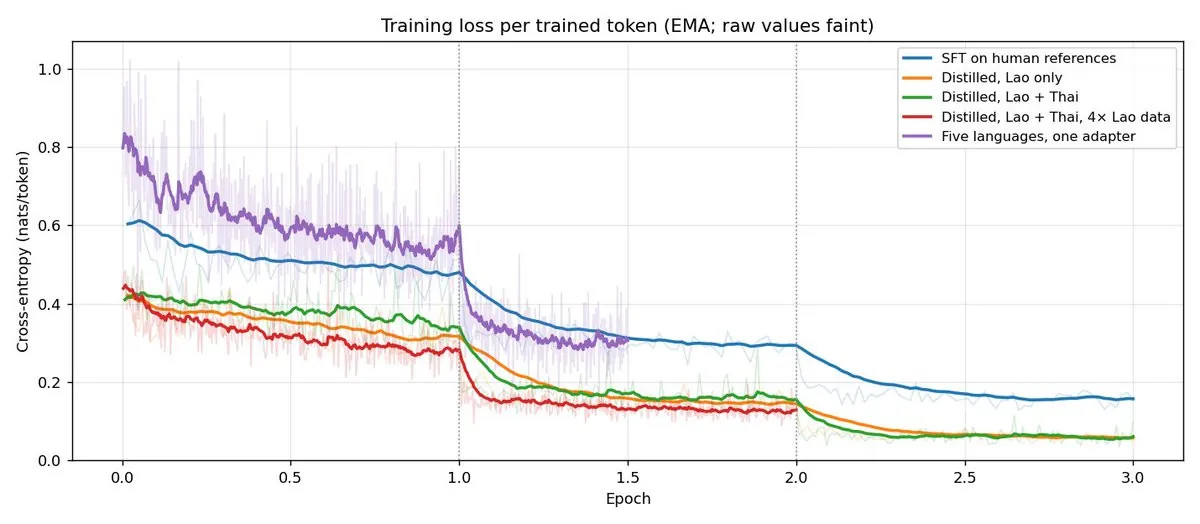
Teacher labels were easier to fit than human labels. On the same FLORES dev sentences, the student began at 0.54 nats per token for human translations and 0.36 for Kimi-K3.1-Pro's, finishing at 0.16 and 0.06 respectively. Together AI suggests that one model's translations may be more internally consistent than a set produced by a team of human translators, leaving less stylistic variance for the student to absorb.
| Run | Steps | Epochs | Trained tokens | Loss, first 10 steps | Loss, last 25 steps |
|---|---|---|---|---|---|
| SFT on human references | 177 | 3 | 0.37M | 0.54 | 0.16 |
| Distilled, Lao only | 180 | 3 | 0.38M | 0.36 | 0.06 |
| Distilled, Lao + Thai | 366 | 3 | 0.49M | 0.43 | 0.06 |
| Distilled, Lao + Thai, 4× Lao data | 602 | 2 | 1.11M | 0.43 | 0.13 |
| Five languages, one adapter | 831 | 1.5 | 1.04M | 0.82 | 0.30 |
In the four Lao runs, training loss fell by more than half after the first epoch while Lao chrF++ on the 300-sentence test moved by between minus one and plus three points. The five-language run had the highest first-epoch loss because four of its five languages started far below the teacher, while only one of the two Lao-run languages had a similarly large gap. These curves reinforce a basic monitoring rule: use training loss to detect optimization failures, not as a substitute for held-out task quality.
Why this matters for embodied AI post-training
The published experiment studies language translation, not robot control. RobotWorld is not treating it as evidence that the same adapter improves a vision-language-action model. The relevance is methodological. Robot foundation models also combine broad pretrained ability with narrow operational requirements that a smaller model may fail to satisfy: a site-specific instruction dialect, a required report format, a rare manipulation mode, a sensor-specific observation convention, or a safety-critical abstention rule.
In those settings, the Together AI workflow suggests a useful evaluation contract. First, identify whether the base policy lacks knowledge, perception, action precision or conditional selection; each failure needs different data. Second, add the narrow capability through an adapter only after a small stratified screen proves the gap is worth training. Third, include trajectories or instruction pairs for adjacent capabilities that must remain stable. Fourth, evaluate both target and retained behavior on held-out operations during training, not only after deployment.
The Thai collapse is especially relevant to continual learning in physical systems. If a robot policy is fine-tuned on a new manipulation task and the retained task is not represented in training or evaluation, the new objective can quietly overwrite behavior that previously worked. A high score on the new task is not evidence of a successful update. The update is successful only if both the target behavior and the protected operating envelope remain within acceptable bounds.
Off-policy distillation also fits a practical cost pattern for embodied teams. A strong teacher can generate labels or demonstrations asynchronously, while a smaller student trains on cached data. The savings disappear if teacher outputs are noisy, stylistically narrow or misaligned with the deployment distribution, so the filtering and round-trip checks are not optional cleanup. They are part of the capability definition.
The durable lesson is not “distill a large model.” It is “measure the conditional behavior you need, train that behavior, and continuously measure the neighboring behavior that the optimizer is allowed to sacrifice.”
Conclusion
Together AI turned a conspicuous failure of Qwen3.8-27B into a controlled post-training experiment. The base model knew how to translate the sample sentence; it did not reliably choose Lao. Off-policy distillation supplied 3,834 teacher-generated Lao examples, a mixed Thai data set protected an adjacent language, and the best adapter reached 44.3 chrF++, closing 92% of the base-to-teacher gap. The student retained Thai at 47.8 and generalized the approach to a five-language adapter.
The most transferable result is the evaluation design. Together AI did not stop when Lao improved. It tested script identity, reference quality, round-trip meaning and Thai retention together. It found the run that looked best on the target metric but had destroyed the neighboring capability, then changed the data mixture rather than hiding the regression. That sequence is directly applicable to any small model being specialized for a narrow, consequential capability.
Sources and attribution
Primary source: Together AI, “Distilling Kimi-K3.1-Pro into Qwen3.8-27B: Teaching a model a new language,” X Article, November 26, 2026. The experiment, measurements, code excerpts and figures belong to Together AI. The final section on embodied AI post-training is RobotWorld's interpretation and does not claim that the original experiment evaluated a robot policy.
Source:Together AI (X Article)https://x.com/togethercompute/status/2126025460416921661