Skip to content
Tags

#OOD Generalization (2)

Robust-WAM: Bridging Generative Pretraining and Semantic Foresight in World-Action Models

Robust-WAM: Bridging Generative Pretraining and Semantic Foresight in World-Action Models

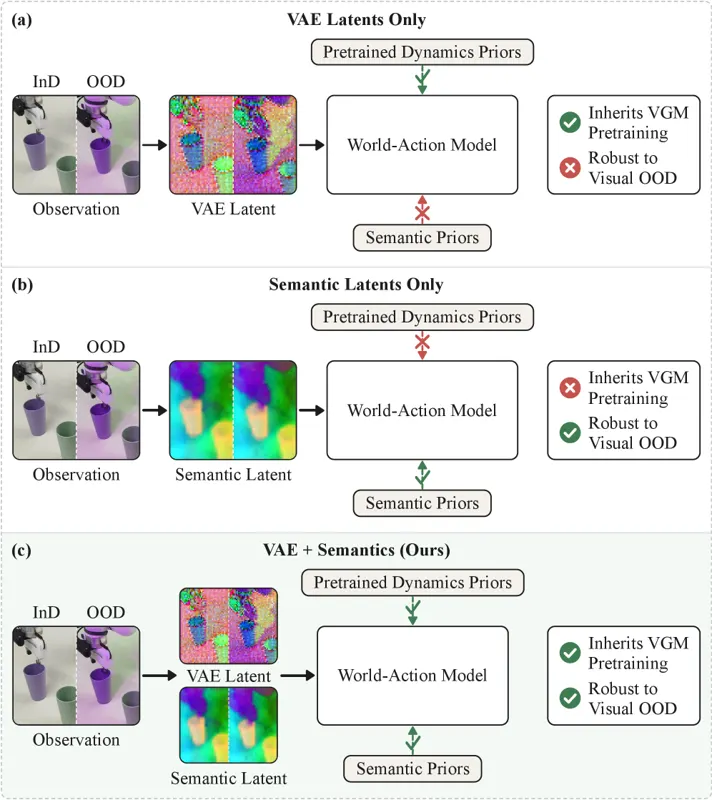
Mainstream World-Action Models (WAMs) adapt pretrained video generation models (VGMs) for robot control, transferring their learned dynamics prior for action prediction. These VGMs are typically trained in a variational autoencoder (VAE) latent space. However, the VAE latent space is optimized for pixel reconstruction, which rewards fine appearance detail and leaves the action prediction fragile under visual shifts. Recent works build WAMs in semantic latent space, which are more robust to appearance shifts. However, these models cannot leverage the large-scale VGM pretraining that exists only in VAE space. To overcome this dilemma, we propose Robust-WAM, a general post-training method for video-generation-based WAMs that preserves the VAE-based generative path and adds a lightweight semantic foresight alignment objective on the action stream. This retains the large-scale VGM pretraining while grounding actions in appearance-invariant dynamics that stay reliable under illumination shifts and other visual out-of-distribution conditions. Specifically, we employ learnable query tokens to bring future-scene semantics into the action stream by aligning their output hidden states with the semantic foresight of future ground-truth frames. To establish the temporal correspondence between each query and the future step it describes, we give it the positional encoding of the matching action tokens. Experiments on out-of-distribution generalization simulation benchmarks and a real-robot setup show that our Robust-WAM consistently improves the success rates of multiple WAM baselines without sacrificing in-distribution performance.
Haodong Yan, Junfeng Li, Junjie HeAug 6, 2026
VAERobust-WAMWorld ModelsAug 6, 2026
RL²-VLA: Adaptive RL Latent Compositional Steering with Test-Time Scaling for Vision-Language-Action Models

RL²-VLA: Adaptive RL Latent Compositional Steering with Test-Time Scaling for Vision-Language-Action Models

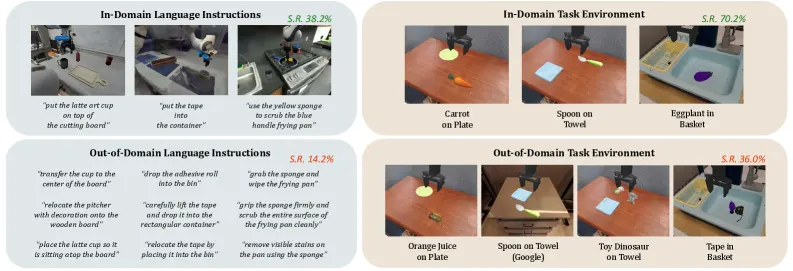
Despite the impressive visuomotor capabilities enabled by Vision-Language-Action (VLA) models, their performance often degrades on challenging and out-of-domain tasks. Recent test-time steering and scaling methods improve performance without extensive data collection and retraining, but action samples often remain concentrated around similar behaviors and therefore inherit correlated failure modes. Moreover, existing methods apply the same intervention strategy at every timestep, regardless of whether the base policy is already likely to succeed. To address these limitations, we introduce RL², an adaptive inference-time steering framework that leverages Reinforcement Learning on VLA Latents. First, we train a lightweight offline RL policy conditioned on expressive latents extracted from the VLA action expert and compose its flow velocity with that of the frozen VLA during inference. This compositional steering strategy combines the behavioral priors of large-scale imitation learning with the action diversity induced by offline RL beyond dominant demonstration modes. We further discover that inference-time steering follows fundamentally different scaling laws under success and failure states, revealing that action diversity is most beneficial when the base VLA is likely to fail, but can unnecessarily perturb already-accurate actions when success is likely. Building on this insight, RL² activates compositional steering only when failure is predicted. Across the SIMPLER and PolaRiS benchmarks, RL² improves success rates by up to +17.3% in out-of-domain settings, while ablations and scaling studies demonstrate the importance of latent representations and RL training. Finally, real-world experiments demonstrate that these gains transfer beyond simulation, establishing RL² as a practical and modular steering framework for VLA deployment.

Derek Ming Siang Tan, Shailesh Shailesh, Srikrishna IyerJul 29, 2026
VLARL2-VLAReinforcement LearningJul 29, 2026