Skip to content
Tags
SKooP: Symmetric Koopman Predictions for Faster and More Generalizable Legged Robot Locomotion with Reinforcement Learning

SKooP: Symmetric Koopman Predictions for Faster and More Generalizable Legged Robot Locomotion with Reinforcement Learning

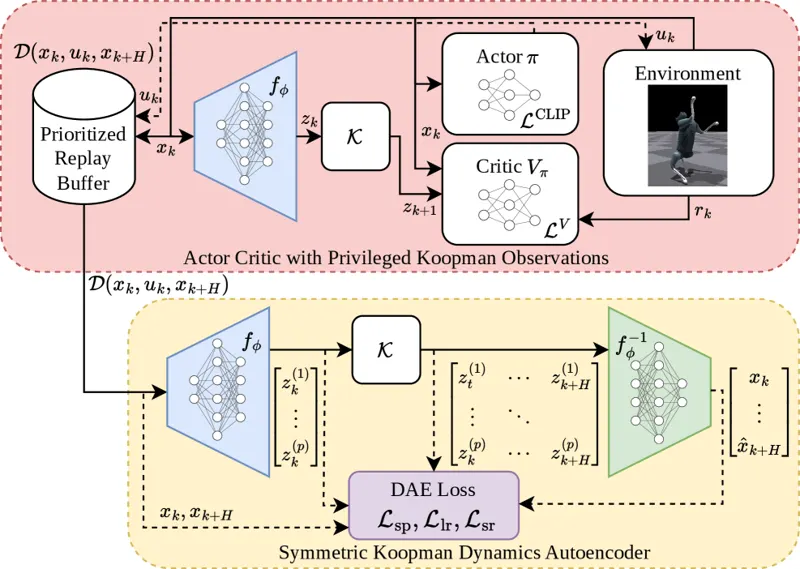
Reinforcement learning (RL) algorithms classically suffer from poor sample efficiency. In robotics, a recent line of work has emerged addressing this problem by encoding physics priors in the learning process. However, most of these approaches are validated on well-defined, low-dimensional benchmark systems rather than high-dimensional robots with complex nonlinear dynamics. In this paper, we introduce SKooP (Symmetric Koopman Predictions), an approach combining the advantages of morphological symmetries with those of a Koopman model learned via autoencoder to enhance policy learning. SKooP learns a Koopman model of the system dynamics alongside the policy. The resulting Koopman predictions are used as privileged observations for the critic, allowing the agent to learn based on smoother, more informative features. We also incorporate group symmetries into the actor, critic, encoder and decoder networks to produce a highly equivariant policy. The SKooP approach is validated via in-depth analysis of the learned Koopman models and symmetric policies to showcase how each of these influences the agent's performance. We also show that the learned policies are transferable to different simulation environments. Our results show that SKooP consistently reduces convergence time and increases the learned reward for multiple challenging bipedal locomotion tasks on a quadruped robot. Project page: https://evelyd.github.io/SymmetricKoopmanPredictions
Evelyn D'Elia, Weishu Zhan, Giulio TurrisiJul 13, 2026
KoopmanReinforcement LearningGait optimizationJul 13, 2026
Koopman Dreamer: Spectrally Constrained Latent Dynamics for Stable World-Model Imagination

Koopman Dreamer: Spectrally Constrained Latent Dynamics for Stable World-Model Imagination

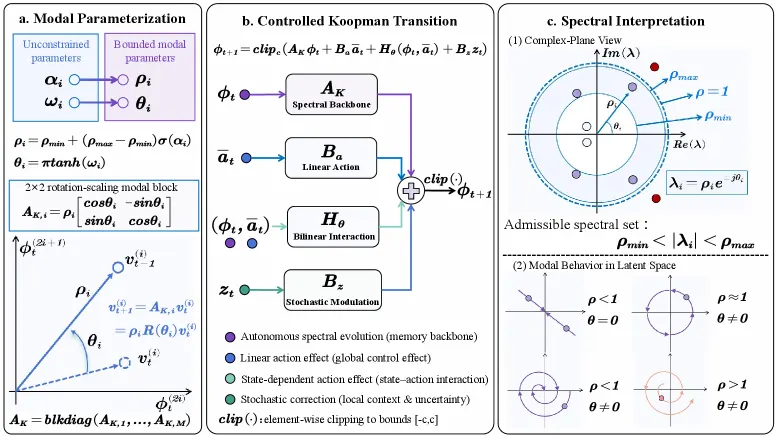
Latent world models improve sample efficiency in continuous control by optimizing policies over imagined latent trajectories, but common neural transitions offer limited direct control over modal persistence and error accumulation in long rollouts. We propose Koopman Dreamer, a Dreamer-style world model with a spectrally constrained deterministic latent dynamics core. Its Koopman-inspired backbone uses two-dimensional rotation–scaling blocks with bounded radii to represent damping, rotation, and near-periodic modes. Linear and low-rank bilinear action terms capture global and state-dependent control effects, while stochastic-state modulation supplies local correction information. To reduce the mismatch between posterior-conditioned training and prior-only imagination, the model combines posterior-conditioned EMA teacher targets with one-step consistency, multi-step rollout, and open-loop observation-prediction objectives. We further derive a multi-step rollout-error bound that separates amplification by the spectral backbone and bilinear interaction from the additive effects of stochastic-state mismatch and modeling residuals, clarifying the trade-off between error attenuation and long-term information retention. Experimental results on proprioceptive continuous-control tasks from the DeepMind Control Suite and UAV-LiDAR autonomous navigation demonstrate that Koopman Dreamer improves the stability of long-horizon latent rollouts and achieves stronger closed-loop control performance on tasks that rely on high-quality multi-step imagination.

Jiaqi Li, Xinglong Zhang, Haibin XieJul 22, 2026
DreamerKoopmanWorld ModelsJul 22, 2026