Skip to content
Tags

#Generative (3)

Teachy Mini: Development and Preliminary Evaluation of a Knowledge-Based Generative Social Robot for Higher Education

Teachy Mini: Development and Preliminary Evaluation of a Knowledge-Based Generative Social Robot for Higher Education

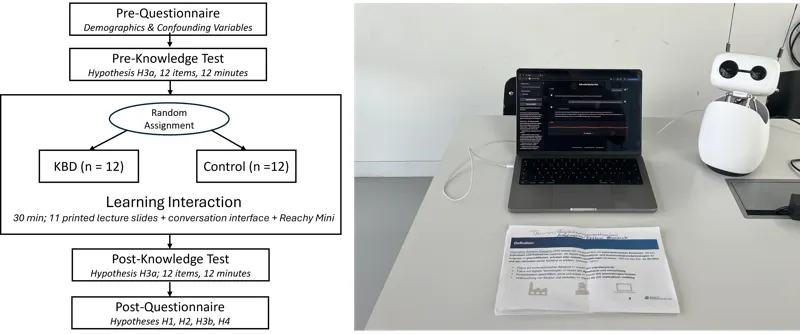
Generative social robots (GSRs) powered by large language models offer new possibilities for personalized tutoring in higher education, but also introduce risks related to misinformation, missing transparency, or reinforcing incorrect student responses. Prior work identified knowledge-based design (KBD) requirements that define the informational prerequisites for GSRs to manifest responsible and effective tutoring behavior in higher education. In this paper, we operationalized selected KBD requirements in the Reachy Mini robot platform through system prompting, retrieval-augmented generation, and stateful prompt orchestration. As a result, we present Teachy Mini, a GSR tutoring system that was developed using KBD. To test the system, we conducted a preliminary evaluation study. Participants (N = 24) completed a robot-guided learning session about research methodologies. They learned either with Teachy Mini or with a control version that did not follow KBD principles. Teachy Mini was perceived as significantly more aligned with responsible tutoring behavior than the control robot. Moreover, a manipulation check illustrated that Teachy Mini used personalization, slide-grounded explanations, Socratic questioning, affective support, and learner-anchored feedback more consistently than the control robot. No significant between-condition differences were found in system acceptance, intrinsic motivation, or learning effectiveness, although exploratory analyses suggested a positive effect of KBD on objective learning gains when accounting for learner preferences. Overall, the study offered an initial implementation and preliminary evaluation of KBD for GSR tutoring, indicating that KBD can shape responsible robot behavior and potentially increase learning effectiveness in robot-supported learning.
Stephan Vonschallen, Karim Kaufmann, Dominique OberleJul 24, 2026
Social RobotEducationGenerativeJul 24, 2026
Persistent Computational State: A Session-Centric Runtime for Generative World Models

Persistent Computational State: A Session-Centric Runtime for Generative World Models

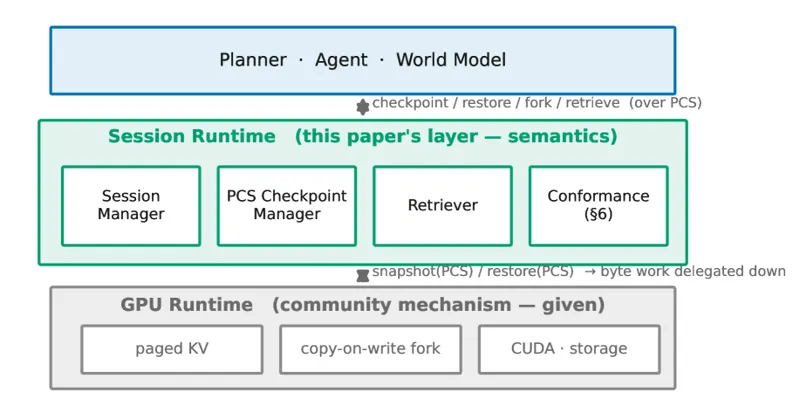
Generative world models are increasingly driven as simulators: a planner forks a state, rolls out futures, backtracks, and returns to a visited viewpoint. Recent benchmarks establish that current video world models fail this usage, and attribute it to the model, prescribing new architectures and training objectives. We show this attribution is incomplete, and for an important class of models simply wrong. Snapshotting the state the runtime already holds – an observation plus RNG state, a memory bank, or a windowed KV context, by architecture – and restoring it after a genuine excursion reproduces the never-left continuation byte-identically on all three; corrupting only the RNG degrades it. The capability was never missing: request-centric serving discarded it, inheriting from language-model serving the assumption that runtime state is recomputable – but world-model state carries a non-recomputable kernel. We define Persistent Computational State (PCS), the minimal non-recomputable state that must survive across requests, show it can be discovered by measurement, and build a session-centric runtime over it. Checkpoint and restore cost 0.012 ms against a 1.85 s generation step; resident sessions become host- rather than device-bounded (measured to 1,024); and world memory must be evicted by relevance to the return, not recency – the inverse of LLM practice.

Zhen LinJul 23, 2026
World ModelsGenerativeRuntimeJul 23, 2026
GS-Agent: Creating 4D Physical Worlds With Generative Simulation

GS-Agent: Creating 4D Physical Worlds With Generative Simulation

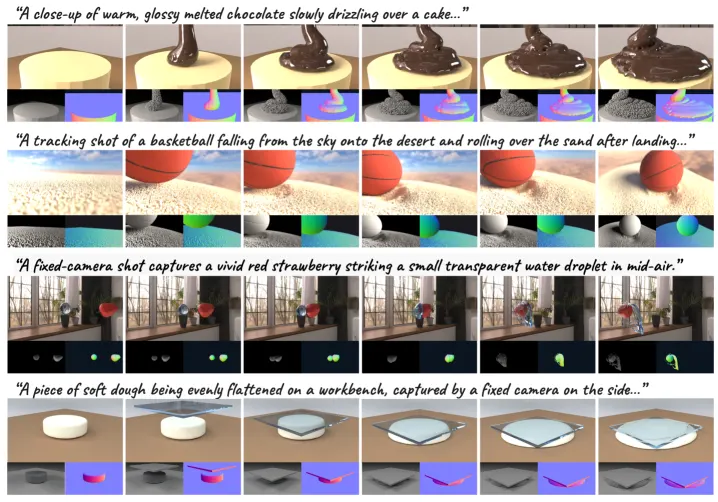
Creating dynamic and physically realistic 4D worlds from natural language descriptions is both fascinating and challenging. Traditional computer graphics methods rely on manual creation, requiring extensive human effort to fine-tune materials, motions, and visual fidelity. Recent advances in generative foundation models have sparked interest in learning to generate such 4D worlds from large-scale data; however, existing methods still struggle to ensure physical plausibility and controllability. In this work, we take a different path by leveraging foundation models to construct an agentic system that emulates how humans traditionally create 4D worlds, yet automates the entire process. We present GS-Agent, an end-to-end multi-agent framework that integrates physics engines in the loop to generate realistic, dynamic, and controllable 4D physical worlds from natural language. Inspired by how humans build 4D worlds, GS-Agent decomposes the task into entity management, covering 3D asset curation, material tuning, placement, and motion control, and rendering configuration, including camera and lighting manipulation. Multiple agents with distinct expertise interact with the physics engine via code, seek multimodal feedback, and collaborate to iteratively construct 4D worlds that align with the given descriptions. Experimental results show that GS-Agent effectively converts natural language into diverse and physically plausible 4D worlds exhibiting rich interactions among liquids, deformable objects, and rigid bodies, while achieving cinematic camera and lighting control. We envision GS-Agent as a foundation for a new paradigm in 4D world generation, empowering creative content creation and physical AI. Project page at https://umass-embodied-agi.github.io/gs-agent/

Hongxin Zhang, Chunru Lin, Junyan LiJul 23, 2026
3D Gaussian Splatting4D GenerationWorld ModelsJul 23, 2026